
Plankton Facts Explained: The Tiny Organisms That Feed the Whole Ocean
Next time you eat a piece of salmon, watch a whale surface, or simply take a breath, thank something you cannot see. These plankton facts explained in plain words will show you why the smallest life in the sea carries the biggest job on Earth. Plankton drift in every ocean, and almost every sea creature depends on them in some way.
TL;DR: Plankton are living things that drift with the water instead of swimming against it. Tiny plant-like plankton make a large share of the world’s oxygen and start the ocean food chain. Tiny animal plankton pass that energy to fish, seabirds, and whales.
Key Takeaways at a Glance
| Topic | Quick Answer |
|---|---|
| What the word means | “Drifter” in Greek (planktos) |
| Two main groups | Phytoplankton (plant-like) and zooplankton (animal-like) |
| Oxygen share | Phytoplankton do about half of all photosynthesis on Earth |
| Biggest daily migration | Zooplankton rise and sink up to 1,000 m every day |
| Biggest “plankton” | Some jellyfish, with tentacles up to about 36 m long |
| Main threats | Warming seas, acidification, plastic, and harmful blooms |
| Best way to see them | A cheap microscope and a water sample from a pond or harbor |
What Is Plankton?
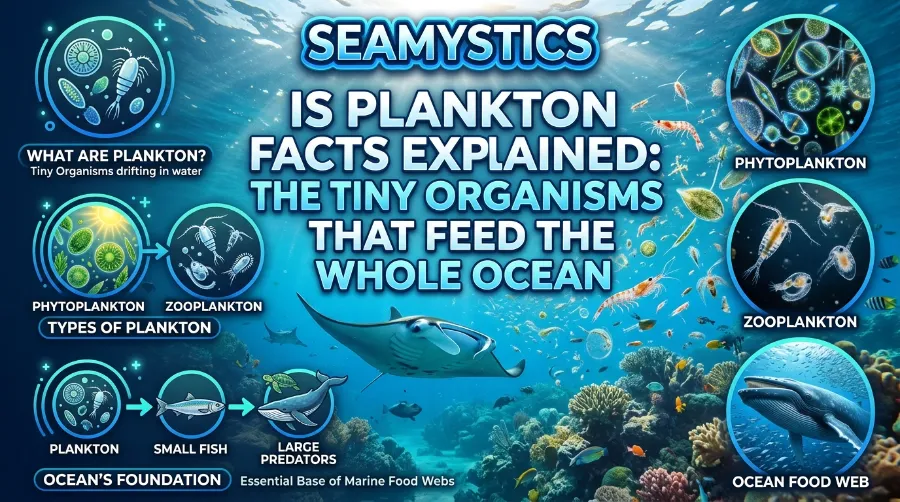
Plankton are living things that drift with water currents. They can swim a little, but not well enough to beat the tide. The name comes from the Greek word planktos, which means “drifter,” as National Geographic Education explains in its plankton guide.
Size does not decide who counts as plankton. Movement does. A single cell and a huge jellyfish both qualify because both go where the water takes them.
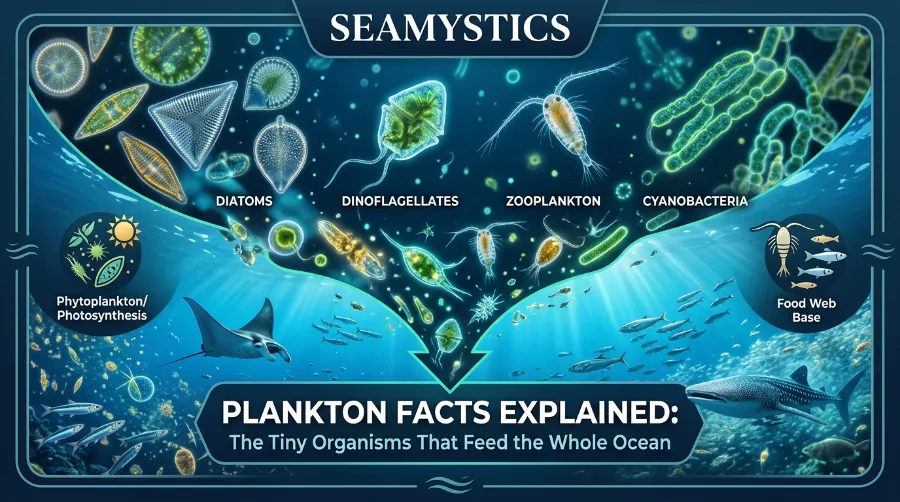
Scientists also split plankton by how long they drift. Holoplankton drift for their whole lives. Meroplankton drift only while young, then settle or swim away as adults.
That second group surprises most people. Sea stars, barnacles, sea urchins, and octopuses all begin life as plankton, according to the Shaw Centre for the Salish Sea. So the next time you see a tide pool full of life, remember that most of it arrived as drifting babies.
A Quick Definition You Can Quote
Plankton are organisms that float or drift in water and cannot swim strongly against currents. They include plants, animals, bacteria, and viruses. Together they form the base of nearly every aquatic food web.
Types of Plankton You Should Know
When people ask about the types of plankton, the easiest answer is by job. Some plankton make food from sunlight. Others eat. A few recycle waste. The table below gives the full picture.
| Type | What It Is | Common Examples | Job in the Sea |
|---|---|---|---|
| Phytoplankton | Plant-like, uses sunlight | Diatoms, dinoflagellates, coccolithophores | Make food and oxygen |
| Zooplankton | Animal-like, eats other life | Copepods, krill, larval fish, jellyfish | Move energy up the food chain |
| Bacterioplankton | Bacteria | Many marine bacteria | Recycle nutrients |
| Virioplankton | Viruses | Marine viruses | Control bacteria and algae numbers |
National Geographic notes that bacterioplankton and virioplankton are even smaller than the two main groups. Most school lessons skip them. Yet they shape how nutrients move through the water.
Phytoplankton: The Ocean’s Grass
Phytoplankton use chlorophyll and sunlight to make energy, just like land plants. For that reason they stay near the surface, where light reaches them. Several kinds matter most.
- Diatoms: These build glass-like shells from silica. They come as disks, needles, or long chains, and they are some of the best-known phytoplankton.
- Dinoflagellates: Most have two whip-like tails, called flagella, that let them spin and move. Some glow at night, which gives us bright blue waves along certain coasts.
- Coccolithophores: These wear tiny chalk plates. Over millions of years their remains built chalk cliffs such as the White Cliffs of Dover.
- Cyanobacteria: A group called Prochlorococcus, found in 1986, is now known as one of the most common photosynthetic cells on Earth.
Zooplankton: The Ocean’s Grazers
Zooplankton eat phytoplankton or each other. Copepods lead the group. NOAA calls them one of the most common and easy-to-spot kinds of zooplankton, found in nearly every ocean, sea, and freshwater habitat.
Krill come next. These shrimp-like animals gather in swarms so dense that satellites can pick them up in the Southern Ocean. Then come the jellyfish, which prove that plankton do not have to be tiny.
The Shaw Centre for the Salish Sea points out that the lion’s mane jelly can grow tentacles up to 120 feet (36.5 m) long. That is longer than a blue whale, and it still counts as plankton.
Plankton by Size
Researchers also sort plankton by size. The scale below is a common one, and it helps when you read lab papers or sampling guides.
| Size Class | Approximate Size | Example |
|---|---|---|
| Picoplankton | 0.2 to 2 micrometers | Tiny photosynthetic bacteria |
| Nanoplankton | 2 to 20 micrometers | Small flagellates |
| Microplankton | 20 to 200 micrometers | Many diatoms |
| Mesoplankton | 0.2 to 20 millimeters | Copepods |
| Macroplankton | 2 to 20 centimeters | Krill, small jellyfish |
| Megaplankton | Over 20 centimeters | Large jellyfish |
If size comparisons fascinate you, our guide to ocean life sizes shows how plankton compare with everything else in the sea.
Plankton Facts Explained: Seven Things Most People Never Hear
Most articles repeat the same few facts. These seven go a little deeper, and each one comes from real research.
- Plankton make the biggest animal migration on Earth. Every day, zooplankton sink into deep water to hide from sight-based predators, then rise at night to feed. The trip can cover up to 1,000 m, as the Shaw Centre explains. Scientists call this diel vertical migration.
- Spring changes water clarity. Winter seas look clear because few plankton live in them. As sunlight grows and animals spawn, plankton numbers jump and the water turns murky. Divers notice it first.
- Phytoplankton can double fast. In good conditions, many species double their numbers in about a day. That speed explains why blooms seem to appear overnight.
- Plankton shape clouds and climate. Some phytoplankton release a gas called dimethyl sulfide. It helps form tiny particles that clouds grow around.
- Diatoms are glass houses. Their silica shells keep fine detail for millions of years, so scientists use fossil diatoms to read old climates.
- Most invertebrate young do not survive. From several thousand eggs, only a few animals reach adulthood. The rest feed the food chain. That sounds sad, but it is how the sea stays balanced.
- Plankton eat our plastic. Lab work from Plymouth in 2013 showed that copepods swallow tiny plastic beads and can eat less real food as a result.
Notice how every fact connects to the next one. That connection is the real story of plankton.
Plankton Importance in the Ocean and on Land
The importance of plankton in the ocean starts with energy. Phytoplankton capture sunlight and turn it into food. Without that first step, the ocean food web would have nothing to stand on.
Oxygen is the second big job. According to National Geographic, phytoplankton account for about half of the photosynthesis on the planet. The Shaw Centre says the same thing in simpler terms: more than half the air we breathe traces back to phytoplankton.
Here I want to add a point that many articles leave out. Most of the oxygen that plankton make gets used again in the ocean by the same plankton, bacteria, and animals that breathe it. So the oxygen that reaches us is smaller than the headline number suggests. Even so, plankton keep the sea and the air working together.
Carbon is the third job. When plankton die or get eaten, some of their carbon sinks toward the sea floor. Scientists call this the biological pump. Over long periods it locks carbon away from the air, and the ocean takes up about a quarter of the carbon dioxide that humans release each year.
| Role | How Plankton Do It | Why You Should Care |
|---|---|---|
| Food base | Phytoplankton make energy from light | Every fish meal starts here |
| Oxygen source | Photosynthesis | Every breath you take |
| Carbon storage | Biological pump moves carbon deep | Slower climate change |
| Fish nursery | Larvae feed on plankton | Healthy fisheries |
| Early warning | Numbers shift when water warms | Plankton act as ocean alarms |
Plankton Food Chain Facts
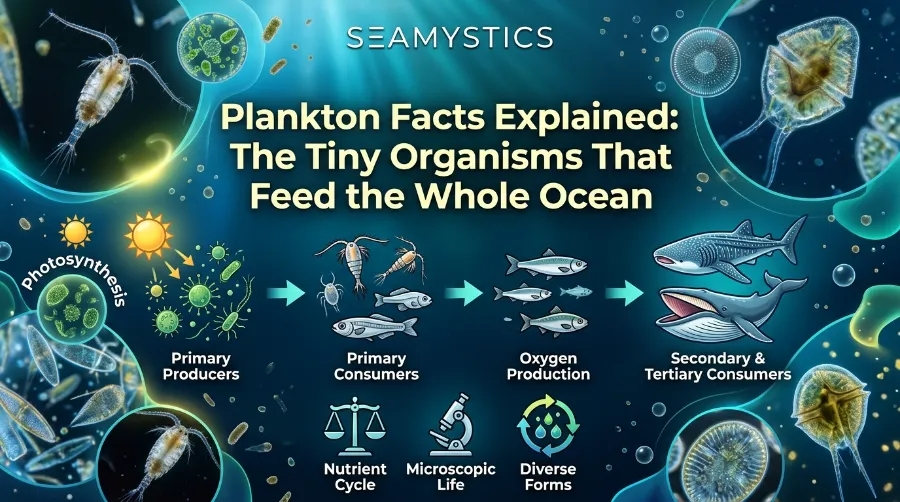
Plankton food chain facts are simple to say and hard to overstate. Phytoplankton feed zooplankton. Zooplankton feed small fish. Small fish feed bigger fish, seabirds, and seals. At each step, energy drops.
As a rule of thumb, only about 10 percent of the energy moves up each step. The real number swings from about 5 to 20 percent. That is why the sea needs so many plankton to support a single whale. The table below uses the 10 percent rule as an example, not as a measurement.
| Food Chain Step | Example Energy Units |
|---|---|
| Phytoplankton | 10,000 |
| Zooplankton | 1,000 |
| Small fish | 100 |
| Large fish | 10 |
| Top predator | 1 |
Here is what that looks like in a real food chain, from the bottom up:
- Diatoms soak up sunlight and nutrients.
- Copepods graze on the diatoms.
- Herring or sand eels eat the copepods.
- Cod, puffins, or seals eat the small fish.
- Orcas or large sharks sit at the top.
Some animals skip the middle steps. Baleen whales, whale sharks, and basking sharks eat plankton directly. A blue whale can swallow several tonnes of krill in a single day during feeding season. That short chain explains why the biggest animals ever to live can thrive on the smallest food.
Three Real Case Studies of Plankton Changing the Ocean
Facts feel stronger when you see them play out. These three cases come from long, well-documented records.
Case 1: The North Sea Copepod Swap
Since 1931, ships towing a device called the Continuous Plankton Recorder have collected plankton across the North Atlantic. Alister Hardy designed it, and the survey is now seen as the most extensive long-term survey of marine organisms in the world.
That record shows a clear shift. As the North Sea warmed, a cold-water copepod called Calanus finmarchicus retreated north. A warmer-water cousin, Calanus helgolandicus, moved in. The two look alike, but the cold-water species is fatter and richer in energy, and it appears at the right time of year for young fish. Studies using this data linked the change to weaker survival of young cod.
Case 2: Right Whales and a Moving Meal
North Atlantic right whales feed heavily on Calanus finmarchicus. As warming waters shifted where that copepod gathers, the whales followed it into new areas, some with busy shipping lanes. Fewer than 400 of these whales remain. The lesson is clear: a small change in plankton can ripple up to an endangered giant.
Case 3: Lake Erie, August 2014
Plankton trouble does not stay in the sea. In early August 2014, a bloom of toxic cyanobacteria in Lake Erie sent a poison called microcystin into the water supply of Toledo, Ohio. Roughly 400,000 people were told not to drink their tap water for about three days. The event shows that too much plankton can hurt as much as too little.
National Geographic also warns that certain blooms release toxins that cause red tides, kill fish, and make people sick when contaminated seafood reaches the table.
What a Plankton Net Taught Me
I have spent many mornings hauling a fine mesh net behind a small boat, then carrying the jar back to a microscope. The first look never gets old. A cloudy, green-brown drop turns into a crowded city of spinning, darting, glowing shapes.
Two habits from that work changed how I see plankton. First, I always sample at the same time of day, because zooplankton move so much that a midday haul and a night haul look like two different oceans. Second, I never judge a bloom by color alone. A green sample can be harmless diatoms or a problem species, and only a microscope or lab test can tell them apart.
Here is my plain opinion, based on that routine. Most people think of plankton as “algae soup” and ignore it. Yet it behaves more like a weather system than a soup, shifting daily, seasonally, and yearly. If we track it as carefully as we track the weather, we would spot ocean trouble years sooner. You can find more stories like this across Sea Mystics, where we cover ocean life from the smallest drifter to the deepest giant.
Threats to Plankton Right Now
Plankton face several pressures at once. Scientists still argue about how fast global numbers are changing, because the ocean is huge and the records are patchy. Still, the local signals are clear.
- Warming water: Warm water holds less oxygen and mixes less, which can cut the nutrients that rise to the surface. Species also move toward the poles.
- Ocean acidification: More carbon dioxide makes seawater more acidic. That makes it harder for shell-builders such as coccolithophores and tiny sea snails called pteropods to grow their shells.
- Plastic and chemicals: Zooplankton swallow microplastics, and the particles can carry harmful chemicals into the food chain.
- Nutrient runoff: Farm fertilizer feeds harmful blooms in lakes, rivers, and coastal waters.
- Overfishing higher up: Removing predators can shift who eats plankton and how much survives.
None of these pressures works alone. Together they test how well plankton can adapt.
How to See Plankton Yourself
You do not need a research ship to meet plankton. A weekend and a basic microscope are enough. Follow these steps.
- Pick your water. A pond, a harbor, or a calm beach works well. Early morning is best.
- Collect a sample. Fill a clean jar, or drag a small fine-mesh net through the water for a few minutes.
- Let it settle. Keep the jar in indirect light for 20 minutes so the plankton gather.
- Place a drop on a slide. Use a dropper and add a cover slip.
- Look at low power first. Then move to higher power and watch for spinning, twitching, and gliding shapes.
- Take notes. Write the date, place, and what you saw. After a few weeks, you will spot your own seasonal patterns.
For aquarium keepers, the idea matters too. A company that sells fish food notes that plankton supply fatty acids such as DHA and EPA that many marine animals need. One more reason to respect the tiny things. To see how these drifters compare with larger sea life, read our ocean life sizes guide.
Frequently Asked Questions
What is plankton in simple words?
Plankton are living things that drift with water currents. They include plant-like cells, tiny animals, bacteria, and even large jellyfish.
Is plankton a plant or an animal?
It can be either. Phytoplankton act like plants, and zooplankton act like animals. Many people also count bacteria and viruses.
Why is plankton important to the ocean?
Plankton start the food chain, make a big share of the world’s oxygen, and move carbon into the deep sea. Without them, most ocean life would starve.
Can you see plankton with the naked eye?
Sometimes. Jellyfish and krill are easy to see. Most phytoplankton are too small, but a dense bloom can turn water green, brown, or red.
Do plankton make half of the world’s oxygen?
Phytoplankton do about half of Earth’s photosynthesis. However, the ocean uses much of that oxygen again, so the amount that reaches the air is smaller.
Are plankton dangerous to humans?
Most are harmless. A few bloom species make toxins that can poison seafood or drinking water, so always follow local health warnings.
Which animals eat plankton?
Fish, shrimp, seabirds, baleen whales, whale sharks, and basking sharks all eat plankton. Many larger animals eat plankton-eaters.
Conclusion
Plankton may be small, but they run the ocean. They feed the food web, make a large share of our oxygen, and help store carbon. Whether you call them drifters, grass of the sea, or the base of everything, the message stays the same: protect the small, and the large will follow. With these plankton facts explained, you can now look at any sea, lake, or plate of seafood and see the tiny engine behind it.
Test Yourself: 5-Question Plankton Quiz
1. What does the word “plankton” mean in Greek?
A) Swimmer
B) Drifter
C) Hunter
2. Which group of plankton makes food from sunlight?
A) Zooplankton
B) Virioplankton
C) Phytoplankton
3. Which animal begins life as plankton?
A) Octopus
B) Blue whale
C) Seagull
4. True or false: Only microscopic organisms can be plankton.
5. True or false: Only about 10 percent of energy typically moves up each step of a food chain.
Answers: 1) B. 2) C. 3) A. 4) False, because jellyfish count as plankton. 5) True, as a general rule of thumb.
References
- National Geographic Education. “Plankton.” education.nationalgeographic.org/resource/plankton/
- Shaw Centre for the Salish Sea. “Plankton Power: Five Plankton Facts.” salishseacentre.org/blog/2022/4/5/plankton-power-five-plankton-facts
- Hikari Sales USA. “Types of Plankton and Why They Matter.” hikariusa.com/wp/about-plankton
- Reid, P. C., Colebrook, J. M., Matthews, J. B. L., and Aiken, J. (2003). “The Continuous Plankton Recorder: concepts and history.” pure.uhi.ac.uk/es/publications/the-continuous-plankton-recorder-concepts-and-history-from-plankt/
- NOAA plankton overview (reposted). maritime-executive.com/article/noaa-facts-what-are-plankton
- Cole, M., et al. (2013). Microplastic ingestion by zooplankton. Environmental Science and Technology.