
Ocean Life Sizes: From Microscopic Plankton to Giant Squid
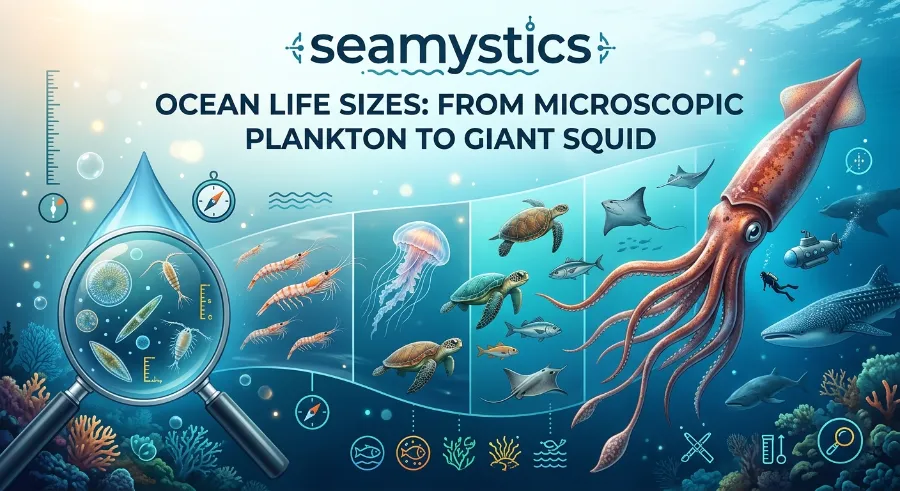
Picture a drop of seawater on your fingertip. Believe it or not, it holds millions of viruses, thousands of bacteria, and a few plankton. Now imagine a blue whale that stretches longer than three school buses. Both share one ocean, and that gap is why ocean life sizes feel so hard to grasp.
TL;DR: Ocean life sizes span a range of about 100 million times, from viruses near 0.0002 mm to blue whales near 30 m. In short, the tiniest life does most of the ocean’s work, while the giants depend on it. Ghost nets, which are lost fishing gear, also harm animals of every size.
Key Takeaways
| Size group | Example | Typical size | Why it matters |
|---|---|---|---|
| Microscopic | Prochlorococcus | About 0.0006 mm | Makes oxygen and feeds the food web |
| Tiny | Copepod | 1 to 2 mm | Feeds fish, whales, and seabirds |
| Small | Antarctic krill | Up to 6 cm | Main food for whales and penguins |
| Medium | Great white shark | 4 to 6 m | Top predator that keeps prey in balance |
| Large | Giant squid | Up to 13 m | Deep-sea hunter, rarely seen alive |
| Giant | Blue whale | Up to 30 m | Largest animal known to have lived |
Why Ocean Life Sizes Matter More Than You Think
Size tells you how an animal eats, moves, hides, and dies. For example, almost anything can eat a tiny copepod. A blue whale, on the other hand, has no natural predator once it grows up. That is why a good marine life size guide does more than list fun facts.
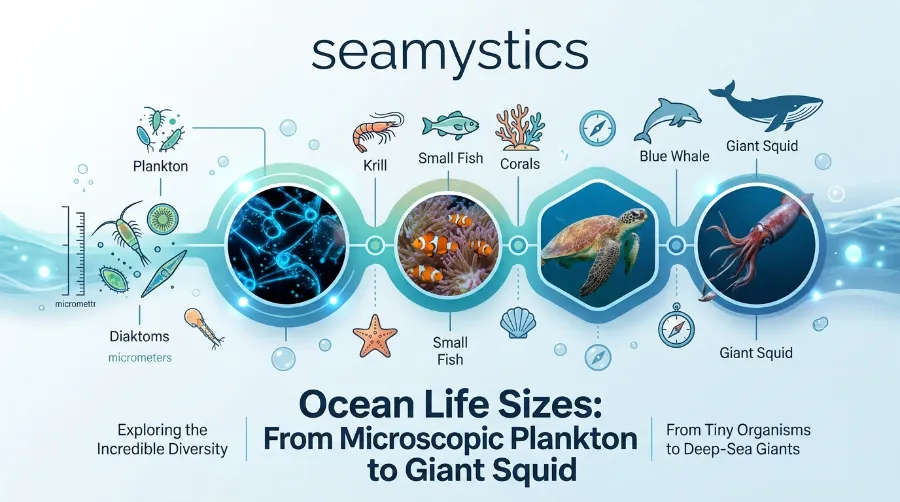
Size also explains how energy moves through the sea. First, tiny plants called phytoplankton catch sunlight. Then small animals eat them, and bigger animals eat those. According to NOAA’s Ocean Service, phytoplankton make at least half of the oxygen on Earth.
Here is the idea I repeat in most of my talks: as animals get smaller, their numbers grow. Because of this, the combined weight of small life often beats the combined weight of big life. Antarctic krill alone weigh in at hundreds of millions of tonnes, which is more than all humans on land.
[Add your field note: a short story about the first time you saw plankton under a microscope or on a research trip, with the date and place.]
If you want a visual feel for scale, try the interactive tool at Story of Size. It lets you place objects side by side, so the numbers below make more sense. Meanwhile, the Smithsonian Ocean pages offer photos of many species in this guide.
The Smallest Ocean Animals and Microbes
The smallest ocean animals are not fish or crabs. In fact, you need a microscope to see most of them. Even so, they run the whole ocean.
Viruses and Bacteria: The Invisible Majority
Seawater holds about 10 million viruses in every milliliter. Most measure between 0.00002 and 0.0002 mm. Strictly speaking, they are not animals. Still, they shape the sea by killing bacteria and returning nutrients to the water.
Bacteria are larger, but they stay tiny. Prochlorococcus, for instance, measures about 0.0006 mm. Scientists rank it among the most common photosynthesizers on Earth, and a single liter of warm, sunlit seawater can hold billions of them.
Plankton: The Drifters
Plankton means “drifter.” These living things cannot swim against a current. Generally, they fall into two groups:
- Phytoplankton: Plant-like cells such as diatoms, which range from 0.002 to 0.2 mm.
- Zooplankton: Tiny animals such as copepods, which usually reach 1 to 2 mm.
Copepods are my favorite small animals to study. Not only do they rank among the most plentiful animal groups on the planet, but they also feed herring, sardines, and baleen whales. If copepods dropped by half, every larger animal would feel it.
Tiny Fish, Octopuses, and Seahorses
Schindleria brevipinguis, a fish from the Great Barrier Reef, is among the smallest vertebrates known. It grows to only about 7 mm, which is smaller than a grain of rice.
Several other small stars deserve a mention:
- Pygmy seahorse: About 2.4 cm long and nearly invisible on its coral home.
- Star-sucker pygmy octopus: Roughly 2.5 cm long and about one gram in weight.
- Vaquita: The smallest living porpoise, near 1.5 m. Sadly, fewer than 10 remain in the Gulf of California.
However, small does not mean safe. Gillnets can trap a vaquita easily, and this is one reason ghost gear matters later in this guide.
Ocean Animal Size Comparison: The Middle of the Scale
Between plankton and giants sits a huge group of fish, sharks, turtles, and dolphins. Most people meet this group from a beach or a boat. To make it easy, the table below puts them in order.
| Animal | Typical length | Typical weight | Where it lives |
|---|---|---|---|
| Clownfish | About 11 cm | Under 250 g | Warm coral reefs |
| Antarctic krill | Up to 6 cm | About 1 g | Southern Ocean |
| Bottlenose dolphin | 2 to 4 m | 150 to 650 kg | Coasts and open sea worldwide |
| Ocean sunfish | Up to 3.3 m | Up to 2,300 kg | Temperate and tropical seas |
| Great white shark | 4 to 6 m | 600 to 2,000 kg | Coastal and open water |
| Greenland shark | Up to 5 m | Up to 1,000 kg | Cold North Atlantic |
Two animals in this table deserve a closer look. The ocean sunfish is the heaviest bony fish, and it eats mostly jellyfish. Meanwhile, the Greenland shark holds the record for the longest life among vertebrates. A 2016 study in Science put one shark’s age at about 392 years, with a margin of error near 120 years.
In other words, size does not always match age or fame. The great white gets the movie poster, yet the slow Greenland shark has seen far more history.
The Largest Ocean Animals
Now we reach the giants. The list of the largest ocean animals includes whales, sharks, squid, and one very long colony of linked parts.
Blue Whale: The Biggest Animal Ever
A blue whale can reach 30 m (98 ft) and about 190 tonnes. Its heart weighs more than a grown man, and a calf can gain around 90 kg a day on milk alone. During the feeding season, an adult eats several tonnes of krill daily.
I often tell students that blue whales prove a simple rule. Put plainly, one of the largest animals on Earth lives on some of the smallest. A giant can survive only if the food chain below it stays strong.
Whale Shark: The Biggest Fish
Despite its name, the whale shark is not a whale. It is a shark, and it is the largest fish alive. Most adults reach 9 to 12 m. Fortunately, it only filters plankton and tiny fish, so it poses no risk to people.
Siphonophores: The Longest Animal Colony
In April 2020, the Schmidt Ocean Institute filmed a siphonophore off Western Australia that measured about 45 m (150 ft). Technically, it is not one animal. Many connected parts work together as one, and this colony floated in a deep canyon in a spiral shape.
Lion’s Mane Jellyfish
The bell of a lion’s mane jellyfish can reach 2.3 m across. Its tentacles often trail over 30 m. Records also describe a specimen that washed ashore in Massachusetts Bay in 1870 at about 36 m.
Chart: Length of the Largest Ocean Animals (meters)
Siphonophore (colony)   █████████████████████████████████████████████  45
Blue whale              ██████████████████████████████                 30
Giant squid             █████████████                                  13
Whale shark (typical)   ████████████                                   12
Colossal squid          ██████████                                     10
Great white shark       █████                                           5
For a cleaner side by side look, the next table pairs each giant with an object you know.
| Animal | Max length | Compare it to |
|---|---|---|
| Blue whale | 30 m (98 ft) | About three double-decker buses |
| Whale shark | 12 m typical (40 ft) | A school bus |
| Giant squid | 13 m (43 ft) | A semi-truck trailer |
| Colossal squid | 10 m (33 ft) | Three family cars in a row |
| Siphonophore | 45 m (150 ft) | Half a football field |
Giant Squid and Colossal Squid: The Deep’s Biggest Mysteries
Sailors told stories of giant squid for hundreds of years. However, real proof of a live one came late. In September 2004, Japanese researcher Tsunemi Kubodera took the first photos of a live giant squid in the wild near the Ogasawara Islands. Later, in 2012, a team led by Kubodera, together with Edith Widder and Steve O’Shea, filmed one at depth for the first time.
Giant squid reach about 13 m including their two feeding tentacles. Their eyes can span 27 cm, which is about the size of a dinner plate. As a result, they can spot the faint glow that sperm whales stir up, and sperm whales are their main predator.
The colossal squid is shorter but heavier, with a much thicker body. In 2007, fishers in the Ross Sea caught one that weighed around 495 kg. Today it sits in the Te Papa museum in New Zealand, and it may be the heaviest invertebrate we know.
If you want first photos and tips on how researchers find these animals, read my deep-sea creatures guide. Keep in mind that each new deep-sea record changes the size charts, so check your sources often.
[Add your field note: an experience from a ROV dive, a museum visit, or a lab day with squid specimens, with date and place.]
Ghost Nets: The Silent Killers Drifting Through the Deep Ocean
Size also changes how an animal gets hurt. A ghost net is fishing gear that boats lose or dump, and it keeps catching life long after the crew leaves. Sadly, it does not care whether the victim is a shrimp or a whale.
How Big Is the Ghost Net Problem?
A 2009 report from the UN’s Food and Agriculture Organization and UNEP estimated that about 640,000 tonnes of fishing gear enter the ocean each year. Likewise, a 2018 study in Scientific Reports by Laurent Lebreton and colleagues found that fishing nets made up at least 46 percent of the weight of the Great Pacific Garbage Patch.
Groups such as Ocean Conservancy track gear clean ups and the animals they find. For that reason, their blog is a good place to check current numbers.
Who Gets Caught?
Different sizes face different dangers:
- Small animals: Crabs, lobsters, and small fish crawl into abandoned traps and cannot leave. Because the traps keep working, they can trap animals for years.
- Medium animals: Sea turtles, seals, and sharks get tangled. Many drown, since they must breathe air or keep moving.
- Large animals: Whales may drag nets for months. For example, the North Atlantic right whale, which reaches 13 to 16 m, has fewer than 400 left, and studies show most carry scars from gear.
Once, I watched a dive team cut a single net from a reef. Inside, they found dozens of trapped animals. At first it looked like a small job, but the count told a different story.
How You Can Help
You do not need a boat to make a difference. Try these steps:
- Choose seafood from fisheries with a sustainable label.
- Support groups that remove ghost gear.
- Join a local beach clean up and report any rope or net you find.
- Recycle old fishing line instead of tossing it.
- Share size charts like this one so more people care about all ocean life.
How Size Shapes Survival: Expert Analysis
After years in the field, I see three patterns that most size charts skip.
First, small animals reproduce fast, so they bounce back from loss. Large animals, in contrast, reproduce slowly, which makes each loss hurt more. A blue whale may have one calf every two to three years, while a copepod can make a new generation in weeks.
Second, deep water favors odd sizes. Cold, dark water and scarce food push some animals toward giant bodies, like the giant squid, and others toward tiny ones. Scientists call the first case deep-sea gigantism, although the cause is still debated.
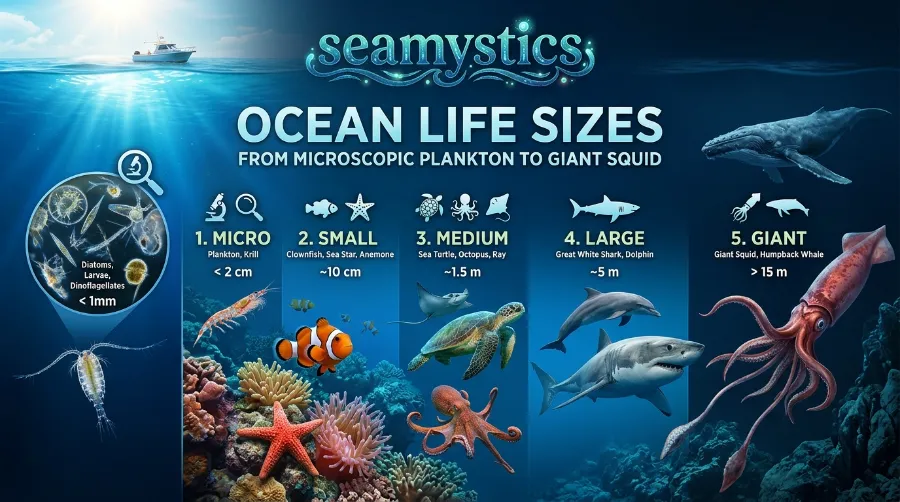
Third, size can hide a species from us. We know blue whales well because they are big and surface to breathe. On the other hand, we know far less about animals under 1 cm. Experts think the ocean holds many species that still have no name.
For more on how depth changes body size, see our guide to ocean zones explained. Additionally, the Sea Mystics homepage lists more guides in this series.
Frequently Asked Questions
What is the smallest animal in the ocean?
Copepods are among the smallest common animals, at 1 to 2 mm. Among fish, Schindleria brevipinguis measures about 7 mm.
What is the largest animal in the ocean?
The blue whale holds that title, at up to 30 m and about 190 tonnes. It is also the largest animal known to have lived on Earth.
How big is a giant squid?
Giant squid reach about 13 m including tentacles. Their eyes span near 27 cm.
Are whale sharks dangerous?
No. They filter plankton and small fish, and they stay gentle around divers.
How long is the longest animal in the sea?
A siphonophore colony filmed in 2020 measured about 45 m. Keep in mind that it is a colony of linked parts, not one body.
What are ghost nets?
They are fishing nets and gear that boats lose or leave in the sea. As a result, they keep trapping animals for years.
Quick Quiz: Test Your Ocean Size Knowledge
1. Which animal is the largest on Earth? (multiple choice)
a) Whale shark
b) Blue whale
c) Giant squid
d) Great white shark
2. About how long is an adult giant squid at its maximum? (multiple choice)
a) 2 m
b) 5 m
c) 13 m
d) 45 m
3. How long was the siphonophore colony filmed in 2020? (multiple choice)
a) 4.5 m
b) 15 m
c) 45 m
d) 450 m
4. True or false: Whale sharks are a type of whale.
5. True or false: Fishing nets made up almost half the weight of the Great Pacific Garbage Patch in a 2018 study.
Answers: 1) b. 2) c. 3) c. 4) False, the whale shark is a fish. 5) True, at least 46 percent.
Conclusion
Ocean life sizes run from viruses you cannot see to blue whales you can hear from far away. Every size has a job, and the biggest animals survive only because the smallest ones thrive. So learn the scale, share it, and help cut down ghost nets, so animals of every size keep a safe place to live.
About the author: Dr. Rabica Marlowe is a marine biologist with a PhD in Oceanography and more than 20 years of field research in plankton ecology and deep-sea exploration. She writes for Sea Mystics to make ocean science simple and trustworthy for everyone.
References
- NOAA National Ocean Service, ocean facts and phytoplankton oxygen: oceanservice.noaa.gov
- Smithsonian Ocean, Ocean Life: ocean.si.edu/ocean-life
- Story of Size: storyofsize.com
- Ocean Conservancy blog: oceanconservancy.org/blog
- Nielsen et al. (2016), “Eye lens radiocarbon reveals centuries of longevity in the Greenland shark,” Science
- Lebreton et al. (2018), “Evidence that the Great Pacific Garbage Patch is rapidly accumulating plastic,” Scientific Reports
- FAO and UNEP (2009), “Abandoned, lost or otherwise discarded fishing gear,” FAO Fisheries and Aquaculture Technical Paper 523
- Kubodera and Mori (2005), “First-ever observations of a live giant squid in the wild,” Proceedings of the Royal Society B
- Schmidt Ocean Institute (2020), Ningaloo Canyons expedition and siphonophore discovery
- Te Papa Museum, colossal squid specimen (2007)