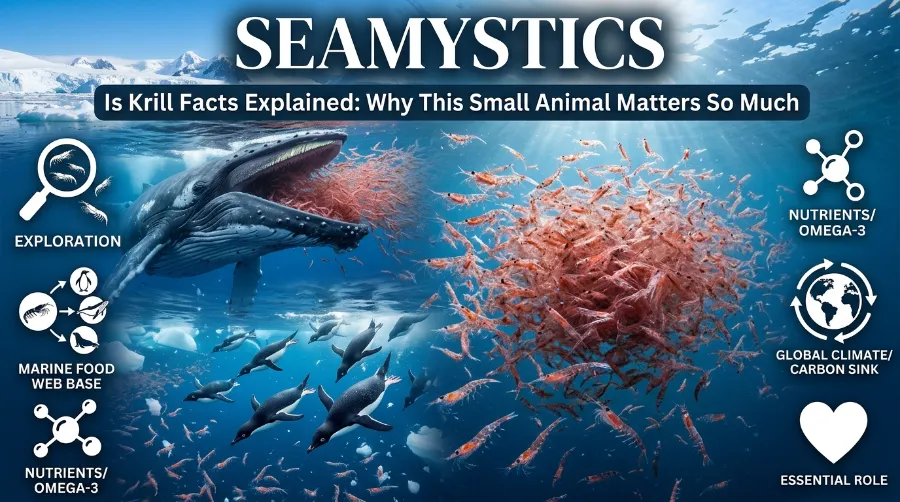

Krill Facts Explained: Why This Small Animal Matters So Much
A blue whale can eat about four tonnes of food in one day, and most of it is no bigger than your little finger. That food is krill. In this guide, I will give you krill facts explained in plain words, so you can see why a shrimp-like animal holds up a whole ocean.
TL;DR: Krill are tiny, shrimp-like animals that feed whales, penguins, seals, and fish. They also move carbon from the surface to the deep sea. Their numbers are shifting because of warming water, less sea ice, and heavier fishing in a few key areas.
Key Takeaways at a Glance
| Topic | Quick fact |
|---|---|
| Scientific name (Antarctic krill) | Euphausia superba |
| Typical adult size | About 6 cm long, 1 to 2 grams |
| Lifespan | Around 5 to 6 years, maybe longer |
| Biggest predator | Baleen whales, including blue and humpback whales |
| Main food | Phytoplankton and ice algae |
| Estimated biomass in Area 48 | About 63 million tonnes (2019 survey) |
| Catch in 2025 | 624,917 tonnes, the highest on record |
| Main pressures | Warming, sea ice loss, concentrated fishing |
Many people think krill are just whale snacks. That is only half of the story. Krill also clean the water, recycle iron, and bury carbon. Because of this, scientists watch them as closely as they watch any big animal.
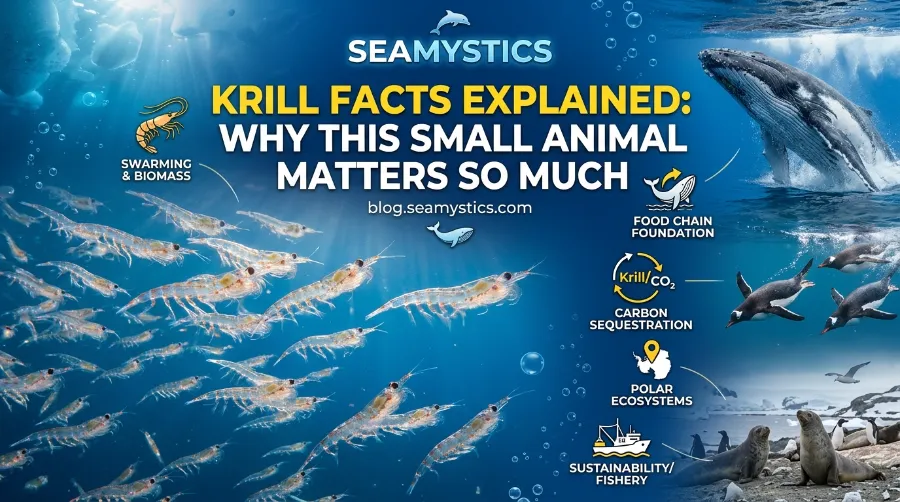
I have studied and written about polar food webs for many years. Again and again, one point stands out. When krill do well, the whole system does well. When krill struggle, the effects show up fast in penguins, seals, and whales.
Krill Facts Explained: What Krill Are and How They Live
Krill are small crustaceans. They look like tiny shrimp, but they belong to a different group called Euphausiacea. Scientists know of about 86 species around the world. The name comes from a Norwegian word that means “small fry.”
If you want a quick species overview from another trusted source, the National Geographic krill profile is a good place to start. It covers the basics in a short read.
Size, Shape, and Lifespan
An adult Antarctic krill is about as long as a paperclip. It has a see-through body, large black eyes, and ten swimming legs. The legs on the front work like a basket. They catch food from the water.
Krill live for about five to six years, and some may live longer. That is a long time for such a small animal. Because they live that long, a bad year for breeding can echo through the food web for years.
Krill also have a surprising trick. When food runs short, they can shrink their bodies at each moult. They get smaller instead of dying. Few animals of this size can do that.
What Do Krill Eat?
Most krill eat tiny plants called phytoplankton. In the Southern Ocean, they also scrape algae from the underside of sea ice. This is why ice matters so much for young krill in winter.
Some krill also eat small animals, such as copepods. So they are not strict plant eaters. This flexible diet helps them survive when one food source fades.
If you want to know how krill compare with other drifting life, read our guide to plankton facts explained. Krill are part of the zooplankton group, but they are strong swimmers, so they can move against weak currents.
Swarms, Glow, and Daily Travel
Krill gather in giant swarms. In dense patches, reports suggest tens of thousands of animals can pack into one cubic metre. Some swarms are so large that satellites and ships can detect them.
Krill also make light. Their bodies carry small organs called photophores. These glow in the dark, and scientists think the light helps with grouping and hiding.
Every day, many krill rise to the surface at night to feed. At dawn, they sink back down to hide from sharks, fish, and seabirds. This daily trip is one of the largest animal movements on Earth.
Not All Krill Live in Ice
Many people link krill only to Antarctica. That is not the full picture. Krill live in every ocean, including the waters near the UK and Europe.
| Species | Where it lives | Approximate adult length |
|---|---|---|
| Antarctic krill | Southern Ocean | Up to 6 cm |
| Northern krill | North Atlantic, North Sea edges, Mediterranean | Up to about 4 cm |
| North Pacific krill | Pacific coast of North America | Up to about 2.5 cm |
Northern krill feed fish such as herring and also feed fin whales in cold European waters. So even if you live far from Antarctica, krill still touch your local sea.
Antarctic Krill Facts You Should Know
The Antarctic species is the star of this story. It is one of the most plentiful animals on Earth when measured by total weight. That gives it huge power in its home waters.
The Numbers Behind the Swarms
The last big survey by CCAMLR, the group that manages Southern Ocean fishing, took place in 2019. It estimated about 63 million tonnes of krill in Area 48, which is a huge zone around the Antarctic Peninsula and the Scotia Sea. The area covers about 3.5 million square kilometres, and the current catch trigger of 620,000 tonnes is less than one percent of that estimated biomass. akerbiomarine
Older studies gave bigger numbers for the whole Southern Ocean. Those guesses vary a lot because krill are hard to count. Swarms move, and the ocean is vast. For this reason, I treat every single krill number as a range, not a fixed fact.
Why Sea Ice Matters
Female krill lay thousands of eggs. The eggs sink deep, hatch, and the young swim up toward the light. When the larvae reach the surface, they need food fast.
In winter, that food is often the algae growing under the ice. If the ice forms late or melts early, the larvae may go hungry. This link between ice and krill is one of the best studied parts of Antarctic biology.
Krill and the Wider Plankton World
Krill sit in the middle of a size ladder that runs from microscopic algae to the largest whales. To see the whole ladder, visit our pillar guide on ocean life sizes. It shows how each step feeds the next.
Another useful read is the Ocean Conservancy article on krill. It explains in simple terms why this small animal supports so many bigger ones.
Krill Food Chain: Who Eats Krill?
The krill food chain is short, and that is the key. Algae feed krill, and krill feed almost everything else. Scientists call krill a “keystone” link because so many animals depend on them.
Here are the main krill predators:
- Baleen whales: Blue, fin, humpback, and minke whales all eat krill. A blue whale can swallow about 40 million krill in one day during the feeding season.
- Penguins: Adélie, chinstrap, and gentoo penguins rely on krill, especially when they raise chicks.
- Seals: Crabeater seals eat mostly krill. Their name is wrong, because they do not eat crabs.
- Fish and squid: Many Antarctic fish feed on young krill.
- Seabirds: Albatrosses, petrels, and skuas all take krill from the surface.
A Simple Way to See the Chain
Here is a short, step by step view of how energy moves:
- Sunlight helps algae grow in the surface water and under the sea ice.
- Krill graze on that algae and grow fast in summer.
- Penguins, seals, and fish eat the krill.
- Whales eat huge amounts of krill and fish.
- Waste and dead animals sink and feed life in the deep sea.
Because the chain is so short, a small loss at step two can cause a big drop at steps three and four. This is why krill news matters to wildlife managers.
A Real Case: Penguins and the Peninsula
The Antarctic Peninsula is where krill, fishing, and wildlife overlap the most. Penguins nest on the coast, and they feed in nearby waters during summer. Around 90 percent of the catch in the Peninsula region in 2026 came after 1 April, which is outside the penguin breeding season. That timing matters, because chicks need food close to the colony in the warm months. akerbiomarine
Since 2019, the krill industry has voluntarily closed about 74,000 square kilometres of buffer zones around penguin colonies from 1 October to 15 March. This is a good step. Still, scientists say that a voluntary rule is not as strong as a legal one. thefishsite
Krill Importance in the Ocean: More Than Just Food
When people ask me about the importance of krill in the ocean, I give them three answers. Krill feed life, move carbon, and recycle nutrients. Each job is big, and each one is easy to miss.
Krill and the Carbon Cycle
Krill eat carbon-rich algae near the surface. Then they release dense waste pellets that sink fast. These pellets carry carbon to the deep sea, where it can stay locked away for a long time.
One widely cited estimate says Antarctic krill help move around 23 million tonnes of carbon down each year. Exact figures differ between studies. The main point is clear: krill act like a slow, natural pump for carbon.
Krill and Iron
The Southern Ocean has plenty of nutrients, but it lacks iron. Algae need iron to grow. Whales and krill help here, because their waste releases iron back into the surface water.
So when whales eat krill, they also help feed the algae that feed new krill. Scientists see this loop as one reason why healthy whale numbers may help krill too. It is a nice example of how big and small life work as a team.
Krill and People
Humans also use krill. The most common uses are omega-3 supplements, fish farm feed, and pet food. The Superba Krill blog shares some facts from the supplement industry viewpoint. I suggest reading it with an open mind, because the industry has its own goals.
| Job krill do | Why it matters | Who benefits |
|---|---|---|
| Feed predators | Supports whales, penguins, seals, fish | Wildlife and tourism |
| Move carbon | Helps lock carbon in the deep sea | The climate |
| Recycle iron | Keeps algae growing | The whole food web |
| Supply omega-3 oils | Used in supplements and feed | People and fish farms |
Krill Population Decline: What the Science Really Says
Now we reach the hard part. You may have read that krill are vanishing. The truth is more detailed, and I want to give it to you straight.
The Early Warning
A well-known 2004 study reported that krill in parts of the Southwest Atlantic had dropped by up to 80 percent since the 1970s. That headline spread fast. Later work questioned parts of it, because sampling nets and methods had changed over the years.
Even so, newer studies agree on one key shift. Krill in the Southwest Atlantic have moved further south, and the area where they live has narrowed. Young krill are also more common in some zones than in others. So the story is not a simple fall in every place.
Why Krill Numbers May Be Changing
The Antarctic Peninsula is one of the fastest warming places on Earth. Here are the main pressures on krill:
- Less sea ice: Fewer ice algae mean less winter food for larvae.
- Warmer water: Krill prefer cold water, so they move south.
- Ocean changes: Shifts in acidity and currents may harm eggs and young.
- Fishing in small areas: Heavy catches near wildlife can leave local gaps.
- Competition: Salps, which are jelly-like drifters, can thrive in warmer water and may crowd out krill.
My Expert View: Location Matters More Than Totals
Here is my honest opinion, based on how I read survey and catch reports. Most headlines focus on the total catch. I think the better question is where and when the catch happens.
A small catch taken from a penguin feeding ground in January can hurt more than a larger catch taken far away in winter. In other words, the same tonnes can have very different effects. Good management should look at both the amount and the place.
Scientists from the British Antarctic Survey have said something similar. They say the 620,000 tonne limit may have little effect on krill and predators, but only if catches are not packed into vulnerable places or key times, such as summer penguin foraging. mongabay
Krill Fishing Today: The Latest Numbers
This part of the story has moved fast. Two seasons in a row have now ended early, and that is new.
In 2025, the fishery hit the 620,000 tonne trigger level for the first time in its history, four months before the season was due to end. The CCAMLR report puts the 2025 catch at 624,917 tonnes. Then in 2026, the season closed on 12 August after reaching the same limit, which made it the second early closure in a row. Aquaculture for all +2
Why the Limit Is Hit So Fast
For 16 years, a rule spread the catch across four subareas. That rule was not renewed after the 2024 season, so the 620,000 tonne cap stayed but the spatial safeguards were gone. As a result, fleets can now focus on the richest areas. seashepherdglobal
The industry sees it differently. Aker says the trigger level equals about 11 percent of the 5.61 million tonne precautionary limit for Area 48, and that the fishery stays one of the most tightly regulated in the world. Both sides have a point, and the honest answer is that science still has gaps. akerbiomarine
| Measure | Figure |
|---|---|
| Annual trigger level | 620,000 tonnes |
| Precautionary limit, Area 48 | 5.61 million tonnes |
| Estimated biomass, Area 48 (2019) | About 63 million tonnes |
| Catch in 2025 | 624,917 tonnes |
| Vessels active in 2026 | About 11 |
| Proposed Peninsula marine protected area | About 455,000 km² |
What Is Happening Right Now
CCAMLR members are meeting in Hobart, Australia, from 19 to 30 October 2026, and they are weighing a new protected area around the Peninsula and a new way to manage krill. At the previous meeting in 2025, members made progress but could not agree on any new measure. The outcome of this year’s talks is still unfolding, so check the news for the final decision. Ahead of CCAMLR meeting, NGOs push for countries to enact new Antarctic protections +2
For deeper reading, the Mongabay report on the 2026 early closure gives a clear summary of the debate.
How to Read Krill News Like a Scientist
I often get asked how to judge krill stories. Here are the questions I ask every time:
- What is the source? A study, a company, or a campaign group? Each has its own goals.
- What is the scale? Is the number about one region or the whole ocean?
- When was the data gathered? Krill surveys can be years old.
- Is the change local or wide? A shift in one bay is not the same as a global drop.
- Who gains from the story? This helps you spot spin on all sides.
A good rule is to trust claims that cite surveys, show methods, and admit what is unknown. Be careful with any claim that says “krill are fine” or “krill are doomed” without showing the data.
What You Can Do to Help Krill
You may feel far away from the Southern Ocean. Still, there are simple steps you can take:
- Check supplement labels. Look for clear sourcing details and ask brands about their fishing areas.
- Cut your carbon. Less warming means more sea ice for young krill.
- Back protected areas. Support groups that push for new Antarctic protection.
- Share good facts. Pass on this guide so more people see why krill count.
- Stay curious. Follow trusted news on the yearly CCAMLR meeting.
Frequently Asked Questions About Krill
How big is a krill?
Antarctic krill grow to about 6 cm and weigh 1 to 2 grams. Other species are smaller. The North Pacific krill, for example, stays near 2.5 cm.
Are krill plankton?
Yes, they count as zooplankton. However, they can swim well, so they can move against mild currents. That makes them different from many drifters.
What eats krill?
Whales, penguins, seals, fish, squid, and seabirds all eat krill. In the Southern Ocean, almost every large animal depends on them in some way.
Are krill endangered?
No. Antarctic krill are not listed as endangered, and the total number is still huge. However, their range is shifting, and local drops can hurt predators. Scientists keep watching them closely.
Is krill oil good for you?
Krill oil has omega-3 fats, and many people take it as a supplement. Ask your doctor before you start, because the right choice depends on your health. Also check how the product was sourced.
How many krill are there?
The last big survey estimated about 63 million tonnes in Area 48. Estimates for the whole Southern Ocean vary, because krill are hard to count.
Conclusion
Krill facts explained in one idea: small animals can carry very large jobs. They feed whales, power the food web, move carbon, and share iron with the sea. They also face new pressure from warming water, less ice, and busy fishing zones.
The good news is that people can still act. With strong rules, smart timing, and better science, krill and the animals that need them can both do well. I hope this guide gives you the facts you need to follow the story with confidence.
Quick Quiz: Test Your Krill Knowledge
1. About how long is an adult Antarctic krill?
A) 1 cm
B) 6 cm
C) 20 cm
2. Which animal is the biggest krill eater?
A) Blue whale
B) Great white shark
C) Sea turtle
3. Why is sea ice important for krill larvae?
A) It gives them warm water
B) It grows algae they eat in winter
C) It blocks predators from the ocean
4. True or false: Krill can shrink their bodies when food is short.
5. True or false: The 2025 krill catch stayed far below the 620,000 tonne trigger level.
Quiz Answers
- B) 6 cm
- A) Blue whale
- B) It grows algae they eat in winter
- True
- False. The catch reached 624,917 tonnes.
About the author: Dr. Rabica is a marine biologist with a PhD in polar ecology and more than 20 years of experience in ocean research and science writing. She writes for Sea Mystics to turn complex ocean science into simple, trusted guides.
References
- CCAMLR krill fishery reports and 2025 catch summary
- Aker BioMarine, “The Antarctic krill fishery closes for 2026” (13 August 2026)
- Mongabay, “Antarctic krill fishery closes months early amid increasing fishing pressure” (August 2026)
- Sea Shepherd Global, “Krill fishery closes early again” (14 August 2026)
- SeafoodSource, reports on the CCAMLR 2025 meeting and the 2026 meeting preview
- Ocean Conservancy, krill overview (2022)
- National Geographic, krill species profile
- Superba Krill, “5 things you probably didn’t know about krill”
- Atkinson et al., research on Southern Ocean krill distribution (2004 and 2019)