
Dolphin Communication Signals: Do They Have Names for Each Other?
Imagine floating on a quiet boat off the coast of Scotland or Florida. Suddenly, a thin, bright whistle cuts through the water, and a second dolphin answers with the same sound. That moment is not random noise. Scientists now think dolphin communication signals include real personal calls that work a lot like names. Because of this, a simple dolphin tour can turn into a front row seat to ocean science.
TL;DR
- Do dolphins have names? Yes, in a way. Each bottlenose dolphin builds its own signature whistle, and other dolphins copy it to call that animal.
- How strong is the proof? Strong. Playback tests in 2006 and 2013 showed that dolphins react to their own whistle and remember old friends for years.
- What is next? Researchers now study shared, non signature whistles, and Google’s DolphinGemma AI (announced April 14, 2025) helps sort the sounds.
Key Takeaways at a Glance
| Question | Short Answer | Best Evidence |
|---|---|---|
| Do dolphins have names? | Their signature whistles work like names | St Andrews playback study, 2013 |
| How many whistles are signature whistles? | About 50% in free swimming animals | University of St Andrews |
| Can they recognize old friends? | Yes, even after many years apart | Royal Society B study, 2013 |
| How far can a whistle travel? | Up to 20 km (12.4 miles) | Researcher Stephanie King |
| Can AI help decode it? | It helps find patterns, but it does not translate yet | Google, Georgia Tech, Wild Dolphin Project, 2025 |
| Best place to hear them | Sarasota Bay, the Moray Firth, or the Azores | Local research programs and tour operators |
What Are Dolphin Communication Signals?
Dolphin communication signals are the sounds, touches, and body moves that dolphins use to share information. They live in a world where sight is limited, yet sound travels fast and far. For that reason, sound sits at the center of their social life.
A good way to think about it is this. Humans talk, wave, and hug. Dolphins whistle, click, and rub against each other. Both groups mix several channels at once.
Whistles, Clicks, and Burst Pulses
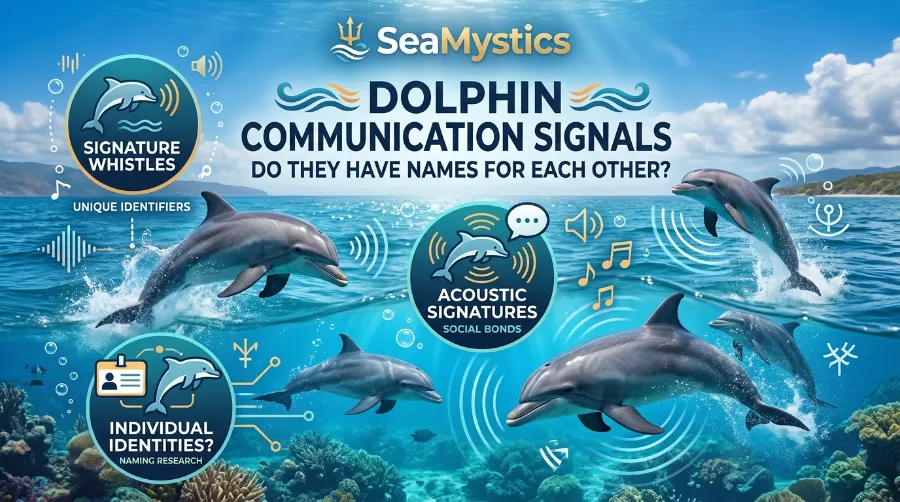
Scientists group dolphin sounds into three main types. Each type has a different job, so it helps to know them before you go out on the water.
- Whistles carry identity and social messages. Bottlenose dolphins use them to stay in touch.
- Clicks help with echolocation. Dolphins send them out and listen to the echo to find fish and obstacles.
- Burst pulses are fast, squawk like sounds. Researchers often hear them during fights or tense moments.
Google’s own research page on DolphinGemma backs up this split. It notes that mothers and calves use signature whistles to reunite, while burst pulse squawks often show up during fights.
Porpoise Dolphin Differences: The Real Porpoise vs Dolphin Facts Explained
Body Language and Touch
Sound is not the whole story. Dolphins also rub flippers, bump bodies, leap, and slap their tails on the surface. Together, these moves add tone and meaning to the whistles.
For example, a calf stays very close to its mother and touches her often. At the same time, the pair exchange whistles. As a result, the calf learns who its mother is long before it can swim far from her.
Signal Types Compared
| Signal | Main Job | When You May Notice It |
|---|---|---|
| Signature whistle | Says who is calling | When dolphins are apart or reuniting |
| Non signature whistle | Shared messages, still being decoded | During group moves and playback tests |
| Echolocation clicks | Find food and objects | While hunting or exploring |
| Burst pulses | Show strong feelings | During fights or close contact |
| Tail slaps and leaps | Warn, play, or show off | Near boats and in active groups |
If you like species detail, the guide on spinner dolphin facts shows how a different dolphin species uses sound and movement together. It is a handy side read before a trip.
The Dolphin Signature Whistle: A Name Made of Sound
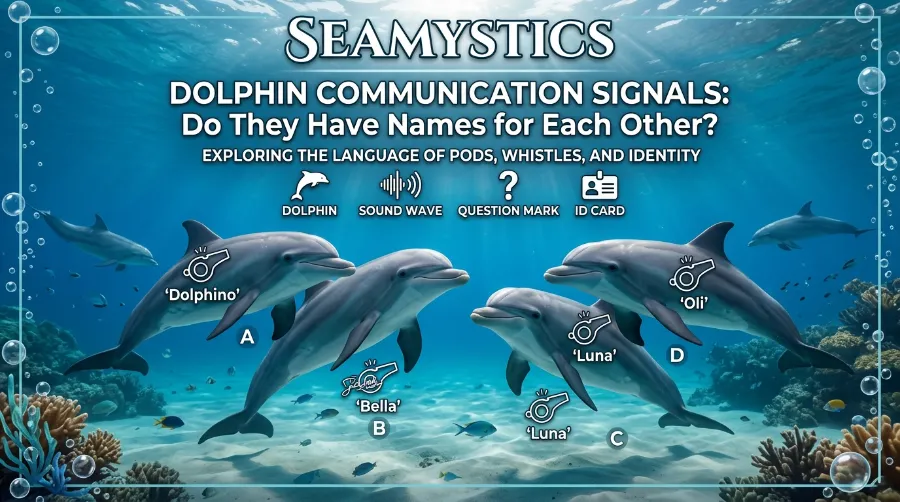
The dolphin signature whistle is the most famous part of the story. Each dolphin builds one unique whistle shape, and it keeps that shape for life. In simple terms, the whistle tells other dolphins who is speaking.
The Dolphin Communication Project also covers this topic in its dolphin communication blog and field reports. It is a good place to read how field teams describe these calls.
How Scientists Found the Signature Whistle
Serious study of dolphin sound began in the 1960s. Researchers such as John Lilly, and the husband and wife team Melba and David Caldwell, tried many experiments back then. The Caldwells recorded dolphins in human care and found that each animal used mostly one unique whistle. They called it the signature whistle.
Later, field teams checked whether wild dolphins do the same thing. They do. In Sarasota, Florida, researchers have tracked a resident dolphin community for decades, and they still use the same idea today.
How a Calf Gets Its Name
Human babies get a name at birth. Dolphins do it another way. Stephanie King, a marine mammal scientist at the University of St Andrews, explains that calves probably start with a whistle and grow into it. Over time, that whistle becomes the animal’s name.
Interestingly, calves do not always copy their mothers. Researcher Laela Sayigh reported in March 2026 that some calves develop whistles similar to their mothers’ whistles, but many do not. So the full rules of whistle building are still open.
Also, mothers change their tone when they talk to their calves. They raise the highest pitch of their signature whistle, much like adults use a higher, softer voice with a baby. Scientists call this “motherese.”
Why a Whistle Name Makes Sense Underwater
On land, we recognize a voice by its sound quality. Underwater, that sound quality changes with water pressure and depth. Dr. Vincent Janik explained that voice features shift under pressure, so a name that does not depend on the voice is a reliable way to show identity.
That idea fits what we see in the data. A dolphin keeps the pattern of rises and falls in its whistle, even when the copy sounds a little different.
Dolphin Names Research: The Studies That Changed Everything
Dolphin names research did not come from a single lucky recording. Instead, it grew from several careful experiments over six decades. Here is a quick timeline.
| Year | Study or Event | Main Finding |
|---|---|---|
| 1960s | Caldwell team | Each dolphin uses mostly one whistle |
| 1985 | Wild Dolphin Project begins | Long term study of Atlantic spotted dolphins in the Bahamas |
| 2006 | Janik, Sayigh, and Wells, PNAS | Whistle shape alone tells dolphins who is calling |
| 2013 | Royal Society B study | Dolphins remember old friends’ whistles for decades |
| 2013 | King and colleagues, PNAS | Wild dolphins answer their own whistle copy |
| 2025 | DolphinGemma announced | AI starts to map dolphin sound patterns |
| 2026 | Sarasota update | At least 20 shared non signature whistle types found |
The 2006 Whistle Shape Test
In 2006, Dr. Janik and his team played computer made whistles to wild dolphins. The sounds had no real voice quality, only the shape of the whistle. In 9 out of 14 cases, a dolphin turned toward the speaker more often when it heard a whistle that matched a close relative.
This result mattered. It showed that the shape of the whistle carries the identity, not the voice.
The 2013 Scotland Experiment
In the next big test, a University of St Andrews team followed wild dolphins off the east coast of Scotland for more than four months. They recorded each animal’s signature whistle. Then they played a computer version of that whistle underwater.
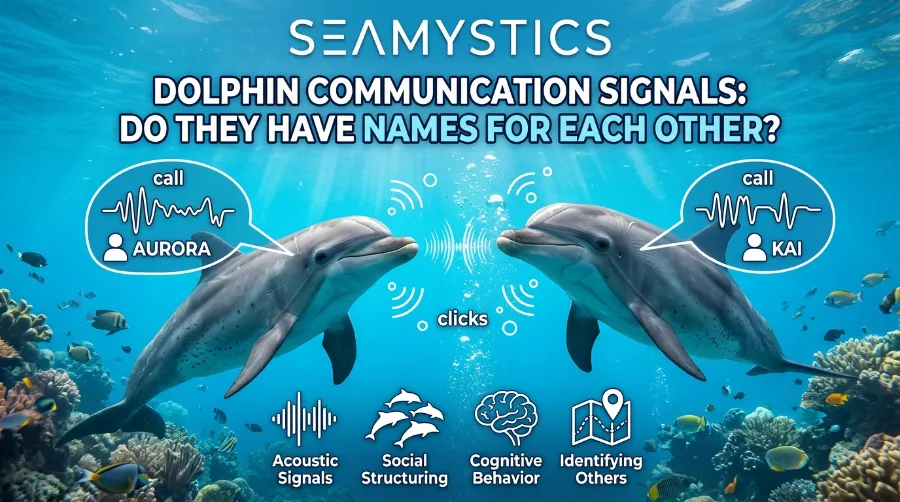
Each dolphin reacted only to its own whistle. Many even whistled the same sound back, often right away. By contrast, they did not react to the whistles of unfamiliar dolphins from a different population.
Sayigh, who was not part of the study, said it was the first time scientists documented this copying in the wild. In her view, no two signature whistles are alike.
One caution applies here. King says it is still unclear whether dolphins use these whistles to talk about a third dolphin who is not present. That would be a closer match to how humans use names. So the word “name” is a good short way to say it, but the science stays careful.
Dolphins Remember Names for Decades
A related 2013 study in the Proceedings of the Royal Society B tested long memory. Researchers played the whistles of dolphins that the test animals had once lived with. The listeners swam up to the speaker, hovered near it, and sometimes tried to whistle back.
That result points to a social memory that lasts for years. For comparison, many humans struggle to remember a name after one weak meeting.
Copies Are for Close Friends
According to coverage of a related study, dolphins copy the whistles of loved ones, such as a mother or a close male buddy, when they are apart. Researchers did not hear these copies in aggressive moments. So the practice looks friendly and caring, not angry.
King also says a dolphin whistle can be detected up to 20 km (12.4 miles) away, depending on water depth and pitch. Consequently, a lost dolphin can call across a wide area.
Spinner Dolphin Facts: Why They Leap and Spin
Dolphin Language Facts: What We Know and What We Do Not
These dolphin language facts help you separate science from hype. Bottlenose dolphins clearly share information, but nobody has proved that they have a language with grammar like ours. Let us look at the numbers.
Sarasota by the Numbers
The Sarasota Dolphin Research Program is the longest running study of its kind. In March 2026, Sayigh shared new data from it.
| Fact | Number |
|---|---|
| Dolphins in the Sarasota community | About 170 |
| Individual dolphins in the whistle database | 324 |
| Recording sessions in the database | Nearly 1,000 |
| Share of whistles that are signature whistles (catch and release setting) | About 85% |
| Shared non signature whistle types found so far | At least 20 |
Here is a simple view of how much of a dolphin’s whistling is its “name.” You can copy this chart into any post or document.
Share of whistles that are signature whistles
Free swimming dolphins (St Andrews) : ##########          about 50%
Short restraint setting (Sarasota)  : #################   about 85%
(each # equals about 5 percentage points)
The gap between 50% and 85% makes sense. Dolphins whistle their names more when they feel stressed and separated. When they swim freely with friends, they use more other whistles.
The Surprise of Shared Whistles
For years, scientists believed non signature whistles were mostly random. Then Sayigh noticed that many different dolphins used the same whistle type. She has now found at least 20 shared types, and she is still adding more.
This finding opened a new door. Maybe dolphins do not only say “it is me.” Maybe they also share short messages that several animals understand. Teams now run playback tests and film the responses with drones to find out.
What Researchers Say About Meaning
Sayigh summed it up well. In her view, dolphin communication is complex, and no single answer will fit every non signature whistle. I agree with that careful view. In my experience reviewing field reports, the claims that sound the most exciting are usually the least proven.
My Practical Opinion
If you want one fact to repeat at dinner, use this one. Dolphins use a learned, personal whistle to call each other, and tests prove they respond to it. Skip the claim that they “speak English with whales” or similar. No study supports it.
How Dolphins Communicate in the Age of AI
Technology now joins the field work. On April 14, 2025, Google, Georgia Tech, and the Wild Dolphin Project announced DolphinGemma, an AI model built to study dolphin sounds. The model has about 400 million parameters, and it runs on Google Pixel phones so that researchers can analyze sound in the field.
The Wild Dolphin Project started in 1985. It studies Atlantic spotted dolphins in the Bahamas and holds the world’s longest running underwater dolphin research record. Google trained DolphinGemma on that archive, which links sounds to known dolphins and behaviors.
The tool does three useful things:
- It turns dolphin audio into small data pieces that a computer can read.
- It looks for repeating patterns and predicts the next sound in a sequence.
- It helps researchers sort large recordings much faster than human ears can.
Still, keep expectations realistic. DolphinGemma finds patterns. It does not yet translate dolphin speech into English. The team also works with a Georgia Tech system called CHAT, which tests whether dolphins can learn simple sounds linked to objects.
Similarly, Sayigh hopes AI will help sort the shared whistle types she has found in Sarasota.
Where to Hear Dolphin Communication Signals in the Wild
You do not need a lab to enjoy this science. However, you do need a good plan. Below are three trip ideas, one each in the US, the UK, and Europe. Prices and seasons change, so always check the operator’s site before you book.
| Destination | Best Time | Typical Tour Cost | What You May Hear or See |
|---|---|---|---|
| Sarasota Bay, Florida, USA | Year round, with calm water in spring and fall | About $35 to $70 USD per adult | Resident bottlenose dolphins, often in small family groups |
| Moray Firth, Scotland, UK | May to September | About 20 to 30 GBP per adult | Bottlenose dolphins near Chanonry Point and Inverness |
| Azores, Portugal, Europe | April to October | About 40 to 70 EUR per adult | Several dolphin species, plus whales on some trips |
Sarasota Bay, Florida
Sarasota is the home of the research community mentioned above. About 170 dolphins live there, and scientists know the age, sex, and family line of almost all of them. Because of this, a boat trip here feels more personal than a trip to a random coast.
My advice is simple. Book a small boat in the morning, when the bay is often flat. Flat water helps you spot fins, and it also keeps engine noise low.
Moray Firth, Scotland
The east coast of Scotland is the area where the University of St Andrews team ran its famous 2013 test. Today, many visitors watch dolphins from the shore at Chanonry Point, which costs nothing. Pack a windproof jacket, even in July, because the wind off the firth can feel sharp.
The Azores
The Azores offer deep, clear water close to land, so you can often see dolphins within an hour of leaving harbor. Operators here also run longer trips that include other species. Ask in advance whether the crew uses a hydrophone, a tool that lets you hear underwater sound.
Planning From a Landlocked State?
Not everyone lives near the coast. If you are based in the Rocky Mountains, you can still build a wildlife year around home and save the dolphin trip for one big vacation. Our Colorado travel guide for 2026 helps you plan the home side of the calendar.
For example, you can spot elk and bighorn sheep in the Rocky Mountain National Park guide. Then, if you want a calmer town base, the things to do in Aspen page and the things to do in Colorado Springs page cover easy day plans.
Winter travelers can use the best ski towns in Colorado list. Meanwhile, the Colorado road trip itinerary guide and the best time to visit Colorado article help you pick dates. Once your home plans are set, you can book your ocean trip with a clear mind.
How to Watch Dolphins the Right Way
Good manners protect dolphins, and they also improve your trip. A quiet, respectful boat sees more natural behavior. Follow these steps on any tour:
- Choose an operator that follows local wildlife rules and keeps a safe distance.
- Stay quiet when the guide asks for silence, because dolphins react to sudden noise.
- Never feed or touch wild dolphins. In the US, feeding them is against the law.
- Keep at least 50 yards (about 45 meters) away if you watch from your own boat, which is the guidance NOAA Fisheries gives.
- Ask the crew if they carry a hydrophone, and listen for whistles when they play it.
For extra background before you go, Dolphins Plus shares several posts in its dolphin communication blog section. Likewise, Low Country Watersports explains how dolphins communicate through sounds in plain words that suit first time visitors.
What to Pack
- A light rain jacket and a sun hat
- Polarized sunglasses, which cut glare so you can see fins
- Motion sickness tablets if you feel queasy on small boats
- A phone with a clip or strap, since splashes happen
Why This Research Matters for Travelers
Dolphin names research changes how we look at a simple boat trip. First, you now know that a group of dolphins is a set of individuals with ties to each other. Second, you know that noise from boats can interrupt calls that help families stay together. Therefore, a quiet engine and a respectful distance are not just rules. They protect real social bonds.
In addition, this science shows why long term study matters. The Wild Dolphin Project has worked since 1985, and Sarasota has tracked its dolphins for decades. Without that patience, nobody could prove that dolphins remember old friends.
Conclusion
So, do dolphins have names for each other? The best answer is yes, with a small note of care. Dolphin communication signals include learned signature whistles that act like names, and tests in 2006 and 2013 show that dolphins respond to them and remember them for years. Scientists still debate whether dolphins use these whistles to talk about absent friends, and AI tools such as DolphinGemma are only starting to sort the rest of the sounds.
For travelers, the lesson is easy. Pick a responsible operator, go out on calm water, and listen. If you hear a thin whistle and a quick answer, you may be hearing two friends find each other.
Frequently Asked Questions
Do dolphins have names for each other?
Yes, in a way. Each bottlenose dolphin builds a unique signature whistle, and other dolphins copy it to call that animal. Tests with wild dolphins show that they answer their own whistle.
How do dolphins communicate with each other?
They use whistles, clicks, burst pulses, touch, and body moves. Whistles carry identity and social messages, while clicks mainly help with finding food.
What is a dolphin signature whistle?
It is a learned, personal whistle that tells others who is calling. Researchers estimate that it makes up about 50% of the whistles of free swimming dolphins.
Can dolphins remember each other?
Yes. A 2013 study found that dolphins respond to the whistles of old companions even after many years apart.
Is dolphin language the same as human language?
No, not as far as we can prove. Dolphins share a lot of information, but nobody has shown that they use grammar like humans do.
Can AI translate dolphin sounds?
Not yet. DolphinGemma, announced on April 14, 2025, finds patterns in dolphin sound and predicts likely next sounds, but it does not translate.
Where is the best place to hear dolphins whistle?
Try Sarasota Bay in Florida, the Moray Firth in Scotland, or the Azores in Portugal. Ask your tour operator about a hydrophone before you book.
Quick Quiz: Test What You Learned
Question 1. What does a dolphin signature whistle mainly do?
- A. It finds food in the dark
- B. It shows who is calling
- C. It warns of sharks
Correct answer: B
Question 2. How far can a dolphin whistle travel, according to researcher Stephanie King?
- A. About 2 km
- B. About 20 km
- C. About 200 km
Correct answer: B
Question 3. What did the 2013 Scotland experiment show?
- A. Dolphins ignore all recorded sounds
- B. Dolphins answer their own whistle played underwater
- C. Dolphins only react to boat engines
Correct answer: B
Question 4. What is DolphinGemma?
- A. An AI model that studies dolphin sounds
- B. A new dolphin species
- C. A boat tracking app
Correct answer: A
Question 5. Which rule helps protect wild dolphins on a tour?
- A. Feed them small fish
- B. Touch them gently
- C. Keep a safe distance and stay quiet
Correct answer: C
References
- University of St Andrews, Dolphins whistle their names, about the 2006 PNAS study by Janik, Sayigh, and Wells.
- University of St Andrews, Dolphins respond to individual names, about the 2013 wild playback study.
- Laela Sayigh, How dolphins communicate: new discoveries from a long term study in Sarasota, The Conversation via WLRN, March 25, 2026.
- Google, DolphinGemma: How Google AI is helping decode dolphin communication, April 14, 2025.
- NBC News, Hey, Flipper! How dolphins learn each other’s names.
- Smithsonian Magazine, Dolphins May Have Names for One Another.
- One World One Ocean, Dolphins call each other by name.
- Natural Habitat Adventures, Wild dolphins identify themselves by individual names.
- NOAA Fisheries, Marine mammal viewing guidelines.
- Dolphin Communication Project, Blog and field reports.