
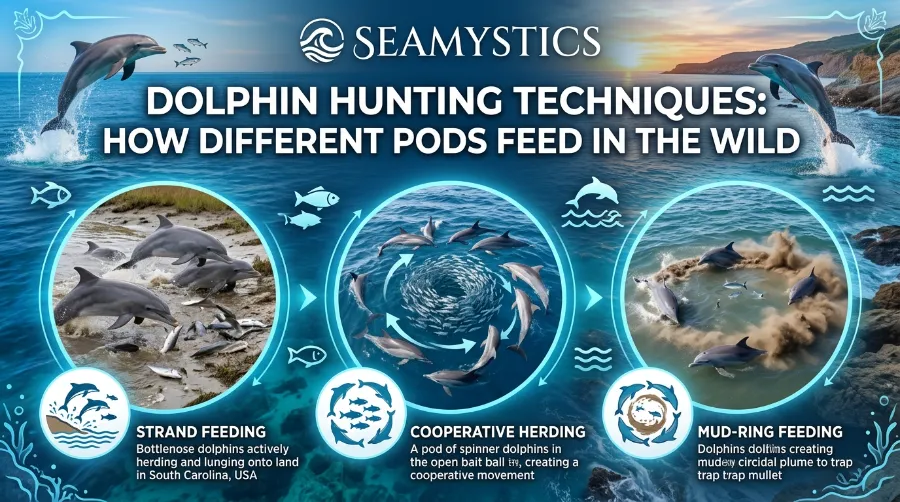

Dolphin Hunting Techniques: How Different Pods Feed in the Wild
Picture a dolphin sprinting along a muddy creek in South Carolina, then sliding onto the bank for a single fish. Thousands of miles away, another dolphin tucks its beak into a sea sponge and plows the seabed like a gardener wearing gloves. These are not tricks for show. They are real dolphin hunting techniques, and each one belongs to a certain pod, place, and family line.
Key takeaways
| Technique | Where it happens | What makes it special |
|---|---|---|
| Mud ring feeding | Florida Keys and Florida Bay, plus Brazil | One dolphin builds a ring of mud, and fish leap out of it |
| Strand feeding | Tidal creeks of South Carolina and Georgia | Dolphins ride up onto mud banks to grab fish |
| Sponging | Shark Bay, Australia | Mothers pass a sponge tool to their daughters |
| Shelling | Shark Bay, Australia | Dolphins shake fish out of empty snail shells |
| Human partnership | Laguna, Brazil | Dolphins and net fishers help each other catch mullet |
TL;DR: Dolphins do not all hunt the same way. Each pod learns a method that fits its home, such as herding fish into a bait ball, building mud rings, or driving prey onto the shore. Young dolphins pick up these skills from their mothers and from their friends, so the methods act like local traditions.
In this guide, you will see how each pod feeds, why the methods differ, and what the newest studies say. You will also learn how researchers know who teaches whom. Along the way, you will find simple tips to watch wild dolphins without causing harm.

Why Dolphin Hunting Techniques Change From Pod to Pod
Dolphins live in almost every ocean, so no single menu or method fits them all. A bottlenose dolphin in a muddy Florida bay faces different fish, water, and dangers than one in a clear Australian channel. Because of that, each group builds a toolkit that fits its home. Scientists call these local habits foraging traditions.
Three things shape the toolkit. Prey type matters first, because schooling mullet need a different plan than a fish that hides in the sand. Habitat comes next, since mudflats, reefs, and open water each reward different moves. Finally, family and friends matter, because young dolphins copy the skills they see.
Most of the best-studied examples come from the common bottlenose dolphin, which you can meet in our bottlenose dolphin facts guide. This species lives from warm bays to cool coasts, and that range helps explain its flexible habits. If you want the wider family tree first, start with the dolphin species guide.
As a marine biologist, I read every new feeding paper with one question in mind. Is this a trick one dolphin invented, or a habit a whole group shares? That question separates a fun video from real science, and it guides how I explain each method below.
How Dolphins Find Their Prey Before the Hunt
Every hunt starts with a search. Dolphins send out rapid clicks and listen for the echoes that bounce off fish, so they can “see” prey in muddy or dark water. If you want the physics, our guide to dolphin echolocation science walks through it in plain steps.
Echolocation also shapes teamwork between species. A recent study in Scientific Reports, led by Sarah Fortune at Dalhousie University, tracked nine northern resident orcas near Vancouver Island in August 2020. The orcas often swam close to Pacific white-sided dolphins and seemed to follow them on foraging dives. The team suggests the orcas may quiet their own sounds to hear the dolphins’ clicks, which could help them find Chinook salmon.
That idea still needs more testing. Even so, it shows how much information one pod’s clicks can carry. In other words, a hunt is not only about speed, but also about who is listening.
Dolphin Fish Herding: Bait Balls, Drivers, and Barriers
Herding is one of the most common dolphin feeding strategies. A pod circles a school of fish and squeezes it into a tight bait ball. Then the dolphins take turns swimming through the ball to snap up fish, which saves energy and keeps the school from scattering.
Spinner dolphins in Hawaii show this plan in open water. Researchers Kelly Benoit-Bird and Whitlow Au found that the dolphins use the fish’s own fear of predators to pack them closer than normal. Pairs of dolphins then took turns feeding inside the crowd. By their estimate, each dolphin gained more access to prey than it would have alone, even after the cost of the group moves.
Bottlenose dolphins near Cedar Key, Florida, add a twist, because they split the job. In a well-known study by Stefanie Gazda and her team, one dolphin acted as the “driver” and herded fish in a circle toward a line of “barrier” dolphins. The driver sometimes slapped its tail on the surface during the chase. The authors noted that earlier reports of group hunting in whales and dolphins had not shown this kind of role specialization, so the Cedar Key study became a key reference.
Here is what to look for if you ever watch a herding hunt:
- Dorsal fins moving in tight circles around one spot
- One dolphin swimming wide while others hold a line
- Fish leaping at the surface in a panic
- Birds dropping in to steal scraps
- Sharp tail slaps that startle the school
Cooperative Dolphin Hunting Across Species and People
Cooperative dolphin hunting is not limited to one pod. Sometimes it crosses species lines, and sometimes it includes people. These cases matter because they show how flexible dolphin minds can be.
The Laguna Partnership in Brazil
In Laguna, on Brazil’s southern coast, net-casting fishers wait in shallow water for wild bottlenose dolphins to drive mullet toward them. Locals have kept this practice alive for more than 140 years. A 15-year study by a team from Brazil and the Max Planck Institute of Animal Behavior used drones and underwater imaging to see what happens beneath the surface. According to the Max Planck report, fishers caught nearly four times more mullet when their moves matched the dolphins’ moves.
The dolphins gain too. Dolphins that join the partnership had a 13 percent higher survival rate, and a PBS NOVA summary explains why. The non-cooperative dolphins were much more likely to die as bycatch in illegal nets elsewhere in the lagoon. However, the models also warn that the practice could fade if mullet numbers fall or young fishers lose interest.
Orcas and Dolphins Off British Columbia
The Scientific Reports team called their findings the first documented case of cooperative foraging between orcas and dolphins. Orcas usually hunt on their own and share fish only within their family group, as our guide to orca pod structure explains. Yet in this study, dolphins were sometimes present when orcas caught and shared Chinook salmon. The researchers say future work must show whether both sides truly benefit.
River Dolphins and Fishers
Teamwork with people is not only a coastal story. Fishers in Myanmar have likely worked with Irrawaddy dolphins for centuries, and the dolphins herd fish and show fishers where to cast their nets, as Smithsonian Magazine reports. For more on species that live in rivers, see our river dolphin facts.
A New Record From Italy
Europe has its own news. In 2024, researchers Pace and Pedrazzi reported the first evidence of barrier feeding by bottlenose dolphins at the Tiber River estuary near Rome. The dolphins hunted flathead grey mullet, the same prey that drives the Laguna partnership. So a method once tied to the Americas now has a European address.
Mud Ring Feeding: The Florida Net Made of Mud
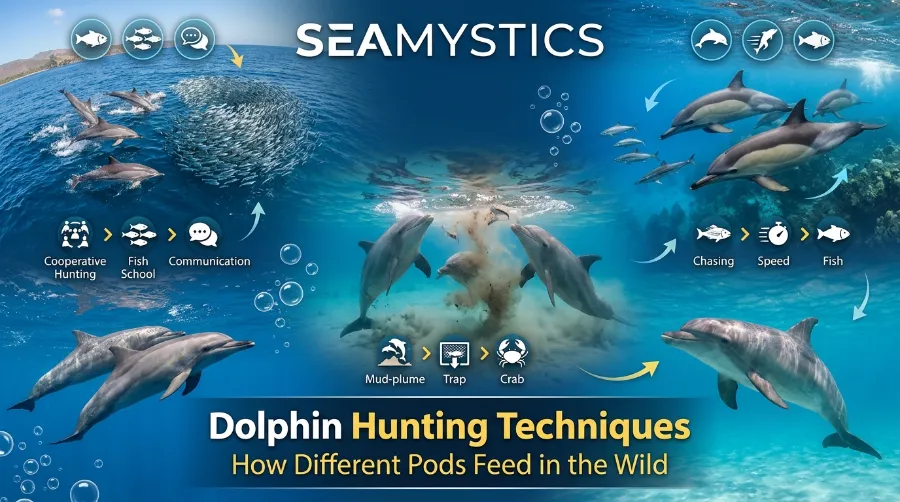
Mud ring feeding looks like magic the first time you read about it. One dolphin, called the ring maker, swims fast in a tight circle in shallow water. It beats its tail near the bottom and lifts a wall of mud that closes around a school of fish. The trapped fish panic, jump over the wall, and land near dolphins waiting outside the ring.
Scientists first wrote about the method in the lower Florida Keys. Jennifer Lewis and William Schroeder described what they called mud plume feeding in Gulf of Mexico Science, using data they gathered from February 1999 onward. Later studies found ring makers in Florida Bay and in Chetumal-Corozal Bay.
The story keeps growing. On July 25, 2018, National Geographic shared rare video of one dolphin near St. Petersburg, Florida, making a mud ring alone. Since then, researchers have also recorded Guiana dolphins using the method in the Cananéia estuary in Brazil. That finding shows the idea is not locked to one species.
Spread matters as much as the trick itself. A 2025 study by João Valle-Pereira and Leigh Torres found that social and spatial boundaries shape how mud ring feeding moves through Florida Bay. In plain terms, dolphins that share space and friends tend to share the skill.
Strand Feeding: Riding the Mud Bank for Dinner
Strand feeding is the boldest of all dolphin feeding strategies. A group pushes fish toward a mud bank, then the dolphins surge out of the water to grab the stranded fish. After that, they wriggle back into the creek. Along the US East Coast, this happens only in tidal creeks and marshes of South Carolina and Georgia, and a similar habit shows up in Ecuador’s Gulf of Guayaquil, according to Oceanography magazine.
Numbers from one monitored site show how routine it is. Between 2018 and 2021, observers logged 3,135 strand feeding events over 1,269 field days, based on a NOAA repository study. Events peaked from May to October and clustered in the hour before and after low tide. Groups ranged from one to six dolphins, with a median of three.
Researchers still debate how the hunt works. The magazine article quotes Cara Gubbins, who suggests a producer and scrounger effect: one dolphin starts the rush at the right time and place, and nearby dolphins join in with quick reflexes. A graduate study at Coastal Carolina University found that the dolphins seem to hit fish already shoaling near the bank rather than herd them first. Both ideas could be partly true.
Mothers appear to teach the skill. In the Kiawah River, one mother named KoKo taught her calf Kai to strand feed, and the pair spent hours in the inlet playing, feeding, and nursing. Local charter captains also describe the behavior well, as in this short explainer on dolphin strand feeding. After a big hunt, dolphins need rest, and you can see how they recover in our guide to dolphin sleep patterns.
Tool Use and Solo Tricks in Shark Bay
Shark Bay in Western Australia is a living lab for dolphin culture. Researchers have followed these dolphins since 1984, so they know the animals by name, family, and friends. That long record lets them test who learns what.
Sponging
Some Indo-Pacific bottlenose dolphins tear off a cone-shaped sponge and wear it over their beak while they probe the seabed. Experts think the sponge shields the nose from stings and scrapes while the dolphin digs for hidden fish. A landmark PNAS paper showed that sponging passes almost entirely within one maternal line, from mothers to their daughters.
Later work gave the habit a timeline. Anna Kopps and William Sherwin at UNSW estimated that the habit may trace back at least 180 years, or about eight generations. Only about 5 percent of Shark Bay dolphins sponge, which makes it a small and special tradition. A 2019 study in Biology Letters used social network tools and again found support for mother to offspring learning.
Shelling
Shelling looks even stranger. A dolphin chases a fish into an empty snail shell, lifts the shell above the surface, and shakes the fish into its mouth. A team of European biologists studied more than 5,000 encounters from 2007 to 2018 and saw at least 19 dolphins shell, as the UTMSI summary explains.
The big surprise was how the skill spread. Shelling moved among dolphins of the same age and across families, instead of moving only from mother to calf. So dolphins can learn from friends, much like great apes do.
Fish Whacking
Not every trick needs a team. In fish whacking, a dolphin herds a school, then whips its tail so hard that a fish flies into the air and lands stunned. The dolphin then scoops it up. Smithsonian Magazine notes that researcher Stefanie Gazda sees an edge for dolphins that specialize in moves like this over those that rely on group hunts.
Dolphin Bubble Net: What Is True and What Is Myth
The classic bubble net belongs to humpback whales, not dolphins. A whale dives below a school of fish and blows bubbles in a rising spiral. The bubbles form a curtain, and the whale lunges up through the middle with its mouth open. A 2025 study found that among seven baleen whale species, only humpbacks can turn sharply enough to build a net, and their large flippers supply nearly half of the turning force.
The method also keeps spreading. A 2024 paper by Allen and colleagues described a novel bubble net strategy in Western Antarctic humpbacks, which shows whales can invent and share new versions. Meanwhile, some sources report dolphins blowing bubbles to startle fish out of a bait ball. That behavior is far less documented, so treat it with care.
So when you see “dolphin bubble net” in a headline, check the animal first. In my experience, most viral clips show whales. Still, the shared idea is worth noting: two very different animals use bubbles as a tool to shape the movement of prey.
How Pods Pass Hunting Skills Down
Learning explains why neighboring pods can hunt in very different ways. Scientists now see three main paths, and each leaves a different trail in the data:
- Mother to calf: Sponging and strand feeding follow family lines. Calves stay close for years, and in Shark Bay, offspring can spend up to four years with their mothers before weaning.
- Friend to friend: Shelling spreads through peers of the same age, even when they share no family tie.
- Neighbor to neighbor: Mud ring feeding moves along shared space and social ties, as the Florida Bay study showed.
I find the strongest proof of culture is not the trick itself but where it stops. When a method follows social lines instead of food supply, it points to learning rather than instinct. That is my reading of the evidence, and other researchers may weigh it differently.
Seven Dolphin Feeding Strategies at a Glance
| Strategy | Region | Team needed | How it spreads | Main risk |
|---|---|---|---|---|
| Herding a bait ball | Open water, worldwide | Pod | Group habit | Heavy energy cost |
| Mud ring feeding | Florida, Brazil | Ring maker plus helpers | Peers and neighbors | Needs shallow, muddy water |
| Strand feeding | South Carolina, Georgia, Ecuador | Small group | Mother to calf | Brief stranding |
| Sponging | Shark Bay | Solo | Mother to daughter | Sponges must be available |
| Shelling | Shark Bay | Solo | Friend to friend | Rare and costly to learn |
| Fish whacking | Florida and beyond | Solo | Likely social | Fish may escape |
| Fisher partnership | Brazil, Myanmar | Dolphins plus people | Both species | Bycatch and falling fish stocks |
Chart-ready numbers from the studies above
| Study | Key number |
|---|---|
| Laguna fishers and dolphins | About 4 times more mullet when synchronized |
| Laguna dolphin survival | 13 percent higher for cooperators |
| NOAA strand feeding record | 3,135 events in 1,269 field days |
| Shark Bay shelling study | More than 5,000 encounters, 19 shellers |
| Shark Bay sponging | About 5 percent of dolphins, about 180 years old |
How to Watch Dolphin Hunts Without Harming Them
Good viewing starts with good habits. Dolphins at feeding spots already face boats, crowds, and fishing gear, and extra stress can break up a hunt. Here is a simple plan:
- Go near low tide if you want to see strand feeding, because the NOAA data show activity peaks around then.
- Use binoculars instead of moving closer.
- Keep a safe distance and follow local rules, since NOAA advises staying at least 50 yards from wild dolphins.
- Book a local guide who knows the creeks and the rules.
- Never offer food, because feeding wild dolphins is illegal in US waters.
NOAA banned feeding wild marine mammals in 1993 under the Marine Mammal Protection Act. The agency explains the harm in its Don’t Feed Wild Dolphins campaign: handouts teach dolphins to beg and pull them away from natural hunting. For fresh field notes from long-term research groups, the dolphin research blogs are a good next stop.
[Dr. Rabica: add one short memory from your own field work here, such as a date, place, and what you saw.]
What Researchers Still Do Not Know
Plenty of questions remain open. Scientists still cannot say why strand feeding stays limited to a few coastal regions, even though mullet and mud banks exist elsewhere. They also cannot say how new tricks start, since one lucky dolphin may invent a move that others later copy. Climate change adds another puzzle, because shifting fish stocks could erase some traditions before anyone fully records them.
Frequently Asked Questions
What are the main dolphin hunting techniques?
The main methods are herding fish into a bait ball, mud ring feeding, strand feeding, sponging, shelling, and fish whacking. Some dolphins also team up with fishers. Each pod uses the methods that suit its home waters.
Do dolphins really hunt in teams?
Yes, many do. At Cedar Key, Florida, one dolphin drives fish while others form a barrier. Spinner dolphins in Hawaii take turns feeding inside a herded school.
Where can I see strand feeding?
The best-known places are tidal creeks in South Carolina and Georgia. A similar habit occurs in Ecuador’s Gulf of Guayaquil. Visit near low tide with a licensed local guide.
Do dolphins use bubble nets?
The famous bubble net belongs to humpback whales. A few reports describe dolphins blowing bubbles to separate fish, but the evidence is thin.
Do young dolphins learn hunting from their mothers?
Often, yes. Sponging passes from mothers to daughters. Yet shelling shows that friends can teach each other too.
Is it okay to feed wild dolphins?
No. Feeding is illegal in US waters and harms the animals by making them beg and lose their natural skills.
Quick Quiz: Test Your Dolphin Knowledge
1. What does a ring maker dolphin build?
a) A bubble curtain
b) A ring of mud
c) A sponge tool
2. Where does daily strand feeding happen on the US East Coast?
a) Maine
b) South Carolina and Georgia
c) New Jersey
3. Who mostly passes sponging down in Shark Bay?
a) Mothers to daughters
b) Fathers to sons
c) Strangers to strangers
4. In Laguna, Brazil, synchronized hunting gave fishers about how much more mullet?
a) Twice as much
b) Nearly four times as much
c) Ten times as much
5. Which animal builds the classic bubble net?
a) Humpback whale
b) Bottlenose dolphin
c) Beluga
Answers: 1) b, 2) b, 3) a, 4) b, 5) a
Conclusion
Dolphin hunting techniques show that intelligence in the sea often looks like culture. A mud ring in Florida, a sponge in Shark Bay, and a net-casting partnership in Brazil all grew from local needs and shared learning. Each method also depends on healthy fish stocks and calm habitats, so protecting both protects the traditions. Next time you watch a dolphin pod, look for the pattern behind the splash, and keep your distance so the hunt can go on.
About the author: Dr. Rabica is a marine biologist with a doctorate in cetacean behavioral ecology and two decades of coastal dolphin research. She writes for Sea Mystics to turn peer-reviewed studies into clear guides for curious readers.
References
- Benoit-Bird, K. J., and Au, W. W. L. Cooperative prey herding by the pelagic dolphin, Stenella longirostris. Journal of the Acoustical Society of America.
- Gazda, S. K., et al. A division of labour with role specialization in group-hunting bottlenose dolphins off Cedar Key, Florida. PubMed Central
- Krützen, M., et al. (2005). Cultural transmission of tool use in bottlenose dolphins. PNAS
- Wild, S., et al. (2019). Multi-network-based diffusion analysis reveals vertical cultural transmission of sponge tool use within dolphin matrilines. Biology Letters.
- Lewis, J. S., and Schroeder, W. W. (2003). Mud plume feeding, a unique foraging behavior of the bottlenose dolphin in the Florida Keys. Gulf of Mexico Science
- Fortune, S., et al. Cooperative foraging between dolphins and fish-eating killer whales. Scientific Reports
- Max Planck Institute of Animal Behavior. Cooperation between dolphins and humans
- NOAA Institutional Repository. Strand feeding study, 2018 to 2021
- Pace, D. S., and Pedrazzi, G. (2024). Bottlenose dolphin predation on flathead grey mullets using barrier feeding techniques. Ethology, Ecology and Evolution.
- Allen, J., et al. (2024). Use and prevalence of novel bubble-net foraging strategy in Western Antarctic humpback whales. Marine Ecology Progress Series.