
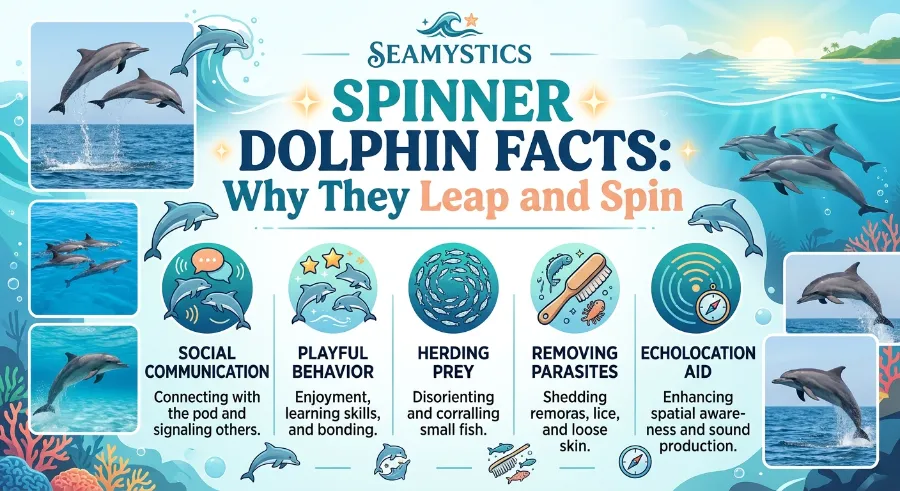

Spinner Dolphin Facts: Why They Leap and Spin
Imagine a calm morning on the Kona coast. The water looks flat, and then a dark shape rockets out of the sea, twists in the air like a corkscrew, and crashes back down with a loud slap. That is the moment most travelers fall for these animals, and it is why spinner dolphin facts are worth knowing before you book a trip. This guide explains why they leap, how the spin works, where they live, and how to see them without harming them.
TL;DR
- Spinner dolphins leap up to about 10 feet (3 m) and spin up to seven times in one jump. Scientists still debate the exact reason, but the best evidence points to communication, parasite removal, and social play.
- They rest in shallow bays by day and hunt in deep water at night, so a spinner dolphin habitat is both a bay and open ocean.
- In Hawaii, federal law bans swimming with or approaching them within 50 yards (about 46 m). Watch from shore or from a boat that keeps its distance.
Key Takeaways at a Glance
| Question | Short Answer |
|---|---|
| What is a spinner dolphin? | A small tropical dolphin, Stenella longirostris, famous for its spinning jumps |
| How many spins can it do? | Up to seven in one leap, about 1 to 2 per second underwater |
| How high can it jump? | Up to roughly 10 feet (3 m) |
| Why do they spin? | Likely communication, parasite removal, courtship, play, and a post-rest warm-up |
| Where do they live? | Tropical and warm waters worldwide, with famous groups around Hawaii |
| When are they active? | They rest by day and hunt by night |
| What is the Hawaii rule? | Stay at least 50 yards (45.7 m) away, within 2 nautical miles of shore |
| Is it safe to swim with them? | It is illegal in Hawaii, and it harms their rest |
Spinner Dolphin Facts: Size, Looks, and Family
Let’s start with the basics. Adults grow to about 7 feet (2.1 m) long and weigh up to 170 pounds (77 kg), according to Oceana’s marine life guide. That makes them slim, fast, and much lighter than a bottlenose dolphin.
Their body is easy to spot once you know what to look for. They have a long, thin beak, a gray back, a lighter belly, and a dark stripe running from the eye to the flipper. Also, many adults show a triangular dorsal fin that stands tall and sometimes tilts forward.
Porpoise Dolphin Differences: The Real Porpoise vs Dolphin Facts Explained

The species name is Stenella longirostris. Scientists split it into several subspecies, and the main ones are easy to remember:
- Gray’s spinner dolphin lives in the central Pacific and includes the Hawaiian groups
- Eastern spinner dolphin lives in the eastern tropical Pacific
- Central American spinner dolphin lives near the Pacific coast of Central America
- Dwarf spinner dolphin lives in the Gulf of Thailand and parts of Southeast Asia
In Hawaiian, people call them naia. Locals use that word with real respect, and you will hear it often on boats and in beach talks.
Their life cycle matters for travelers, because it explains why they need peace. According to NOAA Fisheries, pregnancy lasts about 11 months. Females usually give birth about once every three years, nurse for one to two years, and reach maturity around age seven. As a result, one disturbed mother can slow a whole group’s growth.
| Fact | Number |
|---|---|
| Adult length | Up to 7 ft (2.1 m) |
| Adult weight | Up to 170 lb (77 kg) |
| Pregnancy | About 11 months |
| Calving rhythm | About every 3 years |
| Nursing | 1 to 2 years |
| Sexual maturity | Around 7 years |
| Pod size | Under 50 to several thousand |
Why Do Spinner Dolphins Leap and Spin?
Here is the honest answer: nobody knows for sure. Even the Discover Wildlife guide admits that researchers have not settled the question. However, years of observation have produced several strong ideas, and each one fits a real pattern in spinner dolphin behavior.
Theory 1: Spinning Sends a Message
When a dolphin lands after a spin, it makes a loud slap and a thick cloud of bubbles. Other dolphins can pick up that sound and bubble cloud with echolocation, even from far away. Therefore, many researchers think the landing, not the spin itself, is the real signal.
The message may be simple. It could say “I am here,” “move this way,” or “danger nearby.” In a pod that can reach hundreds of animals, that kind of long-range signal helps keep everyone together.
Theory 2: Spinning Shakes Off Hitchhikers
Remoras and other parasites cling to dolphin skin. A hard spin and a hard landing can knock them loose. In short, the move may work like a quick scratch that the dolphin cannot do with hands.
Marine biologists list this idea next to communication in nearly every summary, including the one from Oceana. Still, it cannot explain every spin, because many spinners jump when no remora is anywhere near.
Theory 3: Spinning Wakes Up the Body
Spinners rest hard during the day. According to Whale and Dolphin Conservation, a lot of spinning happens right after rest, so it may act as a stretch and a way to get blood flowing before the night hunt. Think of it as a morning workout in the sky.
Theory 4: Spinning Builds Social Bonds
Once one dolphin starts to spin, others often join in. Because of that, researchers see a clear social and playful side. Courtship, showing off, and pure fun all seem to play a part, and young dolphins copy the adults as they learn.
My Practical Take
If you watch spinner dolphins for an hour, you will see that the theories overlap. Spinning rarely has one job. In practice, a single leap can send a signal, loosen a hitchhiker, and invite a friend to play at the same time. That is why the “one answer” headline you see online is too simple.
| Theory | Evidence | Strength |
|---|---|---|
| Communication | Landing slap and bubbles carry far underwater | Strong |
| Parasite removal | Hard landing can dislodge remoras | Moderate |
| Post-rest warm-up | Spinning often follows long rest | Moderate |
| Social play and courtship | Spins spread through a pod | Strong |
How Dolphin Spinning Jumps Work
The spin itself is a feat of strength and timing. A spinner starts turning underwater, then speeds toward the surface and breaks through head first. The torque from its tail gives the twist, and the speed gives the height.
The numbers are impressive:
- Underwater, a spinner can make one to two rotations per second.
- In the air, it can make up to seven full turns, according to Discover Wildlife.
- A leap can reach about 10 feet (3 m) high.
- A series of spins usually fades in power and ends with a side slap or belly flop.
Other dolphins spin too, but only a little. Meanwhile, the spinner’s long, slim body gives it low drag and a tight turning axis, so it can rotate along its own length again and again. That body shape is the secret behind the show.
For watchers, one tip helps. Look for a spinner that surfaces fast with a steep angle. That body language often comes right before a leap, so you can lift your camera before the splash.
Text chart: Maximum spins per leap (approximate, from the sources in this guide)
Typical dolphin  | ██                 2
Spinner (average)| ████████████       3 to 4
Spinner (best)   | ██████████████████ 7
Spinner Dolphin Habitat: Where They Live
Spinner dolphins live in warm tropical and subtropical waters around the world. You can find them in the Pacific, Atlantic, and Indian Oceans, and the National Wildlife Federation guide gives a clear overview of their range.
They prefer two kinds of places. First, they use deep offshore water to hunt. Second, they use calm, sandy, shallow bays to rest. Both matter, so a healthy spinner dolphin habitat needs quiet shallows and rich open sea close together.
Spinner Dolphin Facts: Why They Leap and Spin
Hawaii: The Best Known Spot
Hawaii gives travelers the easiest view. NOAA says spinners are probably the most common whales or dolphins you will see near shore in the Pacific Islands. Island groups there stay close to home, which means the same pod often returns to the same bay.
NOAA tracks several separate groups around the islands, and each one has its own home range. Because of that, a harmed group does not simply get replaced by dolphins from the next island over.
A Quick Look at Spinner Types
| Type | Main Range | Notes |
|---|---|---|
| Gray’s (Hawaiian) | Central Pacific, Hawaii | Resting bays by day |
| Eastern | Eastern tropical Pacific | Often travels with tuna |
| Central American | Pacific coast of Central America | Smaller range |
| Dwarf | Gulf of Thailand, Southeast Asia | Smallest form |
Spinners also appear in the Red Sea, where Egypt added strict rules on swimming and boating near dolphin sites in 2004. The pattern is the same everywhere: where tourists crowd the resting bays, the dolphins suffer.
Dolphin Communication Signals: Do They Have Names for Each Other?
Spinner Dolphin Behavior: A Day in the Life
Their daily routine explains almost everything you will see from a boat or a beach.
Morning to afternoon: They rest in shallow bays. NOAA describes this pattern clearly, and the research shows they move slowly and keep part of the brain awake. Dolphins never fully sleep because they must think about each breath.
Late afternoon: They wake up, stretch, and spin. This is often the best time to see leaps.
Night: They move offshore to deep water and hunt small fish, squid, and shrimp that rise from the depths.
Pods vary a lot. Some hold fewer than 50 animals, while others reach into the thousands. They also mix with spotted dolphins and bottlenose dolphins, and in some oceans they swim above large tuna schools. For that reason, tuna fishing has hurt spinners in several regions, because nets set around dolphins can catch both.
They talk constantly too. Their sounds include clicks, whistles, and pulses. They also touch, with pairs rubbing flippers in a way that looks a lot like holding hands.
Dolphin Acrobatics Facts: How Spinners Compare
Many dolphins jump, but only a few put on a show like this one. The table below shows how spinners stack up against two common species.
| Feature | Spinner Dolphin | Bottlenose Dolphin | Spotted Dolphin |
|---|---|---|---|
| Typical length | Up to 7 ft (2.1 m) | 8 to 12 ft (2.4 to 3.7 m) | 5 to 7 ft (1.5 to 2.1 m) |
| Signature move | Multi spin leap | Bow riding, tail walking | Speed leaps |
| Pod size | Under 50 to thousands | Usually under 30 | Dozens to hundreds |
| Rest pattern | Day rest, night hunt | Rests at varied times | Mixed |
| Best sign to look for | Corkscrew leap | Large, stocky body | Light spots on adults |
The lesson is simple. If you want a dolphin that performs on its own, without any trainer, pick the spinner. If you want a closer look at a slower animal, a bottlenose trip usually works better.
Hawaii’s 50 Yard Rule: What Travelers Must Know
Here is the most useful part of this guide for anyone planning a trip. On September 28, 2021, NOAA Fisheries published a final rule that protects Hawaiian spinner dolphins, and it took effect on October 28, 2021. You can read the text in the Federal Register.
The rule is short and clear:
- You cannot swim with, approach, or stay within 50 yards (45.7 m, about 150 feet) of a Hawaiian spinner dolphin.
- It applies within 2 nautical miles (3.7 km) of the main Hawaiian Islands, plus designated waters between Maui, Lanai, and Kahoolawe.
- It covers people, boats, kayaks, paddleboards, and drones.
- You also cannot block a dolphin’s path so it ends up closer to you.
There are exceptions. For example, if dolphins swim up to your boat on their own, you can keep a normal course. And if you end up within 50 yards by accident, you must not chase them and must move away at once.
Why the Rule Exists
The reason comes from research, not red tape. A study of dolphins on the Kona coast of Hawaii Island found that they face tourism for more than 82 percent of daylight hours, according to the rule’s own documents. A group that cannot rest cannot hunt well at night, and over time it raises fewer calves.
A Marine Mammal Commission presentation by University of Hawaii researchers found that estimates for the Hawaii Island group ranged from about 630 to 2,330 animals across survey years. The same research put the yearly value of dolphin tourism at around $58 million for Oahu’s group and $44 million for Hawaii Island’s group. In short, protecting the dolphins also protects local jobs.
Chart: Estimated yearly tourism value of spinner dolphin groups (USD)
Oahu group         | ██████████████████ $58 million
Hawaii Island group| ██████████████     $44 million
How to See Spinner Dolphins the Right Way
You can enjoy a great encounter without breaking the rule. Follow these steps.
- Pick a responsible operator. Ask if the crew follows the 50 yard rule and keeps the boat engine in neutral when dolphins are near. A good captain will answer without hesitation.
- Go in the morning. Calm water makes spotting easier, and glare stays low. Many tours leave early on the leeward coasts of Hawaii Island and Oahu.
- Choose a boat tour or a shore view. Watching from a cliff or a beach lets you see leaps for free, and it adds no pressure on the animals.
- Bring binoculars and a zoom lens. A lens lets you keep your distance and still get the shot.
- Stay quiet. Loud talk and engine noise carry far underwater, as the researchers in the presentation above noted.
- Leave the drone at home. The law counts drones as objects, and they can scare resting dolphins.
Costs vary by island and season, and prices change often. As a rough guide, many wildlife cruises cost between $90 and $200 per adult. Check the operator’s website for a current price before you book.
Good Places to Start
For local detail, the guide on spinner dolphins in Hawaii from Hawaii Ocean Rafting shares short, practical facts from a tour operator. If you prefer a resort based view, Murex Resorts explains how spinners show up in dive regions in Southeast Asia.
| Region | What to Expect | Best Viewing Style |
|---|---|---|
| Kona coast, Hawaii Island | Frequent morning sightings | Small boat or shore |
| Waianae coast, Oahu | Resting pods near shore | Boat tour at distance |
| Maui and Lanai waters | Pods between islands | Boat tour |
| Red Sea, Egypt | Reef sites with rules | Licensed boat tours |
| Gulf of Thailand | Dwarf spinners | Boat tours |
Threats and Conservation
Spinner dolphins face several dangers. NOAA and other groups list the main ones, and each hits a different region.
- Tourism pressure in resting bays
- Tuna fishing nets in the eastern Pacific
- Entanglement in fishing gear
- Marine pollution and loss of habitat
- Predators such as sharks and killer whales
The species overall is not in the same danger as many whales, but local groups can be small and fragile. For example, island groups in Hawaii stay close to home, so each one needs its own protection. Careful tourism works as the best tool for that, because every traveler who keeps a distance helps a pod rest.
There is also good news. After years of debate that began around 2005, Hawaii finally set a clear rule, and many tour companies now use shore based and distance based viewing as the standard.
Planning Your Wider Trip
Most travelers do not build a whole vacation around one animal. If you like wildlife and big landscapes, pair your dolphin trip with a mountain trip later in the year. Our Colorado travel guide for 2026 shows how to plan a full wildlife and scenery route, and the best time to visit Colorado page helps you pick your season. For a longer overland plan, try the Colorado road trip itinerary guide.
Moreover, many readers ask us how to mix ocean and mountain trips in one year. A simple pattern works well: go to Hawaii in spring or autumn for calm seas, then head to the Rockies in summer when the trails open.
Quick Facts Chart for Easy Sharing
Here is a summary you can copy and paste into notes or a trip plan.
| Category | Fact |
|---|---|
| Scientific name | Stenella longirostris |
| Hawaiian name | Naia |
| Length | Up to 7 ft (2.1 m) |
| Weight | Up to 170 lb (77 kg) |
| Max leap | About 10 ft (3 m) |
| Max spins | 7 per leap |
| Pregnancy | About 11 months |
| Rest time | Daytime, in shallow bays |
| Hunt time | Night, in deep water |
| Hawaii distance rule | 50 yards (45.7 m) |
| Rule area | Within 2 nautical miles (3.7 km) of shore |
| Rule start date | October 28, 2021 |
Frequently Asked Questions About Spinner Dolphins
What are the most interesting spinner dolphin facts?
Spinners can leap about 10 feet (3 m) and spin up to seven times in one jump. They rest in bays by day, hunt in deep water by night, and live in pods that range from under 50 to thousands. In Hawaii, a federal rule keeps people 50 yards away.
Why do spinner dolphins spin?
Scientists have not found one answer. The leading ideas are communication through the landing splash, shaking off parasites, warming up after rest, and social play or courtship. Most experts think the spin serves more than one purpose.
How high can a spinner dolphin jump?
A spinner can leap up to roughly 10 feet (3 m) above the water. Most jumps stay lower, and a series of leaps usually loses power until the dolphin ends with a side slap.
Where do spinner dolphins live?
They live in warm tropical and subtropical seas across the Pacific, Atlantic, and Indian Oceans. Hawaii, the eastern tropical Pacific, the Red Sea, and the Gulf of Thailand all host well known groups.
Can you swim with spinner dolphins in Hawaii?
No. Since October 28, 2021, federal rules ban swimming with, approaching, or staying within 50 yards (45.7 m) of Hawaiian spinner dolphins within 2 nautical miles of shore. You can still watch from land or from a boat that keeps its distance.
What time of day is best to see them?
Morning is the most reliable time for calm water and easy spotting. Late afternoon is also good, because the dolphins wake from rest and often start to spin.
Do spinner dolphins sleep?
They rest, but they never sleep fully. Dolphins breathe on purpose, so they keep half of the brain alert while they float or swim slowly in shallow bays.
Are spinner dolphins endangered?
The species as a whole is not in the same danger as many large whales. However, some local groups are small and face pressure from tourism, fishing gear, and pollution, so they still need careful protection.
Test Your Knowledge: 5 Question Spinner Dolphin Quiz
Question 1. How many full spins can a spinner dolphin make in one leap?
- A. Two
- B. Up to seven
- C. Up to twenty
Question 2. What do spinner dolphins usually do during the day?
- A. Hunt in deep water
- B. Rest in shallow bays
- C. Migrate across the ocean
Question 3. How close can you legally get to a Hawaiian spinner dolphin?
- A. 10 yards
- B. 25 yards
- C. No closer than 50 yards
Question 4. Which theory says the landing splash and bubble cloud carry a message?
- A. The communication theory
- B. The hunting theory
- C. The migration theory
Question 5. About how long does a spinner dolphin pregnancy last?
- A. About 3 months
- B. About 11 months
- C. About 24 months
Answers: 1 = B, 2 = B, 3 = C, 4 = A, 5 = B
Conclusion
Spinner dolphins give travelers one of the best free shows in the ocean. The leap, the corkscrew turn, and the loud landing all come from a small animal with a slim body and a very social life. Although scientists still debate the exact reason for the spin, the evidence points to a mix of messages, play, and body care.
The key lesson is simple. These dolphins need quiet days in their bays to hunt well at night and raise healthy calves. Therefore, the best way to enjoy them is from shore or from a boat that follows the 50 yard rule. Keep your distance, choose a responsible crew, and you will take home a better memory and leave the pod in peace.
References
- NOAA Fisheries. Spinner Dolphin species profile: fisheries.noaa.gov/species/spinner-dolphin
- NOAA Fisheries Pacific Islands Regional Office. Hawaiian spinner dolphin protected resources page: fpir.noaa.gov/PRD/prd_spinner.html
- Federal Register, Vol. 86, No. 185 (September 28, 2021). Protective regulations for Hawaiian spinner dolphins: govinfo.gov
- Discover Wildlife. Why do spinner dolphins spin: discoverwildlife.com
- Whale and Dolphin Conservation. Spinner dolphin overview: whales.org
- Oceana. Marine life encyclopedia, spinner dolphin: oceana.org
- National Wildlife Federation. Spinner Dolphin wildlife guide: nwf.org
- Hawaii Ocean Rafting. 6 facts about spinner dolphins in Hawaii: hawaiioceanrafting.com
- Murex Resorts. Spinner dolphins: murexresorts.com
- U.S. Marine Mammal Commission. Bejder presentation on Hawaii Island spinner dolphins (2019): mmc.gov
- Ellison, K. (2009). The wrong spin on dolphins. Frontiers in Ecology and the Environment, 7(8): 452.