
Porpoise Dolphin Differences: The Real Porpoise vs Dolphin Facts Explained
You lean on the ferry rail and spot a gray fin slicing through the waves. One passenger shouts “dolphin!” Another says “porpoise!” Still, both sound sure. The porpoise dolphin differences look tiny from far away, yet they are easy to learn once you know where to look. In short, this guide gives you simple field clues, real numbers, and trip tips for the USA, UK, and Europe.
TL;DR
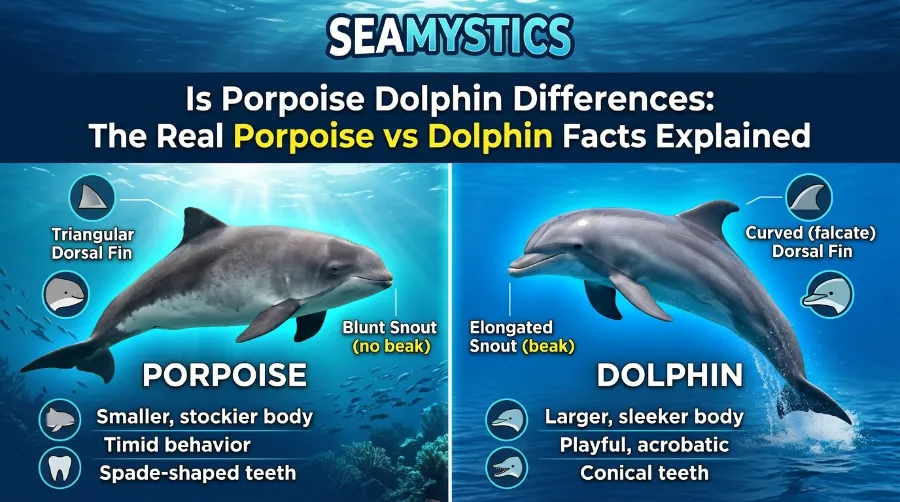
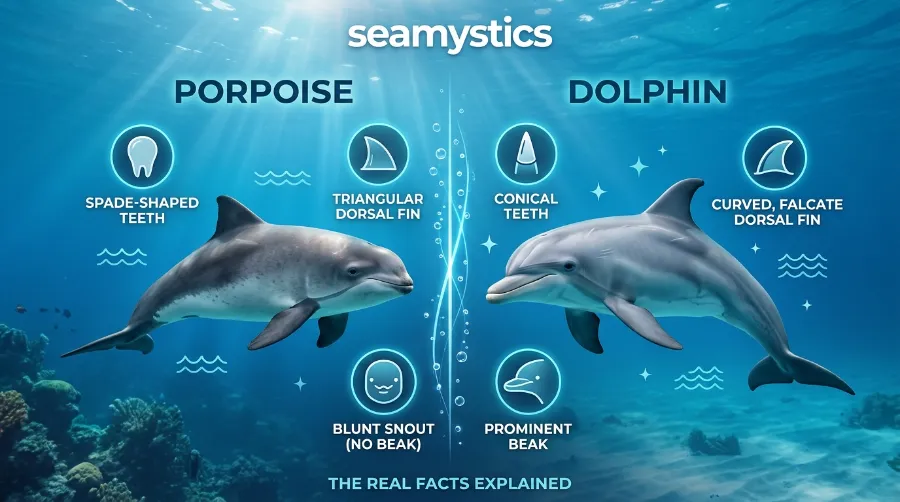
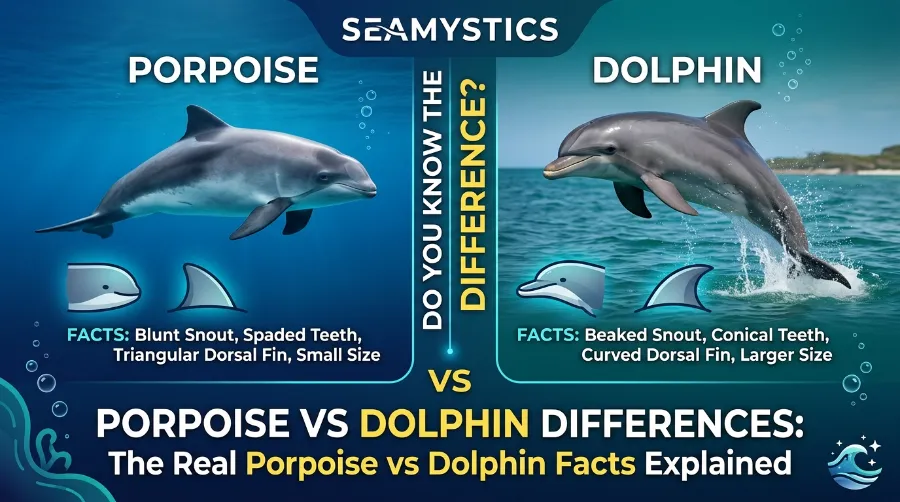
- Dolphins have a beak, a curved fin, cone-shaped teeth, and a long, lean body. Porpoises have a rounded face, a small triangular fin, spade-shaped teeth, and a chunky body.
- Porpoises are shy, quiet, and shorter-lived. In contrast, dolphins are social, chatty, and often ride the waves behind your boat.
- Check the face first, then the fin. As a result, those two clues solve most sightings in about ten seconds.
Key Takeaways
| Feature | Dolphin | Porpoise |
|---|---|---|
| Face | Long beak, often looks like a smile | Rounded, blunt head with no beak |
| Dorsal fin | Curved, hook-like | Small and triangular |
| Teeth | Pointed cones | Flat, spade-shaped |
| Body | Long and lean | Short and stocky |
| Behavior | Curious, loud, loves boats | Shy, quiet, avoids boats |
| Species | About 40 species in several families | 7 species in one family |
Why the Difference Matters on a Trip
Why does this matter on vacation? First, it makes every boat tour more fun. Next, it helps you pick the right place and the right season. Also, it saves you when your kids ask. Finally, it shows you which animals need help right now, because some porpoises sit on the edge of extinction.
For this reason, I wrote this guide the way I would brief a friend before a boat day. Also, every number comes from a named source, such as IFAW, NOAA, the IUCN, or the SCANS surveys. Where two sources disagree, I tell you. Therefore, you can trust the facts and use them on the water.
Dolphin Communication Signals: Do They Have Names for Each Other?
Porpoise Dolphin Differences: Are They Even Related?
Are Porpoises and Dolphins the Same Animal?
Short answer: yes, but only as distant cousins. However, a dolphin is not a type of porpoise. Likewise, a porpoise is not a type of dolphin. IFAW explains that they are two separate groups, and each group holds several species.
First, both groups belong to the toothed whales. Scientists call this group Odontoceti. Also, their shared ancestors lived roughly 50 million years ago. After that, the two lines drifted apart and built different bodies, different habits, and different voices.
Meet the Seven Porpoise Species
Next, porpoises belong to one family, Phocoenidae. In total, that family has seven species. Yet surprisingly, porpoises sit closer to narwhals and belugas than to dolphins. Here are the seven:
- Harbor porpoise (the one you will most likely meet)
- Vaquita (the rarest marine mammal on Earth)
- Burmeister’s porpoise
- Spectacled porpoise
- Indo-Pacific finless porpoise
- Narrow-ridged finless porpoise
- Dall’s porpoise
How Wide Is the Dolphin Group?
In contrast, dolphins cover far more ground. Most people think of oceanic dolphins, such as the bottlenose and the common dolphin. However, the dolphin group also includes several river dolphin families. Also, even the orca counts as a dolphin. Yes, the largest dolphin is the killer whale.
For example, spinner dolphins show how wide the dolphin group can be. They spin in the air like acrobats, and you can read more in these spinner dolphin facts. In contrast, a harbor porpoise rarely does anything like that.
What Dolphins and Porpoises Share
Still, despite the split, the two groups share a lot. Here is what they have in common:
- Both use echolocation to find fish and squid.
- Both have a fatty forehead organ called the melon, which helps focus sound.
- Both have teeth, a dorsal fin, and a blowhole.
- Both have darker backs and lighter bellies, which helps them hide from above and below.
- Both face the same dangers, such as fishing nets, ship strikes, noise, and plastic.
So the confusion makes sense. Still, the differences are real, and you can spot them with a little practice.
Spinner Dolphin Facts: Why They Leap and Spin
How to Tell Dolphin Porpoise Apart: 7 Checks From the Boat
However, most guides give you a long list and no order. Instead, I prefer a simple order. Start with the face, then move to the fin, then watch the behavior. That order works best because it follows what you actually see first.
1. Check the Face
Dolphins usually have a clear beak. It gives them a long, slim snout and that famous smile. In contrast, porpoises have a rounded, blunt head and a smaller mouth. Dolphin Encounters also lists the beak as a top visual clue.
However, there is one catch. At sea, you often see only a low, dark back. For example, a harbor porpoise rolls up, breathes, and slips away. So you may never see its face. In that case, move on to the fin.
2. Check the Dorsal Fin
The fin is the best clue from far away. A dolphin fin curves backward like a hook or a shark fin. In contrast, a porpoise fin is smaller and shaped like a triangle. Therefore, a short, three-sided fin in the middle of the back points to a porpoise.
Two exceptions matter. Dall’s porpoise has black and white patches and a triangular fin, so some people mistake it for a baby orca. Finless porpoises have no dorsal fin at all, but they live mainly in Asian waters, so you will not meet them on a Western boat trip.
3. Check the Body Size and Shape
Dolphins are generally longer and leaner. In contrast, porpoises are shorter and rounder. For example, IFAW notes that the orca can reach about 10 meters (32.8 feet) and 9,800 kilograms (21,600 pounds). In contrast, the vaquita, the smallest porpoise, grows to about 1.5 meters (5 feet) and 55 kilograms (120 pounds).
Meanwhile, the harbor porpoise, the species most visitors see, usually measures around 1.4 to 1.9 meters (4.5 to 6 feet). A common bottlenose dolphin often reaches 2 to 4 meters (6.5 to 13 feet). So if the animal looks as long as a small rowboat, think dolphin.
4. Watch the Behavior Around Your Boat
First, dolphins love attention. They swim at the bow, surf the wake, and sometimes leap clear of the water. In contrast, porpoises do the opposite. They avoid boats, surface quickly, and disappear.
However, Dall’s porpoise breaks this rule. According to NOAA, it often rides the bow wave of fast boats, as IFAW also points out. So behavior helps, but it never replaces the face and fin checks.
Also, here is a quick tip from how tour crews work. Because engines scare harbor porpoises, good crews shut the engine down and drift. If your boat does that, you are in for a better chance at a porpoise sighting.
5. Count the Group
Dolphins live in pods. A pod can have a handful of animals, and some common dolphin groups reach hundreds. In contrast, porpoises stay in smaller groups. Often you will see one, two, or three animals together.
Therefore, a big noisy group racing across the sea almost always means dolphins. A single quiet animal rolling at the surface usually means a porpoise.
6. Listen for Sound and Breath
Dolphins whistle. Scientists believe whistles help dolphins call each other and keep in touch. If you want to learn how this works, read these dolphin communication signals. In contrast, porpoises do not whistle. They use very high, narrow clicks that humans cannot hear.
But porpoises still make one sound you can catch. When the sea is flat and quiet, you may hear a small “pfff” as a harbor porpoise exhales. Also, old sailors even called it the “puffing pig.” So stay silent on deck for a minute, and you might hear it before you see it.
7. Check the Teeth (At a Museum or Visitor Center)
You will not see teeth from a boat, but you may see a skull at a marine center. Dolphin teeth are pointed cones. In contrast, porpoise teeth are flat and shaped like spades. This is one of the oldest scientific ways to tell the two groups apart.
Your 10-second field routine
- Check the sea state first. Calm water makes every sighting easier.
- Look at the fin shape. Curved means dolphin, triangle means porpoise.
- Look for a beak when the animal lifts its head.
- Count the animals in the group.
- Watch how the animal reacts to your boat.
- Take a photo of the fin and the back, then check it later. Do not chase the animal.
The University of Texas Marine Science Institute also covers this topic in a short radio piece, and it is a nice listen on the drive to the harbor.
Dolphin Porpoise Comparison: Size, Lifespan, and Babies
Why Porpoises Live Fast
However, the body differences go deeper than looks. In fact, porpoises live fast. IFAW reports that porpoises tend to grow quickly, breed earlier, and live shorter lives than dolphins. Dolphins take longer to grow, but they live longer and raise fewer calves.
Harbor Porpoise vs Bottlenose Dolphin vs Orca
Next, here is a side-by-side look at three well-known animals. Ranges are typical values from NOAA, IFAW, and standard marine mammal references. Individual animals vary.
| Feature | Harbor porpoise | Common bottlenose dolphin | Orca (largest dolphin) |
|---|---|---|---|
| Typical length | 1.4 to 1.9 m (4.5 to 6 ft) | 2 to 4 m (6.5 to 13 ft) | Up to about 10 m (33 ft) |
| Typical weight | 45 to 65 kg (100 to 145 lb) | 150 to 650 kg (330 to 1,430 lb) | Up to about 9,800 kg (21,600 lb) |
| Fin shape | Small triangle | Tall and curved | Very tall, straight on males |
| Wild lifespan | Often 8 to 12 years | Often 40 to 50 years | About 50 to 90 years |
| Pregnancy | About 10 to 11 months | About 12 months | About 15 to 18 months |
| Calf timing | Can be yearly | Every few years | Every few years |
Length Chart: Porpoise vs Dolphin Sizes
Chart 1: Typical adult length in meters (copy and paste into Excel or Google Sheets to graph)
| Animal | Length (m) |
|---|---|
| Vaquita (porpoise) | 1.5 |
| Harbor porpoise | 1.7 |
| Dall’s porpoise | 2.2 |
| Common bottlenose dolphin | 3.0 |
| Orca (dolphin) | 8.0 to 10.0 |
Overall, the numbers tell a clear story. Even the biggest porpoise stays smaller than the average bottlenose dolphin. As a result, size alone gives you a fast filter when you see an animal next to your boat.
Finally, one more fun fact: the word “porpoising” confuses people. It describes fast animals that leap in low arcs to save energy. Also, dolphins, penguins, and sea lions do it too. Still, real porpoises seldom put on that show.
Porpoise Facts Ocean Lovers Should Know
Porpoises get less attention than dolphins, so travelers often know very little about them. Yet porpoises have some of the most interesting stories in the sea. Let’s meet the four that matter most.
Harbor Porpoise: The One You Will Likely See
The harbor porpoise (spelled “harbour” in the UK) lives in cool coastal waters across the North Atlantic and North Pacific. It feeds on small fish such as herring and sandeel, and it hunts almost all day. Cold water pulls heat from a small body fast, so it needs lots of food.
Best of all, you can spot it from shore. For example, headlands, tidal races, and narrow sounds work well. So pick a calm day, bring binoculars, and scan for slow, rolling backs.
Dall’s Porpoise: The Speedy One
Dall’s porpoise lives in the North Pacific. It has a bold black and white body and a thick, strong build. It is also one of the few porpoises that loves boats. If you visit the Pacific Northwest, ask your captain about it.
Finless Porpoises: The Smooth Ones
The two finless porpoise species lack a dorsal fin and have a smooth back with a ridge. Also, they live in warm Asian waters and rivers. However, the IUCN rates the narrow-ridged species as endangered and the Indo-Pacific species as vulnerable.
Vaquita: The Rarest Marine Mammal
The vaquita lives in one small stretch of the Upper Gulf of California in Mexico. It has dark rings around its eyes, which look like eye makeup. It is the smallest cetacean in the world. Sadly, it is also the closest to extinction. You will read more about it in the case studies below.
Porpoise vs Dolphin: Conservation Status and Real Case Studies
Travel guides often skip this part. Yet it may be the most important one. Both groups face the same threats, but some porpoise species face them with almost no room for error.
The IUCN rates porpoise species very differently. Here is the latest picture, based on the list IFAW publishes.
Chart 2: IUCN status of the seven porpoise species
| Porpoise species | IUCN status |
|---|---|
| Vaquita | Critically endangered |
| Narrow-ridged finless porpoise | Endangered |
| Indo-Pacific finless porpoise | Vulnerable |
| Burmeister’s porpoise | Near threatened |
| Harbor porpoise | Least concern |
| Spectacled porpoise | Least concern |
| Dall’s porpoise | Least concern |
Dolphins look healthier on paper, but trouble hides inside the group. IFAW counts two critically endangered dolphins, the baiji and the Atlantic humpback dolphin. It also counts seven endangered species, such as Hector’s dolphin, the Irrawaddy dolphin, and several river dolphins. In total, 23 dolphin species sit at least concern.
Case Study 1: The Vaquita Numbers Tell the Story
In 1997, scientists estimated about 567 vaquitas. By 2018, reports put the number near 10. The 2024 survey counted only 8, the lowest result ever recorded. However, the team did not call it a true drop, because some animals may have moved outside the survey area.
Then came better news. The 2025 survey ran from May to September and found between 7 and 10 animals, plus new calves, according to Seafood Source and the IUCN Cetacean Specialist Group. Mexican officials say the population has not fallen sharply for three years in a row.
Please read these numbers with care. Recent counts are minimum sightings in a small search area, not full population estimates. Experts expected a fuller estimate in 2026, so check the IUCN for the newest figure before you quote it.
Chart 3: Vaquita numbers over time (copy and paste to graph)
| Year | Number | Type of number |
|---|---|---|
| 1997 | About 567 | Population estimate |
| 2018 | About 10 | Reported estimate |
| 2024 | 8 | Lowest sightings on record |
| 2025 | 7 to 10 | Sightings, with calves |
The lesson is simple. Illegal gillnets for totoaba fish drown vaquitas. Gillnets also threaten many other small whales, so the same fight matters far beyond Mexico.
Case Study 2: North Sea Harbor Porpoises Hold Steady
The SCANS surveys give us the best long-term view of harbor porpoises in Europe. The 2016 survey estimated about 345,000 porpoises in the North Sea. The 2022 SCANS-IV survey estimated about 350,000, according to a 2025 ASCOBANS progress report. A Dutch review of the same data gives about 339,000. So the North Sea number looks stable, near 340,000 to 350,000.
But stable does not mean safe everywhere. Scientists treat the Belt Sea population in the western Baltic as a separate group, and one 2024 study in Frontiers in Marine Science calls it vulnerable with a falling trend. In short, one sea can look fine while the next one struggles.
The wider SCANS-IV survey also found about 1.4 million whales, dolphins, and porpoises in the European Atlantic. It saw common dolphins spreading farther north too. That is good news for UK boat trips, because you now have a better chance of seeing both types on the same day.
Case Study 3: The 2024 Cape Cod Stranding
Dolphins and porpoises also strand on beaches. IFAW says that since 1998 its Cape Cod team has responded to 7,595 marine mammal strandings and rescued 1,180 dolphins. In 2024, the team handled the largest mass dolphin stranding in US history and saved 102 of 146 dolphins.
The takeaway for travelers is direct. If you see a stranded animal, do not push it back into the water. Keep people and dogs away, and call local experts fast. On Cape Cod and southeastern Massachusetts, IFAW lists the hotline as (508) 743-9548. Elsewhere, call the local coast guard or marine rescue group.
Where to See Dolphins and Porpoises: USA, UK, and Europe
Now for the fun part. Below you will find reliable regions for each animal. Prices are typical ranges, so check each operator before you book. Also, choose a company that follows local wildlife rules.
| Region | Place | Likely sighting | Best months | Typical cost |
|---|---|---|---|---|
| USA | San Juan Islands, Washington | Harbor and Dall’s porpoise | May to September | $100 to $150 |
| USA | Cape Cod, Massachusetts | Harbor porpoise, dolphins | April to October | $60 to $80 |
| USA | Florida Gulf Coast | Bottlenose dolphins | Year round | $25 to $50 |
| UK | Cardigan Bay, Wales | Bottlenose dolphin, harbor porpoise | July to September | £20 to £40 |
| UK | Chanonry Point, Moray Firth | Bottlenose dolphins from shore | April to October | Free |
| UK | Pembrokeshire coast | Harbor porpoise | July to September | £30 to £50 |
| Europe | Azores, Portugal | Common, bottlenose and spotted dolphins | April to October | €60 to €90 |
| Europe | Strait of Gibraltar | Common dolphins | Year round | €30 to €45 |
| Europe | Sylt and the Wadden Sea, Germany | Harbor porpoise | May to August | €25 to €40 |
My opinion is simple. Pick a small boat with a naturalist guide over a big party boat. Small boats stay quieter, so they get closer looks at shy porpoises. Also, skip any attraction that lets you swim with captive dolphins. Wild watching teaches you far more.
Practical Tips That Raise Your Odds
- Go early. Morning seas are often flatter, and porpoises show up better on a flat sea.
- Aim for light wind. Seas of Beaufort 2 or lower work best for porpoises.
- Bring binoculars with 8x or 10x power.
- Scan the water near tidal races, headlands, and bait fish.
- Wear layers. It feels cooler on the water than on land.
- Keep your voice low when the engine stops.
NOAA advises staying at least 50 yards (about 46 meters) from dolphins and porpoises. Never chase them, and never feed them. Besides being harmful, feeding and harassing wild marine mammals breaks the law in the USA.
Planning Beyond the Coast
Not every trip needs an ocean. Many TravelWice readers plan one sea trip and one mountain trip in the same year. If the mountains come first, start with our Colorado travel guide for 2026, which maps the whole state.
For high country days, read our guides to things to do in Aspen and the Rocky Mountain National Park guide. City lovers will like our list of things to do in Colorado Springs. Winter fans can check the best ski towns in Colorado.
Want to drive between stops? Our Colorado road trip itinerary guide lays out the route day by day. Also, our best time to visit Colorado page helps you pick the season. After that, save the coast for a second trip, and use this guide to enjoy it. You can find more ideas on the TravelWice homepage.
Myths That Confuse Travelers
Many wrong ideas stick around because movies and cartoons repeat them. Here are the most common ones, with the facts.
| Myth | Fact |
|---|---|
| Flipper was a porpoise. | Flipper was a bottlenose dolphin. |
| A porpoise is a baby dolphin. | No. Porpoises stay porpoises for life. |
| Dolphins always smile. | The beak shape creates the look. It does not show mood. |
| Porpoises are just small dolphins. | They form a separate family with different teeth, fins, and voices. |
| All porpoises avoid boats. | Dall’s porpoise often rides bow waves. |
Frequently Asked Questions
Is a porpoise a dolphin?
No. Porpoises and dolphins are separate groups of toothed whales. Porpoises have a rounded head, a triangular fin, and spade-shaped teeth. Dolphins have a beak, a curved fin, and cone-shaped teeth.
Which one is bigger, a porpoise or a dolphin?
Dolphins are usually bigger. The orca, which is a dolphin, can reach about 10 meters. The vaquita, the smallest porpoise, reaches about 1.5 meters.
Do porpoises jump out of the water?
Most porpoises stay low and roll at the surface. Dolphins jump more often and put on a bigger show. Dall’s porpoise is the usual exception, because it moves fast and throws up a spray when it swims.
Can I see porpoises from the shore?
Yes. In the UK, Wales, and Scotland, headlands and tidal races give good views in calm weather. Bring binoculars, watch for slow rolling backs, and stay patient.
Are porpoises dangerous to people?
No. Porpoises are shy and avoid contact. Still, treat every wild animal with respect and keep your distance.
Which is smarter, a dolphin or a porpoise?
Both have large, complex brains. Scientists have studied dolphins more, partly because dolphins are easier to watch and work with. Porpoises are harder to study, so we know less about them.
Quick Quiz: Test Your Porpoise Dolphin Differences
1. Which fin shape points to a porpoise?
- A. Tall and hooked
- B. Small and triangular
- C. No fin at all on every porpoise
Answer: B. Most porpoises have a small triangular fin. Only the finless porpoises lack one.
2. Which animal is the smallest porpoise?
- A. Dall’s porpoise
- B. Harbor porpoise
- C. Vaquita
Answer: C. The vaquita is the smallest of all cetaceans.
3. What shape are porpoise teeth?
- A. Flat, like spades
- B. Long, like needles
- C. Pointed cones
Answer: A. Dolphins have the pointed cones.
4. Which sound do dolphins make that porpoises do not?
- A. High narrow clicks
- B. Whistles
- C. Low rumbles only
Answer: B. Dolphins whistle, while porpoises rely on very high clicks.
5. Which sighting most likely means a porpoise?
- A. A large, noisy pod surfing your wake
- B. A single, quiet animal rolling away from your boat
- C. An animal with a long beak leaping high
Answer: B. Shy, quiet, and short-lived is the porpoise way of life.
Conclusion
So, what are the real porpoise dolphin differences? Dolphins have a beak, a curved fin, cone-shaped teeth, and loud, social habits. Porpoises have a rounded face, a small triangular fin, spade-shaped teeth, and shy habits. Remember the order: face, fin, behavior. Then check group size and sound if you still feel unsure.
The best way to learn is on the water. Choose a calm day, a small boat, and a good guide. Keep your distance, stay quiet, and let the animals decide how close to come. Before long, you will call the sighting before your friends even finish the argument.
References
- IFAW: Dolphins vs. porpoises, what is the difference?
- Dolphin Encounters: Dolphin vs porpoise differences
- University of Texas Marine Science Institute: Dolphin vs porpoise
- NOAA National Ocean Service: What is the difference between a dolphin and a porpoise?
- IUCN Red List: Vaquita
- IUCN Cetacean Specialist Group: 2025 vaquita survey
- Seafood Source: Latest vaquita survey
- ASCOBANS: North Sea progress report 2025
- University of Veterinary Medicine Hannover: SCANS-IV results
- Frontiers in Marine Science: Belt Sea harbour porpoise
- Sea Sea Mystics: Spinner dolphin facts
- Sea Mystics: Dolphin communication signals