
Marine Biodiversity Hotspots: The Richest Ecosystems in the Ocean
Picture a dead coral head the size of a football. Now picture a research team in Bali pulling it apart and counting every crab and shrimp hiding inside. The team then used DNA barcodes to compare those counts with reefs around the world, and Bali came out as the most diverse spot they had tested. That small experiment, run by a team working with the Smithsonian, shows why marine biodiversity hotspots pack in more life than most people expect. In this guide, I will show you where the richest places are, why they formed, what threatens them in 2026, and what you can do about it. si
TL;DR: An ocean hotspot is a small area with a huge number of species, and the Coral Triangle in Southeast Asia is the richest of all. The 2023 to 2025 bleaching event hit about 84% of the world’s reefs, so protecting these places now matters more than ever.
| Key takeaway | What to know |
|---|---|
| Richest region | The Coral Triangle (Indonesia, Philippines, Malaysia, Papua New Guinea, Timor-Leste, Solomon Islands) |
| Coral species | About 605 of the world’s 798 (76%) |
| Reef fish species | About 2,228 of roughly 6,000 (37%) |
| Single richest reef area | Raja Ampat, with 553 coral species |
| Biggest threat | Marine heatwaves: 84% of reefs hit between 2023 and 2025 |
| Best fix | Protected areas, fair fishing rules, and cutting emissions |
What Are Marine Biodiversity Hotspots?
A hotspot is a place with an unusually high number of species, and often many species that live nowhere else. Conservation biologists first used the idea on land. Then marine scientists borrowed it for the sea.
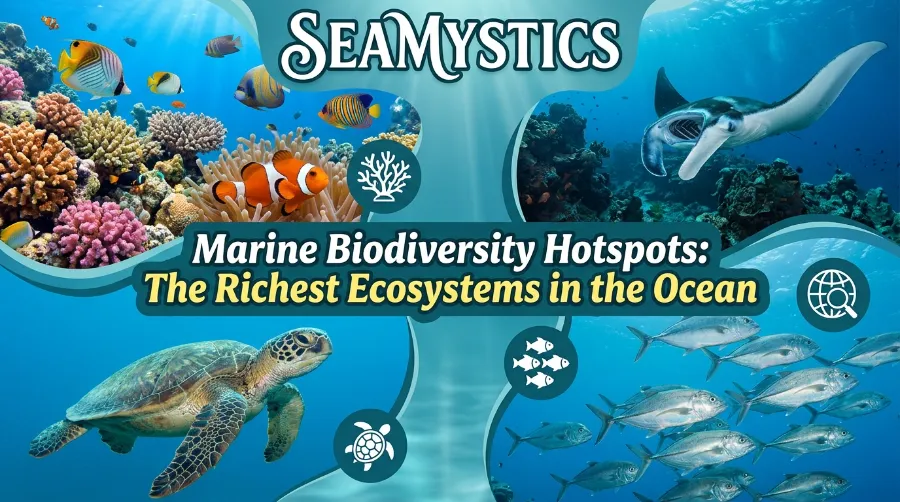
So what does that look like in numbers? The ocean holds over 200,000 identified species, and a single square meter of reef can hold more than 1,000. That is a lot of life in a small space. However, scientists agree that most marine species still have no name. 1ocean
Species Richness and Endemism
Two ideas define any ocean biodiversity hotspot. Species richness counts how many different species live in an area. Endemism counts how many of them live only there.
A place can score high on one and low on the other. For example, a wide open sea may hold a few huge, famous animals. A small island reef may hold hundreds of tiny fish found nowhere else. The best hotspots score high on both.
How We Measure Marine Species Density
Marine species density is the number of species found in a set area, such as one square kilometer or one transect line. It sounds simple. In practice, it takes careful work.
Here are the main tools I trust when I read a survey:
- Visual transects: Divers swim along a measured line, often 50 meters, and count fish and corals on each side.
- Quadrats and rubble sampling: Teams count tiny animals inside a fixed square or inside a piece of dead coral, like the Bali study.
- DNA barcoding and eDNA: Labs match genetic traces in specimens or water samples to known species.
- Remote tools: Sonar, drones, and robot submersibles map places that divers cannot reach.
Two divers on the same line rarely write down the same list. Because of that, good teams train together and repeat their counts. When you read any species density number, always check how the team counted.
The Coral Triangle: The Richest Marine Ecosystem on Earth
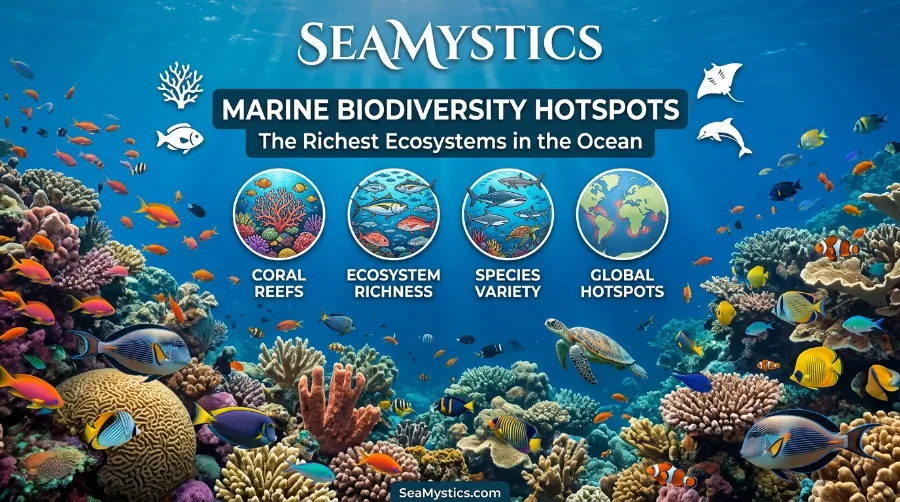
If you ask which place deserves the title of richest marine ecosystem, most scientists point to the Coral Triangle. It sits between the Pacific and Indian Oceans and touches six countries. The Coral Triangle Atlas lays out the key facts.
The region holds 605 of the world’s 798 coral species, about 76%, and 2,228 of roughly 6,000 reef fish species, about 37%. By comparison, the Caribbean has about 8% of coral species, and Hawaii has about 7% of reef fish species. The gap is huge. coraltriangleinitiativecoraltriangleinitiative
The region also matters to people. About 363 million people live there, and the waters serve as spawning and nursery grounds for five tuna species, which supports the largest tuna fisheries in the world. Six of the world’s seven sea turtle species also live in parts of the triangle. coraltriangleinitiativeSmithsonian Magazine
| Measure | Coral Triangle | Caribbean | Hawaiian Islands |
|---|---|---|---|
| Share of world coral species | 76% (605) | 8% (61) | Not listed in source |
| Share of world reef fish species | 37% (2,228) | Not listed in source | 7% (420) |
Source: Coral Triangle Atlas, Coral Triangle Initiative.
Inside the triangle, one spot stands out. Raja Ampat, in Indonesia’s Bird’s Head region, holds 553 coral species. That single area has about nine times more coral species than the whole Caribbean.
In 2010, Raja Ampat created a shark and ray sanctuary, and local communities now play a big role in guarding the reefs. I think this is the key lesson. Rules work best when the people who live beside the reef help write them.
Why the Caribbean Has Fewer Species
The Caribbean is not a poor reef region. It simply has a different history. Many scientists link its lower coral count to the closing of the gap between North and South America about three million years ago, which cut the Caribbean off from the Pacific and led to many local extinctions.
The Indo-Pacific never lost that connection. So its reefs kept building species for millions of years.
Other Biodiversity Ocean Regions Worth Knowing
The Coral Triangle gets the headlines, but other biodiversity ocean regions matter too. Some are warm and colorful. Others are cold, dark, and full of whales.
| Region | Why it stands out | Main concern |
|---|---|---|
| Coral Triangle | Highest coral and reef fish diversity on Earth | Heat, overfishing, coastal development |
| Red Sea | Reefs that handle warm water better than most | Coastal building and shipping |
| Mediterranean | Roughly 17,000 species and many found nowhere else | Warming, overfishing, plastic |
| Hawaiian Islands | High share of species found only there | Heat and run-off from land |
| California Current and Oregon coast | Cold, nutrient-rich water, canyons, whales | Bottom trawling and changing currents |
| Mesoamerican Reef (Caribbean) | Long barrier reef shared by four countries | Bleaching and disease |
Cold Water Hotspots in the United States
Not every hotspot is tropical. Off the US West Coast, Oceana’s Pacific hotspot surveys describe Monterey Bay as a place of global ecological value. It has three submarine canyons, living seafloor with corals and sponges, whales, sea turtles, dolphins, and many rockfish. Its main canyon is larger than the Grand Canyon.
Oceana also identified 31 Important Ecological Areas off Oregon. The coast there serves as a stop for more than 20,000 gray whales on their trip between the Arctic and Baja California. oceana
Why does cold water hold so much life? Strong winds push surface water away from shore, and cold, nutrient-rich water rises to replace it. That rise feeds a burst of tiny algae, which feeds krill, fish, and whales. You can read more about this chain reaction in our guide to the phytoplankton bloom ecosystem.
Europe’s Own Hotspots
European readers often think of hotspots as faraway places. However, the Mediterranean holds roughly 17,000 species, and many live nowhere else. Seagrass meadows, such as Posidonia, act as nurseries and store carbon.
Closer to the UK, Lundy off the Devon coast became England’s first no-take zone in 2003. Later surveys there reported more and larger lobsters inside the zone than outside. In my view, Lundy proves a point that I see again and again: a small, well-guarded patch can rebuild numbers faster than people expect.
Why Hotspots Form in the First Place
Hotspots do not appear by chance. Several forces stack up in the same place.
- Ocean currents deliver larvae. Many fish, corals, and invertebrates drift as larvae. In the Coral Triangle, currents gather those larvae and hold them near island chains.
- Old, stable habitats allow species to build up. Researchers think many Indo-Pacific coral groups either began there or survived there when they vanished elsewhere.
- Complex habitat creates many homes. Coral branches, seagrass, mangroves, and rock walls give each species a niche.
- Nutrients keep the engine running. Healthy reefs recycle waste fast, which is why marine nutrient cycling is so central to hotspot health.
Mangroves deserve a special mention. The Coral Triangle holds the world’s largest mangrove forest, and these roots shelter young fish before they move to the reef. Take away the mangroves, and the reef slowly loses its next generation.
Hidden Diversity: Small Animals, Deep Water, and Odd Echoes
Most hotspot stories focus on big, bright animals. Yet the bulk of species are small and hidden. That is exactly what the Bali study found: crabs and shrimp tucked into cracks in dead coral added up to a huge, mostly unseen layer of life.
Depth hides even more. Roughly 17,000 species have been named in the deep sea, and the average ocean depth is about 4,000 meters, so most of it remains unexplored. Each depth band has its own cast of animals, as our guide to ocean zonation layers explains.
Sometimes technology raises more questions than answers. Sonar crews occasionally record strange shapes in open water, and many turn out to be schools of fish, layers of plankton, or seabed features. If that topic interests you, read about sonar unidentified shapes.
Keystone Species Keep Hotspots Balanced
A hotspot is not just a long species list. It is a web. Remove one strong link, and the web changes.
Parrotfish scrape algae off reefs so corals can settle. Sharks keep prey numbers in check. Our guide to keystone marine species shows how one animal can shape a whole habitat. For the bigger picture, start with the ocean food chain, which links every hotspot we cover on Sea Mystics.
Big animals also move carbon. When whales, fish, and plankton die and sink, they carry carbon to the deep, a process we explain in our piece on the biological carbon pump. So a rich hotspot helps the climate as well as local fishers.
Threats to Biodiversity Hotspots in 2026
Heat is now the largest threat. In April 2025, NOAA and the International Coral Reef Initiative reported that the fourth global bleaching event hit 83.7% of the world’s reef area between January 2023 and April 2025, across at least 83 countries and territories. The previous record, set in 2014 to 2017, was 68.2%. yahoo
NOAA scientists say the event likely ended in mid-2025, but ocean temperatures remain historically high in many regions. The agency also had to add new alert levels to its scale. Level 5 now signals that more than 80% of corals on a reef could die from long bleaching. climatefactchecksworldports
| Global bleaching event | Share of reefs hit by bleaching-level heat |
|---|---|
| First (1998) | 21% |
| Second (2010) | 37% |
| Third (2014 to 2017) | 68% |
| Fourth (2023 to 2025) | 84% |
Local Pressure Decides Who Recovers
Here is my honest read of the evidence. Heat is the big shock, but local pressure decides who bounces back. Reefs that also face overfishing, dirty run-off, and coastal building have less strength left when the water warms.
The main local threats are:
- Overfishing and destructive fishing, which remove the fish that keep reefs clean.
- Coastal development and pollution, including mining and oil work, which cloud the water and stress corals.
- Ghost gear, meaning lost or dumped nets and lines that keep trapping animals for years.
- Ocean acidification, which makes it harder for corals to build their skeletons.
The upside is that people control the local list. We cannot cool the ocean next month. We can, however, cut nets, sewage, and trawling right now.
What Works: Protecting and Rebuilding Hotspots
Conservation does work when it is well designed. Three tools stand out.
- No-take and well-managed marine protected areas. Lundy and Raja Ampat show the idea at work.
- International targets. The 2022 global biodiversity framework set a goal to protect 30% of the ocean by 2030. The High Seas Treaty also reached its 60 ratifications in 2025 and took effect in January 2026, which opens the door to protected areas beyond national waters.
- Community ownership. Fishers who share the benefits tend to follow the rules.
In practice, a paper park does little. I always ask three questions before I trust a protected area. Does it have clear borders? Does anyone enforce the rules? Do local people gain from it?
How to Help and Visit Responsibly
You do not need a boat to help a hotspot. Small choices add up, so here is a simple plan.
- Choose sustainable seafood. Ask where and how your fish was caught.
- Pick reef-safe habits. Use mineral sunscreen, never touch corals, and keep fins off the bottom.
- Book with operators who follow the rules. Look for small groups, moorings instead of anchors, and local guides.
- Support groups that protect habitat. Many publish clear reports on their results.
- Join citizen science. Photo surveys and reef counts help scientists fill data gaps.
- Cut your own carbon. Heat drives the biggest losses, so energy use at home matters.
Field Checklist: How I Judge a Hotspot’s Health
When I look at any reef or coastal site, I use a quick mental checklist. You can use it too on your next snorkel or dive.
- Do you see many sizes of fish, or only small ones?
- Are plant-eating fish, such as parrotfish and surgeonfish, present?
- Can you spot tiny baby corals on bare rock?
- Is the water clear, or does it look green and cloudy?
- Do you see healthy live coral, or mostly algae and rubble?
No single sign tells the whole story. Still, three or four “no” answers in a row usually mean the site needs help.
Frequently Asked Questions
What is the richest marine ecosystem on Earth?
The Coral Triangle in Southeast Asia is widely seen as the richest marine ecosystem. It holds about 76% of the world’s coral species and about 37% of its reef fish species.
How many species live in the Coral Triangle?
Scientists have recorded about 605 coral species and more than 2,000 reef fish species there. Many more small animals remain uncounted.
Where are marine biodiversity hotspots near the United States?
Good examples include the Mesoamerican Reef in the Caribbean, the Hawaiian Islands, and the cold, nutrient-rich waters off California, Oregon, and Washington.
Why is marine species density so high in some places?
Currents gather larvae, old habitats let species build up, and complex reefs give each species a home. Steady nutrients keep the whole system running.
Can a damaged hotspot recover?
Yes, if the stress drops. NOAA notes that bleached corals can recover when conditions improve, and protected zones like Lundy show that fish and shellfish numbers can climb back.
Conclusion
Marine biodiversity hotspots are the ocean’s richest neighborhoods. The Coral Triangle leads with 605 coral species and over 2,000 reef fish species, while cold water regions like Monterey Bay and Oregon add whales, canyons, and kelp. Together, these biodiversity ocean regions feed fisheries, protect coasts, and store carbon.
However, the record bleaching event of 2023 to 2025 showed how fast things can change. Still, the evidence gives me hope. Where people protect habitat, cut local pressure, and share the benefits, life returns.
Start small. Eat sustainably, travel gently, and share what you learn. Then explore more of our guides on Sea Mystics to see how every hotspot connects to the rest of the ocean.
Quick Quiz: Test What You Learned
1. Which region holds about 76% of the world’s coral species?
a) The Caribbean
b) The Coral Triangle
c) The Red Sea
2. How much of the world’s reef area did bleaching-level heat hit between 2023 and 2025?
a) About 21%
b) About 50%
c) About 84%
3. Which area holds 553 coral species?
a) Raja Ampat
b) Monterey Bay
c) Lundy
4. True or false: Bleached coral is always dead.
5. True or false: Cold water regions can also be biodiversity hotspots.
Answers: 1) b. 2) c. 3) a. 4) False. Corals can recover if the stress drops. 5) True. Monterey Bay and the Oregon coast are good examples.
References
- Coral Triangle Atlas, Coral Triangle Initiative: https://ctatlas.coraltriangleinitiative.org/About
- Smithsonian Ocean, Hotspot of Biodiversity: https://ocean.si.edu/ecosystems/coral-reefs/hotspot-biodiversity
- Oceana USA, Pacific Hotspots: Places: https://usa.oceana.org/pacific-hotspots-places/
- One Ocean Foundation, Ocean biodiversity: https://1ocean.org/news/ocean-biodiversity
- NOAA NESDIS, World’s fourth mass coral bleaching event likely ended in 2025: https://www.nesdis.noaa.gov/news/worlds-fourth-mass-coral-bleaching-event-likely-ended-2025