
Stand at the edge of a frozen lake in January and you will see a smooth sheet of solid ice. Stand at the edge of the Arctic Ocean on that same freezing morning and the water might still be rolling, dark, and liquid, even though the air feels just as cold. That difference is not an accident. The ocean freezing point sits well below zero degrees Celsius, and the reason comes down to salt, movement, and a few quiet chemistry rules that most people never learn in school. Once you understand why the sea behaves this way, ice, currents, and even weather patterns start to make a lot more sense.
What Is Thermohaline Ocean Circulation? Earth’s Global Conveyor Belt Explained
TL;DR: The ocean freezing point is about -1.8°C (28.8°F), roughly two degrees colder than the 0°C (32°F) mark where fresh water turns solid. Salt dissolved in seawater gets in the way of ice crystal formation, and constant mixing from waves and currents pushes the freezing threshold even lower in open water. This is why polar seas stay liquid long after lakes and rivers have iced over.
Key Takeaways
| Fact | Detail |
|---|---|
| Average seawater freezing point | About -1.8°C (28.8°F) at 35 ppt salinity |
| Pure fresh water freezing point | 0°C (32°F) |
| Coldest liquid seawater ever recorded | -2.6°C, found under an Antarctic glacier in 2010 |
| Average ocean salinity | 35 grams of salt per kilogram of water (35 ppt) |
| 2025 Arctic sea ice minimum | 4.60 million square kilometers, the tenth lowest on record |
| Main reason oceans resist freezing | Salt content plus constant wave and current mixing |
What Is the Actual Ocean Freezing Point?
Most seawater around the globe carries a salinity of roughly 35 parts per thousand, which means every kilogram of ocean water holds about 35 grams of dissolved salt. Because of this salt load, the ocean freezing point drops to around -1.8°C, or 28.8°F, according to data from the National Oceanic and Atmospheric Administration. That is almost two full degrees colder than the freezing mark for the water in your kitchen tap.
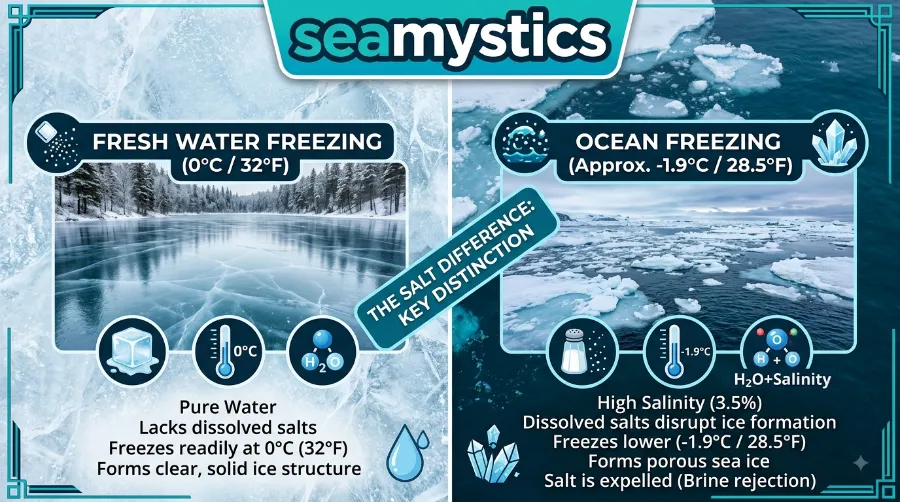
This gap might sound small, but in polar science it changes everything. A lake in Minnesota can freeze solid once air temperature dips near 0°C. The Arctic Ocean, on the other hand, needs sustained cold well past that point before ice even starts to form on the surface.
How Salt Changes Seawater Freezing Temperature
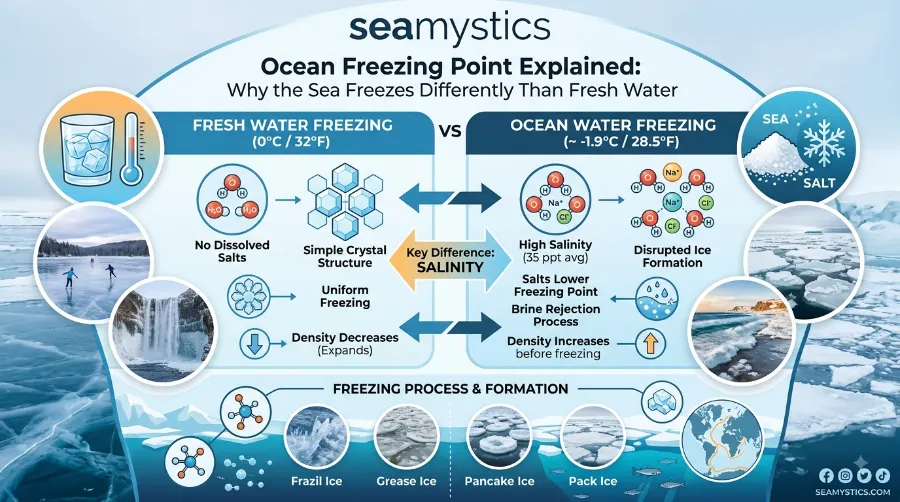
Salt molecules interfere with the way water molecules line up into the neat hexagonal pattern that makes ice. Fresh water molecules bond easily in cold conditions because nothing stands in their way. Seawater freezing temperature drops because dissolved sodium and chloride ions physically block that bonding process, forcing the water to get colder before ice crystals can lock into place.
How Much Water Is Actually in the Ocean?
Scientists at West Texas A&M University explain this using basic chemistry: dissolved salts lower the freezing point of any solution, and seawater is simply a very large, very salty solution. The more concentrated the salt, the further the freezing point drops. Below is a simple table showing how salinity and freezing temperature move together.
| Salinity (parts per thousand) | Approximate Freezing Point |
|---|---|
| 0 ppt (fresh water) | 0°C (32°F) |
| 10 ppt | -0.5°C (31.1°F) |
| 20 ppt | -1.08°C (30°F) |
| 24.7 ppt | -1.33°C (29.6°F) |
| 30 ppt | -1.63°C (29.1°F) |
| 35 ppt (typical seawater) | -1.9°C (28.6°F) |
The chart above this section shows that same relationship: as salinity climbs, the freezing point drops in a steady, almost straight line. Nothing dramatic happens, just a slow, steady chemical push against freezing.
Why the Ocean Doesn’t Freeze Like a Lake
A calm pond can turn to ice overnight because still water loses heat quickly and has nothing standing in the way of crystal formation. The open ocean plays by different rules entirely. Even after seawater cools below its freezing threshold, wind, waves, and deep currents keep mixing warmer water up from below, which delays ice formation for weeks or even months in some regions.
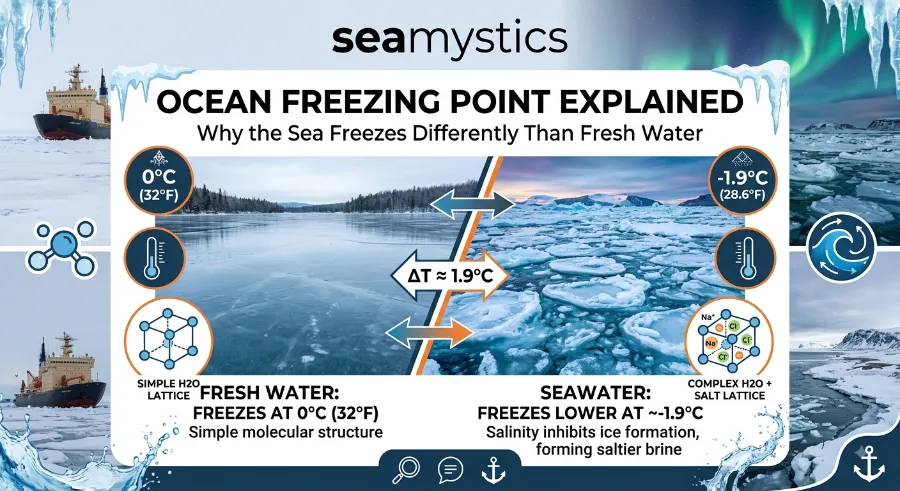
Ocean Freezing Point Explained Why the Sea Freezes Differently Than Fresh Water
This is one of the biggest reasons people ask why the ocean doesn’t freeze the same way a backyard pond does. It is not just about temperature. It is about motion, depth, and the way salt water actually gets denser as it cools, unlike fresh water, which becomes less dense near freezing.
Salt Water Freezing Science: Density and Sinking
Here is where salt water freezing science gets genuinely interesting. Fresh water reaches its maximum density at about 4°C, then becomes lighter as it approaches 0°C, which is why ice floats on top of lakes. Seawater, however, keeps getting denser as it cools all the way down to its freezing point.
Because of that, cold surface seawater sinks instead of forming a stable frozen layer right away. Warmer water rises to take its place, and the whole process has to repeat across the entire water column before the surface can finally hold onto its ice. This vertical churn is a major reason polar seas resist freezing far longer than shallow lakes or rivers.
Underwater Sound Travel How Sound Moves Through the Ocean Compared to Air
For readers curious about how depth and force interact underwater, our guide on ocean pressure explained breaks down how pressure changes with depth and why it also plays a small supporting role in lowering the freezing threshold in the deep sea.
The Role of Currents and Wind
Ocean currents move heat around the planet like a slow conveyor belt. Warm currents from the equator travel toward the poles, carrying enough heat to keep some polar waters liquid even in brutal winter air temperatures. Wind adds another layer of disruption by constantly breaking up any thin ice skin that tries to form.
How Scientists Measure Ocean Depth Today
A few real numbers make this clearer. Surface seawater near Norway’s coast, warmed by the Gulf Stream, regularly sits several degrees above freezing even in January, while nearby fjords protected from that current ice over completely. Location, current strength, and wind exposure often matter just as much as raw air temperature.
What Causes Red Tide The Science Behind Toxic Algae Blooms
How Ocean Ice Formation Actually Happens
Ocean ice formation is a slower, messier process than freshwater freezing, and it happens in distinct stages. Because salt gets pushed out of the forming ice crystals, the water directly beneath the new ice becomes saltier and denser, which briefly resists further freezing before conditions catch up.
Here is a simplified breakdown of the process, step by step:
- Surface seawater cools steadily as air temperature drops, losing heat to the atmosphere.
- Once the water reaches roughly -1.8°C, tiny ice crystals called frazil ice begin forming in the top few centimeters.
- These crystals clump together into a slushy layer known as grease ice, which gives the surface a dull, matte look.
- Wind and wave action can break grease ice into small round shapes called pancake ice.
- If cold conditions continue without much wave disturbance, the pancakes freeze together into a solid, continuous ice sheet.
- Salt gets rejected during this process and drains into pockets called brine channels, leaving the ice itself far less salty than the water it came from.
Brine Rejection and Why Old Sea Ice Is Nearly Fresh
Brine rejection is one of the more surprising parts of this story. As ice crystals form, they push salt out because the crystal structure simply cannot hold onto it. That rejected salt sinks into the surrounding water, making it saltier and denser, which then sinks toward the ocean floor and helps drive deep ocean circulation.
Over time, trapped brine pockets inside young sea ice slowly drain out through tiny channels. This is why researchers and Arctic explorers have long noted that ice more than a year old is safe to melt and drink, since most of its original salt content has already escaped. The Marine and Lake Conservation Alliance covers this brine drainage process in detail for readers who want a deeper technical walkthrough.
Real World Examples: What 2025 and 2026 Data Show
Numbers make this science feel real. Arctic sea ice reached its 2025 minimum extent of 4.60 million square kilometers on September 10, ranking as the tenth lowest recorded in the 47 year satellite record, based on figures released by the National Snow and Ice Data Center. That number sits well above the record low of 3.39 million square kilometers set back in 2012, but it still confirms a long pattern of thinner, later, and more fragile ice cover across the last two decades.
Winter tells a similar story. The 2025 to 2026 Arctic maximum extent reached only 14.53 million square kilometers in early March, ranking as the second lowest winter maximum since consistent tracking began in 2006. Meanwhile, on the Antarctic side, sea ice hit its 2025 maximum extent of about 17.81 million square kilometers, the third lowest on record.
How Light Behaves Underwater The Science of Ocean Color Zones
The bar chart above shows how Arctic minimum extent has shifted over the last five years. The extent bounces year to year because of wind, storms, and short term weather, yet it has stayed within a fairly narrow low band since 2007. This matters for anyone tracking marine ecosystems, since sea ice cover directly affects light penetration and, in turn, the oxygen producing plankton blooms we cover in our guide to ocean oxygen production.
Regional stories add texture too. In New England, coastal ponds and shallow bays that had gone several winters with little ice cover saw a noticeable return of solid ice in early 2025, a shift that Maine Audubon documented alongside its effects on local wildlife and shoreline habitats. Small regional swings like this remind us that global averages hide a lot of local variation.
A Firsthand Look From the Field
During a research rotation aboard a polar survey vessel in the Chukchi Sea a few winters ago, our team recorded surface water sitting at -1.7°C for nearly three straight weeks before any stable ice sheet formed. Air temperature had already dropped below -20°C, yet the water stubbornly stayed liquid because storm systems kept churning the top thirty meters of the water column. That gap between air temperature and actual freezing conditions is something textbooks mention briefly, but experiencing it firsthand, watching slush form and then get torn apart by wind within hours, makes the science stick in a way no chart can fully capture.
Fishing crews working out of Norwegian and Alaskan ports report a similar pattern nearly every season. Boats can operate in open water well into what should be deep winter, simply because current strength and wind exposure delay ocean ice formation along their usual routes. Local knowledge like this often lines up closely with satellite data, which is reassuring for anyone building forecasts around both sources.
Why Freezing Behavior Matters for Coastal Life and Climate
Sea ice does more than look dramatic in photographs. It reflects sunlight back into space, which helps regulate global temperature, and it creates a physical platform that seals, polar bears, and countless seabirds depend on for survival. When the ocean freezing point shifts due to changing salinity or warming currents, the timing and thickness of that ice shifts too, and those changes ripple through entire food webs.
Fishing industries across the United States and Europe also track these patterns closely. Shipping lanes through the Arctic, insurance calculations for coastal infrastructure, and even offshore wind farm planning all depend on knowing when and where ocean water is likely to freeze. Because seawater freezing temperature responds to both salt content and heat transport, small regional shifts can mean the difference between a port staying open or shutting down for the season.
- Reduced sea ice extent lowers the reflectivity of the polar surface, allowing more heat absorption.
- Thinner ice breaks apart more easily under storm activity, accelerating melt in following seasons.
- Changing salinity from melting glaciers can locally alter the freezing threshold, creating patchy ice conditions.
- Coastal communities from Maine to Norway plan fishing and shipping schedules around these seasonal freeze patterns.
Frequently Asked Questions
What temperature does the ocean freeze at?
Typical seawater with a salinity of 35 parts per thousand freezes at about -1.8°C, or 28.8°F. Less salty coastal water freezes at a slightly warmer temperature, while extremely salty water in enclosed seas can stay liquid even colder.
Why is seawater freezing temperature lower than fresh water?
Dissolved salt ions get in the way of water molecules bonding into ice crystals, so the water has to drop further below zero before freezing can begin. This is a basic property of any solution, not something unique to the ocean.
Does every part of the ocean freeze at the same temperature?
No, and this surprises a lot of people. Salinity varies by region, so the Baltic Sea, which is much less salty than the open Atlantic, freezes at a noticeably warmer temperature than water near Antarctica.
Can the entire ocean ever freeze solid?
Not under current conditions. Constant mixing from currents, wind, and heat transport from warmer regions keeps most of the ocean liquid year round, with ice forming only in the coldest surface layers near the poles.
How does climate change affect ocean ice formation?
Warmer air and water temperatures delay the start of freezing each year and speed up melting in spring, which shortens the overall ice season. Melting glaciers can also freshen nearby surface water, subtly shifting the local freezing point in either direction depending on the region.
Final Thoughts
The ocean freezing point is not a single fixed number carved in stone. It shifts with salinity, moves with currents, and responds to decades long climate patterns, yet it always stays colder than the freezing point most people learned about in a basic science class. Once you understand the roles that salt, density, and constant water movement play, the whole idea of why the sea resists freezing longer than a lake stops feeling mysterious and starts feeling like straightforward chemistry in action. For readers who want to keep exploring how the ocean works beneath the surface, our full collection of marine science guides over at Sea Mystics covers everything from pressure to plankton in plain, approachable language.
References
- National Oceanic and Atmospheric Administration, Sea Water
- National Snow and Ice Data Center, 2025 Arctic Sea Ice Minimum Analysis
- National Snow and Ice Data Center, Arctic Sea Ice Minimum and Maximum Extents 2025 to 2026
- Marine and Lake Conservation Alliance, Why Does the Ocean Freeze
- West Texas A&M University, Why Don’t the Oceans Freeze
- Maine Audubon, Sea Ice Is Back