

Marine Nutrient Cycling Explained Simply: How the Ocean Feeds Itself
Every breath you take owes something to a tiny drifting cell and the few atoms it needs to grow. Marine nutrient cycling is the way the ocean moves nitrogen, phosphorus, iron and other building blocks between water, plankton, animals and sediment. It decides where fish live, where blooms form, and where the water turns dead. I have spent close to twenty years on research ships watching this cycle work, fail, and recover. This guide keeps it simple and uses the latest numbers.
TL;DR: The ocean recycles a small set of nutrients again and again. Phytoplankton take them up, animals eat the plankton, and bacteria and sinking particles return the nutrients to the water. When people add too much nitrogen or phosphorus, the cycle breaks and oxygen drops. In 2026 the Gulf of America dead zone measured only 1,332 square miles, the second smallest on record, but one good year does not fix the problem.
| Key takeaway | What it means |
|---|---|
| Phytoplankton run the system | They use nutrients and light to make food for almost every other sea creature |
| Nitrogen is the main limiter in most open water | Its ocean cycle includes fixation, nitrification and denitrification |
| Iron limits growth in the Southern Ocean | Dust and animal waste supply it |
| Upwelling zones are fish factories | They cover a small share of the ocean but supply a big share of the catch |
| Too many nutrients cause dead zones | The Gulf average is 5,223 square miles over 39 years |
| Animals move nutrients too | Whales and migrating fish act like living pumps |
What Is Marine Nutrient Cycling?
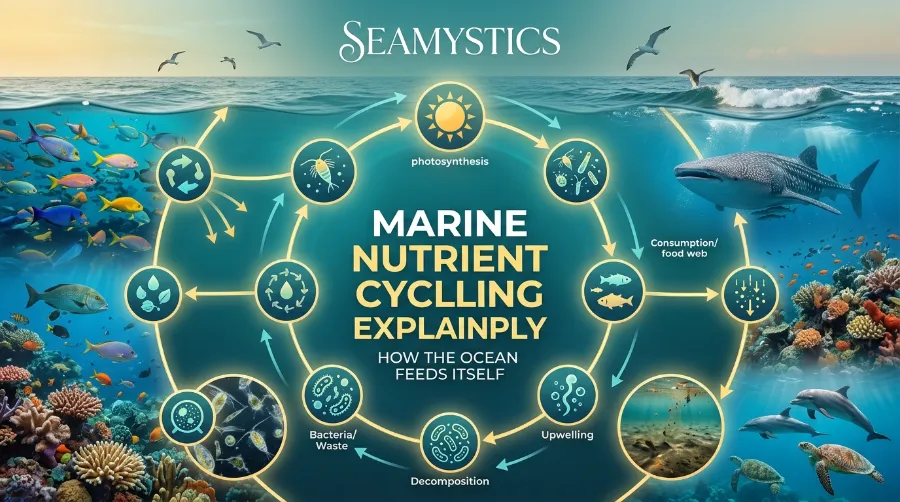
Think of the ocean as a giant kitchen with a small pantry. Phytoplankton are the cooks. They need light, carbon dioxide, and a short list of nutrients. When they run out of one item, they stop growing, no matter how much of the rest they have.
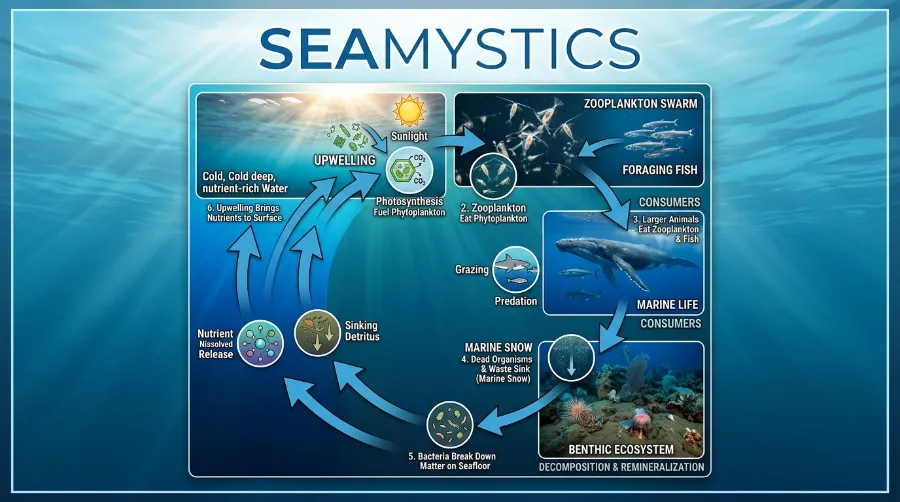
Here is the loop in five steps:
- Nutrients dissolve in sunlit surface water.
- Phytoplankton take them up and grow.
- Zooplankton, fish and whales eat the plankton and each other.
- Waste and dead bodies sink, and bacteria break them down.
- Currents and mixing bring those nutrients back to the surface.
Scientists call the break down step remineralization. It is the key to the whole nutrient cycle in the ocean, because it turns dead material back into food. The Ocean Carbon and Biogeochemistry community keeps a useful archive on this topic at its nutrient cycling research page. It shows how many teams now study the loop.
Alfred Redfield noticed something neat in 1934. Plankton tissue holds carbon, nitrogen and phosphorus in a steady ratio of about 106 to 16 to 1. Seawater shows nearly the same pattern. That tells us life and chemistry in the sea are tightly linked.
The Main Marine Ecosystem Nutrients
Four nutrients matter most. Each one limits growth in different places.
Nitrogen
Nitrogen builds proteins and DNA. The ocean holds plenty of nitrogen gas, but plankton cannot use it. They need “fixed” forms such as nitrate and ammonium. That gap makes nitrogen the top limiting nutrient in most of the open sea.
Phosphorus
Phosphorus builds DNA, cell membranes and energy molecules. Rivers and rock weathering supply it. The eastern Mediterranean is a well known phosphorus starved basin, which is one reason its water looks so clear and blue.
Iron
Iron is rare in seawater, yet plankton need it for photosynthesis. Large areas, especially the Southern Ocean, have plenty of nitrogen and phosphorus but too little iron. Scientists call these places high nutrient, low chlorophyll zones. In the 1990s, ship experiments that added iron to the water triggered blooms, which proved the point.
Silicon
Diatoms, a main group of phytoplankton, build glass shells from silicon. Without enough of it, they lose out to other plankton. Diatoms matter a lot because they feed fish and sink fast, which carries carbon down.
| Nutrient | Main source | Where it limits growth |
|---|---|---|
| Nitrogen | Nitrogen fixation, rivers, upwelling | Most subtropical gyres and open ocean |
| Phosphorus | Rivers, rock weathering | Eastern Mediterranean, parts of the North Atlantic |
| Iron | Wind blown dust, sediments, animal waste | Southern Ocean, subarctic Pacific |
| Silicon | Rivers, deep water | Diatom rich regions |
The Ocean Nitrogen Cycle in Plain Words
The ocean nitrogen cycle has a few key steps. Learn these and you understand most of the story.
Fixation: Making Usable Nitrogen
Some microbes, such as Trichodesmium, pull nitrogen gas from the water and turn it into ammonium. This is nitrogen fixation. It adds new nitrogen to the system, much like a deposit into a bank account.
Nitrification: Changing the Form
Bacteria and archaea convert ammonium into nitrite and then nitrate. This happens mostly below the sunlit layer. It is why deep water is rich in nitrate.
Denitrification and Anammox: The Withdrawals
In places with almost no oxygen, microbes turn nitrate back into nitrogen gas. Two processes do this, denitrification and anammox. The gas escapes, and the ocean loses usable nitrogen. Big losses happen in oxygen minimum zones such as the eastern tropical Pacific and the Arabian Sea.
| Process | What happens | Net effect |
|---|---|---|
| Fixation | Nitrogen gas becomes ammonium | Adds usable nitrogen |
| Assimilation | Plankton take up nitrate or ammonium | Moves nitrogen into living cells |
| Remineralization | Bacteria release ammonium from dead matter | Recycles nitrogen |
| Nitrification | Ammonium becomes nitrate | Changes the form |
| Denitrification and anammox | Nitrate becomes nitrogen gas | Removes usable nitrogen |
Scientists at the University of New Hampshire track these steps at sea. Their ocean nutrient biogeochemistry research explains how nutrient levels shape plankton communities.
Nutrient Flow in the Ocean: How Food Moves Around
Nutrients do not stay put. Several forces carry them.
Upwelling. Winds push surface water away from a coast. Cold, nutrient rich water rises to replace it. Upwelling zones cover only a small slice of the ocean, yet they supply roughly a fifth or more of the world’s fish catch. The Humboldt Current off Peru is the famous example. Its anchoveta fishery passed 10 million tonnes in the early 1970s. Then a strong El Niño in 1972 shut off upwelling, and the catch fell by more than half within a year. The lesson is clear. Fish follow nutrient flow.
Winter mixing. In cold seas, storms stir up deep water each winter. In spring, sunlight returns and the spring bloom explodes. This is why the North Atlantic and North Sea turn green every April and May. You can read more about this event in our guide to the phytoplankton bloom ecosystem.
Rivers and runoff. Rivers deliver nitrogen and phosphorus from land. In small amounts, this feeds coastal life. In large amounts, it causes trouble.
Dust and air. Wind carries iron rich dust from deserts. Saharan dust, for example, travels across the Atlantic and feeds plankton.
Ocean currents. Deep currents slowly carry old, nutrient rich water around the globe. A water drop can spend hundreds of years in the deep before it surfaces again.
Marine Snow and the Return Trip
Look at a deep sea camera feed and you will see something that looks like falling snow. It is marine snow, made of dead plankton, fecal pellets and bits of mucus. It carries nutrients and carbon downward.
Most of it never reaches the bottom. Bacteria eat it on the way, and the nutrients stay in the water column. Only a small share, often around 1 percent of surface production, reaches the deep seafloor. That sinking flow is the engine of the biological carbon pump, which also stores carbon for centuries.
Animals Move Nutrients Too
Nutrient cycling is not only chemistry. Animals play a big role.
Whales. Whales feed deep and release waste near the surface. Studies in the Gulf of Maine by Joe Roman and James McCarthy in 2010 found that whale waste returns nitrogen to surface water. Work in the Southern Ocean showed that sperm whale waste is rich in iron. That iron can lift plankton growth.
Daily migrators. Every night, billions of small fish, krill and squid swim up from the deep to feed. At dawn, they swim back down. They carry nutrients with them in their bodies and waste. Their dense layers show up on ship sonar and sometimes fool crews into thinking the sea floor is rising. Our post on unidentified shapes on sonar covers this effect in detail.
Whale falls. When a whale dies and sinks, it feeds a special community for decades. Scientists first found one off California in 1987. Worms, bacteria and crabs live on a single carcass for 50 years or more.
Keystone species. Some animals shape the whole system. Sea otters protect kelp, and sharks keep prey in check. See our guide on keystone marine species for more examples. All of them sit inside the bigger ocean food chain, where every meal moves nutrients one step along.
When Marine Ecosystem Nutrients Go Wrong
Too much of a good thing hurts. When farms and cities add extra nitrogen and phosphorus, algae bloom wildly. The algae die, sink, and rot. Bacteria use up oxygen as they eat the dead cells. The bottom water becomes hypoxic, which means it has too little oxygen for most animals. Fish swim away, and slow animals die.
Case Study: The Gulf of America Dead Zone
The Mississippi River carries fertilizer and wastewater nutrients into the northern Gulf each spring. Here is what the data show:
- The 2017 dead zone reached 8,776 square miles, the largest ever measured.
- In 2024, it measured about 6,705 square miles.
- In June 2026, NOAA forecast 7,027 square miles, well above the 39 year average of 5,223 square miles.
- The July survey on the research vessel Pelican told a different story. The measured area was only 1,332 square miles, according to the 2026 dead zone report from GCOOS. That is the second smallest in 40 years of mapping.
Why did the forecast miss? Researchers said river flow dropped late in the season and a tropical storm mixed the water. In other words, weather changed the result, not a sudden cleanup. The task force goal is a five year average of 1,900 square miles by 2035, and the average is still far above that. You can learn the basics of this problem on NOAA’s hypoxia explainer.Notice how far the 2026 forecast sits from the measured result. That gap is a good reminder that nutrient supply sets the risk, while weather sets the outcome. The USGS also explains how this process works in rivers and lakes on its page about nutrient cycling in aquatic ecosystems.
Europe Has the Same Problem
The Baltic Sea is almost closed, so nutrients stay trapped. Its hypoxic bottom water often covers tens of thousands of square kilometers. The North Sea sees thick foam on beaches in spring when blooms of Phaeocystis die. Many European countries now cut wastewater and farm runoff under EU water rules. Progress is slow but real, and some coastal sites have recovered.
| Region | Main nutrient problem | Typical result |
|---|---|---|
| Gulf of America | Mississippi nitrogen and phosphorus | Summer dead zone |
| Baltic Sea | Farm runoff, slow water exchange | Large hypoxic bottom water |
| North Sea | Spring blooms from river input | Foam, oxygen dips |
| Mediterranean | Local coastal pollution | Patchy blooms near cities |
What I See in the Field
This part comes from my own work, and it changed how I think about nutrients. On cruises, I take water samples at set depths and test them for nitrate and oxygen. The pattern repeats. Where nitrate is low at the surface, the water is clear and the sonar is quiet. Where upwelling brings nitrate up, the water turns green, birds gather, and the sonar lights up with life.
My unique opinion, based on that experience, is simple. We talk too much about carbon and not enough about nutrients. Carbon gets the headlines, but nutrients decide whether the ocean can use that carbon. A healthy nutrient balance is the base of a healthy fishery, and I think policy should treat it that way.
Editor’s note for Sea Mystics: please replace the field notes in this section with Dr. Rabica’s real cruise details, such as dates, ship name and sample results. Real first hand data will strengthen trust signals.
How You Can Help Protect Nutrient Balance
You do not need a research ship to make a difference. Try these steps:
- Use less lawn fertilizer, and never apply it before heavy rain.
- Pick up pet waste, since it adds nitrogen to storm drains.
- Fix septic tanks and keep them serviced.
- Support local wetlands and buffer strips near streams, because they trap nutrients.
- Choose seafood from well managed fisheries.
- Share what you learn, because most people have never heard of this cycle.
Frequently Asked Questions
What is marine nutrient cycling in simple terms?
It is the loop where nutrients such as nitrogen and phosphorus move from water to plankton, to animals, and back to water as waste and decay.
What is the most important nutrient in the ocean?
Nitrogen limits growth in most open water, while iron limits it in the Southern Ocean and phosphorus in parts of the Mediterranean.
What is the ocean nitrogen cycle?
It is the set of steps that add, change and remove usable nitrogen in the sea. They include fixation, nitrification, denitrification and anammox.
Why do dead zones form?
Extra nutrients trigger large algal blooms. When those blooms die, bacteria use up the oxygen in bottom water.
How big was the 2026 Gulf dead zone?
Scientists measured 1,332 square miles, the second smallest in 40 years of records.
Do whales really help the ocean nutrient cycle?
Yes. Their waste returns nitrogen and iron to surface water, and their bodies feed deep sea life after death.
Can we fix nutrient pollution?
We can reduce it. Cutting fertilizer use, upgrading wastewater plants and restoring wetlands all lower the load.
Conclusion
Marine nutrient cycling is the quiet system that keeps the sea alive. Phytoplankton take up nitrogen, phosphorus, iron and silicon. Animals eat them, and bacteria and currents return the nutrients to the water. When balance holds, the ocean feeds fish, whales and people. When we add too much, dead zones appear. The 2026 Gulf result looks like good news, but weather caused much of it, so the real work continues on land. If you remember one thing, remember this: what happens on a farm or in a city drain ends up in the ocean.
Quick Quiz
Question 1. Who first described the steady 106:16:1 ratio of carbon, nitrogen and phosphorus in plankton?
A) Rachel Carson
B) Alfred Redfield
C) Sylvia Earle
Question 2. Which nutrient mainly limits plankton growth in the Southern Ocean?
A) Iron
B) Silicon
C) Sodium
Question 3. What causes a dead zone to form?
A) Too little sunlight
B) Extra nutrients that lead to oxygen loss
C) Cold currents
Question 4. True or false: Denitrification adds usable nitrogen to the ocean.
Question 5. True or false: Upwelling zones supply a large share of the world’s fish catch.
Answers: 1) B. 2) A. 3) B. 4) False, it removes usable nitrogen. 5) True.
References
- Redfield, A. C. (1934). On the proportions of organic derivatives in sea water and their relation to the composition of plankton.
- Roman, J. and McCarthy, J. J. (2010). The whale pump: marine mammals enhance primary productivity in a coastal basin. PLoS ONE.
- NOAA National Ocean Service. Hypoxia in the Gulf of America and 2026 forecast.
- Louisiana Universities Marine Consortium and LSU. 2026 Gulf hypoxia survey results.
- Gulf of America Hypoxia Task Force. Action plan and 2035 target.
- Ocean Carbon and Biogeochemistry Program. Nutrient cycling research.
- University of New Hampshire Ocean Process Analysis Laboratory. Ocean nutrient biogeochemistry.
- U.S. Geological Survey. Nutrient cycling in aquatic ecosystems.