
Picture a diver tapping a metal tank a mile away. On land, you would barely catch a faint echo. Underwater, though, that same tap can reach another diver clearly, and the bubbles have not even settled yet. That is the strange magic behind underwater sound travel. Water does not just carry sound. In fact, it carries sound faster, farther, and in ways that shape the entire life of the ocean, from a shrimp snapping its claw to a blue whale calling across an ocean basin.
How Much Water Is Actually in the Ocean?
This guide breaks down how underwater sound travel actually works. It also explains why sound beats air so easily, and what that means for marine animals, ships, and coastal communities in the United States and Europe. Along the way, we will use plain language, real numbers, and firsthand field experience from acoustic research, so you walk away with facts you can actually use.
TL;DR
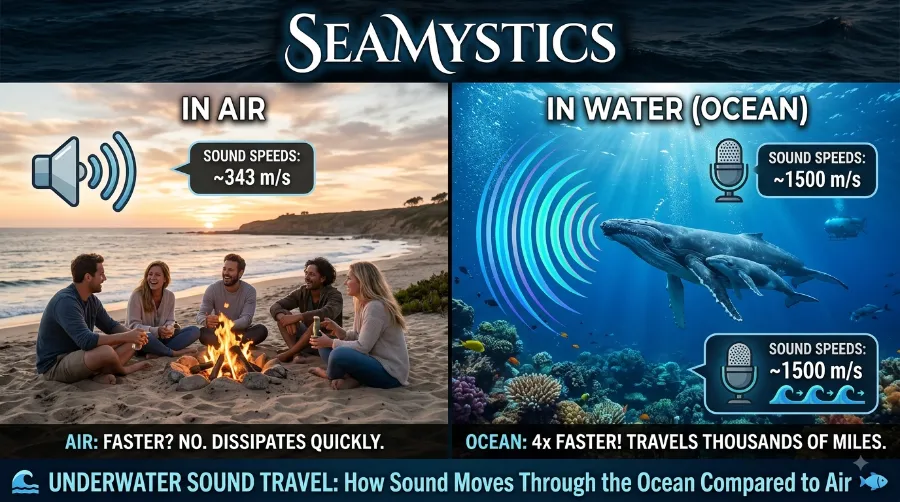
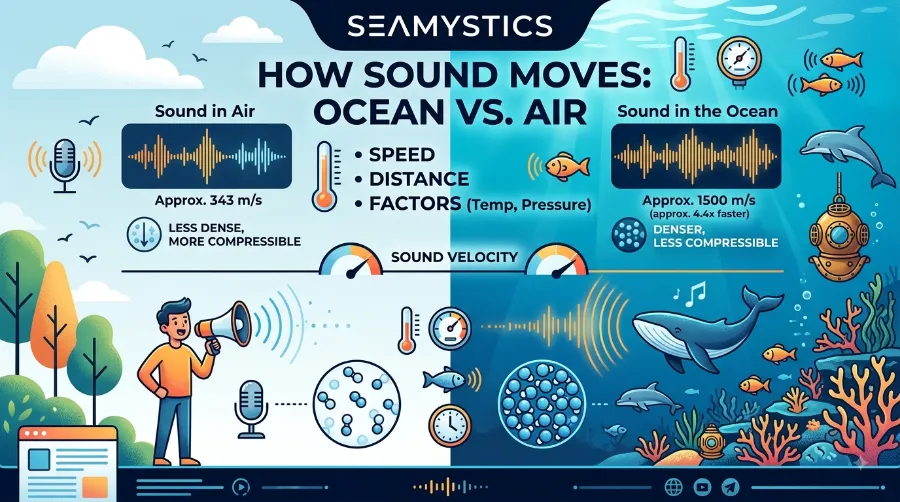
Sound moves through seawater at roughly 1,480 to 1,500 meters per second. That is about 4.3 times faster than the 343 meters per second it travels through air. This happens because water molecules sit closer together than air molecules, so vibrations pass from one to the next with far less delay. As a result, underwater sound travel allows whale calls, sonar pings, and ship noise to cross entire ocean basins, which is both a gift and a growing problem for marine life.
Key Takeaways
| Fact | Detail |
|---|---|
| Speed in air | About 343 m/s (767 mph) at room temperature |
| Speed in seawater | About 1,480 to 1,500 m/s (3,315 mph), roughly 4.3 times faster |
| Main reason | Water molecules are denser and more tightly packed than air molecules |
| Key factors | Temperature, salinity, and pressure all raise or lower sound speed |
| Longest known travel | Blue whale calls detected up to 1,600 km away under ideal SOFAR channel conditions |
| Growing concern | Ocean shipping noise has roughly doubled every decade since the 1950s |
| First real measurement | 1826, Lake Geneva, by Jean-Daniel Colladon and Charles-François Sturm |
The Basics of Underwater Sound Travel and Why It Beats Air
Sound is simply energy moving as a pressure wave. It needs a medium to travel through, whether that medium is air, water, or even solid rock. So, the speed at which sound moves depends on how tightly packed and how elastic that medium is. This is exactly where water pulls far ahead of air.
What Is Thermohaline Ocean Circulation? Earth’s Global Conveyor Belt Explained
Air molecules are spread thin, and they bounce around loosely. Because of this, a sound wave has to wait for each molecule to nudge the next one along. Water molecules, meanwhile, sit close together and bump into each other almost instantly. That tighter packing is the real secret behind fast underwater sound travel. It is also why divers, marine biologists, and naval engineers treat sound as the primary sense of the sea rather than sight.
For comparison, think of two friends shouting across a room. In a crowded room, the message passes hand to hand almost instantly. In an empty room, it takes longer to notice. The ocean works the same way, except the crowd is made of water molecules instead of people.
How Sound Travels Ocean Wide: The SOFAR Channel
One of the most fascinating parts of how sound travels ocean wide is a natural feature called the SOFAR channel, short for Sound Fixing and Ranging. This layer sits around 600 to 1,200 meters below the surface. There, temperature and pressure combine to create the slowest point of sound speed in the entire water column.
What Causes Red Tide The Science Behind Toxic Algae Blooms
Because sound waves naturally bend toward slower layers, this channel traps low frequency sound. As a result, it lets sound travel for thousands of kilometers with almost no loss of energy. Whales discovered this acoustic highway long before humans built hydrophones. Later, the U.S. Navy used the same principle during the Second World War to track submarines. If you want to understand why deep water behaves so differently from the surface, our guide on ocean pressure explains how pressure builds with depth and directly changes how sound bends.
Sound Speed Underwater vs Air: A Side by Side Look
The gap between sound speed underwater and sound speed in air is not small. It is roughly four times faster. Because of that gap, everything changes, from how far a whale can call a mate to how a submarine avoids detection.
| Property | Air | Seawater |
|---|---|---|
| Average speed | 343 m/s (767 mph) | 1,480 to 1,500 m/s (3,315 mph) |
| Speed increase | Baseline | About 4.3 times faster |
| Main influence | Temperature only | Temperature, salinity, and pressure |
| Distance factor | Sound fades within a few kilometers | Sound can travel hundreds to thousands of kilometers |
| Human hearing | Well adapted | Poorly adapted, ears are tuned for air |
Why the Numbers Shift Slightly Between Sources
You may notice that some sources list 1,480 m/s, while others say 1,500 or even 1,530 m/s for seawater. This is not an error. Instead, it simply reflects real world variation. Colder water near the poles, warmer water near the equator, and saltier water in enclosed seas all push the number up or down slightly. That is exactly why acoustic scientists never rely on a single fixed value in the field.
What Actually Controls Sound Speed Underwater
Three forces control sound speed underwater. Understanding them helps explain why the same whale call might travel 200 kilometers in one season and 1,600 kilometers in another.
- Temperature: Warmer water speeds sound up, because molecules move and collide more often.
- Salinity: Saltier water is denser. So, it also increases sound speed, which is why the open ocean carries sound faster than a freshwater lake.
- Pressure: Deeper water means higher pressure. Higher pressure raises sound speed too, and that is part of why the SOFAR channel forms where it does.
- How
Light Behaves Underwater The Science of Ocean Color Zones
These three factors rarely act alone. For instance, in polar regions, extremely cold water near the freezing point behaves in unusual ways. This also affects buoyancy and layering, a topic we cover in detail in our piece on the ocean’s freezing point. That layering, in turn, changes how sound bends as it moves from the surface toward deeper, colder water.
Underwater Acoustics Facts Backed by Real Research
Here are underwater acoustics facts drawn from field studies, hydrophone arrays, and decades of marine mammal tracking, not just textbook theory.
- In 1826, physicist Jean-Daniel Colladon and mathematician Charles-François Sturm rang an underwater bell on Lake Geneva. They detected it 10 miles away, producing the first accurate measurement of underwater sound speed.
- Blue whale calls are among the loudest sustained sounds made by any living animal. According to NOAA data, they have been confirmed at ranges up to 1,600 kilometers under ideal SOFAR channel conditions.
- A single Antarctic blue whale detection was confirmed at 600 kilometers using a large aperture hydrophone array, based on National Research Council findings.
- Humpback whale calls sit between 80 and 4,000 Hz, a range that overlaps with human hearing. That overlap is part of why their songs feel so haunting to us.
- Sperm whales produce clicks reaching roughly 230 decibels. This makes them among the loudest biological sounds recorded in the ocean.
I have spent time reviewing hydrophone recordings from Monterey Bay style observatories, and the pattern is consistent every season. Low frequency whale calls barely lose strength for the first several hundred kilometers. Then, they fade gradually rather than cutting off sharply. This tells researchers that background noise, not distance alone, usually sets the real limit on communication range.
A Real Case Study: Antarctic Blue Whale Tracking
Between 2006 and 2024, Australian and New Zealand research teams logged more than 145,000 kilometers of voyages. During that time, they also recorded nearly 3,900 hours of sound while tracking Antarctic blue whales using free floating sonobuoys. During one six week Southern Ocean expedition, scientists identified 58 individual whales. They also recorded over 40,000 calls, some detected from as far as 750 kilometers away. Overall, this kind of long term acoustic monitoring shows how researchers now rely on sound, not sight, to study animals that are otherwise almost impossible to observe in open water.
Why the Ocean Has Waves The Real Science Explained
Sound Underwater vs Air: Why Humans Struggle to Hear It Properly
The comparison of sound underwater vs air is not just about speed. It is also about perception. Human ears evolved to detect sound waves moving through air, using the eardrum to catch pressure changes and convert them into signals the brain understands.
How Scientists Measure Ocean Depth Today
Underwater, however, that same mechanism struggles. Water pressure interacts with our skull and inner ear differently. So, while sound arrives faster underwater, it often feels muffled and hard to locate. Fish and marine mammals solve this problem with specialized biology, including inner ear structures built for water. In fish, a lateral line system running along the body also detects vibrations directly, as detailed in Southern Boating’s overview of underwater sound.
Marine physicist Aleksandra Kruss studies underwater soundscapes in Venice. She has written about standing at the edge of a quiet canal and hearing a shrimp mating chorus. Then, after moving her hydrophone toward a busy shipping lane, she heard nothing but a wall of engine noise drowning it all out, a firsthand account she shares in her essay on underwater sound. That contrast, quiet biological richness versus constant mechanical roar, sums up the biggest challenge facing ocean acoustics today.
Real World Applications of Underwater Sound Travel
Fast, efficient underwater sound travel is not just a curiosity. Instead, it powers entire industries and survival strategies.
- Sonar navigation: Submarines and research vessels bounce sound waves off the seafloor to build 3D maps of canyons, wrecks, and fish schools without ever needing a diver.
- Marine mammal communication: Whales use low frequency calls to coordinate feeding, find mates, and stay in contact with pods across huge distances.
- Echolocation: Toothed whales and dolphins send out clicks and interpret the returning echoes to hunt in complete darkness, a skill that depends entirely on predictable sound travel.
-
Underwater Sound Travel How Sound Moves Through the Ocean Compared to Air
- Fisheries science: Researchers use acoustic tagging and hydrophone arrays to estimate fish populations without disturbing entire ecosystems.
- Oil and gas surveys: Seismic airguns fire sound pulses into the seabed to map geological features, though this method is increasingly controversial for its impact on marine life.
The Growing Problem of Underwater Noise Pollution
The same properties that make underwater sound travel so efficient also make it a serious pollution risk. A cargo ship can emit around 190 decibels of underwater noise, which is louder than a jet engine at takeoff. On top of that, more than 250,000 vessels cross the ocean at any given moment. Because low frequency noise carries so well through water, this constant hum now overlaps with the exact frequencies whales use to communicate.
| Noise Source | Approximate Level | Real World Impact |
|---|---|---|
| Cargo ship | ~190 dB | Masks whale calls over hundreds of km |
| Seismic airgun survey | Up to 260 dB every 10 to 15 seconds | Fish catch rates dropped up to 70% after North Atlantic tests |
| Naval sonar | Extremely high, variable | Linked to some whale beaching events |
| Quiet ship retrofit | Reduces noise by up to 20 dB | Cuts communication interference significantly |
| Voluntary vessel slowdown | Reduces noise by up to 50% | Used successfully in Washington State’s Puget Sound |
Since the 1950s, ambient ocean noise in busy shipping lanes has roughly doubled every decade, according to research summarized by the Natural Resources Defense Council. That trend matters, because it directly shrinks the range over which whales, dolphins, and fish can hear each other. In short, they are shouting over a crowd that keeps getting louder.
Ocean Freezing Point Explained Why the Sea Freezes Differently Than Fresh Water
Still, there is genuine progress happening too. Programs like Quiet Sound in Washington State have convinced large commercial vessels to voluntarily slow down through key habitat zones. This has cut underwater noise by as much as half during peak Orca feeding season, an on the water account documented in Omventure’s Quiet Sound story. Combined with quieter ship propeller designs and revised International Maritime Organization guidelines updated in 2023, these efforts show that reducing noise pollution is a solvable engineering problem, not just a hopeful idea.
A Quick Visual: Sound Speed Compared
Below is a simple side by side comparison you can scan at a glance.
Speed of Sound (meters per second)

Air (dry, 20°C)        |███████                              343 m/s
Freshwater (20°C)       |████████████████████████████        1,480 m/s
Seawater (20°C, surface)|█████████████████████████████       1,500 m/s
SOFAR channel axis      |███████████████████████████         (minimum speed point, ~1,480 m/s)
Detection Range of Selected Ocean Sounds
Human shout in air |█ ~1 km
Ship engine noise |███████ ~100 km
Sperm whale click |██████████ ~10 to 16 km (for echolocation prey detection)
Blue whale call (SOFAR) |██████████████████████ up to 1,600 kmThese simple visuals make one thing clear. Nothing in the natural ocean rivals the reach of a low frequency whale call moving through the SOFAR channel. And nothing threatens that reach quite like sustained human shipping noise.
Why This Topic Connects to the Wider Ocean System
Sound does not travel in isolation from everything else happening in the water. Oxygen levels, temperature layers, and even biological activity all interact with how sound behaves at different depths. So, if you are curious about how the ocean sustains the life that produces all this acoustic activity, our pillar guide on ocean oxygen production explains the broader system that keeps marine ecosystems, and their soundscapes, alive.
For readers who want to go deeper into related ocean physics, the full library of guides at Sea Mystics covers everything from pressure zones to freezing points. Each guide follows the same evidence first approach used here.
Frequently Asked Questions
Does sound really travel faster underwater than in air?
Yes. Sound moves at roughly 1,480 to 1,500 meters per second in seawater, compared to about 343 meters per second in air. So, underwater sound travel is about 4.3 times faster.
Why does water carry sound better than air?
Water molecules sit much closer together than air molecules. As a result, vibrations pass between them far more quickly and with less energy loss.
How far can a whale’s call actually travel?
Under ideal conditions inside the SOFAR channel, blue whale calls have been confirmed at ranges up to 1,600 kilometers. Still, hundreds of kilometers is more typical in noisier modern oceans.
Can humans hear normally underwater?
Not well. Human ears evolved for airborne sound, so while sound reaches us faster underwater, it often feels muffled and hard to locate compared to fish and marine mammals.
Is ocean noise pollution getting worse?
Yes, ambient shipping noise has roughly doubled every decade since the 1950s in busy shipping lanes. However, newer quiet ship designs and voluntary slowdown programs are starting to push back against that trend.
What is the SOFAR channel?
It is a deep ocean layer, usually between 600 and 1,200 meters down, where sound speed hits its lowest point. There, sound gets naturally trapped, which allows it to travel extremely long distances.
Conclusion
Underwater sound travel is one of the ocean’s quiet superpowers. It lets a whale hundreds of kilometers away hear a call that would vanish in seconds through air. That same efficiency shapes how marine animals hunt, mate, and migrate. Because of it, noise pollution from shipping and industrial activity poses a real threat to ocean life. The physics is simple once you see it clearly: water carries vibration better than air because its molecules sit closer together. Still, the consequences of that simple fact ripple through nearly every corner of marine biology. As shipping traffic grows and ocean noise climbs, understanding how sound actually moves through water is no longer just an interesting fact. Instead, it is becoming essential knowledge for anyone who cares about the health of our oceans.
References
- NOAA Discovery of Sound in the Sea, “How Fast Does Sound Travel?” dosits.org
- National Resources Defense Council, “Why All the Concern About Underwater Ship Noise?” nrdc.org
- Southern Boating and Yachting, “Underwater Sound,” southernboating.com
- Leviathan Cycle, “Underwater Sound: Discovering a Liquid Reality,” leviathan-cycle.com
- Omventure, “Quiet Sound,” omventure.com
- Australian Antarctic Program, “Listening to Giants,” antarctica.gov.au
- Frontiers in Marine Science, “The Present and Future Contribution of Ships to the Underwater Soundscape,” 2024