
Stand on any beach at sunrise and you will notice something strange. The water never stops moving. Even on a still, windless morning, small ripples keep arriving on the sand like clockwork. This simple, endless motion is the heart of ocean wave science, and once you understand it, the ocean stops feeling random and starts feeling like a giant, elegant machine.
Why the Ocean Has Waves The Real Science Explained
Most people assume waves are just “wind pushing water,” and that is partly true, but it is only the beginning of the story. Wave formation science actually blends physics, weather, gravity, and even the shape of the seafloor into one continuous process. As a marine biologist who has spent years studying coastal ecosystems, I still find it remarkable how much energy, distance, and timing goes into a single wave breaking on shore.
What Causes Red Tide The Science Behind Toxic Algae Blooms
TL;DR: Ocean waves are mostly created by wind transferring energy to the water’s surface, though tides, earthquakes, and gravity from the sun and moon also play a role. Wind wave ocean facts show that wave size depends on wind speed, how long it blows, and how far it travels across open water, a concept called fetch. Understanding how waves form helps explain everything from beach erosion to hurricane forecasting.
Key Takeaways
| Factor | What It Does | Real World Example |
|---|---|---|
| Wind speed | Transfers energy to the sea surface | 25 mph winds can build waves over 6 feet in open water |
| Fetch (distance) | Longer fetch means bigger waves | North Atlantic storms with 500+ mile fetch create massive swells |
| Wind duration | Longer wind exposure builds taller waves | A 12 hour storm produces bigger waves than a 1 hour gust |
| Water depth | Shallow water forces waves to slow and rise | Waves steepen sharply near coral reefs and shorelines |
| Gravitational pull | Creates tides, a slower wave-like motion | Bay of Fundy sees tidal ranges over 50 feet |
| Seismic activity | Triggers tsunamis, a different wave type | 2011 Tōhoku earthquake generated waves over 130 feet in parts of Japan |
What Causes Ocean Waves in the First Place
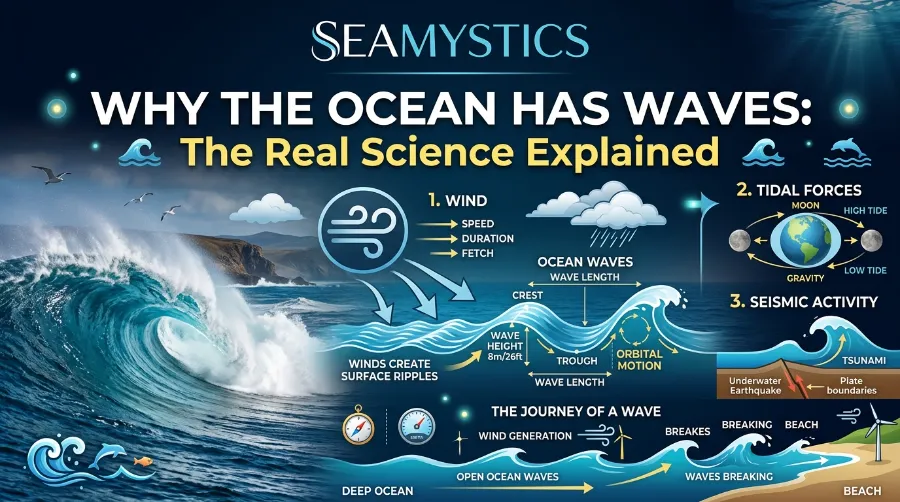
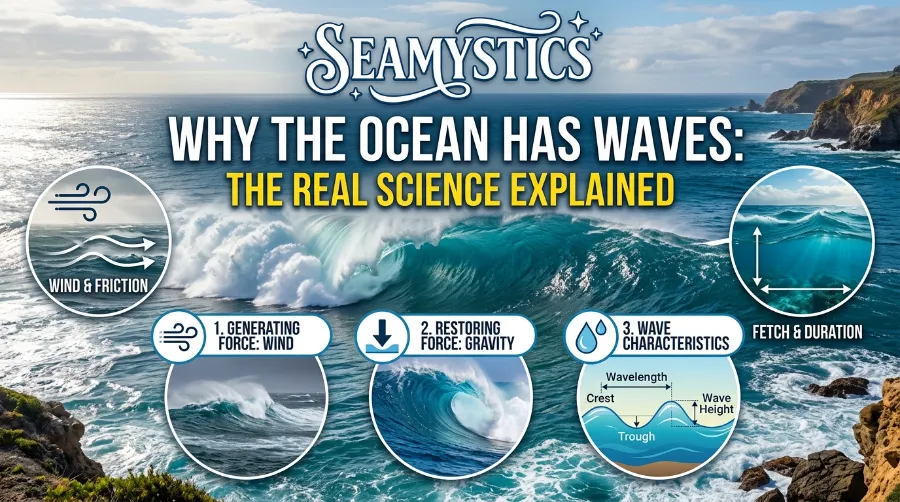
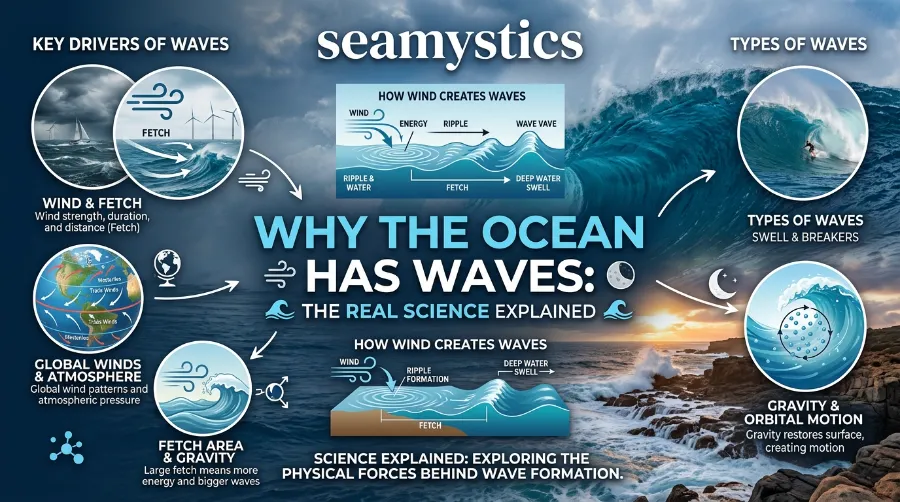
The short answer is wind, but the honest answer is a little more layered than that. Wind wave ocean facts show that when moving air passes over the sea surface, friction transfers energy from the atmosphere into the water. That energy does not disappear, it organizes itself into rhythmic ripples that grow as more wind energy piles on.
Three things decide how big those ripples eventually become.
- Wind speed, since faster wind pushes more energy into the water
- Wind duration, since longer exposure lets waves keep growing
- Fetch, the open distance wind travels across water without interruption
A gentle breeze over a small lake barely creates a ripple because the fetch is short and the wind rarely blows long enough. The open Pacific Ocean is a completely different story. Storms there can generate wind wave systems that travel thousands of miles before they ever reach a coastline, arriving as smooth, rolling swell rather than choppy chop.
How Waves Form Once Wind Energy Enters the Water
Once energy enters the sea surface, it does not move water forward in a straight line the way many people assume. Instead, individual water molecules travel in small circular orbits, passing energy to the next patch of water like a stadium wave passed hand to hand through the seats. This is why a floating buoy bobs up and down in place instead of surfing toward the beach.
How Light Behaves Underwater The Science of Ocean Color Zones
As wind continues feeding energy into this rotating motion, waves organize into what oceanographers call a “fully developed sea,” a point where wave height stabilizes because the water cannot absorb more energy at that wind speed. This detail matters for forecasting, since it explains why a hurricane with sustained 120 mph winds can generate waves taller than 40 feet, while a moderate storm tops out much lower no matter how long it blows.
Robert Ballard Discoveries The Man Who Found the Titanic
Recent research from the University of Miami’s Rosenstiel School sharpened this picture even further. Using a wind wave tank capable of simulating Category 5 hurricane conditions, researchers led by Peisen Tan measured airflow and pressure directly above the water’s surface, something long considered nearly impossible to do accurately over open ocean. Their findings show wind pressure effectively acts like fuel for waves, since higher pressure pushing on the front of a wave makes it grow taller and move faster. The team also found that once air flow separates on the sheltered side of a steep wave, older forecasting models underestimate the energy being transferred by more than 30 percent, a gap that matters enormously when predicting storm surge for coastal communities.
Wave Formation Science Beyond Wind
Wind is the dominant driver, but it is not the only one. If it were, the ocean would go completely still during calm weather, and it never does. A few other forces keep water in constant motion.
- Tides, driven by the gravitational pull of the moon and sun, create the slowest and largest wave motion on Earth. The Bay of Fundy in Canada experiences tidal ranges over 50 feet, among the most extreme on the planet.
- How
Scientists Measure Ocean Depth Today
- Seismic activity, such as underwater earthquakes or landslides, generates tsunamis. These are technically waves too, though they behave very differently from wind waves, moving at jet speed across open ocean and only rising to dangerous heights near shore.
- Ocean currents and density differences, caused by temperature and salinity variation, produce slower, deeper water movement that indirectly shapes surface wave behavior over time.
- HMS Challenger Expedition The Voyage That Founded Oceanography
If you want to see how deep water pressure and density interact with these forces, our guide on ocean pressure explained breaks down what actually happens to water molecules thousands of feet below the surface, a topic that connects closely to how wave energy dissipates with depth.
Why Some Waves Travel Thousands of Miles
Here is something that surprises most people. A wave that hits a California beach may have started as a storm near New Zealand weeks earlier. Once wind stops feeding energy into a wave system, the waves transform into swell, a smoother, more organized wave pattern that can travel enormous distances with very little energy loss.
Swell waves lose height gradually but keep their rhythm, which is why experienced surfers can track storm systems on the other side of the planet and predict, almost to the hour, when quality waves will arrive on their local coast. According to Oceana’s coverage of ocean wave research, wave sound and rhythm also influence marine life behavior, since many species rely on the predictable pattern of wave noise for navigation and communication, adding a biological layer to what looks like a purely physical process.
Wind Wave Ocean Facts That Change How You See the Beach
A few numbers make this science feel real instead of abstract.
- The tallest wave ever reliably recorded was estimated at 1,720 feet, triggered by a landslide in Lituya Bay, Alaska in 1958, technically a megatsunami rather than a wind wave
- The largest wind generated wave measured by a ship’s instruments reached 62.3 feet in the North Atlantic in 2000, recorded by the British research vessel RRS Discovery
- The 2011 Tōhoku earthquake off Japan generated tsunami waves that reached over 130 feet in some coastal areas, according to post disaster surveys
- Standard ocean swell in open water typically ranges between 3 and 12 feet, depending on distant storm activity
These numbers highlight something important about wave formation science. Wind waves and tsunami waves are physically different phenomena that happen to share the same word. Wind waves build gradually from surface energy transfer, while tsunamis are sudden displacement waves that move an entire column of water at once, from seafloor to surface.
If you are curious how water behaves at true ocean depth, our piece on the total ocean volume puts these wave heights into perspective against the sheer scale of the water they are moving through.
How Coastlines and the Seafloor Shape a Wave’s Final Form
Waves change dramatically as they approach shore, and this transformation is where most beachgoers actually experience ocean wave science firsthand. In deep water, wave energy extends far below the surface without much interference. As the seafloor rises, however, that energy has nowhere to go but up, forcing the wave to slow down, grow taller, and eventually break.
This is why a gentle rolling swell offshore can become a powerful breaking wave right at the shoreline. Reefs, sandbars, and underwater canyons all shape how and where a wave breaks, which is why surf spots with the same swell can behave completely differently just a few hundred feet apart.
Researchers at ACCESS-CI’s coastal modeling project use high performance computing to simulate exactly this kind of wave and coastline interaction, helping engineers predict erosion patterns and design more resilient sea walls and breakwaters. This kind of computational modeling has become essential as coastal communities face more frequent and intense storm activity.
For readers interested in how deep water temperature and salinity affect wave behavior over long distances, our guide on thermohaline ocean circulation explains the slower, deeper currents working underneath the waves you see at the surface.
A Field Perspective on Wave Behavior
During coastal fieldwork, one pattern shows up again and again that textbooks rarely capture well. Wave height forecasts based purely on wind speed regularly underestimate real conditions near reef systems, because the seafloor topography amplifies wave steepness in ways general models smooth over. This is part of why local wave buoys and tide station data, not just regional weather forecasts, matter so much for anyone working or swimming near reef heavy coastlines.
Fishermen and coastal researchers who work the same stretch of water for years develop an intuitive sense for this, often noticing wave pattern shifts hours before official forecasts update. That kind of hands on pattern recognition, built from repeated observation, still outperforms pure modeling in specific microclimates, even with today’s improved forecasting tools.
Common Mistakes People Make About Ocean Waves
A few misconceptions come up constantly, even among people who spend a lot of time near the water.
- Assuming water physically travels across the ocean with each wave, when in reality only energy moves forward while water molecules stay in roughly the same place
- Believing bigger storms always create bigger local waves, when fetch and duration often matter more than raw wind speed
- Confusing tsunamis with wind waves, when they are generated by entirely different forces and behave differently in open ocean
- Thinking wave height alone determines danger, when wave period, or the time between waves, often affects safety just as much
Understanding these distinctions is not just trivia. It directly affects how coastal warnings are issued, how surf conditions are forecast, and how engineers design ocean facing infrastructure that needs to survive decades of wave impact.
FAQ: Ocean Wave Science Explained
What causes ocean waves to form?
Wind is the primary cause, transferring energy to the sea surface through friction. Tides, earthquakes, and gravitational pull from the moon and sun also generate wave motion, though through very different mechanisms than wind waves.
How do waves form without wind?
Waves can form from underwater earthquakes, landslides, or volcanic activity, producing tsunamis rather than typical wind waves. Tides also create a slow, massive wave motion driven purely by gravity, independent of wind conditions.
Why do waves get bigger far from shore?
Open water offers more fetch, meaning wind has a longer uninterrupted distance to transfer energy into the water. Longer fetch combined with longer wind duration typically produces larger, more powerful waves.
Do all waves eventually break?
Most waves break once they reach shallow water and the seafloor forces their energy upward, but waves in deep open ocean can travel for thousands of miles without breaking at all.
Is wave height the only factor in ocean danger?
No, wave period and local seafloor shape often matter just as much as height, since a shorter period wave with the same height can hit with significantly more force.
Conclusion
The ocean’s constant motion is not random noise, it is the visible result of energy moving through water in an incredibly precise and measurable way. From wind and fetch to gravity and seismic activity, ocean wave science shows that every wave carries a story about weather systems, distant storms, or geological events that may have started thousands of miles away. Once you understand how waves form, the beach stops feeling like background scenery and starts feeling like a live readout of planetary forces in motion, a small window into just how connected our oceans really are.
References
- Tan, P., et al. “Wind-Wave Momentum Flux in Steep, Strongly Forced Surface Gravity Wave Conditions.” Journal of Geophysical Research: Oceans, January 2025, via University of Miami Rosenstiel School news release.
- Oceana. “Sound, Brain, and Ocean Waves.” usa.oceana.org.
- ACCESS-CI. “Waves on the Rocks: Coastal Wave Modeling Research.” access-ci.org.
- National surveys of the 2011 Tōhoku earthquake and tsunami, coastal impact assessments.
- RRS Discovery wave measurement records, North Atlantic, 2000.