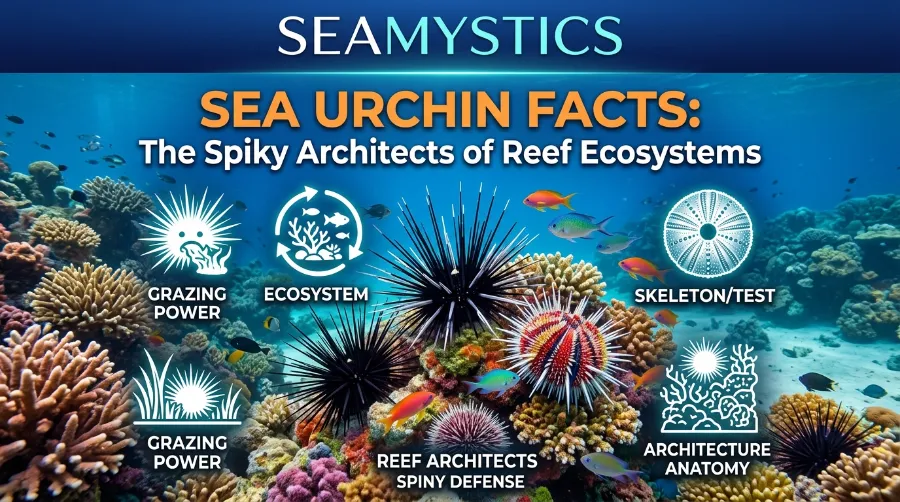

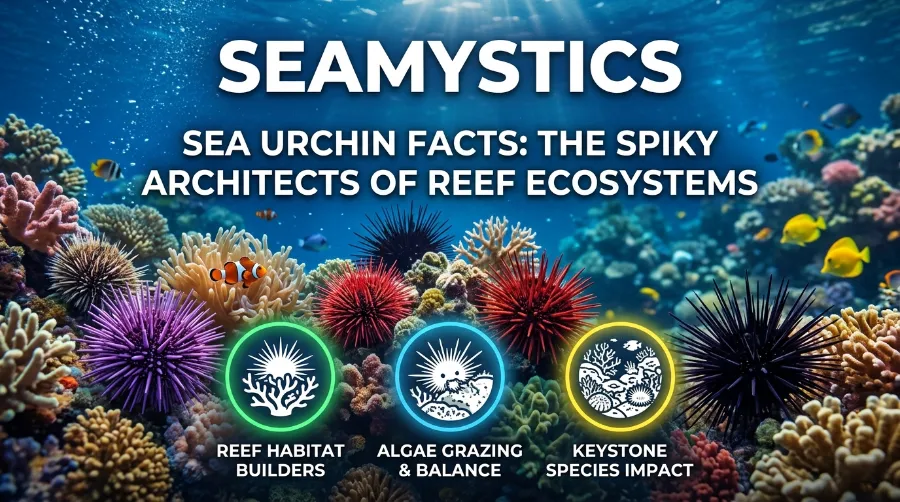
Sea Urchin Facts: The Spiky Architects of Reef Ecosystems
Most people see a sea urchin as a spiky ball that ruins a beach walk. I see it as one of the most powerful animals on a rocky reef. This pocket-sized grazer can protect a kelp forest or erase it in a single summer. These sea urchin facts show how something so small shapes whole coastlines in the US, the UK and across Europe.
| Key Takeaway | Quick Fact |
|---|---|
| Group | Class Echinoidea, about 950 species |
| Age of the group | More than 450 million years in the fossil record |
| Main food | Algae, kelp, seagrass, plus some animals |
| Typical shell width | 3 to 18 cm, depending on species |
| Lifespan | A few years to more than 100 years |
| Biggest danger to people | Broken spine tips and, in a few species, venom |
| Reef role | Grazer that controls algae, but a threat to kelp when predators vanish |
TL;DR: Sea urchins are spiny, boneless grazers that eat algae and kelp with a five-toothed mouth. They keep reefs healthy in small numbers, but too many can wipe out kelp forests and leave bare “barrens.” Their spines hurt, yet only a few species carry real venom.
I have counted urchins on cold rocky shores and warm reefs for many years. Each time, the numbers tell the same story: the balance matters more than the animal itself. Let’s start with the basics.
What Are Sea Urchins? Sea Urchin Facts You Should Know First
A sea urchin is a marine invertebrate in the phylum Echinodermata. That group also holds starfish, sea cucumbers and brittle stars. If you like this group, you may enjoy our guide to sea star facts.
Here is a simple way to picture the animal. It is a round, hard shell covered in movable spines. Under the spines sit hundreds of tiny, sticky tube feet. The feet help it walk, grip rocks and sense the world.
According to Britannica’s sea urchin overview, the group has about 950 living species. They live in every ocean, from icy polar water to warm tropical reefs.
Here are some quick facts worth remembering:
- Urchins have no brain. They use a ring of nerves around the mouth.
- Their shell is called a test, and it is made of calcium carbonate plates.
- They move on tube feet and spines, usually only a few centimeters a minute.
- They have no eyes, but their skin senses light and shadow.
- Five teeth sit inside the mouth, in a structure called Aristotle’s lantern.
The Body Plan: A Tiny Bulldozer
The most striking part is the mouth. Aristotle’s lantern is a set of five teeth held by small bones and strong muscles. The teeth scrape, bite and grind. Because the teeth keep growing, the animal never wears them down.
Why does this matter for you? It explains how a small animal can strip a rock bare. The lantern works like a rotating drill, and it never gets dull.
Size and Lifespan
Sizes vary a lot. A purple urchin fits in your palm. A red urchin can grow as wide as a grapefruit. Lifespan varies just as much. Some small species live only a few years. Red urchins in the North Pacific often pass 100 years, and some estimates are higher
| Species | Common Region | Typical Lifespan |
|---|---|---|
| Green urchin (Strongylocentrotus droebachiensis) | North Atlantic, Norway, UK, Maine | About 10 to 15 years |
| Purple urchin (Strongylocentrotus purpuratus) | US West Coast | 20 or more years |
| Edible urchin (Echinus esculentus) | UK and Atlantic Europe | About 10 to 15 years |
| Red urchin (Mesocentrotus franciscanus) | US West Coast | 50 to 100 or more years |
| Long-spined urchin (Diadema antillarum) | Caribbean | About 10 years or more |
Sea Urchin Diet: What Do Urchins Eat?
The sea urchin diet is mostly plants and algae, but urchins are flexible eaters. They scrape algae off rocks, chew kelp blades and nibble seagrass. When food runs short, they also eat barnacles, sponges, mussels and dead fish.
That flexibility is the secret to their success. Moreover, it explains why they survive in very different places.
How Urchins Feed
An urchin finds food by smell and touch. Then it grips the surface with its tube feet and works the lantern. It scrapes, tears and swallows. Meanwhile, spines help move food toward the mouth.
Here is what feeding looks like in the main groups:
- Kelp grazers: Purple, red and green urchins often chew kelp stems at the base. The kelp then floats off.
- Algae scrapers: Many tropical urchins graze fuzzy algae on coral rock.
- Seagrass eaters: Some warm water species, like the collector urchin, eat seagrass leaves.
- Scavengers: In poor areas, urchins eat whatever animal matter they find.
A fun fact: urchins in kelp forests often wait for drifting pieces of kelp. They hold their spot and catch food as it floats by. Food is easy, so they stay hidden in cracks. However, once the kelp is gone and predators have vanished, they leave the cracks and graze in open view. That is the first sign of trouble on a reef.
For a larger food web view, see how tiny drifting life feeds bigger animals in our plankton facts explained guide and our krill facts explained article. Young urchins start life as plankton too, so they belong to that same story.
Sea Urchin Habitat: Where Do Urchins Live?
Sea urchin habitat covers rocky shores, kelp forests, coral reefs, seagrass beds and even the deep sea. Most species like hard surfaces they can grip. Some burrow into rock to hide. Others bury in sand, like heart urchins and sand dollars.
Here is a quick map of where you find them:
| Habitat | Example Urchin | Where in the World |
|---|---|---|
| Cold kelp forest | Purple and red urchins | California, Oregon, Washington |
| Cold rocky shore | Green urchin, edible urchin | UK, Ireland, Norway, Maine |
| Coral reef | Long-spined urchin, pencil urchin | Caribbean, Red Sea, Pacific |
| Seagrass bed | Collector urchin | Warm Atlantic and Indo-Pacific |
| Sandy bottom | Heart urchin | Worldwide shallow seas |
| Deep sea | Several deep urchin groups | Below 1,000 m worldwide |
Why Habitat Matters
Urchins need shelter, food and cool, clean water. Rocky cracks keep them safe from fish and crabs. Waves also matter. Strong surf can wash urchins away, so many species hide in the lower shore or in deeper water.
Climate change also shifts their range. Warm water helps some species spread north. In Tasmania, for example, the long-spined urchin has moved south and now grazes reefs that were once too cold for it. This is a clear case of warming water moving an animal into a new home.
Because I work with ocean life of every size, I often point readers to our ocean life sizes pillar guide. Urchins sit in the middle of that scale: far bigger than plankton, far smaller than whales, yet strong enough to change a whole habitat.
Sea Urchin Spines Danger: Are Urchins Really Harmful?
The sea urchin spines danger is real, but it is easy to overstate. Urchins do not chase anyone. Injuries happen when someone steps on one or brushes it in a wave. Most stings cause pain, swelling and a few bad days. Serious problems are rare.
The Key West Aquarium has a helpful page on sea urchin biology and care that shows how gentle these animals are when left alone.
Types of Urchin Injury
There are two main risks:
- Puncture wounds: Sharp spines snap off in the skin. Long-spined species can go deep.
- Venom: A few species, such as the flower urchin (Toxopneustes pileolus), carry venom in small pincer-like parts called pedicellariae. Their sting can cause strong pain, and in rare cases breathing trouble.
Spines that land near a joint deserve extra care. They can cause lasting swelling, so a doctor should check them. Black marks under the skin may be dye from the spine. These often fade, but real spine pieces can stay behind.
What to Do If You Step on an Urchin
I have helped people on shore after a bad step. This simple routine keeps things calm:
- Get out of the water and sit down.
- Remove any large pieces with tweezers. Pull them out straight, and do not crush them.
- Soak the foot in hot water the person can safely stand, for about 30 to 90 minutes. Heat can ease venom pain.
- Wash the area with soap and clean water.
- See a doctor if spines sit near a joint, if the person feels dizzy, or if redness spreads.
A quick note on a famous myth. Many people say vinegar or urine dissolves spines. Medical sources do not support that idea, so skip it and choose the steps above.
How to Avoid Spine Injuries
Prevention is easy. Wear sturdy water shoes. Shuffle your feet in murky shallows. Look before you grab a rock. Never pick up an urchin barehanded. Finally, teach children to look but not touch.
The Urchin Reef Ecosystem Role: Gardeners and Wreckers
The urchin reef ecosystem role has two sides. In small numbers, urchins act like gardeners. They clear fast-growing algae so corals and kelp babies can find space. In large numbers, they act like wreckers. They chew through the base of kelp and leave bare rock.
Which side wins depends on one thing: the predators.
The Predator Link
Sea otters, lobsters, fish like California sheephead, and sea stars all eat urchins. When these animals thrive, urchin numbers stay in check. When they fall, urchins explode in number. Scientists call this a trophic cascade, which simply means a chain reaction in the food web.
Here is a clear example. When sea otters returned to parts of the Pacific coast, urchin numbers dropped and kelp forests grew back. That story shows why one predator can matter so much.
Case Study 1: The Caribbean Die-Off (1983 to 1984)
The long-spined urchin Diadema antillarum once grazed almost every Caribbean reef. In 1983 and 1984, a mysterious disease wiped out about 97 percent of them across the region.
The result surprised everyone. Algae spread fast and smothered young coral. Reefs that once had green and brown growth in balance turned into algae carpets. Decades later, most sites still hold far fewer urchins than before. Some recovery has happened, and reef teams now raise urchins to help.
The lesson is simple. Too many urchins hurt kelp, but too few hurt coral. A reef needs the right middle.
Case Study 2: California’s Kelp Collapse (2013 to Today)
Now look at the Pacific. In 2013, sea star wasting disease killed huge numbers of sunflower stars, a top urchin predator. At the same time, a long marine heat wave from 2014 to 2016 stressed kelp.
Purple urchin numbers on the northern California coast rose about 60 times, based on published monitoring. More than 95 percent of bull kelp vanished from parts of the coast. Red abalone and other kelp-dependent animals suffered too, and local fisheries closed.
This is the clearest modern example I know of a sea urchin boom. It also shows why predators like sea stars matter so much, a theme we cover in our sea star facts guide.
| Case | Years | Main Cause | Result |
|---|---|---|---|
| Caribbean Diadema die-off | 1983 to 1984 | Disease | About 97% of urchins lost, algae overgrew coral |
| Northern California kelp loss | 2013 to present | Sea star loss plus heat | Purple urchins rose about 60 times, over 95% of bull kelp lost |
| Maine green urchin fishery | Early 1990s | Heavy harvest | Landings peaked near 40 million pounds, then fell sharply |
Urchin Barrens: The Gap Many Guides Skip
Many short guides skip one key idea: urchin barrens. A barren is a patch of rock with almost no kelp and a thick layer of urchins. It looks like a desert underwater.
Once a barren forms, it can last for years or even decades. The urchins starve in place but stay alive by eating almost nothing. They simply wait for new kelp to land. Then they eat it before it grows.
Here is how a barren often forms:
- Predators fall in number through disease, fishing or heat.
- Young urchins survive in larger numbers.
- Urchins leave their hiding spots and graze in the open.
- Kelp disappears, and the rock turns pale.
- The urchins stay and block any regrowth.
Interestingly, starving urchins are not a good meal. Their gonads, the part people eat, shrink to almost nothing. That is why some groups now collect these “empty” urchins and feed them in tanks. It helps the kelp and can turn waste into a product.
Recovery work uses three main tools:
- Diver removal: Divers smash or collect urchins in small plots.
- Predator recovery: Teams protect otters, lobsters or sea stars.
- Kelp seeding: Crews plant young kelp on cleared rock.
In my experience, no single tool works alone. The best projects mix all three and watch the site for years.
How Sea Urchins Reproduce: A Short Life Cycle
Most urchins release eggs and sperm into open water. This is called broadcast spawning. Warm water, longer days or a chemical cue from nearby urchins can trigger it. As a result, a whole reef can spawn on the same night.
A fertilized egg becomes a tiny, free-swimming larva called a pluteus. It looks like a small glass arrow with arms. It drifts as plankton for weeks, then settles on the bottom and turns into a baby urchin the size of a pinhead.
Most larvae never make it. Fish and other plankton eaters take a huge share. However, in a good year, a rare wave of survivors can load a coast with young urchins. That is often the first step toward a barren.
Humans and Urchins: Food, Fisheries and Research
People have eaten urchins for centuries. The soft, orange gonads, called uni in Japanese, are a prized food. Japan is the largest market, and chefs in the US and Europe also serve it.
Fisheries can boom and bust fast. In Maine, green urchin landings climbed in the late 1980s and peaked near 40 million pounds in the early 1990s. Then the catch fell sharply as stocks ran thin. Today the fishery is far smaller and carefully managed.
In the UK and Ireland, the edible urchin and other species attract smaller fisheries. The Pangea Shellfish blog offers a clear guide to sea urchin facts for buyers and cooks if you want the food side. For wild populations and local rules in Britain, the Marine Conservation Society has a good deep dive into sea urchins.
Urchins also help science. Their eggs are clear and easy to watch under a microscope. Because of this, researchers have used them for over a century to study how cells divide and how embryos grow. The NOAA Ocean Service also tracks reef and kelp health, which helps link urchin counts to larger ocean trends.
From My Field Notes: What Urchin Surveys Teach You
When we survey a rocky reef, we place a square frame on the bottom and count every urchin inside it. We repeat this at many spots. It sounds simple, but the numbers reveal a lot.
Here are three habits I trust after years of counting:
- Look for gaps, not just numbers. A healthy reef has urchins hiding in cracks. When many sit in the open, the reef is already in trouble.
- Check size groups. Many tiny urchins and few large ones can signal a recent boom year.
- Watch the predators. A missing lobster, sheephead or sea star often explains the urchin count better than any water test.
In one survey season, I found the same pattern at two nearby sites. One had cracks full of urchins and thick kelp. The other had open, grazing urchins and bare rock. The only clear difference was predator numbers. That simple contrast made the cascade easy to explain to students.
My honest view is this: urchins are not villains. They are a mirror. When urchins boom, they show that something upstream has already broken.
Frequently Asked Questions
Are sea urchins dangerous to humans?
Most are not. They hurt only if you step on them or touch them. A few species, like the flower urchin, carry venom, so treat any urchin with respect.
What do sea urchins eat?
They eat mostly algae, kelp and seagrass. Some also eat barnacles, sponges and dead fish when food is scarce.
How long do sea urchins live?
It depends on the species. Small ones live a few years, while red urchins can live over 100 years.
Do sea urchins have brains or eyes?
No. They have a nerve ring and can sense light with their skin and tube feet.
Why are sea urchins important to reefs?
They control algae, which helps corals and kelp. However, too many urchins can destroy kelp forests, so balance matters.
Can you eat sea urchins?
Yes. The gonads, called uni, are a delicacy in Japan and a growing food in the US and Europe. Always buy from trusted, well-managed fisheries.
What should I do if I step on a sea urchin?
Remove large spines, soak the area in hot water you can bear, clean it, and see a doctor if spines sit near a joint or symptoms grow worse.
Conclusion
These sea urchin facts show how a small, spiny animal can shape a whole coastline. Their diet of algae and kelp keeps reefs clean when predators are healthy. Their spines look scary, but the real risk is to ocean balance more than to people. When predators vanish, urchins can wipe out kelp and leave barrens that last for decades.
So the next time you see an urchin on a rock, remember that it is a signal as well as an animal. Protect its predators, respect its spines, and support healthy kelp and reefs. That small act keeps the whole ocean food web in better shape.
Quick Quiz: Test Your Urchin Knowledge
Q1. What is the five-toothed mouth of a sea urchin called?
A) Radula
B) Aristotle’s lantern
C) Lantern fish gill
D) Test plate
Q2. Which event caused about 97 percent of Caribbean long-spined urchins to die in 1983 and 1984?
A) A marine heat wave
B) Oil spill
C) A disease outbreak
D) Overfishing
Q3. What usually keeps urchin numbers in balance on a reef?
A) Strong waves only
B) Predators like otters, lobsters and sea stars
C) Cold water
D) Sunlight
Q4. True or false: Sea urchins have a brain.
Q5. True or false: Vinegar is a proven way to dissolve urchin spines in the skin.
Answers:
- B
- C
- B
- False. They have a ring of nerves, not a brain.
- False. Medical sources do not support this myth.
References
- Britannica. “Sea urchin.”
- Key West Aquarium. “Sea Urchins.”
- Marine Conservation Society (UK). “A deep dive into sea urchins.”
- Pangea Shellfish. “About sea urchins: facts and guide.”
- NOAA Ocean Service. Kelp, reef and ocean ecosystem resources.
- Lessios, H. A. Studies on the 1983 to 1984 mass mortality of Diadema antillarum in the Caribbean.
- Rogers-Bennett, L. and Catton, C. (2019). “Marine heat wave and multiple stressors tip bull kelp forest to sea urchin barrens.” Scientific Reports.