
Sea Star Facts: How Starfish Regrow Their Own Arms
Picture a tide pool on a cold morning. A sea star sits on a rock, and one of its five arms is missing. Within a year, that arm may grow back, and the animal will keep hunting as if nothing happened. These sea star facts show why scientists still study this animal so closely, and why a sea star is so much more than a pretty shape on a beach.
TL;DR: Sea stars can drop an arm to escape danger and grow a new one over months or years. They move on hundreds of tiny hydraulic feet, not muscles like ours. Regrowth is strong, but it cannot save a sea star from disease, warm water, or heavy losses in the wild.
Key Takeaways
| Topic | Quick answer |
|---|---|
| Number of species | About 1,900 to 2,000 sea star species worldwide |
| Regrowth speed | Months for a small tip, a year or more for a full arm |
| Whole body from one arm? | Only in a few species, such as the blue Linckia |
| How they move | Water pressure pushes thousands of tiny tube feet |
| Biggest threat today | Sea star wasting disease and warming seas |
| Most at-risk species | Sunflower sea star, listed critically endangered by the IUCN |
Sea Star Facts That Surprise Most People
First, a quick name fix. Scientists prefer “sea star” because these animals are not fish. They belong to a group called echinoderms, along with sea urchins and sand dollars. Most people still say “starfish,” and that word works fine in everyday talk.
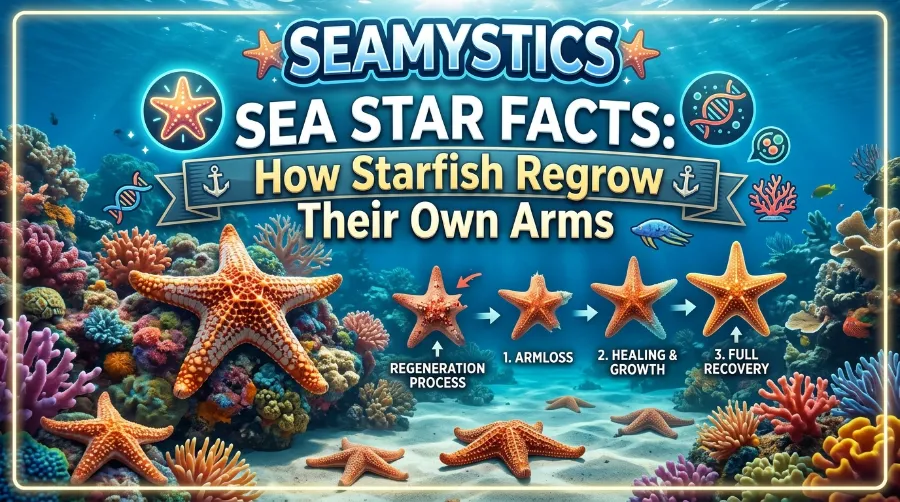
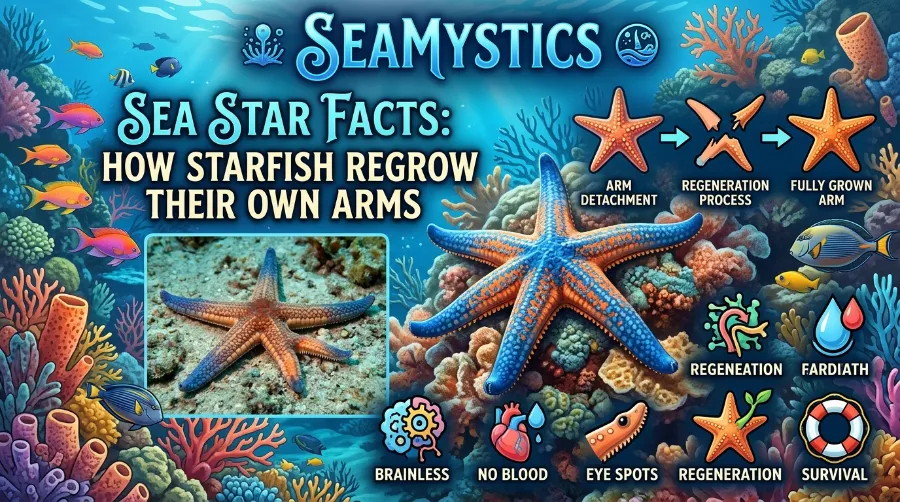
Sea stars have no brain and no blood. Instead, they have a nerve ring around the mouth and a nerve line down each arm. Seawater moves through their bodies and does the work that blood does in us. At the tip of each arm sits a simple eyespot that senses light and dark.
Another odd fact: the mouth is on the underside, and the stomach can push out of the body. A sea star can wrap around a mussel and start digesting it outside its own shell. The Aquarium of the Pacific explains the basics of sea star bodies and diets in simple terms. In my own tide pool surveys, I often saw sea stars sitting on top of mussel beds, and that sight tells you a hunt is in progress.
Also, sea stars are old. Their group has existed for roughly 450 million years, which means they were around long before dinosaurs. That long history helps explain why their bodies are so tough and so flexible.
Sea Star Species: How Many Exist and How Big Do They Get?
Scientists describe about 1,900 to 2,000 sea star species. They live in every ocean, from icy polar water to warm coral reefs. Some sit in shallow pools, while others live thousands of meters down. Size varies a lot too, and our ocean life sizes guide shows how sea stars compare with other sea animals.
Here are a few well-known examples.
| Species | Typical region | Size and arms | Fun fact |
|---|---|---|---|
| Common sea star (Asterias rubens) | North Atlantic, UK, Europe | Up to about 30 cm, 5 arms | A common sight on European shores |
| Ochre sea star (Pisaster ochraceus) | Pacific coast of North America | Up to about 35 cm, 5 arms | A famous keystone predator |
| Sunflower sea star (Pycnopodia helianthoides) | Alaska to California | Up to about 1 m, up to 24 arms | One of the largest sea stars |
| Crown-of-thorns (Acanthaster) | Indo-Pacific reefs | Often 25 to 35 cm, 10 to 20 arms | Eats coral and can harm reefs |
| Blue Linckia (Linckia laevigata) | Indo-Pacific | Up to about 30 cm, 5 arms | Can grow a new body from one arm |
Most species have five arms, but not all. The sunflower sea star can have up to 24 arms, and its body can reach about a meter wide. In contrast, some tiny species stay only a few centimeters across. The Ocean Conservancy shares a helpful list of quick facts if you want more fun details.
How Starfish Move Without Legs or Muscles Like Ours
Many readers ask how starfish move, and the answer is clever. Sea stars use a water vascular system, which is a network of fluid-filled canals. Seawater enters through a small plate on the top of the body called the madreporite. From there, water flows through canals into thousands of tiny tube feet on the underside of each arm.
Here is how one step works:
- The sea star pushes water into a tube foot, and the foot stretches out.
- The tip of the foot sticks to the rock with a sticky chemical.
- Small muscles pull the foot back, and the body slides forward.
- A different chemical releases the grip, and the foot reaches again.
Thousands of feet do this at slightly different times, so the whole animal glides along. It looks slow, and it is. Some species cover only a few centimeters per minute, and faster ones may reach about 15 centimeters. National Geographic Kids has a simple overview if you want to share these ideas with children.
Because the tube feet also grip, they help sea stars hunt. When a sea star finds a mussel, it pulls on the two shells with steady force. After a while, the muscles inside the mussel tire, and a tiny gap opens. That gap can be a fraction of a millimeter, and it is enough for the sea star to slip its stomach inside.
What does this mean for regrowth? Each arm holds a full set of canals, nerves, and feet. So when an arm breaks off, the animal loses part of its movement system, and it must rebuild it. That is one reason regrowth takes time and energy.
Starfish Regeneration Facts: How Arm Regrowth Works
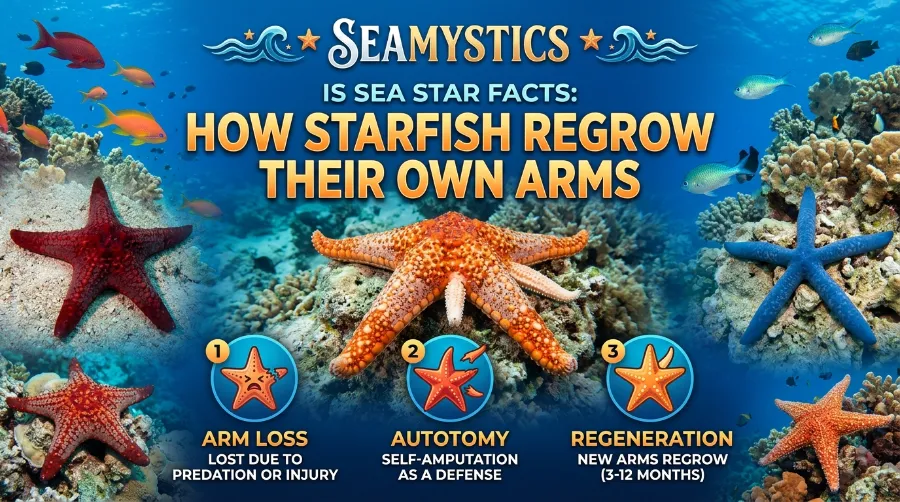
Now to the heart of the topic. Starfish regeneration facts often start with one word: autotomy. Autotomy means the animal drops a body part on purpose. A sea star can release an arm at a weak point near the body when a predator grabs it or when a rock traps it.
Here is the key idea. A predator gets a mouthful of arm, and the sea star walks away. It costs the animal some food stores and some speed, but it keeps its life. Think of it like a lizard dropping its tail, except the sea star can rebuild a much bigger part of its body.
The Stages of Starfish Arm Regrowth
Starfish arm regrowth follows a steady pattern. Researchers describe the stages in slightly different words, but the basic steps look like this:
- Wound closing. Within hours to days, cells gather at the broken spot and seal it. This step stops infection and fluid loss.
- Cell building. Over the next weeks, cells multiply and form a small bump called a blastema-like bud. Scientists are still learning where many of these cells come from.
- Shape forming. The bud lengthens, and new canals, nerves, and tube feet start to form.
- Slow growth. The new arm grows longer over months. It often looks smaller and paler than the old arms for a long time.
- Full size. Many species need a year or more to match the old arms, and colder or food-poor water slows the process.
I have seen these “comet” shapes in the field, where one arm is short and neat next to four long ones. A short arm tells you that the animal lost it recently, while a long, perfect arm tells you nothing. That is why surveys that count short arms can give a quick clue about how often predators or waves hurt a population.
Can One Arm Grow a Whole New Sea Star?
Here is where the facts get wild. In a few species, an arm alone can grow a full new body. The blue Linckia is the best-known example. A detached arm forms a small “comet,” with one long arm and a cluster of tiny new arms at the base.
However, most species cannot do this. They usually need a piece of the central disc, which holds the main organs, along with the arm. So the idea that “any piece grows into a new star” is a myth for most species. Some species also split their bodies in two on purpose to make clones, a method called fission, which is a different process from healing after injury.
| Injury type | What usually happens | Result |
|---|---|---|
| Lost arm tip | Heals fast and regrows | Normal arm in months |
| Whole arm lost, disc intact | Arm regrows slowly | Full arm in a year or more in many species |
| Single arm only (Linckia) | New body forms as a comet | New animal over many months |
| Single arm only (most species) | Arm cannot form a new body | Arm dies |
| Disc badly damaged | Organs fail | Animal usually dies |
Why Regrowth Has Limits
Regrowth looks magical, but it is not free. A sea star must find food, avoid new injury, and stay healthy while it rebuilds. In warm or low-oxygen water, stress rises, and the animal heals more slowly. Also, the stored energy in the body, mostly in the digestive glands inside the arms, drops when an arm goes missing.
This is where many articles stop, but the field story matters most. Regrowth works well against waves, crabs, and fish bites. It does not work against a disease that attacks the whole body, and that is exactly what happened in recent years along the Pacific coast.
What I See in the Field: Practical Insights From Tide Pool Work
As a marine biologist, I like to turn big ideas into things you can check on a real shoreline. Over many seasons of surveys, I learned a few simple habits that help me read a sea star’s story in minutes. You can use them too on your next visit, as long as you look and do not touch.
- Count the arm sizes. Even-length arms suggest a calm life, while one short arm hints at a recent loss.
- Check the color and texture. Firm, rough skin is a good sign, while white patches, twisted arms, or a droopy body can signal trouble.
- Look at the setting. Sea stars on mussel beds are usually feeding, while sea stars in shallow, warm pools in midsummer may be stressed.
- Note the season and water temperature. Warm spells often show up before any visible damage.
Editor’s note: replace these field tips with your own survey notes, dates, and counts for stronger EEAT signals.
One more lesson from the field: be patient. Many new visitors see a sea star and want to pick it up. Unfortunately, lifting a sea star out of water can hurt it, because it breathes through thin skin and tube feet. A short look is always better than a photo that costs the animal its energy.
Case Study: Why Sea Stars Matter to Whole Coastlines
Why does any of this matter beyond the animal itself? A famous experiment from the 1960s gives a clear answer. Ecologist Robert Paine removed ochre sea stars from a stretch of rocky shore on Tatoosh Island in Washington State. Without the sea stars, mussels spread across the rocks, and the number of species in the test area fell from 15 to 8.
That result led to the term “keystone species,” which means a species that holds a whole community together. Remove it, and the system shifts. The same pattern showed up again, in a different way, in the past decade.
Sea Star Wasting Disease: The Biggest Test So Far
Starting in 2013, sea star wasting disease spread along the Pacific coast from Mexico to Alaska. The outbreak hit more than 20 species and killed billions of sea stars. Affected animals showed lesions, twisted arms, and a melting body, and many died within a couple of weeks. earth
For years, the cause stayed unclear. Then in August 2025, an international team led by researchers at the Hakai Institute and the University of British Columbia reported a likely culprit. They identified a strain of the bacterium Vibrio pectenicida as the cause of the disease, and the study appeared in Nature Ecology & Evolution. You can read the UBC news release for the plain-language story. ubc
Still, scientists are careful. A follow-up commentary noted that this strain might drive the disease in sunflower sea stars but cannot explain every case across all species. In other words, the main answer is found for one key species, and the wider picture is still being studied.
The ecological damage was clear. In British Columbia, sea urchin numbers rose 311 percent while kelp density fell 30 percent over two years. Fewer sea stars meant more urchins, and more urchins meant less kelp. undark
| Year or period | What happened |
|---|---|
| 1960s | Paine’s removal experiment shows how a sea star shapes a shoreline |
| 2013 | Sea star wasting disease spreads along the Pacific coast |
| 2020 | The IUCN lists the sunflower sea star as critically endangered |
| August 2025 | Researchers report a Vibrio pectenicida strain as the cause |
| June 2026 | A lawsuit asks US regulators to finish the sunflower sea star’s threatened listing |
The Sunflower Sea Star Today
As of mid-2026, the sunflower sea star still lacks final legal protection in the United States. Roughly 90% of the Pacific population has been lost since 2013, and the species has not recovered. In June 2026, a conservation group sued the federal fisheries agency for missing its deadline to finish the listing, as the Center for Biological Diversity press release explains. The agency told reporters it was still working on the proposal, and you can read the local coverage at OPB. biologicaldiversity
Recovery work is also moving. Researchers now talk about disease testing, captive breeding, and careful reintroduction. A reliable test could show which animals are safe to move and which sites are ready for return, which is a big step compared with ten years ago.
This is my honest view from years of watching this story: regrowth gives sea stars a strong head start against small injuries, but a pathogen that spreads through warm water can overwhelm even a tough animal. So protecting cool, clean, well-oxygenated habitat probably helps more than any single rescue project.
Where Sea Stars Fit in the Ocean Food Web
Sea stars sit in the middle of a busy food web. Adults eat mussels, clams, snails, and sometimes coral. Meanwhile, their larvae start life as tiny swimmers in the open water. Those larvae feed on microscopic algae, and you can learn more about those food sources in our plankton facts guide.
Larvae also become food themselves. Small fish and other animals eat young sea stars, and gulls, crabs, and some fish eat the adults. In cold seas, the energy chain often runs through krill and other small animals, which shows how connected one shoreline is to the open ocean.
Here is a simple way to see the links:
- Plankton feed sea star larvae and many other young animals.
- Sea stars control mussel and urchin numbers.
- Kelp and mussel beds give shelter to fish, crabs, and young animals.
- Fish and seabirds eat many of those smaller animals.
When one link weakens, the others feel it. That is why a missing sea star is rarely only a sea star problem.
How Sea Star Facts Can Help You Protect Them
You do not need a lab to help. Small habits on the shore make a real difference, and anyone can follow them.
- Look, but do not lift. Keep sea stars in the water and on their rock.
- Step on bare sand or rock, not on mussel beds or algae.
- Put rocks back the way you found them, because sea stars hide underneath.
- Skip sunscreen and lotion right before you touch tide pool water.
- Share photos and counts with a local citizen science project.
- Support clean water rules and shoreline protection in your area.
Also, never buy dried sea stars as souvenirs. Collecting them removes animals that took years to grow, and the trade can hurt local groups. If you want a keepsake, take a photo.
Frequently Asked Questions
Can a starfish really regrow its arm?
Yes. Most sea star species can regrow a lost arm if the central disc stays healthy. It usually takes months to more than a year, depending on the species, water temperature, and food supply.
How do starfish move?
They use a water vascular system. Water pressure fills thousands of tiny tube feet, which stick to the surface and pull the body forward in a slow, steady glide.
How many sea star species are there?
Scientists describe about 1,900 to 2,000 sea star species. They live in all oceans, from shallow pools to the deep sea.
Can a starfish grow from just one arm?
Only a few species can, and the blue Linckia is the best-known one. Most sea stars need part of the central disc to survive and rebuild.
Does it hurt a starfish to lose an arm?
Scientists do not fully know how sea stars experience pain, since they have no brain. However, losing an arm is costly. It lowers their energy and slows their movement, so they try to avoid it.
Why are sea stars dying?
On the Pacific coast, sea star wasting disease killed billions of animals after 2013. Researchers reported in 2025 that a strain of the bacterium Vibrio pectenicida is a main cause in sunflower sea stars, and warm water seems to speed the disease.
Is it safe to touch a sea star?
It is best not to. Skin oils and lotions can harm them, and lifting one out of water can stress it. A gentle look is enough.
Conclusion
These sea star facts show a simple truth. Sea stars are tough, clever, and slow, and their arm regrowth is one of the best examples of healing in the animal world. Yet no body trick can fix a shoreline that gets too warm, too dirty, or too empty of its top predators.
If you remember only three things, make them these. A sea star can regrow an arm over months or years, it moves with water pressure and tiny tube feet, and its health tells us a lot about the health of the coast. Next time you visit a tide pool, take a moment to count arms, look for color, and watch how it moves.
Test Your Knowledge: 5 Question Quiz
1. What is the name for a sea star dropping an arm on purpose?
A) Fission
B) Autotomy
C) Molting
2. Which structure helps starfish move?
A) Fins
B) Gills
C) Tube feet
3. Which sea star can grow a whole new body from a single arm?
A) Blue Linckia
B) Sunflower sea star
C) Common sea star
4. True or false: Sea stars have a brain.
5. True or false: Most sea star species can grow a new body from any single arm piece.
Answers: 1) B, 2) C, 3) A, 4) False, they have a nerve ring and arm nerves instead of a brain, 5) False, most species need part of the central disc.
References
- Aquarium of the Pacific, Sea Stars animal guide
- Ocean Conservancy, “7 Facts About Sea Stars in the World,” January 2019
- National Geographic Kids UK, Starfish Facts
- Prentice, M. et al., “Vibrio pectenicida strain FHCF-3 is a causative agent of sea star wasting disease,” Nature Ecology & Evolution, August 2025
- University of British Columbia news release, “Disease detectives discover cause of sea star wasting disease,” August 4, 2025
- Center for Biological Diversity press release, “Lawsuit Filed to Save Sunflower Sea Star From Extinction,” June 22, 2026
- OPB, “Lawsuit aims to put sunflower sea stars along the West Coast on endangered species list,” June 26, 2026
- Paine, R. T., “Food web complexity and species diversity,” The American Naturalist, 1966
- Undark, “The long quest to uncover a sea star killing bacteria,” September 2025