
Barnacle Facts Explained: The Animal That Glues Itself for Life
Most people see a barnacle as a rough white bump on a rock or a boat. I see one of the most extreme animals on the shore. These barnacle facts explained here come from years of walking tide lines, scraping hulls, and counting settlers on test plates. A barnacle starts life as a swimming speck. Then it picks one spot, glues its head to it, and never moves again.
TL;DR
A barnacle is a crustacean, not a mollusk, and it is a close cousin of crabs and shrimp. It swims as a larva, picks a surface, and cements itself there for life. Its glue works underwater, and engineers study it for new adhesives.
Key Takeaways at a Glance
| Topic | Quick fact |
|---|---|
| Animal group | Crustacean (same group as crabs, shrimp, and krill) |
| Adult lifestyle | Fixed in one place for life |
| Larval stages | Six nauplius stages, then one cyprid stage |
| Sex | Most species are hermaphrodites |
| Common habitats | Rocky shores, piers, ship hulls, whales, turtles, and deep sea vents |
| Food | Plankton, caught with feathery legs called cirri |
| Famous fan | Charles Darwin studied them for about eight years |
| Human impact | Hull fouling raises fuel use and costs shippers billions |
What Are Barnacles? A Plain Answer
Barnacles belong to a group called Cirripedia. The name comes from the Latin word for a curl of hair, and it points to their legs. Those legs look like small feathers.
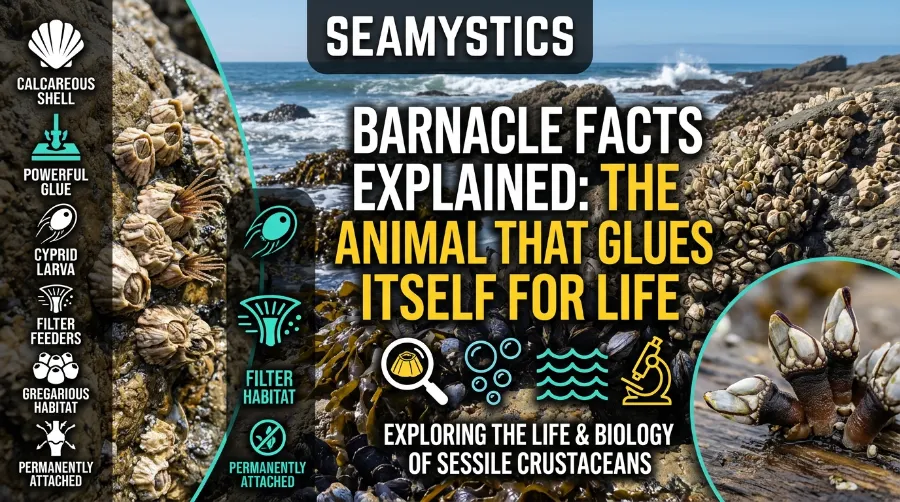
For a long time, people thought barnacles were mollusks. They have hard shells, so the mistake made sense. In 1830, a British army surgeon named John Vaughan Thompson raised barnacle larvae and saw that they swim like young crabs. That one test moved barnacles into the crustacean family.
You can find two main types on most coasts. Acorn barnacles sit flat on rock and look like tiny volcanoes. Goose barnacles hang from a fleshy stalk and look like little necks with shells on top. Both types share the same body plan, and the shell is just a fortress built around a shrimp-like animal lying on its back.
For a quick fact sheet from another angle, the Florida Museum shares five facts about barnacles that pair well with this guide.
Barnacle Facts Explained: Anatomy in Simple Words
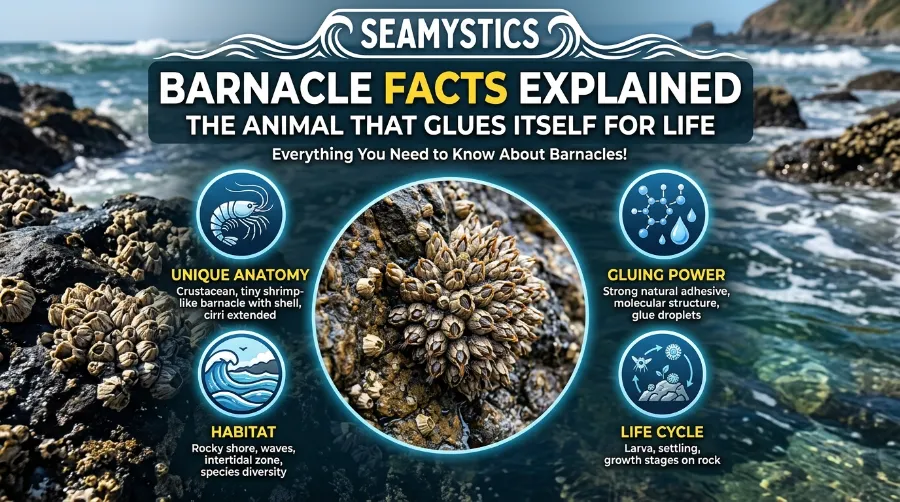
Think of a barnacle as a shrimp glued upside down inside a stone house. Its head sits at the bottom, and its legs point up and out. The “house” has hard plates. Four to six wall plates form a ring, and two pairs of lid plates close at the top like a door.
When the tide goes out, the barnacle shuts the door. That trick keeps water inside the shell, and it protects the animal from sun, wind, and birds. When the tide returns, the door opens, and the legs start to sweep.
Here is what each part does:
- Wall plates: They guard the soft body from heat, waves, and predators.
- Opercular plates: They seal the shell during low tide.
- Cirri: These six pairs of feathery legs grab plankton from the water.
- Cement base: It locks the animal to the surface.
- Mantle cavity: It holds the body, the gills, and the eggs.
Size varies a lot. Most acorn barnacles measure about a centimeter across. In contrast, the giant barnacle of Chile can reach about 20 centimeters in height, though most animals stay smaller.
Barnacle Glue Science: The Underwater Superglue
Barnacle glue science draws more attention than any other part of barnacle biology. Most glues fail in water. Barnacles beat that problem every day on wet rock, in salt, and under crashing waves.
How the Glue Works
The barnacle makes its cement in special glands. Tiny channels carry the cement to the base, where it spreads as a thin layer. Researchers report that the cement is a mix of proteins, and some of those proteins fold into tight, rigid sheets. Those sheets look a lot like the ones found in some human disease proteins, but in barnacles they do a useful job.
Scientists also found that the barnacle first lays down an oily film. That film pushes water off the surface. Then the protein glue goes down and bonds with the clean spot. I like to describe this as drying a spot before you stick on a plaster, except the barnacle does it underwater.
Why Engineers Care
Doctors want glues that work inside a wet body. Boat builders want paints that stop barnacles from settling. Both groups study the same cement, one to copy it and the other to beat it.
I saw the problem first hand while checking settlement plates at a harbor study. Plates with smooth, clean paint stayed bare for weeks. Plates with a tiny scratch grew a ring of young barnacles within days. The larvae seem to choose a rough spot, which hints that they can read the surface before they commit.
You can read more about the animal’s strange features in this Salish Magazine feature on barnacles.
Barnacle Glue by the Numbers
| Glue fact | What it means |
|---|---|
| Works underwater | It beats most human made glues in the same test |
| Starts with an oily film | The film clears water before the bond forms |
| Made of proteins | Researchers copy these proteins for medical glue ideas |
| Permanent for adults | A barnacle does not move after it sets |
The Barnacle Life Cycle: From Drifting Speck to Rock Dweller
The barnacle life cycle has two very different lives. First comes a swimming life, and then comes a stuck life. The shift between them takes only a moment.
Stage 1: Eggs Inside the Shell
Fertilized eggs stay inside the parent’s shell. The parent keeps them safe until they are ready to hatch. In cool waters, many species release their young in spring, right when plankton blooms feed the babies.
Stage 2: Nauplius Larvae
The eggs hatch into tiny larvae called nauplii. Each one has a small shield, a single eye, and three pairs of legs. They swim in short jerks and eat plankton. Over several weeks, they molt through six stages, and each stage grows a little larger.
Stage 3: The Cyprid
The last larval stage is the cyprid. It has a two part shell, like a tiny clam, and it does not eat. Its only job is to find a home. It walks on its antennae and tests the surface with a sticky pad, almost like a person feeling for a light switch in the dark.
A cyprid can wait for days or even weeks for a good spot. It likes surfaces where other barnacles already live. A chemical cue from adults tells the larva that the place is safe. That habit explains why barnacles grow in crowds.
Stage 4: Settling and Metamorphosis
Once the cyprid picks a spot, it glues itself down on its head. Then its body rebuilds. The shell plates form, and the legs turn into feeding cirri. Within a day or two, the larva becomes a tiny adult.
Stage 5: Adult Life
Adults feed, grow, and breed. Many acorn barnacles live for several years, and some species live longer. Growth depends on food, water flow, and how much time the animal spends underwater.
Here is the full cycle in order:
- Eggs develop inside the parent shell.
- Nauplius larvae hatch and swim.
- Larvae molt through six stages.
- The cyprid searches for a surface.
- The cyprid cements itself and changes into an adult.
- The adult feeds and breeds for life.
Barnacle Reproduction Facts: Strange and Smart
Barnacle reproduction facts surprise almost everyone. Barnacles cannot move, so they cannot chase a mate. They solved that problem in a very unusual way.
Hermaphrodites with a Very Long Reach
Most barnacles carry both male and female parts. In theory, one animal could fertilize its own eggs. In practice, most species prefer a partner, because mixing genes keeps a group healthy.
To reach a neighbor, the barnacle extends a long, thin organ from its shell. For its size, this organ is among the longest in the animal kingdom. It can stretch to several times the barnacle’s own body length. The barnacle feels around, finds a neighbor, and delivers sperm.
That is why crowds matter. A barnacle with no neighbors within reach has few options. Dense colonies solve the problem, and that fact helps explain why larvae choose to settle near adults.
Releasing Sperm into the Water
Not every barnacle uses direct contact. A 2013 study on the acorn barnacle Balanus glandula found that some animals also release sperm into the water. This sperm casting works as a backup for animals that sit too far from a neighbor.
Timing Is Everything
Barnacles time their breeding with the seasons. On temperate coasts, many species brood eggs in winter and release larvae in spring. The release lines up with the spring plankton bloom, which gives the larvae food. If you want to know more about that bloom, read our guide to plankton facts explained.
Field Notes
In my own survey work on a rocky shore, I noticed that barnacle clumps with tight spacing carried egg masses more often than lone animals. I treat this as a field observation, not a proven rule, because tide height and wave exposure also change the result. Still, it matches what research says about crowding and mating success.
Barnacle Habitat Facts: Where These Animals Live
Barnacle habitat facts cover almost every coast on Earth. You can find barnacles in cold polar seas and warm tropical bays. They live on rocks, docks, pilings, shells, and ship hulls.
The Intertidal Zone
The rocky shore is the classic barnacle home. Waves hit it, the sun bakes it, and the tide covers and uncovers it twice a day. Barnacles handle that stress well because they can seal their shells and wait.
A famous study by Joseph Connell in 1961 on the Scottish coast showed how this works. He found that two barnacle species lived in different bands on the same rock. One species, Chthamalus, lived higher on the shore. The other, Semibalanus, lived lower. When Connell removed the lower species, the higher species spread downward. This showed that competition, not just the weather, set the boundaries.
Each band has its own rules:
- Upper shore: The barnacle faces heat and long dry spells, but it has fewer competitors.
- Middle shore: Food and space are good, but crowding gets fierce.
- Lower shore: Water covers the animal most of the time, but predators like snails and sea stars hunt there.
Riding on Other Animals
Some barnacles live on living animals. Whale barnacles grow on humpback and gray whales, and some turtle barnacles grow on sea turtle shells. A whale gives a barnacle two big gifts: a free ride and a steady stream of fresh water full of food.
Deep Sea Vents
A few barnacle species live at hydrothermal vents, deep on the ocean floor. They sit near hot, mineral rich water and feed on the life around it. This shows how far the group has spread from the shoreline.
Floating Plastic and Lost Gear
Goose barnacles often settle on floating objects such as driftwood, buoys, and plastic. Lost fishing gear, sometimes called ghost nets, can carry barnacles too. This raft habit lets barnacles travel across oceans. It also helps some coastal species spread into new areas, which is not always good news for local wildlife.
For a wider view of the ocean’s small and large residents, visit our pillar guide on ocean life sizes.
What Barnacles Eat and Who Eats Them
A barnacle is a filter feeder. When the tide covers it, the animal opens its shell and sweeps its cirri through the water. Each stroke traps tiny bits of plankton, and the legs pass the food to the mouth.
This diet overlaps with other small ocean animals. Young krill and barnacle larvae both live in the plankton, and adult krill share a similar food web. If this topic interests you, our krill facts explained page shows how the same food chain feeds whales and fish.
Predators also stalk barnacles:
- Dog whelks: These snails drill through the shell or slip in through the door.
- Sea stars: They pull on the shell plates until the animal tires. Read more in our sea star facts guide.
- Birds and fish: Some species peck or crush the shell.
- Sea urchins: They scrape rock surfaces and can clear young settlers as they graze. Learn about them in our sea urchin facts post.
Barnacles, Darwin, and a Medieval Mix Up
Charles Darwin spent about eight years studying barnacles, from 1846 to 1854. He dissected hundreds of specimens and wrote several large books on them. Many scholars think this work gave him the skills and confidence to write On the Origin of Species. Barnacles showed him how much variation exists inside one group.
An older story is even stranger. In medieval Europe, people believed that barnacle geese grew from goose barnacles. The idea spread because nobody had seen the geese nest in the far north. Some church leaders even allowed people to eat the geese during fasting days, since they were thought to be “born from the sea.” It is a good example of how a missing piece of data can create a myth.
Today people also eat goose barnacles on purpose. In Spain and Portugal, the stalked barnacle Pollicipes pollicipes, called percebes, is a famous delicacy. Harvesters climb wave-battered cliffs to collect them, and the price can run well above 100 euros per kilogram. If you ever try one, you will taste something close to a mix of crab and sea air.
Why Barnacles Matter to People
The Cost of Biofouling
Barnacles on ship hulls cause real money problems. Growth on a hull adds drag, and drag burns more fuel. A 2011 study by Schultz and colleagues estimated that hull fouling on one class of US Navy destroyers added tens of millions of dollars in fuel and cleaning costs each year. Across the global shipping fleet, the total cost climbs much higher.
The fix is not simple. Older paints used toxic metals, and those poisoned other sea life. Newer coatings try to be slick, so animals slip off. Researchers also study barnacle glue to find weak points in the bond.
Barnacles as Climate Signals
Scientists use barnacle shells and range maps to track warming seas. Species that like warm water have moved north in several regions. Because barnacles stay put as adults, their location records change in a clear and simple way.
Barnacles in Medicine and Materials
The same glue that frustrates ship owners inspires doctors. A medical glue that works in a wet body could close wounds without stitches. Researchers study barnacle proteins for that purpose, though most of this work is still in the lab.
For another list of interesting points, the Round Glass Sustain barnacle infographic offers a visual summary.
What I Have Learned from Years of Watching Barnacles
After years on tide pools and docks, I trust three simple habits.
- Look at the surface. Rough spots and cracks collect larvae first.
- Look at the neighbors. Barnacles grow in groups because the group helps them breed.
- Look at the tide line. The height on the shore tells you which species you have.
These habits also help students who want to start field notes. Bring a ruler, a notebook, and a camera. Count animals in a small square, and repeat the count every few weeks. You will see settlement, growth, and loss in real time.
A quick note on safety. Wear shoes with grip, and watch the incoming tide. Barnacle shells are sharp, and a slip on a wet rock can cut skin badly.
Quick Comparison: Acorn Barnacles vs Goose Barnacles
| Feature | Acorn barnacle | Goose barnacle |
|---|---|---|
| Body shape | Flat, cone shaped shell | Long stalk with shell on top |
| Typical home | Rocks, piers, hulls | Driftwood, buoys, wave-hit cliffs |
| Movement as adult | None | None |
| Human use | Mostly none | Eaten in parts of Europe |
| Example genus | Semibalanus, Balanus | Pollicipes, Lepas |
Frequently Asked Questions
Are barnacles alive?
Yes. A barnacle is a living animal. Its hard shell can make it look like a rock, but a soft body sits inside.
Can barnacles move?
Adult barnacles cannot move to a new spot. Only the larvae swim and walk before they settle.
How long do barnacles live?
Many acorn barnacles live for several years. Some larger species live longer. Food, waves, and predators all change the number.
Do barnacles hurt whales?
Most whale barnacles cause little harm. They add a bit of drag, and some people think heavy loads may cost the whale a little energy. Most studies call the relationship mostly neutral.
Can you eat barnacles?
Yes. Goose barnacles, called percebes, are a prized food in Spain and Portugal. People cook them briefly in boiling water and eat the meat from inside the stalk.
Why do barnacles stick so well?
They make a protein based cement that bonds to wet surfaces. An oily film first pushes water away from the spot, so the glue can grab hold.
Are barnacles a pest?
On ship hulls, yes, because they slow boats and raise fuel costs. On natural shores, they are a normal and useful part of the food web.
Five Question Quiz
1. Barnacles belong to which animal group?
A. Mollusks
B. Crustaceans
C. Worms
2. What is the name of the final larval stage that picks a home?
A. Nauplius
B. Polyp
C. Cyprid
3. Which scientist spent about eight years studying barnacles?
A. Charles Darwin
B. Jacques Cousteau
C. Rachel Carson
4. True or false: Adult barnacles can walk to a new rock when food runs low.
5. True or false: Most barnacle species are hermaphrodites.
Answers: 1. B. 2. C. 3. A. 4. False. 5. True.
Conclusion
Barnacles look simple, but their story is anything but. They start as tiny swimmers, choose one home, and glue themselves down for life. Their cement works underwater, their breeding tricks solve the problem of being stuck, and their shells record changes in the sea. Next time you see a crust of white cones on a pier, stop and look closer. Each one is a small crustacean with a very big story, and these barnacle facts explained here are only the start.
References
- Connell, J. H. (1961). The influence of interspecific competition and other factors on the distribution of the barnacle Chthamalus stellatus. Ecology, 42(4), 710 to 723.
- Darwin, C. (1851, 1854). A Monograph on the Sub-class Cirripedia. Ray Society.
- Schultz, M. P., Bendick, J. A., Holm, E. R., and Hertel, W. M. (2011). Economic impact of biofouling on a naval surface ship. Biofouling, 27(1), 87 to 98.
- Barazandeh, M., et al. (2013). Something Darwin didn’t know about barnacles: spermcast mating in a sessile marine invertebrate. Proceedings of the Royal Society B.
- Florida Museum, Salish Magazine, and Round Glass Sustain pages linked in the article.