
Have you ever wondered what happens when the ocean quietly changes without anyone noticing? Unlike oil spills or plastic pollution, ocean acidification is almost invisible. Yet it is one of the biggest threats to marine life today. If you are searching for ocean acidification explained simply, this guide will help you understand the science in easy words while exploring why this issue matters to every person on Earth.
The ocean covers about 71% of our planet and produces roughly half of the oxygen we breathe. It also absorbs large amounts of carbon dioxide (CO₂) from the atmosphere. Although this process slows climate change, it creates another challenge. As more CO₂ enters seawater, the water becomes more acidic. Even a small change in ocean chemistry can affect coral reefs, shellfish, plankton, and entire marine food webs.
you can read our blog ocean how to protect oceans
Key Takeaways
| Topic | Quick Answer |
|---|---|
| What is ocean acidification? | The ocean becomes more acidic because it absorbs carbon dioxide. |
| Main cause | Human activities that release CO₂, especially burning fossil fuels. |
| Most affected species | Corals, oysters, mussels, clams, sea urchins, and tiny plankton. |
| Why it matters | It threatens marine biodiversity, fisheries, tourism, and coastal economies. |
| Can it be slowed? | Yes. Cutting carbon emissions and protecting marine ecosystems can help. |
What Is Ocean Acidification?
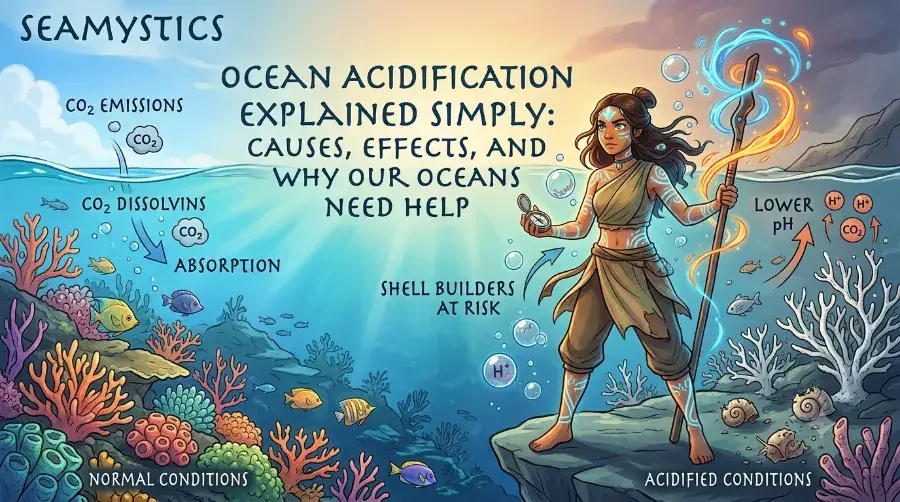
Ocean acidification means seawater is slowly becoming more acidic than it was before the Industrial Revolution. This happens because oceans absorb carbon dioxide from the air.
Think of the ocean as a giant sponge. Every day, it soaks up enormous amounts of carbon dioxide. Scientists estimate that the ocean absorbs about 25–30% of all human-produced CO₂ emissions. This natural process helps reduce the speed of global warming. However, it also changes seawater chemistry.
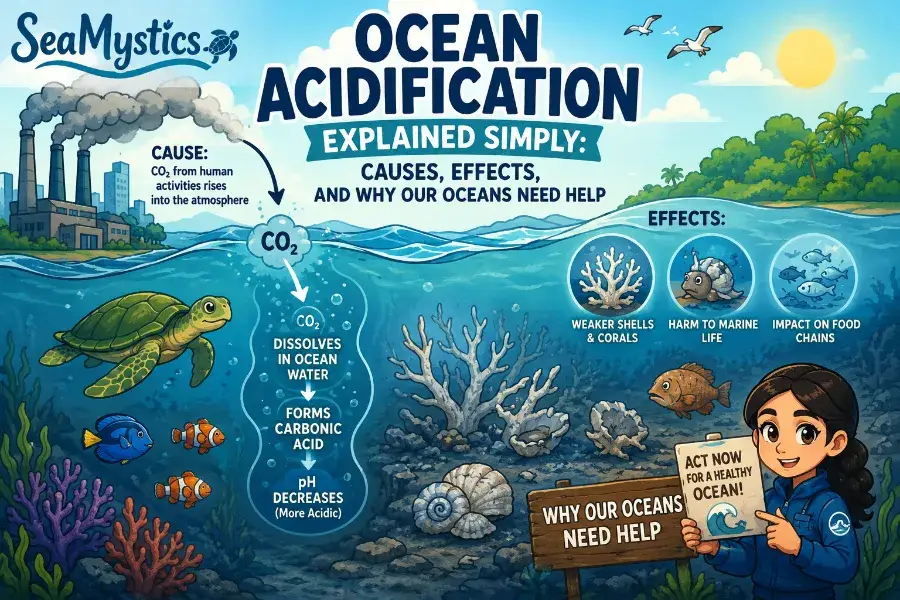
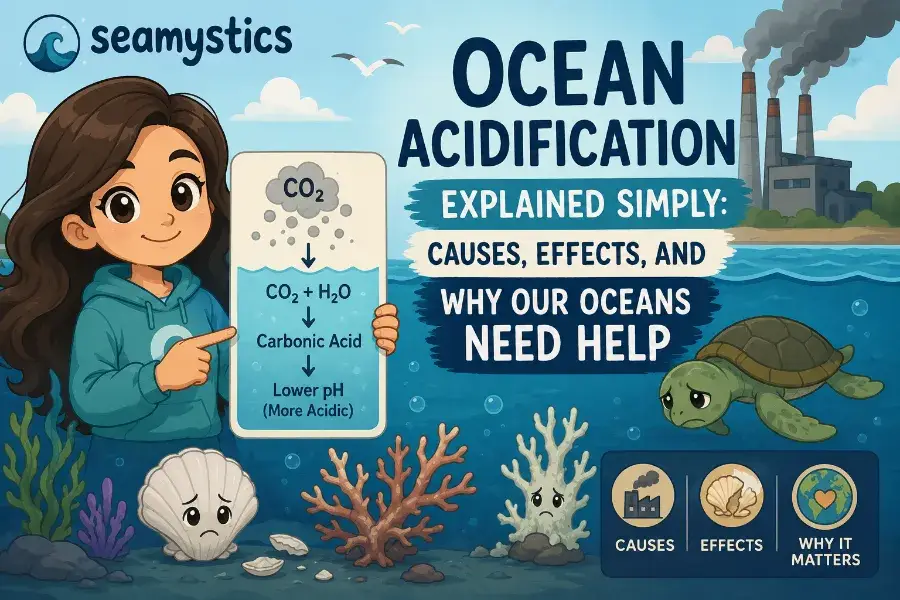
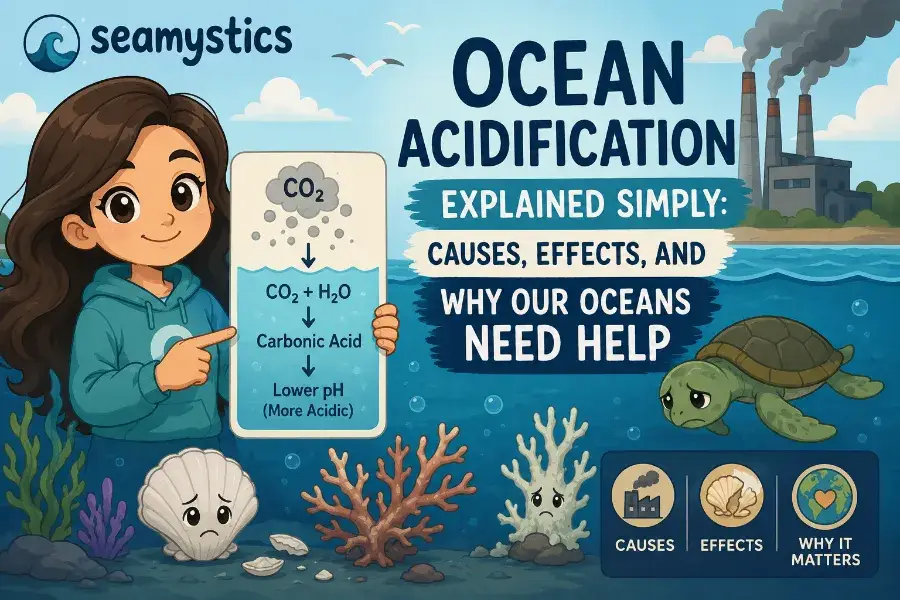
When carbon dioxide mixes with seawater, it forms carbonic acid. That weak acid then releases hydrogen ions, which lower the ocean’s pH. At the same time, fewer carbonate ions remain available for marine animals that need them to build shells and skeletons.
Although the word “acidification” sounds dramatic, the ocean is still slightly alkaline. The concern is the rapid rate of change, not that the ocean has become acidic like lemon juice
How Ocean Acidification Works
The chemistry may sound complicated, but the idea is simple.
Step 1: Carbon Dioxide Enters the Atmosphere
People release carbon dioxide by:
- Burning coal
- Burning oil
- Burning natural gas
- Manufacturing cement
- Deforestation
- Large-scale industrial activities
Step 2: Oceans Absorb CO₂
Instead of remaining entirely in the atmosphere, a significant portion dissolves into seawater.
Step 3: Carbonic Acid Forms
CO₂ reacts with water.
Carbon dioxide + Water → Carbonic Acid
Carbonic acid is weak, but billions of tons entering the ocean each year gradually change seawater chemistry.
Step 4: Ocean pH Drops
More hydrogen ions reduce pH.
Scientists measure acidity using the pH scale.
| pH Level | Meaning |
| 0–6 | Acidic |
| 7 | Neutral |
| 8–14 | Alkaline |
The average ocean pH has fallen from about 8.2 to around 8.1 since the Industrial Revolution. That small change represents roughly a 30% increase in acidity because the pH scale is logarithmic.
ocean acidification explained simply
Why Is Ocean Acidification Happening Faster Today?
Natural changes in ocean chemistry have always happened. However, today’s changes are much faster.
Before large-scale industrialization, carbon moved through Earth’s systems slowly. Human activities dramatically increased atmospheric CO₂ during the last two centuries.
Today, major contributors include:
- Electricity generation
- Transportation
- Heavy industries
- Agriculture
- Forest loss
As atmospheric carbon dioxide continues rising, the ocean keeps absorbing more of it.
Latest Trend in Ocean Chemistry
| Year | Estimated Atmospheric CO₂ (ppm) | Ocean Condition |
| 1850 | ~285 | Stable chemistry |
| 1950 | ~310 | Slight decline in pH |
| 2000 | ~370 | Faster acidification |
| 2020 | ~414 | Significant chemical changes |
| 2025 | ~425+ | Continued long-term decline in pH |
Why Carbonate Ions Matter
Many marine animals build protective shells.
Examples include:
- Oysters
- Mussels
- Clams
- Scallops
- Sea snails
- Coral reefs
These animals need carbonate ions to produce calcium carbonate.
When ocean acidification increases, carbonate becomes less available. As a result:
- Shells grow more slowly.
- Skeletons become weaker.
- Young animals struggle to survive.
- Coral reefs recover more slowly after storms.
Imagine trying to build a brick house while someone keeps taking away your bricks. That is similar to what many marine organisms experience.
Which Marine Animals Are Most at Risk?
Not every sea creature responds the same way.
Coral Reefs
Corals build massive limestone structures over hundreds or even thousands of years.
More acidic water slows coral growth and weakens reef structures.
Healthy reefs provide homes for nearly 25% of all known marine species, even though reefs cover less than 1% of the ocean floor.
Shellfish
Young oysters, mussels, and clams often develop thinner shells.
In several shellfish hatcheries, more acidic water has already reduced the survival of larvae, creating economic challenges for coastal communities.
Tiny Plankton
Some microscopic plankton also produce calcium carbonate shells.
Although tiny, these organisms support much of the marine food web.
If plankton populations decline, fish populations may also change over time.
Sea Urchins
Sea urchin larvae often develop more slowly in acidic water.
Scientists continue studying how these changes affect survival and reproduction.
Ocean Acidification and Coral Reefs
Coral reefs are often called the rainforests of the sea because they support extraordinary biodiversity.
Unfortunately, reefs face several pressures at once:
- Ocean warming
- Coral bleaching
- Stronger marine heatwaves
- Pollution
- Ocean acidification
Together, these stressors reduce reef resilience.
Coral Growth Comparison
| Condition | Coral Growth |
| Healthy water chemistry | ██████████ 100% |
| Mild acidification | ████████ 80% |
| Moderate acidification | ██████ 60% |
| Severe acidification | ████ 40% |
The chart illustrates the overall trend observed by researchers: coral growth generally declines as acidification increases.
How Ocean Acidification Affects People
Many people assume this problem only concerns marine biologists. In reality, healthy oceans support millions of livelihoods.
Ocean acidification can affect:
- Commercial fisheries
- Seafood supplies
- Coastal tourism
- Coral reef protection
- Local economies
- Food security
Fishing industries depend on healthy ecosystems. Likewise, tourism businesses rely on vibrant coral reefs that attract divers and snorkelers from around the world.
Real-World Example
The U.S. Pacific Northwest has experienced periods when naturally deep, CO₂-rich seawater reaches the surface. Combined with increasing ocean acidification, some oyster hatcheries have faced large losses of young oysters during certain seasons. In response, hatcheries began monitoring seawater chemistry more closely and adjusting water intake times to improve survival rates. This example shows how understanding ocean chemistry can help communities adapt while broader efforts focus on reducing carbon emissions.
Conclusion
Ocean acidification may happen beneath the surface, but its effects reach far beyond the sea. As the ocean absorbs more carbon dioxide, its chemistry changes, making it harder for corals, shellfish, and many other marine organisms to survive and grow. These changes can disrupt food webs, reduce fish populations, and threaten the coastal communities and industries that depend on healthy oceans.
The good news is that ocean acidification is not an unsolvable problem. Reducing carbon emissions, protecting marine habitats, restoring coastal ecosystems, and supporting sustainable ocean policies can all make a meaningful difference. Every action, from global climate efforts to local conservation projects, helps protect the ocean for future generations. By understanding ocean acidification explained simply, we can make informed choices that contribute to healthier seas, stronger marine ecosystems, and a more sustainable future for life on Earth.