

Picture floating in warm, bright water off the coast of Hawaii. Now picture dropping straight down, past the light, past the fish you can name, into total darkness. Three kilometers below that sunny surface, the deep ocean temperature sits at a steady 2 to 4 degrees Celsius, cold enough to make your fridge feel generous. That gap between a tropical swim and a near-freezing seafloor is one of the strangest facts in ocean science, and it holds true almost everywhere on Earth.
I have spent two decades studying deep water systems, and the question I get asked most often at public talks is simple: how cold does it actually get down there? The short answer is that most of the deep sea hovers between 0 and 4 degrees Celsius. The longer answer, and the more interesting one, involves salt, density, ancient polar water, and a slow-motion circulation system that connects every ocean on the planet.
Key Takeaway Table
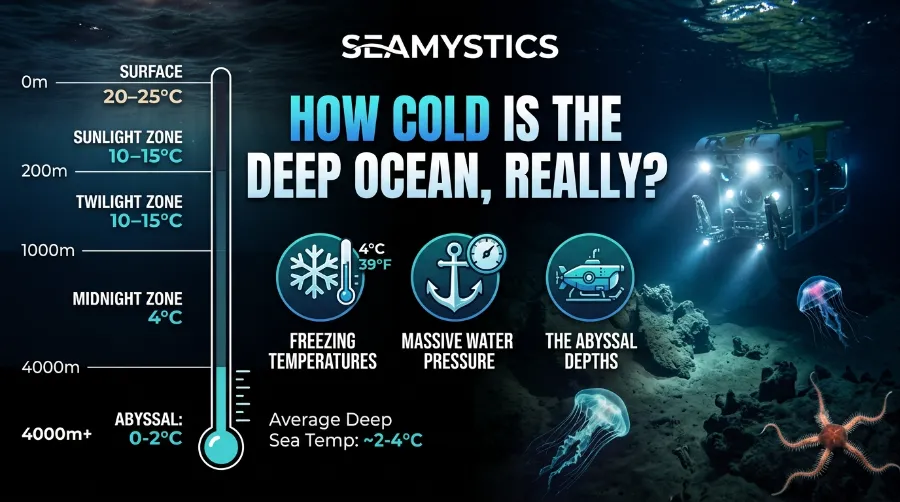
| Ocean Layer | Depth Range | Typical Temperature |
|---|---|---|
| Sunlight Zone | 0 to 200 m | 20°C to 4°C |
| Twilight Zone | 200 to 1,000 m | 4°C to 2°C (thermocline) |
| Midnight Zone | 1,000 to 4,000 m | 4°C to 2°C |
| Abyssal Zone | 4,000 to 6,000 m | 2°C to 0°C |
| Hadal Zone | 6,000 to 10,900+ m | 1°C to 0°C, occasionally below |
TL;DR: The deep ocean, generally anything below about 1,000 meters, sits at a fairly constant 0 to 4 degrees Celsius no matter where on Earth you measure it. This happens because cold, salty polar water sinks and spreads along the seafloor in a global current system. Salt also lowers seawater’s freezing point to around minus 1.9°C, which is why deep water stays liquid even that close to zero.
Why the Deep Ocean Stays So Cold
Sunlight is the whole story here. Warmth from the sun only reaches the top 200 meters or so of the water column, a layer scientists call the mixed layer. Below that, temperatures drop fast through a transition zone known as the thermocline, and then they level off into a long, cold plateau that barely changes for thousands of meters.
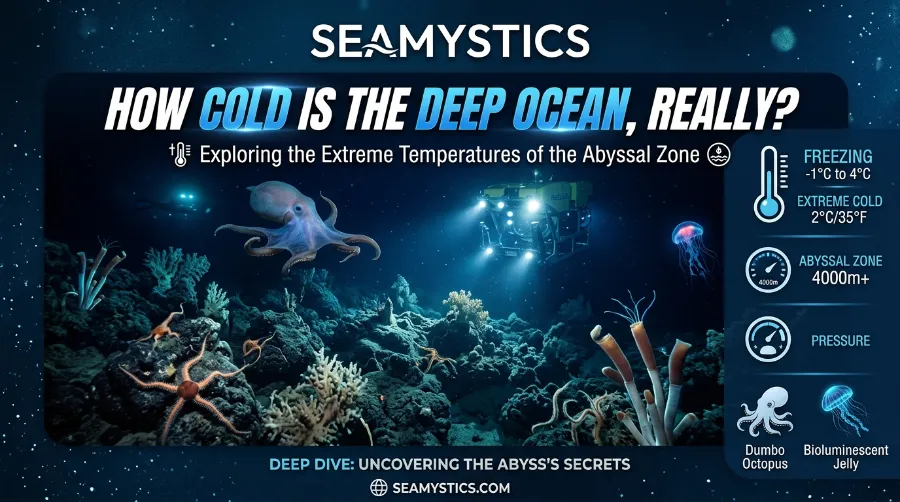
That plateau is what most people mean when they ask about deep ocean temperature. It is not the weather down there. It is closer to a physical constant.
Cold water is also denser than warm water, so it sinks. Near the poles, especially around Antarctica, seawater gets so cold that it forms dense brine, and this heavy water slides down the continental slope and spreads across the ocean floor. That single mechanism explains why a seafloor under the tropics can be nearly as cold as one near the Arctic. If you want a deeper dive into how ocean chemistry shapes these processes, our guide on ocean salinity trends covers the salt side of this story in detail.
Ocean Temperature by Depth: A Layer-by-Layer Breakdown
Ocean scientists split the water column into zones, and each one behaves differently.
- Sunlight zone (epipelagic), 0 to 200 meters. Warm, bright, and where almost all marine photosynthesis happens. Surface temperatures here can swing from about 30°C in the tropics down to near freezing at the poles.
- Twilight zone (mesopelagic), 200 to 1,000 meters. This is where the thermocline lives and where temperature drops sharply with every extra meter.
- Midnight zone (bathypelagic), 1,000 to 4,000 meters. Perpetual darkness, and temperatures settle into the 2 to 4°C range.
- Abyssal zone, 4,000 to 6,000 meters. Covers roughly 83 percent of the ocean floor. NOAA researchers recorded 2.2°C at 5,000 meters on Mona Seamount during the 2018 Océano Profundo expedition off Puerto Rico, a figure that lines up almost exactly with abyssal averages worldwide.
- Hadal zone, below 6,000 meters. Found mainly in deep-sea trenches. Temperatures here can dip toward 1°C, and near Antarctica, bottom water sometimes drops below 0°C without freezing.
That last point trips a lot of people up, so it deserves its own section.
The Coldest Part of the Ocean, and Why It Doesn’t Freeze
The coldest part of the ocean is generally the bottom water near Antarctica, where temperatures can fall to around minus 1.9°C. Fresh water freezes at 0°C, so this sounds impossible at first.
The trick is salt. Dissolved salt lowers the freezing point of seawater, and at a typical ocean salinity of about 35 parts per thousand, seawater does not freeze until roughly minus 1.8 to minus 1.9°C. Deep water sitting at 1 to 4°C is still comfortably above its own freezing threshold, even though it would freeze your garden hose solid in seconds.
Pressure plays almost no role in this, despite what many people assume. Water is nearly incompressible, so pressure does not meaningfully heat the deep sea. It is density and salinity doing the real work.
Abyssal Zone Temperature and Global Circulation
The abyssal zone temperature stays remarkably uniform across ocean basins, and that uniformity comes from a single global engine: thermohaline circulation. Cold, dense water forms near the poles, sinks, and creeps along the seafloor toward the equator over centuries. This slow conveyor belt is why deep water off Hawaii is nearly the same temperature as deep water in the North Atlantic, even though those two spots sit thousands of miles apart.
Researchers have traced this journey directly. One widely cited estimate puts the trip of North Atlantic deep water reaching the Pacific at roughly 900 years, a timeline explored in Kona Sea Salt’s writeup on deep ocean water’s journey. Understanding this circulation also connects directly to some common misconceptions about the ocean, which we break down in our ocean myths debunked guide.
For a technical, research-grade explanation of how these deep currents form and move heat around the planet, the American Museum of Natural History’s overview of global ocean circulation and deep-sea temperatures is one of the clearest public resources available.
Deep Sea Temperature Facts That Surprise Most People
A few numbers stick with people long after they leave one of my talks.
- The average temperature of the entire deep ocean, when you account for its enormous volume, comes out to roughly 3.5°C, according to classic oceanographic estimates.
- At the Challenger Deep, nearly 11 kilometers down in the Mariana Trench, temperatures still hover between about 1 and 4°C year round.
- Hydrothermal vents on the seafloor can blast out water as hot as 460°C, sitting just meters from water that is close to freezing.
- Humans have physically mapped only around 10 percent of the seafloor in detail, so scientists still rely on satellite data and models to estimate the rest.
That vent statistic surprises almost everyone, and it is worth sitting with for a moment. A single fissure can produce water hotter than a pizza oven, while the surrounding seafloor sits a few degrees above freezing. Life clusters around those vents precisely because of that extreme contrast, a topic closely tied to how species survive pressure in general, which we cover in our piece on human free diving limits.
Recent research has also found that deep ocean warming, while slow, is measurable and accelerating in some basins, a trend discussed by Kuʻualoha’s summary of rising deep ocean temperatures. Even a fraction of a degree of warming at these depths carries enormous implications for global heat storage, since the deep ocean absorbs a large share of the planet’s excess heat.
Why This Matters Beyond Curiosity
Deep ocean temperature is not just trivia for aquarium tours. It shapes where species can survive, how fast nutrients cycle through the water column, and how much heat the planet’s climate system can absorb before that heat shows up at the surface.
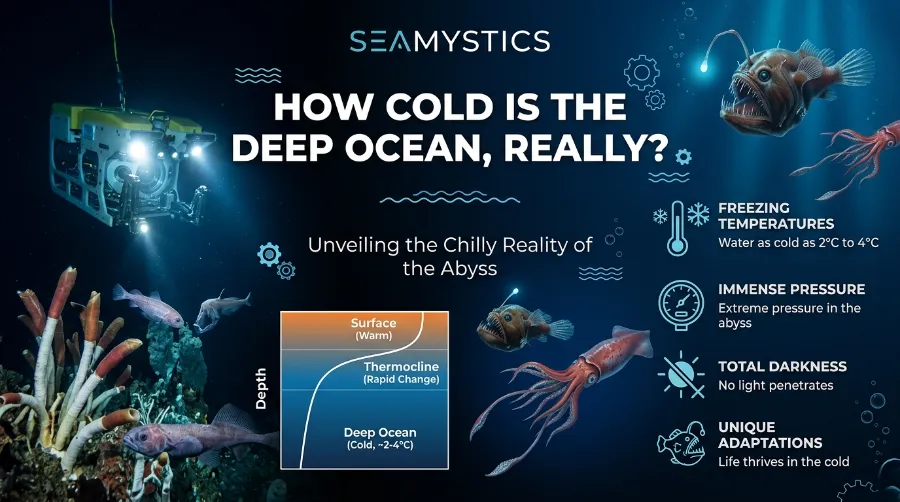
Cold, stable deep water also acts as a buffer. It stores heat that would otherwise raise surface and atmospheric temperatures faster than they already are. Small shifts in deep circulation patterns can ripple outward into weather systems, fisheries, and coastal biodiversity, which is part of why researchers keep close tabs on changes at these depths.
Frequently Asked Questions
What is the average deep ocean temperature?
Most of the deep ocean sits between 0 and 4°C, with a commonly cited global average around 3.5°C once you factor in its total volume.
What is the coldest part of the ocean?
Bottom water near Antarctica is typically the coldest, often sitting around minus 1.9°C without freezing, due to its salt content.
Does ocean temperature by depth ever reverse, with deeper water being warmer?
Generally no, except near hydrothermal vents, where localized water can reach several hundred degrees Celsius right next to near-freezing water just meters away.
Why doesn’t deep seawater freeze if it’s below 0°C?
Salt lowers the freezing point of seawater to around minus 1.8 to minus 1.9°C, so water at minus 1.9°C is still liquid, just barely.
Is the deep ocean warming?
Yes, though slowly. Long-term monitoring shows measurable warming trends in several deep ocean basins over recent decades.
Test What You’ve Learned
1. What is the typical temperature range of the abyssal zone?
A) 10°C to 15°C
B) 2°C to 0°C
C) 20°C to 25°C
Answer: B
2. Why doesn’t the coldest ocean water near Antarctica freeze?
A) It’s under too much pressure
B) Salt lowers its freezing point
C) Deep vents keep it warm
Answer: B
3. Roughly how deep does the thermocline typically begin?
A) Around 200 meters
B) Around 50 meters
C) Around 5,000 meters
Answer: A
4. What temperature did NOAA record at 5,000 meters on Mona Seamount in 2018?
A) 12°C
B) 2.2°C
C) 0°C exactly
Answer: B
5. What mainly drives the global movement of cold deep water?
A) Wind on the surface
B) Thermohaline circulation
C) Tidal pull from the moon
Answer: B
Conclusion
The deep ocean keeps a secret that surface weather never hints at. No matter how warm the tropics feel on a beach vacation, the seafloor beneath is locked into a near-freezing state that has held steady for a very long time. Salt, density, and a centuries-long global current explain nearly all of it, and that cold, dark world quietly shapes the climate we experience above the waves. Understanding it is not just a fun fact for dinner parties. It is a piece of the same puzzle scientists use to track everything from ocean biodiversity to long-term climate change, subjects we explore further in our guide to ocean and land biodiversity.
References
- NOAA Ocean Exploration, “How Does Ocean Temperature Vary?”
- American Museum of Natural History, “Global Ocean Circulation and Deep-Sea Temperatures”
- Britannica, “Abyssal Zone”
- WorldAtlas, “How Cold Is the Bottom of the Ocean?”
- ScienceABC, “With All That Pressure, Why Is the Bottom of the Ocean So Col