
Stand on any pier in Gloucester, Massachusetts or Grimsby, England today, and you’ll hear the same complaint fishing families have repeated for two generations. The boats go out farther. They stay out longer. They still come back with less. That’s not folklore. It’s ocean fish depletion showing up in real landing logs, and the numbers behind it are now impossible to ignore.
Key Takeaways
| Fact | Data Point | Source Year |
|---|---|---|
| Global stocks overfished | 35.5% of assessed stocks exceed sustainable limits | FAO, 2025 |
| Stocks sustainably fished | 64.5% overall, but only 35.1% in the Mediterranean and Black Sea | FAO, 2025 |
| Fishing gear lost yearly | 500,000–1,000,000 tons of ghost gear enters the ocean each year | WWF |
| Marine animals affected | Ghost gear entangles over 100,000 whales, dolphins, seals, and turtles annually | World Animal Protection |
| Long-term trend | Sustainable stock share fell from 90% in 1974 to roughly 64.5% today | FAO |
TL;DR: The ocean won’t run out of fish overnight, but it is running out of healthy, abundant fish in specific regions right now. Over a third of the world’s assessed marine fish stocks are already overfished, and that number climbs past 60% in the Mediterranean. Regions with real fisheries management, like the Northeast Pacific, prove the trend can reverse.
What “Running Out of Fish” Actually Means
The phrase gets thrown around loosely, so let’s ground it. Nobody serious predicts an empty ocean by a specific date. Scientists instead track fish stock decline: can a population reproduce fast enough to replace what’s caught? When a stock falls below that replacement threshold, researchers classify it as overfished. That classification is where the real story of ocean fish population change lives.
How Deep Sea Mapping Sonar Actually Works Today
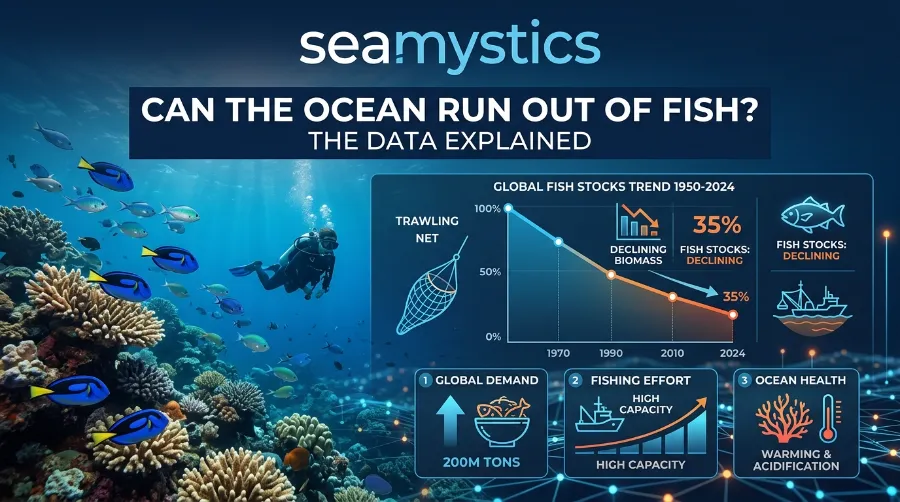
The UN’s Food and Agriculture Organization runs the largest version of this tracking. Its newest assessment, released at the 2025 UN Ocean Conference, evaluated 2,570 individual fish stocks. More than 650 scientists across 90 countries contributed data. It’s the widest lens researchers have ever used, and the results came back mixed rather than apocalyptic. That’s actually more useful than a headline built for panic.
Why Sharks Rarely Attack Humans, According to Data
The Overfishing Data, Plainly Stated
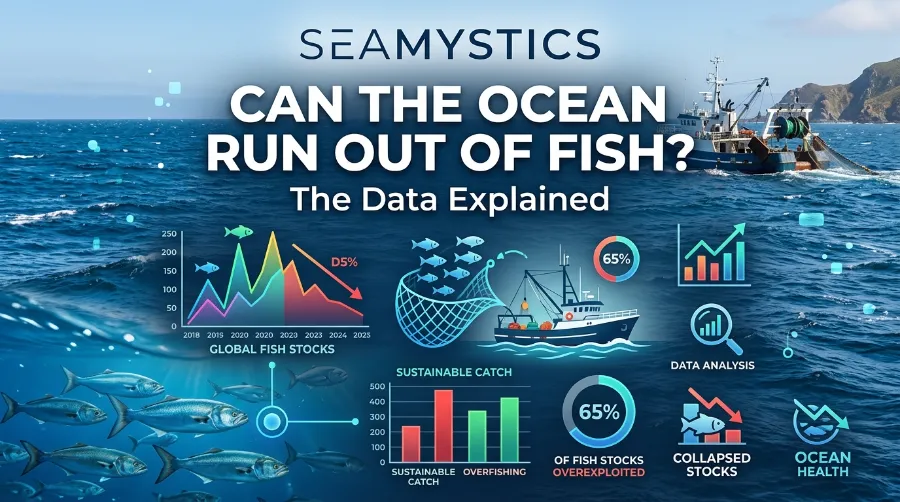
Here’s where the overfishing data facts stand, straight from that 2025 review:
- 64.5% of global fish stocks currently sit within biologically sustainable limits.
- 35.5% are overfished, meaning fishing pulls them down faster than they can recover.
- Weighted by catch volume rather than stock count, 77.2% of the fish landed globally comes from sustainable stocks, since well-managed fisheries tend to produce the most.
That last point matters. The crisis isn’t spread evenly. It concentrates in specific waters and specific species, and it tracks almost exactly with how well a region enforces its fishing limits. Check the full FAO 2025 marine fishery review for the raw methodology behind these numbers.
Where Fish Stock Decline Hits Hardest
Regional variation is the part most coverage skips. The FAO broke sustainability rates down by ocean basin, and the gap is stark:
| Region | Share of Stocks Sustainably Fished |
|---|---|
| Antarctic (assessed for the first time) | 100% |
| Northeast Pacific | 92.7% |
| Southwest Pacific | 85% |
| Eastern Central Atlantic | 47.4% |
| Southeast Pacific | 46% |
| Mediterranean and Black Sea | 35.1% |
Along Northwest Africa’s coastline, from Morocco down to the Gulf of Guinea, more than half of all stocks are now overfished. Recovery there remains slow. The Mediterranean fares worse still, with roughly two-thirds of its stocks fished unsustainably. Boat traffic in that same basin has dropped by nearly a third over the past decade, though. That decline hints that policy shifts are starting to work, just slowly.
Compare that to the Northeast Pacific, off the US and Canadian coast. Consistent quota enforcement keeps over 90% of stocks healthy there. The same ocean, the same fish biology, and a completely different outcome. Management makes the difference, not the water itself.
A Case Study: Atlantic Cod Off New England
Numbers on a chart are easy to skim past. A real collapse is harder to ignore. Canada shut down its Northern Atlantic cod fishery entirely in 1992. The stock had crashed by roughly 99% from its historic size. That closure put about 30,000 people out of work overnight in Newfoundland alone. Fishers had worked those cod grounds since the 1500s. Industrial trawling gutted the population in under fifty years, a population that had survived four centuries of dory fishing.
More than thirty years later, that stock still hasn’t fully rebuilt. Fisheries scientists return to this case constantly. It proves two things at once. Collapse can happen faster than anyone expects, and recovery isn’t guaranteed on any predictable timeline once a stock falls that far. For more on how fish experience that kind of pressure biologically, our piece on fish pain and sensory science breaks down the research.
Ghost Nets: The Silent Killers Drifting Through the Deep Ocean
Overfishing gets the headlines, but a quieter driver of ocean fish depletion drifts through the water column long after the fishing boat has gone home. Ghost gear, meaning nets, traps, and lines that fishers lose, abandon, or cut loose, keeps fishing on its own for years. Nobody controls it anymore, but it never stops catching.
How Much Gear Is Actually Out There
The scale is hard to picture. The World Wildlife Fund estimates that fishers discard or lose between 500,000 and 1 million tons of fishing gear in the ocean every year. Discarded nets and lines now make up roughly 46% of the mass in the Great Pacific Garbage Patch. That’s not a scattering of forgotten scraps. Some drifting nets span a full soccer field.
What Ghost Gear Does to Marine Life
Ghost gear kills indiscriminately, and the mechanics are grim:
- It entangles animals that can’t surface to breathe, so they drown slowly instead of dying quickly.
- It keeps catching and killing for years, sometimes decades, since synthetic nets can take centuries to break down.
- Currents drag heavy nets across coral reefs and seafloor habitat, damaging both with every pass.
- It strips commercially valuable fish from stocks that are already stressed, worsening the same fish stock decline these fisheries depend on.
World Animal Protection estimates that ghost gear entangles or kills more than 100,000 whales, dolphins, seals, and turtles every year. Nearly half of all marine mammals on the IUCN’s Red List have suffered harm from it.
Is the Ocean Actually Getting Saltier Over Time?
The Cost Nobody Adds Up
The WWF calculated that ghost fishing and related plastic pollution cost the Mediterranean roughly €641 million a year. Lost tourism, damaged marine industries, and reduced fisheries income make up that total. For organizations tackling the problem directly, Conserve Fish’s ongoing coverage tracks recovery efforts net by net, which is worth following if you want to see what removal looks like on the water.
Are We Running Out of Fish, or Running Out of Management?
This is the honest answer, and it’s less dramatic than the question implies. The ocean fish population isn’t collapsing uniformly. It’s splitting into two tracks, and the split depends entirely on whether a fishery has enforceable limits.
The Future of Ocean Exploration: What’s Next After 2026
Tuna proves this split clearly. Fishers now catch 87% of global tuna stocks sustainably, and 99% of all tuna caught comes from healthy stocks, according to FAO data. That species group was in real trouble two decades ago. Catch limits, tighter fleet regulation, and cooperation between countries that agree on little else turned it around. It shows the trend can reverse when the political will exists.
Compare that to the toli shad, Indian oil sardine, and several sardinella populations across South and Southeast Asia. All sit classified as overfished today, in waters where enforcement stays patchy and subsidized fleets carry far more fishing capacity than the stocks can support. The fish aren’t biologically different. Only the management differs.
Bycatch: The Overfishing You Don’t See on a Menu
A huge share of ocean fish depletion never reaches a dinner plate at all. Bycatch, meaning marine life caught unintentionally alongside a target species, makes up roughly a quarter of all marine catch worldwide. Shrimp trawling produces an even starker ratio. Boats often discard bycatch weighing up to five times more than the shrimp they actually keep.
That’s not a rounding error. A meaningful chunk of the running out of fish problem stays invisible to the average shopper, buried in catch methods rather than final sales numbers. Circle hooks, turtle excluder devices, and seasonal closures have cut bycatch significantly wherever fisheries adopted them. That’s another sign this problem is fixable through engineering and policy, not unstoppable by nature.
Do Fish Feel Pain? What Fish Pain Science Actually Shows
What Actually Works: Evidence From Recovered Fisheries
It helps to end on what’s proven, drawn from regions that already turned their numbers around:
- Hard catch limits tied to science, not political negotiation, predict a healthy stock better than any other single factor, as the Northeast Pacific’s 92.7% sustainability rate shows.
- Marine protected areas let breeding populations rebuild, but only when authorities actually enforce them rather than just designating them on paper.
- Reduced fleet subsidies remove the financial incentive to keep boats fishing a stock past the point of profitability.
- Gear modification requirements, like turtle excluder devices, cut both bycatch and the future ghost gear problem at the source.
- Regional cooperation agreements matter more than any single country acting alone, since fish cross maritime borders freely.
You can watch this pressure play out in real time through groups like the Marine Conservation Institute’s work against destructive fishing, which pushes for the exact gear and quota reforms listed above.
How Deep Can Humans Actually Dive Without Equipment?
Myths That Muddy This Conversation
Confusion around ocean fish depletion often comes from mixing up separate issues, or from outdated claims that keep circulating. Our ocean myths debunked guide covers several of these in depth, but two deserve a mention here.
Ocean Myths Debunked: What Marine Science Actually Confirms
- “The ocean is basically empty now.” This claim is false as a global statement. Overall biomass faces pressure in specific stocks and regions, not everywhere equally, and some fisheries produce more today than they did a decade ago.
- “Farmed fish solves the problem entirely.” Aquaculture eases pressure on some wild stocks, but it creates its own issues, since feed often comes from wild-caught forage fish. That shifts the pressure rather than removing it.
Curious how ocean chemistry factors into all this? Our breakdown of ocean salinity trends covers a related pressure compounding fish stock decline, separate from direct fishing pressure.
Frequently Asked Questions
Can the ocean actually run out of fish completely?
Not in the sense of zero fish left, but specific commercially important stocks have already collapsed to near zero. Northern Atlantic cod did exactly that in 1992. Total extinction of all marine fish isn’t the realistic risk; regional and species-level collapse already is.
What percentage of fish stocks are overfished right now?
The FAO’s 2025 review found 35.5% of the 2,570 assessed marine fish stocks worldwide qualify as overfished.
Is ghost fishing gear really that big a problem?
Yes. Fishers lose or abandon between 500,000 and 1 million tons of gear every year, and that gear keeps catching and killing marine life long after anyone controls it.
Which fish stocks are recovering, not just declining?
Tuna stands out as the clearest global success story. Fishers now catch 87% of tuna stocks sustainably after decades of tighter international quotas. Antarctic stocks, newly assessed in 2025, came back at 100% sustainable.
What can an individual actually do about this?
Choosing seafood certified by recognized sustainability programs helps. So does supporting policy that funds enforcement rather than just designating protected areas on paper, and backing gear-recovery groups that pull ghost nets out of the water.
Conclusion
Ocean fish depletion isn’t a single countdown toward an empty sea. It’s a patchwork of outcomes. Some are genuinely alarming. Others are genuinely hopeful. The difference almost always comes down to whether real management exists and gets enforced. The Mediterranean’s collapse and the Northeast Pacific’s recovery are unfolding in the same decade, in the same ocean, under wildly different rules. That gap is the actual story, and policy choices being made right now are still writing its ending.
References
- FAO. Review of the State of World Marine Fishery Resources 2025. Food and Agriculture Organization of the United Nations, 2025.
- World Wildlife Fund. Ghost Fishing Gear Explainer. worldwildlife.org, 2024.
- World Animal Protection. Ghost Gear Statistics and Global Ghost Gear Initiative Reports.
- NRDC. A Single Discarded Fishing Net Can Keep Killing for Centuries. nrdc.org.
- Fisheries and Oceans Canada. Northern Cod Stock Assessment History, 1992–present.
- Marine Stewardship Council. What the FAO’s Latest Report Tells Us About Sustainable Fishing: Six Takeaways. msc.org, 2025.