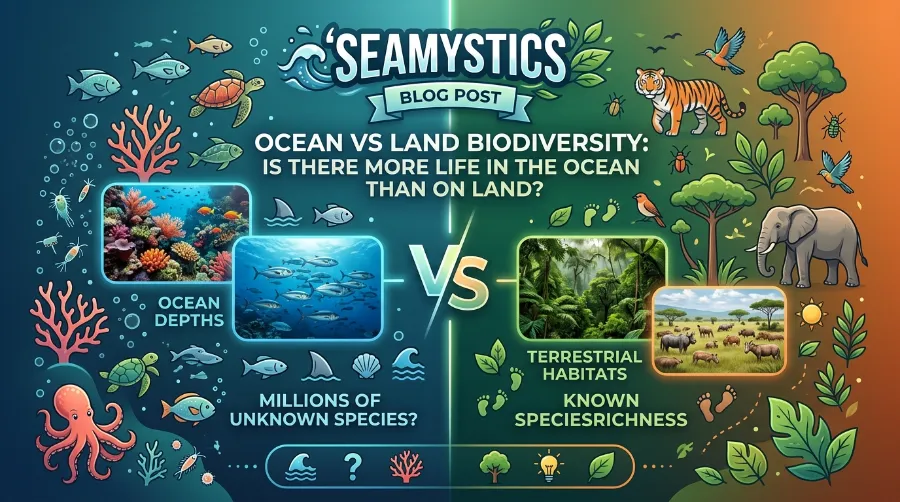

Ask ten people whether the ocean or the land holds more life, and most will pick the ocean without a pause. After all, the sea covers about 71 percent of our planet. But the real answer to the ocean land biodiversity question depends on what you count. In this guide, I break down species, weight, and living space with the newest 2026 numbers.
TL;DR: Land holds far more named species, about 80 percent of the total, and almost all of the plant weight. However, the ocean holds most of the animal weight, more major animal groups, and most of Earth’s living space. So land wins the species count today, but the sea may still hide millions of species that no one has named.
Key Takeaways: Ocean and Land Life at a Glance
| Question | Short answer | Best current number |
|---|---|---|
| Which realm has more named species? | Land | About 80% land, 15% ocean, 5% fresh water |
| How many marine species have names? | About 250,000 | 250,844 accepted species (WoRMS, 2026) |
| Which has more total weight of life? | Land | About 470 Gt C on land, 6 Gt C in the sea |
| Which has more animal weight? | Ocean | About 78% of all animal biomass |
| How many marine species exist? | Nobody knows yet | Estimates range from 0.3 to 2.2 million |
| How many new ocean species per year? | 1,000 to 2,300 | 1,121 found by Ocean Census in 2025 to 2026 |
I am Dr. Rabica, and I have spent two decades working with marine species lists, survey data, and taxonomy teams. Because of that work, I learned one lesson early: the question sounds simple, yet every number hides a definition. So let me walk you through it step by step. First, we will clear up what “more life” means. Then we will look at species counts, the weight of life, and the big gaps that remain. Finally, we will look at what is at risk and what you can do.
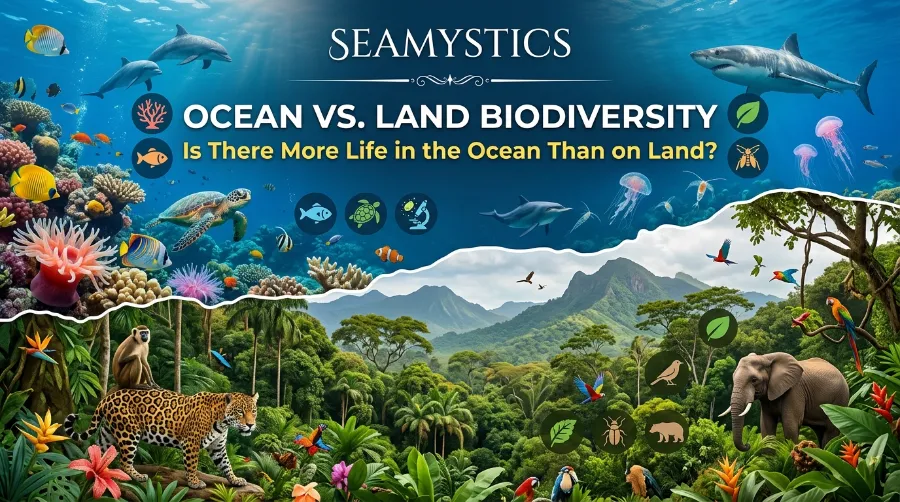
What Does “More Life” Really Mean?
Four Ways to Measure Life
Most online answers fight each other because they measure different things. For example, one page says most life is in the ocean, while another says most life is on land. Both can be right, because each one counts something different. Here are the four ways scientists compare life in the two realms:
- Species count: how many different kinds of organisms live there.
- Biomass: the total weight of living things, usually in gigatons of carbon (Gt C).
- Body plans: how many major animal groups (phyla and classes) appear.
- Living space: how much room is available for life to spread out.
Each measure gives a different winner. Also, each one has its own problems. For instance, species counts depend on who has named what, while biomass depends on what you include, such as microbes deep underground.
Why the Winner Changes
In my experience, the fastest way to spot a weak claim is to ask one question. Which of the four measures is this number using? If the writer does not say, be careful. The table below shows how the winner shifts.
| Measure | Land | Ocean | Winner |
|---|---|---|---|
| Named species share | About 80% | About 15% | Land |
| Major animal groups | Fewer | More | Ocean |
| Plant weight | 99.8% | 0.2% | Land |
| Animal weight | 22% | 78% | Ocean |
| Habitable space | Small share | About 97% | Ocean |
As the table shows, scientists estimate that 80 percent of Earth’s species live on land, 15 percent in the ocean, and the rest in fresh water. Meanwhile, the ocean holds about 97 percent of the habitable space and roughly 78 percent of animal biomass. So the ocean is the biggest home on Earth, yet land has more named kinds of life.
Ocean Species Count: How Many Species Live in the Ocean Today?
Let us start with the number everyone wants. Because the ocean species count climbs every year, it is a moving target.
The 2026 WoRMS Milestone
On 13 May 2026, the World Register of Marine Species passed a new milestone. It now lists more than 250,000 accepted marine species, with 250,844 in the database at the latest count. Only three years earlier, the same register held about 242,000 valid species. As a result, the list grew by roughly 8,800 species by my math.
Names Are Not the Same as Species
Now, why do people quote so many different totals? The answer is that names and species are not the same thing. For example, WoRMS holds 524,511 marine names, including synonyms. So fewer than half of the names on file, about 48 percent, are accepted species. The rest are old names, duplicates, and spelling variants.
Here is a practice tip from my own work. Before I trust any species list, I run it through a synonym check. Otherwise, you count the same animal twice and inflate the total.
Marine Animals Alone
Next, look at animals only. Scientists have described about one million animal species, including more than 170,000 marine ones. That means marine animals make up roughly one in six named animals, by my calculation. Still, broader estimates suggest Earth may host about 7.7 million animal species, with around 2.1 million in the sea.
| Group | Named so far | Estimated total |
|---|---|---|
| All marine species | About 250,000 | 0.3 to 2.2 million |
| Marine animals | More than 170,000 | About 2.1 million |
| All species on Earth | About 2.16 million | About 8.7 million |
If you want to see how easily popular numbers drift from the data, our guide to ocean myths debunked is a good place to start. In short, treat every figure as a snapshot, not a final answer.
Ocean vs Land Species: Why Land Wins the Headcount
Here is the puzzle. Because the ocean is huge and very old, it should hold more species. Yet it does not.
Less than 15 percent of described multicellular species are marine, while 80 percent live on land and 5 percent in fresh water. In fact, Robert May pointed out this puzzle in 1994, so scientists have argued about it for more than 30 years. Some people say land is simply better explored. That is a fair idea, but the numbers do not back it up. For example, marine species are described at about 2,332 per year, or 0.95 percent of the marine total. On land, about 16,000 species are described each year, or 1.02 percent. Since the two rates are almost the same, sampling bias cannot explain the whole gap.
Plants and Insects Give Land a Big Head Start
The strongest clue sits at the bottom of the food chain. Land and fresh water hold about 391,000 species of vascular plants, while the sea holds only about 5,000 species of marine phytoplankton. That is a gap of nearly 80 to 1.
Why does this matter? Because plants build habitat. For example, a forest gives insects thousands of leaves, roots, bark layers, and flowers to live on. Then each insect group gets its own predators and parasites. As a result, one plant species can support dozens of animal species. In the open ocean, however, the main producers are tiny floating cells. Since they live for days, not decades, they build no tall structure and open fewer niches.
The Ocean Is One Connected Room
Water moves. So currents carry larvae across whole basins, and many marine populations keep mixing. That mixing works against the birth of new species, because new species often form when groups stay apart.
Land, on the other hand, has mountains, deserts, rivers, and islands. Each one splits populations, and over millions of years those splits create new species. Therefore, many ecologists think this difference explains a large part of the gap.
Old Life Does Not Always Mean More Species
The sea had a huge head start. In fact, most animal groups alive today arose in the sea after the Cambrian explosion, about 540 million years ago. Plants began colonizing land much later, around 390 million years ago. Even so, land now leads the species count, so time alone does not decide diversity.
Here are the main reasons in short:
- Land plants create complex 3D habitat.
- Insects split into millions of specialized niches.
- Barriers on land isolate populations and speed up speciation.
- Ocean currents mix populations and slow that process.
- Some marine groups are still under-described, especially small worms and crustaceans.
Biodiversity Comparison Ocean: Where the Sea Wins
More Body Plans in the Sea
Now let us flip the story. When you shift from species to body plans, the ocean pulls ahead. A phylum is a major body plan, such as arthropods, mollusks, or chordates. Oceans contain more phyla and classes than land and fresh water combined.
For instance, an older analysis counted 34 phyla in the marine realm against 15 on land, and 77 classes in the sea against 33 on land. Although the exact counts have shifted since then, the pattern still holds. In plain words, land has many species built on a few designs, while the sea has fewer species but far more designs. For example, jellyfish, comb jellies, sponges, sea stars, and sea squirts have no true match on land.
More Animal Weight and Space
The ocean also wins on animal weight. As shown earlier, about 78 percent of animal biomass sits in the sea, including fish, krill, copepods, and squid. Also, the ocean is deep. Because its average depth is 3,682 meters and life exists throughout, it offers a truly three-dimensional home. Most land life, however, lives on or near the surface.
Fear Can Skew the View
Fear can also skew how we see the sea. For example, sharks get the headlines, yet the real shark attack statistics show how rare bites are compared with the millions of other animals living quietly below. Likewise, the debate over how fish feel pain reminds us that ocean vertebrates are far more complex than many people assume.
So my own view is simple. A fair biodiversity comparison ocean and land should show both scores side by side. Land wins on species, but the sea wins on design variety and animal weight.
Ocean Land Biodiversity by Biomass: The Weight of Life
Land Is About 80 Times Heavier
Weight tells a very different story. Here, land wins by a wide margin. A major study from Yinon Bar-On, Rob Phillips, and Ron Milo mapped all life by weight. It found about 550 Gt C in total, with plants at about 450, bacteria at about 70, archaea at about 7, and animals at about 2.
Also, land holds about 470 Gt C while the ocean holds only about 6 Gt C. So by my math, land is about 80 times heavier.
| Kingdom | Weight (Gt C) | Where most of it lives |
|---|---|---|
| Plants | About 450 | Land |
| Bacteria | About 70 | Deep underground |
| Archaea | About 7 | Deep underground |
| Animals | About 2 | Mostly the ocean |
Why Ocean Life Weighs So Little
Yet there is a twist. The two realms make about the same amount of new plant matter each year. The difference is speed. Because ocean algae live and die in days, animals eat them almost as fast as they grow. Trees, on the other hand, store carbon for decades or centuries.
The makeup of life also flips. For instance, animals, protists, and bacteria make up about 80 percent of marine biomass but only about 2 percent on land, while plants make up about 95 percent of land biomass. So the sea is a consumer world, and land is a plant world.
An Upside-Down Food Pyramid
Here is the visual version of the land and ocean gap.
[Insert Chart 1: Total biomass, land 470 Gt C vs ocean 6 Gt C]
The ocean’s food pyramid is also upside down. Its consumers weigh about 5 Gt C, while its producers weigh only about 1 Gt C. In other words, the sea holds more grazers and hunters than plants, and that only works because the tiny producers regrow so fast.
How Many Species Ocean Scientists Still Need to Find
Two Estimates, One Big Gap
Now we reach the biggest question mark. Nobody knows the final number, and experts do not agree. In 2011, the Census of Marine Life team predicted about 8.7 million eukaryote species on Earth, give or take 1.3 million. Of those, about 2.2 million live in the ocean. Also, the same study said 86 percent of land species and 91 percent of ocean species still lacked a name.
But other scientists disagree. A later group estimated that only about 0.3 million marine species may exist once you account for synonyms. So the possible total runs from 0.3 million to 2.2 million, a gap of more than seven times.
My Analysis of the Gap
Here is where I add my own analysis. First, I took today’s WoRMS count of 250,844 accepted species. Then I tested it against both estimates, using the long-term pace of 2,332 new marine species a year.
| Estimate | Total marine species | Share named today | Years left at 2,332 per year |
|---|---|---|---|
| Low (Costello) | 0.3 million | About 84% | About 21 years |
| High (Mora) | 2.2 million | About 11% | About 836 years |
The result is striking. If the low estimate is right, taxonomists could finish within one working career. But if the high estimate is right, it would take centuries at the current pace. So the size of the ocean’s hidden life depends on one disputed number.
[Insert Chart 2: Marine species, named today 0.251 million vs low estimate 0.3 million vs high estimate 2.2 million]
Why the Count Is So Hard
Why is the count so hard? For one thing, many species already sit in storage. UNESCO reports that roughly 65,000 unknown species have been collected but never formally described. Also, about 150 new marine fish species get described each year, and around 5,000 marine fish remain unknown.
Then there is the sampling gap. Around half of the global ocean is still under-sampled, and more than 160 million square kilometers below 200 meters lack data. In addition, scientists have directly seen less than 0.001 percent of the seafloor, and NOAA estimates that 700,000 to 1,000,000 species remain undiscovered.
Depth adds to the challenge, because even the deepest human breath-hold dives barely scratch the surface, as our piece on human free diving shows. So most ocean life lives far below where any diver can go.
Real Case Studies: What New Discoveries Teach Us
Numbers feel abstract, so let us look at real discoveries. Each one teaches a different lesson.
Case Study 1: Ocean Census, 2025 to 2026
Between April 2025 and March 2026, the Ocean Census alliance found 1,121 new marine species, a 54 percent rise in yearly discoveries. For this, the team ran 13 expeditions and nine species discovery workshops. Highlights included a new deep-sea ghost shark from the Coral Sea and a worm that lives inside the chambers of a glass sponge on a volcanic seamount. In addition, some finds came from depths of up to 6,575 meters.
Case Study 2: The Museum Drawer Effect
Here is the part that surprised me most. Out of the 1,121 new species, 728 came from teams working through museum archives and their own collections. To speed this work, Ocean Census gave 25 discovery awards to taxonomists in 14 countries.
So my analysis is simple: the main bottleneck is not ships or robots, but people who can name a species. Therefore, funding more taxonomists may add more species to the list than funding another expedition.
Case Study 3: A Decade of Big Animals
Even large animals still turn up. For instance, UNESCO’s review of 1999 to 2008 counted 780 new crab species, 29 new lobster species, 286 new shrimp species, and 1,565 new fish species. So the idea that only tiny things remain is wrong.
What Experts Say
Dr. Michelle Taylor, head of science at Ocean Census, warns that scientists are in a race against time. Her point is that some species may vanish before anyone documents them. I agree, and that concern shapes the next sections.
My Evidence-Based View
Here is my honest opinion, and I label it as such. First, the low estimate of 0.3 million looks too tight to me, because discovery is not slowing down and half the ocean is under-sampled. But the high estimate of 2.2 million rests on a model that assumes patterns hold everywhere. So the truth likely sits between them. Overall, I would not bet on the ocean beating land on total species count, but I would bet on a much larger marine total than we list today.
Common Mistakes When People Compare Ocean and Land Life
Over the years, I have seen the same errors again and again. Watch for these:
- Mixing measures: quoting biomass for one realm and species for the other.
- Counting synonyms: treating 524,511 names as 524,511 species.
- Ignoring microbes: because most microbial diversity is hard to name, tables often leave it out.
- Using coasts as the model: shallow reefs are packed with life, but the open ocean is often more like a desert with oases.
- Assuming unexplored means unlimited: unknown does not mean endless.
To check any claim, follow these steps:
- First, find out which measure the number uses: species, weight, or space.
- Next, check the year, because numbers from 2011 and 2026 are not the same.
- Then look for the original study, not a copy of a copy.
- Also check whether the count includes synonyms, fossils, or fresh water.
- Finally, compare at least two sources before you share it.
Threats: Life Disappearing Before We Name It
Why does all this matter? Because we can lose species we never counted.
Overfishing and Changing Water
Overfishing is the clearest pressure. If you want the long story, read our breakdown of ocean fish depletion. Also, warming and shifting chemistry matter, and ocean salinity trends show how changes in the water itself can reshape where species can live.
Lost Gear and Deep Mining
Then there is lost fishing gear. Because abandoned nets keep catching animals for years, they often entangle whales, turtles, and fish. Deep-sea mining is a newer worry too, since it targets the same seafloor where scientists keep finding new species.
Groups That Track the Problem
Good field groups explain all of this in plain language. For example, Oceana’s blog follows plastic, mining, and right whale entanglement. Meanwhile, Ocean Wise stories cover kelp forests, whales, and sustainable seafood. And Together for the Ocean explains the push to protect at least 30 percent of the ocean by 2030. You can also find more of our guides on the Sea Mystics homepage.
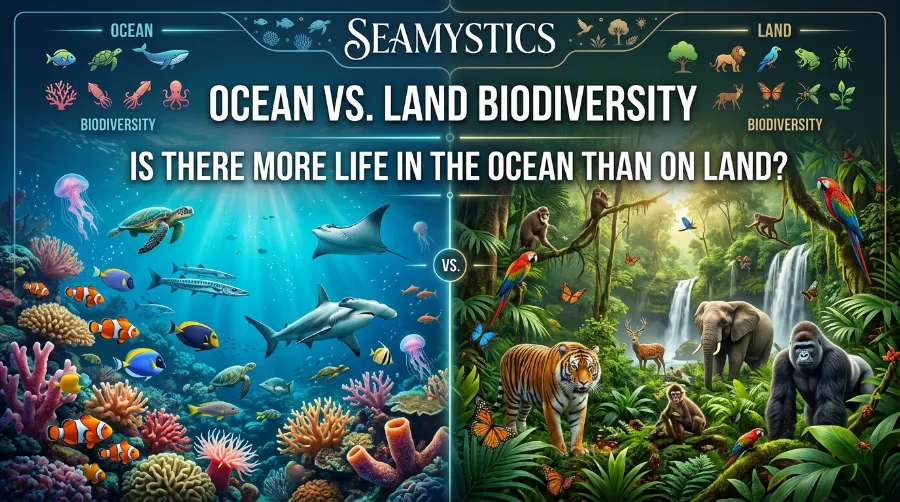
Simple Ways to Protect Ocean Life
You do not need a research ship to help. Start with these steps:
- Pick better seafood. First, ask where your fish came from and how it was caught.
- Cut single-use plastic. Because less plastic means less trash reaching the sea, small habits add up.
- Support ocean protection goals. Also, back local and national efforts to protect marine areas.
- Join citizen science. Then report whale sightings and beach finds to real programs.
- Share checked facts. Finally, use the steps above before you repost a big number.
Frequently Asked Questions
Is there more life in the ocean than on land?
It depends on the measure. Land has more named species and far more plant weight. However, the ocean has more animal weight, more major animal groups, and most of the habitable space.
How many species live in the ocean?
About 250,000 marine species have accepted names today. Still, scientists estimate the real total at anywhere from 0.3 million to 2.2 million.
Why does land have more species if the ocean is bigger?
Because land plants build complex habitat, insects split into millions of niches. Also, barriers like mountains and rivers isolate populations and speed up new species. Ocean currents, however, mix populations, which slows that process.
How much of the ocean have scientists explored?
Very little in detail. For example, scientists have directly seen less than 0.001 percent of the seafloor, and about half of the ocean is under-sampled.
How many new ocean species are found each year?
The long-term average is about 2,332 new marine species per year. In 2025 to 2026, however, Ocean Census alone added 1,121.
Conclusion
So, is there more life in the ocean than on land? On species, land leads. But on animal weight, body plans, and living space, the ocean leads. And on total weight of life, land wins by about 80 times.
The bigger lesson is that ocean land biodiversity is not a single score. Instead, it is a set of scores, and each one tells a different part of the story. Best of all, the ocean’s story is still unfinished. With about 250,000 species named and possibly hundreds of thousands more waiting in jars and deep trenches, the next big discovery may already be sitting in a museum drawer.
Quick Quiz: Test What You Learned
1. About what share of described species live on land?
A) 30% B) 50% C) 80% D) 95%
2. Which realm holds most of the world’s animal biomass?
A) Land B) Ocean C) Fresh water D) The air
3. Roughly how many accepted marine species did WoRMS list in 2026?
A) 25,000 B) 250,000 C) 2.5 million D) 25 million
4. True or false: Land holds about 80 times more total biomass than the ocean.
5. True or false: Fewer than half of the marine names in WoRMS are accepted species.
Answers: 1) C. 2) B. 3) B. 4) True, about 470 Gt C versus 6 Gt C. 5) True, about 48 percent are accepted.
References
- World Register of Marine Species (WoRMS), species counts and milestone notice, 2026.
- Ocean Census press release, “Scientists discover over 1,100 new marine species,” May 2026.
- Scientific American, coverage of the Ocean Census 2025 to 2026 results, 2026.
- Bar-On, Phillips and Milo, “The biomass distribution on Earth,” PNAS, 2018.
- Bar-On and Milo, “The biomass composition of the oceans,” Cell, 2019.
- Mora et al., “How many species are there on Earth and in the ocean?” PLoS Biology, 2011.
- Bouchet et al., “Marine biodiversity discovery: the metrics of new species descriptions,” Frontiers in Marine Science, 2023.
- BIOcean5D and AZTI, “The diversity conundrum: why do oceans shelter fewer species than land?” 2025.
- UNESCO, “Ocean life: the marine Age of Discovery.”
- NOAA Ocean Exploration, “How much of the ocean has been explored?”
- Nature Communications, “Gaps and drivers of global marine animal biodiversity from the surface to abyss,” 2026.
- Encounter Edu, “8 ocean vs land life facts.”