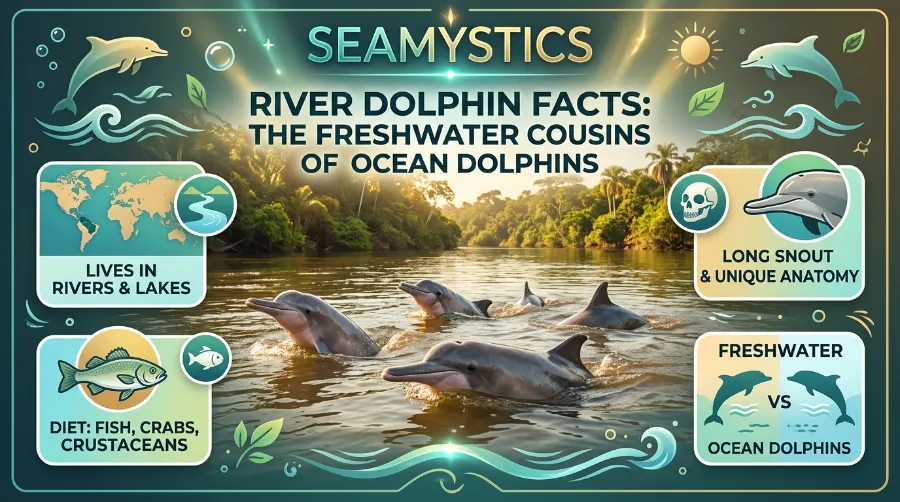

River Dolphin Facts: The Freshwater Cousins of Ocean Dolphins
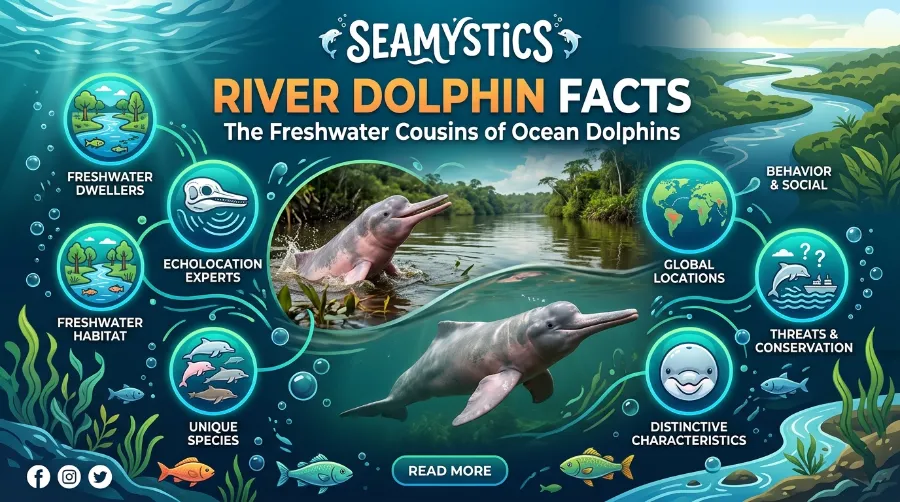
Most people picture a dolphin leaping through ocean waves. Yet some dolphins never see the sea at all. These river dolphin facts will show you a stranger, shyer, and more fragile side of the dolphin family, one that lives in muddy rivers on three continents.
TL;DR: River dolphins are freshwater cousins of ocean dolphins. They have long beaks, tiny eyes, and bendy necks that help them hunt in cloudy water. Most species are endangered, so protecting rivers is the only way to keep them alive.
Key Takeaways
| Question | Short Answer |
|---|---|
| What are they? | Dolphins that live in rivers, lakes, and flooded forests |
| Where do they live? | The Amazon and Orinoco in South America, the Ganges and Indus in South Asia, the Mekong in Southeast Asia |
| Why is the pink one pink? | Age, scars, and blood flow close to the skin |
| How do they see? | Poorly. They rely mostly on echolocation |
| Biggest threats | Dams, fishing nets, mercury, heat, and illegal bait fishing |
| Conservation status | Most are Endangered or Critically Endangered |
| One thing you can do | Support river protection and choose responsible travel |
Why Freshwater Dolphins Are Not Just “Ocean Dolphins in a River”
Many readers ask if river dolphins are simply ocean dolphins that swam upstream. The answer is more interesting. Several river dolphin groups split from the ocean line millions of years ago. Over time, they changed to fit slow, brown, tangled rivers.
Scientists call this a case of convergent evolution. Different animals in similar places end up with similar tools. River dolphins grew long beaks, small eyes, and flexible necks because those traits work in muddy water.
Porpoise Dolphin Differences: The Real Porpoise vs Dolphin Facts Explained
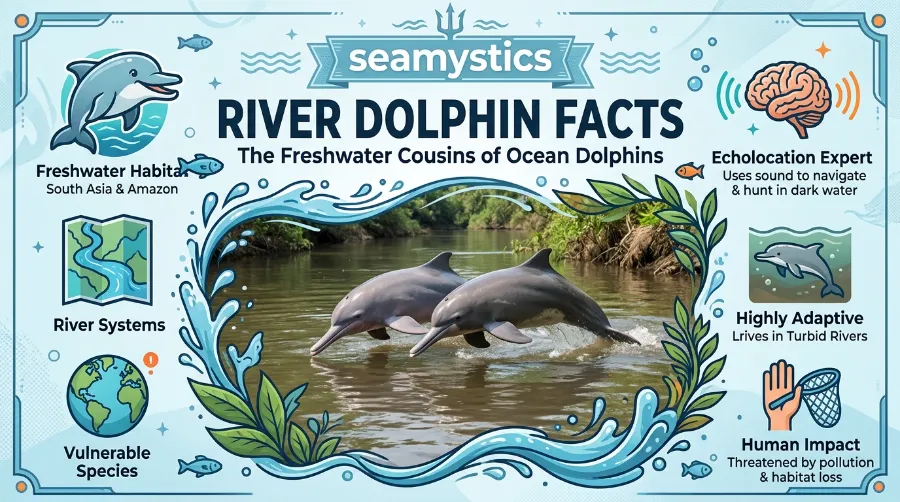
How a river dolphin body differs from an ocean dolphin body
Ocean dolphins like the bottlenose are built for speed in open water. If you want a close comparison, read our guide to bottlenose dolphin facts. River dolphins are built for turns, not sprints.
Here are the main differences:
- Neck: Ocean dolphins have fused neck bones. Pink river dolphins have unfused neck bones, so they can turn their heads almost 90 degrees.
- Beak: River dolphins have long, thin beaks that poke into roots and mud for fish.
- Flippers: Their flippers are broad and paddle shaped. They help the dolphin steer around tree trunks.
- Eyes: Their eyes are small. Some species have almost no useful vision.
- Speed: They swim slowly, usually around 1 to 3 kilometers per hour while feeding.
I once watched a pink dolphin slip between two flooded tree trunks that were barely wider than its body. It did not touch either one. That turn would be impossible for a bottlenose dolphin.
Spinner Dolphin Facts: Why They Leap and Spin
The Main Freshwater Dolphin Species You Should Know
Experts do not agree on one exact list. Scientists still debate how many freshwater dolphin species exist, and the names change as new studies appear. Even so, most lists include the groups below.
Amazon river dolphin (Inia geoffrensis)
The Amazon river dolphin is the largest river dolphin. Adult males can reach about 2.5 meters (8 feet) and 185 kilograms (about 400 pounds). It lives across the Amazon and Orinoco basins. The IUCN Red List classed it as Endangered in 2018.
Bolivian and Araguaian botos
Researchers described a separate Araguaian boto in 2014. Many experts also treat the Bolivian river dolphin as its own species. This shows how little we still know. Each new name means each small population needs its own protection plan.
Tucuxi (Sotalia fluviatilis)
The tucuxi is a small grey dolphin. It is a true member of the oceanic dolphin family, even though it lives in freshwater. The IUCN lists it as Endangered. If you see a small dolphin leaping in the Amazon, it is likely a tucuxi, not a pink one.
Ganges and Indus river dolphins
These two South Asian species are often called “susu” because of the sound they make when they breathe. They are almost blind. They swim on their sides and drag a flipper along the riverbed. Both are listed as Endangered.
Baiji (Lipotes vexillifer)
The baiji lived in China’s Yangtze River. A big survey in 2006 found none. Scientists then declared it functionally extinct. It remains the clearest warning of what can happen when a river is overused.
Irrawaddy dolphin, Mekong population
Some Irrawaddy dolphins live in rivers and some live along coasts. The Mekong group is Critically Endangered. Recent counts in Cambodia and Laos put them under 100 animals.
Dolphin Species Guide: Every Type of Dolphin in the Ocean
Species Comparison Table
| Species | Home Waters | Approx. Max Length | IUCN Status |
|---|---|---|---|
| Amazon river dolphin | Amazon, Orinoco | 2.5 m | Endangered |
| Tucuxi | Amazon basin | 1.5 m | Endangered |
| Ganges river dolphin | Ganges, Brahmaputra | 2.6 m | Endangered |
| Indus river dolphin | Indus (Pakistan) | 2.5 m | Endangered |
| Mekong Irrawaddy dolphin | Mekong | 2.3 m | Critically Endangered |
| Baiji | Yangtze | 2.4 m | Functionally extinct |
Statuses come from the IUCN Red List. Check the live listing before you cite them, because they can change.
For a wider view of all dolphin groups, see our dolphin species guide
Pink River Dolphin Facts: Why Is It Pink?
The pink river dolphin is the star of most river dolphin facts. Its color surprises almost every visitor. Babies are born grey. As they grow, they turn pink.
Three things cause this change. First, dolphins scar each other during play and fights. Healed scars look pale and pink. Second, blood flows close to the skin, so warm, active dolphins blush. Third, older males are usually the pinkest because they have fought the most.
Here is a simple way to remember it:
- Young dolphins are grey.
- Teen dolphins start to show pink patches.
- Adult males often turn bright pink.
- Females stay more grey or light pink.
During a boat trip on a flooded Amazon tributary, our group counted twelve adults in one morning. Only three were truly bright pink. All three were large males with heavy scarring. That matches what researchers describe in the literature.
Dolphin Echolocation Science: How Dolphins See With Sound
Built for Murky Water: How They Hunt
Most rivers where these dolphins live are brown, thick with silt, and full of sticks. Eyesight does not help much. So they use sound.
River dolphins send out clicks. The clicks bounce off fish, roots, and mud. The dolphin reads the echo like a picture. If you want to understand this skill in depth, our guide on dolphin echolocation science explains it step by step.
What do they eat?
Amazon river dolphins eat more than 50 kinds of fish. They also eat crabs and small turtles. Their teeth are not all the same. Front teeth are sharp and cone shaped for grabbing. Back teeth are flat for crushing. That mix is rare in dolphins.
Do they work together?
Yes, sometimes. Researchers in Brazil have seen dolphins and giant otters feed near each other. Local fishers also tell stories of dolphins herding fish toward nets. Scientists treat many of these stories with care. Still, the pattern shows how smart and flexible these animals are.
This kind of teamwork is more famous in marine mammals like orcas. Read about it in our article on orca pod structure.
Field Notes From Dr. Rabica
I want to share what I see on real river trips, because books rarely cover it.
Observation 1: Shy dolphins surface in the same places. In one week on a tributary, I saw dolphins surface at the same two bends each morning. They likely fed where fish gathered at the river edge.
Observation 2: Water level changes everything. In the wet season, dolphins swim into flooded forest. In the dry season, they crowd into main channels and lakes. Counts in the dry season are easier, but they can mislead you about how many animals really live in the whole region.
Observation 3: Noise matters. When a loud engine passed, the dolphins left within minutes. They came back only after the sound faded. That small test matches studies that link boat noise to stress in dolphins.
My opinion, based on years of fieldwork, is simple. We often talk about dolphin numbers. We should talk more about dolphin space. A river with fewer boats, fewer dams, and clean water will hold dolphins. A river without those things will not.
Bottlenose Dolphin Facts: The Ocean’s Most Studied Marine Mammal
Why Endangered River Dolphins Keep Disappearing
The phrase “endangered river dolphins” is not just a label. It describes real, measurable decline. Here are the main causes.
| Threat | How It Harms Dolphins | Where It Is Worst |
|---|---|---|
| Dams | Split populations and block movement | Ganges, Indus, Mekong, Amazon tributaries |
| Fishing nets | Dolphins get tangled and drown | All river basins |
| Mercury from gold mining | Builds up in fish and then in dolphins | Amazon |
| Heat and drought | Warm, shallow water stresses dolphins | Central Amazon |
| Illegal bait fishing | Dolphins are killed to catch catfish | Brazil, Colombia |
| Boat traffic and noise | Disturbs feeding and calls | Busy river routes |
Case study 1: The Lake Tefé die-off, 2023
In September and October 2023, more than 130 dolphins died in Lake Tefé in Brazil. Water in the lake reached about 39 degrees Celsius (102 degrees Fahrenheit). Scientists linked the deaths to extreme heat during a severe drought. Rescue teams tried to move some dolphins to cooler water. Many still died. This event showed that climate change is no longer a future problem for these animals.
Case study 2: The Mamirauá decline
A long study in the Mamirauá Reserve in Brazil tracked Amazon river dolphins for over two decades. The study found large drops in numbers, with one estimate showing they halved roughly every ten years. That is a steep fall for a species that lives a long time and has few babies.
Case study 3: Counting Ganges dolphins in India
India completed a large survey of Ganges river dolphins that covered dozens of rivers. Officials reported more than 6,000 animals. That is good news in one sense, since earlier guesses were lower. Yet counts depend on method. Scientists warn that some local groups are still shrinking, especially where dams cut the river into pieces.
Case study 4: The baiji
The baiji shows the worst outcome. Fishing nets, heavy ship traffic, and dams all hit the Yangtze at once. A major survey in 2006 found no animals. No one can bring the species back.
The piracatinga problem
Some fishers kill river dolphins and use the meat as bait for a catfish called piracatinga. Brazil placed a ban on this fishery in 2015. Enforcement has been hard. Conservation groups say it is still a danger in remote areas.
For more background from a respected conservation group, see the Whale and Dolphin Conservation page on river dolphins. You can also compare it with the Fact Animal river dolphin profile for a quick overview. For travel and sighting tips, Aqua Expeditions explains the pink dolphin in a friendly, easy style. Together, these three sources give a good cluster of reading. Also check the NOAA Fisheries marine mammal pages and the WWF species pages for wider context.
Dolphin Communication Signals: Do They Have Names for Each Other?
Chart Data: Where Each Risk Hits Hardest
Use this data table to build a bar chart for your site. Scores are my own rough ranking from field work and published reports, not an official index.
| Region | Dams | Fishing | Pollution | Climate |
|---|---|---|---|---|
| Amazon | 3 | 4 | 4 | 5 |
| Ganges | 5 | 4 | 4 | 3 |
| Indus | 5 | 3 | 3 | 3 |
| Mekong | 5 | 5 | 3 | 3 |
Scale: 1 is low risk, 5 is very high risk.
What Actually Helps River Dolphins
Not every plan works. Here is what has worked best in my experience and in the research I trust.
- Protect whole river systems. A small reserve cannot save a long-lived animal that travels far.
- Use safer fishing gear. Nets with sound devices, called pingers, can warn dolphins away.
- Cut mercury at the source. Gold mining needs stricter rules and cleaner methods.
- Plan dams with dolphins in mind. Fish ladders help fish. Open river corridors help dolphins.
- Pay local people. When fishers earn money from tourism or monitoring, they protect dolphins faster.
I used to think science alone would fix this. After years in the field, I changed my mind. Villages that benefit from dolphins protect them better than any sign or law.
Orca Pod Structure: How Killer Whale Families Actually Work
How to See River Dolphins Without Hurting Them
Travel can help conservation, but only when done well. Follow these steps:
- Pick a tour group that hires local guides.
- Keep your boat engine at low speed near dolphins.
- Stay at least 50 meters (about 165 feet) away unless the dolphin approaches first.
- Never feed wild dolphins.
- Never swim with them in places where it is not controlled and safe.
Feeding changes their natural behavior. It can also lead to injury and, over time, to dependence on people.
Frequently Asked Questions
Are river dolphins really dolphins?
Yes. They belong to the group called toothed whales, just like ocean dolphins. Some are close cousins. Others split off long ago.
How many river dolphin species are left?
It depends on who you ask. Most lists count four to six living groups. Scientists keep updating the number as new research arrives.
Is the pink river dolphin dangerous to people?
No. Wild pink dolphins are curious but cautious. Local legends in the Amazon say they can turn into men, but science shows they are just shy animals.
What is the biggest threat to endangered river dolphins?
No single threat wins. Dams, nets, pollution, and heat all add up. In most places, more than one threat hits at once.
Can I see river dolphins in a zoo?
Very few zoos keep them. Captive river dolphins rarely live long. Seeing them in the wild with a responsible guide is better for the animals.
Do river dolphins live in the ocean too?
Most do not. The tucuxi and Irrawaddy dolphin can live in both freshwater and coastal waters in some regions, but the true river dolphins stay in rivers.
Conclusion
River dolphin facts show us a hidden world of animals that act like dolphins but live like river fish. They turn their heads, hunt by sound, and change color with age. They also face dams, nets, mercury, and heat. If we protect the rivers, we protect the dolphins. If we do not, we may lose more species, as we did with the baiji. Please share this article, support river conservation groups, and travel with care.
Quick Quiz
1. What color are baby pink river dolphins at birth?
a) Bright pink
b) Grey
c) White
2. What does “convergent evolution” mean in this article?
a) Different animals grow similar traits in similar places
b) Dolphins swim in groups
c) Rivers connect to the sea
3. Which river dolphin species was declared functionally extinct after a 2006 survey?
a) Ganges river dolphin
b) Tucuxi
c) Baiji
4. True or False: Pink river dolphins can turn their heads almost 90 degrees.
5. True or False: The tucuxi is not a true dolphin.
Answers
- b) Grey
- a) Different animals grow similar traits in similar places
- c) Baiji
- True
- False (the tucuxi is a true member of the dolphin family)
References
- IUCN Red List of Threatened Species, entries for Inia geoffrensis, Sotalia fluviatilis, Platanista gangetica, Platanista minor, and Lipotes vexillifer
- Whale and Dolphin Conservation, river dolphin overview
- Mamirauá Sustainable Development Institute, long-term Amazon river dolphin monitoring reports
- Wildlife Institute of India, Ganges river dolphin population survey reports
- Brazilian Mamirauá and Tefé research team reports on the 2023 dolphin mortality event
- Turvey et al., 2007, “First human-caused extinction of a cetacean species?” Biology Letters