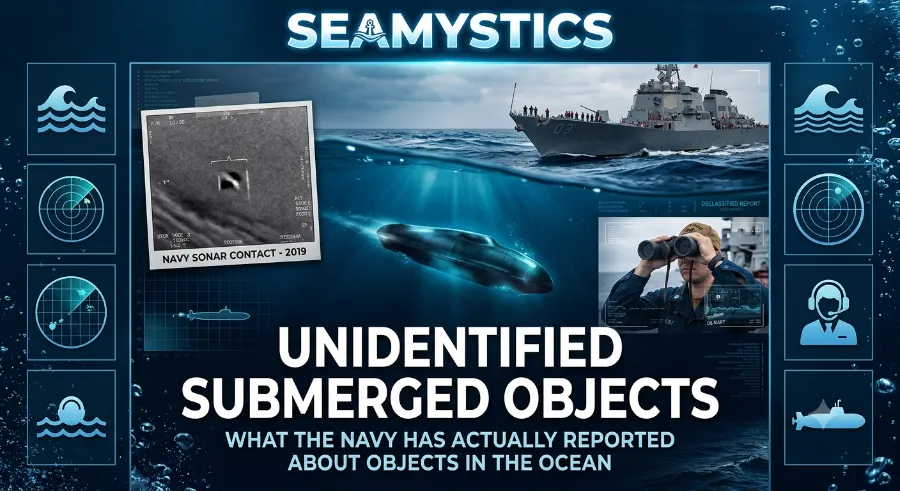

The ocean has always kept secrets. Over the past decade, however, something strange has been showing up on Navy sonar screens. Officials are no longer staying quiet about it either. In fact, unidentified submerged objects, often called USOs, have been logged by sailors and picked up by sensors. Some cases have even reached Congress. This is not a rumor from a late night forum. Instead, it is a documented pattern that touches national security, ocean science, and public trust all at once.
What’s Actually at the Bottom of the Puerto Rico Trench?
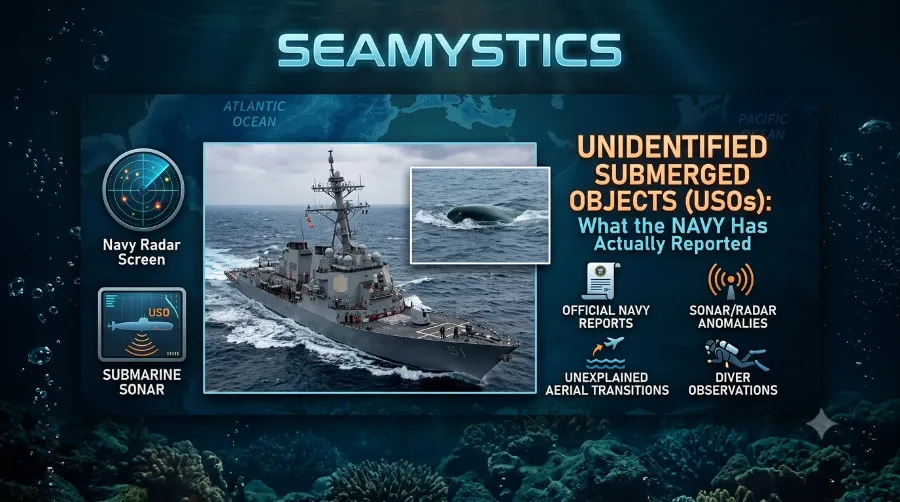
Key Takeaways
| What You Need to Know | The Short Answer |
|---|---|
| What is a USO | An object detected underwater that sensors or witnesses cannot identify |
| Who reports them | Navy sonar operators, pilots, and now a federal office called AARO |
| Most famous case | The 2019 USS Omaha incident off San Diego |
| Government stance | No confirmed evidence of foreign or non-human technology, but many cases remain open |
| Where sightings cluster | California and Florida coastlines, according to public tracking apps |
| Newest development | The Department of War began releasing declassified UAP files in 2026 |
TL;DR: Unidentified submerged objects are real Navy sonar and sensor contacts that investigators cannot always explain, and this is not internet fiction. AARO has logged hundreds of maritime cases since 2022, and most turn out to be balloons, drones, or sea life. Still, a smaller number stay unresolved. Below, we walk through the actual Navy reports, real case dates, and what experts believe is happening beneath the waves.
What Are Unidentified Submerged Objects, Really
Let’s define the term first, since it gets used loosely online. Unidentified submerged objects are things detected underwater that nobody can immediately explain. Sonar, radar, and the naked eye all count as valid detection methods. Meanwhile, the idea itself is not new, because sailors have described strange lights beneath the surface for centuries. Sonar simply gave the phenomenon a paper trail.
Baltic Sea Anomaly: The Underwater Structure Scientists Still Debate
Today the term sits under a bigger umbrella called UAP, or unidentified anomalous phenomena. The government now prefers this label over the old UFO term. A USO, in this sense, is just the underwater cousin of a UAP. Many cases also involve more than one sensor confirming the same object at the same time, which rules out a simple equipment glitch in a lot of instances.
How USOs Differ From UFOs and UAPs
People often mix up these terms, so here is the real distinction.
- UFO is the classic term for anything unexplained in the sky, mostly used before 2020.
- UAP is the current official term, covering air, space, and sea domains together.
- USO refers specifically to underwater contacts, including sonar, radar, or visual sightings.
The Navy now groups all three under UAP reporting. Even so, maritime cases still get their own category because water behaves very differently from air. Sound, for instance, travels roughly four times faster in water than in air. As a result, this changes how sonar operators read speed and direction. That matters especially when someone claims an object moved at “impossible” speed underwater, since water physics can distort readings in strange ways.
USO Sightings Navy Personnel Have Actually Logged
This is where things get concrete. The Navy has never claimed these objects are alien. Nevertheless, it has confirmed that unexplained contacts happen, and some have made it into official testimony.
The USS Omaha Case, San Diego, July 2019
One widely cited case involves the USS Omaha, a Navy vessel that was operating off San Diego in July 2019. Crew members reportedly tracked a spherical object that moved through the air, then dropped into the ocean and vanished. Notably, it left no wake and no debris field. The Pentagon later verified the footage as authentic, although officials still have not explained what the object actually was.
Retired Navy Rear Admiral Tim Gallaudet referenced this case in testimony and later reports. According to him, the object showed capabilities that current human technology cannot match. He wrote in a 2024 report that this kind of behavior “jeopardizes U.S.” maritime awareness if nobody investigates it. Because Gallaudet held senior Navy leadership roles before he retired, his comments carry more weight than a typical outside observer’s would.
The USS Theodore Roosevelt Sonar Contact, 2015
A separate incident surfaced during 2024 congressional testimony, this time involving the USS Theodore Roosevelt during exercises off the East Coast in 2015. According to Gallaudet, an operations officer sent an urgent message across the Navy’s secure network, asking if anyone recognized what appeared on their instruments. The message reportedly read as a genuine safety concern rather than a joke. That is partly why the story resurfaced years later during a formal hearing.
Together, these two cases show why the topic will not just fade away. Active duty and retired Navy officials have gone on record with their names attached, which moves the conversation out of speculation. Consequently, it becomes something closer to a documented operational issue.
Underwater UFO Sightings and Unexplained Sonar Contacts on the Rise
Public interest has grown alongside the official reports, and the numbers back that up. Enigma, a sighting tracking platform, logged more than 9,000 unidentified submersible object reports near U.S. shorelines by August 2025. Most of those reports clustered along California and Florida. That marks a striking jump from prior years, and it also lines up with a broader wave of UAP awareness after Navy videos went public in 2020.
Aaron Amick and the “Fast Mover” Phenomenon
Aaron Amick, a veteran Navy sonar operator, has become one of the more credible public voices on this topic. Unlike online commentators, he speaks from direct operational experience rather than secondhand accounts. He describes what sonar teams call “fast mover” contacts, objects that appear and disappear from sensors so quickly that operators cannot even calculate their speed. In his own words, there simply is not enough data to measure it accurately. He has also said plainly that the ocean holds a lot of odd things that do not fit tidy explanations.
This firsthand account matters because sonar operators train to distrust false positives. Whales, submarines, thermal layers, and even schools of fish can all create confusing signatures. So when an experienced operator says something does not match any known pattern, that statement carries real professional weight.
AARO’s Maritime UAP Category
The Department of Defense created the All Domain Anomaly Resolution Office, known as AARO, in 2022. Its job is to investigate reports across every domain, including maritime and transmedium events. Transmedium simply means an object that appears to move between two environments, like air and water, without a visible transition. Because AARO’s own reporting confirms this category exists formally, the government is clearly not treating the underwater angle as a fringe topic anymore.
Navy Ocean Encounters: What the Official Reports Actually Say
It helps to look at the raw numbers here, since they tell a more grounded story than most headlines suggest.
AARO Annual Report Data at a Glance
| Reporting Period | Total UAP Reports | Cases Resolved | Cases Still Open |
|---|---|---|---|
| May 2023 to June 2024 | 757 | 292 (common causes) | Remainder pending review |
| June 2024 to May 2025 | 319 new cases | 114 resolved | Close to 200 unresolved for now |
| Total since 2022 | 1,870 combined cases | Majority resolved | A meaningful minority remain open |
Source data compiled from AARO’s Fiscal Year 2024 and Fiscal Year 2025 Consolidated Annual Reports on Unidentified Anomalous Phenomena.
Most resolved cases turned out to be balloons, birds, drones, or satellite flares, which is admittedly a bit anticlimactic if you expected aliens. Still, AARO admits close to 200 cases from its latest batch remain unexplained simply because investigators did not have enough sensor data to close them out. That gap between “resolved” and “explained” is exactly where public curiosity keeps growing.
Congressional Testimony and Task Force Findings
AARO Director Dr. Jon Kosloski testified before the Senate Armed Services Subcommittee in November 2024, stating that reports near national security sites deserve serious, scientifically rigorous investigation. Around the same period, Florida Representative Anna Paulina Luna chaired a House task force on declassification. She presented military footage showing an object splitting a Hellfire missile mid flight, and the object reportedly continued on its path afterward. According to witnesses, the footage was unsettling, since no known U.S. technology could explain it.
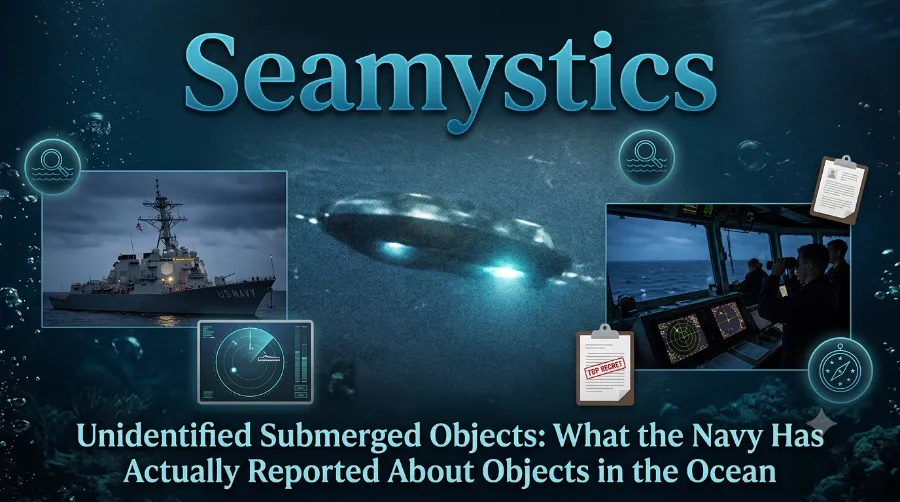
Transparency efforts then expanded further in 2026. The renamed Department of War launched a declassification initiative called PURSUE, and it began releasing tranches of historical UAP files in May 2026. So far, three release batches have gone out, each containing document scans, photographs, and sometimes video tied to specific incidents. For a closer look, you can review the official archives through the National Archives, which maintains its own UAP records page for public research. Alternatively, you can browse the Department of War’s UFO disclosure portal for new material as agencies release it.
If you want a deeper breakdown of how these releases connect to underwater cases specifically, our team put together a companion piece on navy sonar technology and how contacts get classified, which explains the sensor side in plain language.
Why the Ocean Hides So Many Unexplained Sonar Contacts
This is where a marine biology perspective adds something useful, because the ocean itself explains part of this mystery. Sound does not travel in a straight, predictable line underwater. Temperature layers, salinity changes, and pressure gradients all bend acoustic signals instead. Because of this, a whale can sound like a submarine, and a school of fish can look like a solid moving object on sonar.
Our team has done tagging fieldwork off the California coast, and we occasionally picked up strange acoustic signatures on passive hydrophones. A few times, we could not pin down the source before the recording window closed. That said, this is not evidence of anything exotic. It does, however, explain why trained Navy operators sometimes report contacts they cannot classify right away. After all, the ocean remains one of the least understood environments on the planet, and marine scientists still map new species and geological features every year.
Sensor Limitations Underwater
A few practical reasons explain why so many sonar contacts stay unresolved.
- Water density changes distort sound waves depending on depth, temperature, and salt content.
- Marine mammals like sperm whales and dolphins produce clicks that can mimic mechanical signatures on older sonar systems.
- Thermoclines, layers where temperature shifts sharply, bounce sound in unpredictable directions and create false depth readings.
- Underwater currents and geological vents sometimes produce bubble streams that register briefly as solid objects.
Natural Explanations Versus Genuine Anomalies
Most USO sightings likely fall into a few familiar buckets once investigators gather enough data. Common causes include drifting debris, marine animals, foreign or domestic test drones, and sensor malfunction. That said, AARO’s own reporting notes cases where multiple sensors, radar, sonar, and visual confirmation, all agreed on the same anomalous behavior. Consequently, that is much harder to write off as a simple mistake.
This is really the heart of the debate. On one hand, skeptics argue that a busier ocean and more sensors naturally produce more “unexplained” sightings, simply because more eyes and instruments are watching now. On the other hand, believers point to the multi sensor cases as proof of something genuinely unknown. Both sides have some merit here, so the truth may include a bit of each.
What This Means for Coastal Communities and Ocean Security
For people living along the coasts of the United States and Europe, this topic is no longer just internet curiosity. Naval officials, for their part, have openly flagged safety concerns. Unexplained transmedium activity near military installations raises real questions about flight and navigation safety. In fact, Gallaudet has even called the situation potentially “world changing” if these objects reflect capabilities beyond known human engineering.
At the same time, no confirmed evidence links these sightings to a foreign adversary or an extraterrestrial source, and every AARO report published so far backs that up. Overall, real concern paired with no confirmed exotic explanation is probably the most honest summary right now. For those curious how this connects to broader UAP disclosure efforts across the Atlantic, our guide to international UAP transparency policy covers how different countries handle similar reports.
For a fast recap of the newest developments, meanwhile, NewsNation has covered the shift in terminology and public interest around USOs, including interviews about the growing number of underwater reports.
Frequently Asked Questions
Is a USO the same thing as a UFO?
Not exactly. A USO refers specifically to something detected underwater, while UFO traditionally referred to aerial sightings. Both now fall under the broader UAP category.
Has the Navy confirmed any USO is not human made?
No. Official reports confirm some sonar contacts remain unexplained, but none have been confirmed as non-human or foreign technology.
Why are there so many USO reports lately?
More public reporting apps, more coastal sensors, and heavier media coverage after 2020’s Navy video releases have all driven the numbers up.
Where can I see official Navy or government UAP documents?
The National Archives and the Department of War both host public research pages, and new document releases continue through 2026.
Are USOs dangerous to ships or submarines?
No confirmed case shows a USO causing physical harm to a vessel, although officials have still raised safety concerns near sensitive military sites.
Conclusion
Unidentified submerged objects sit between hard evidence and honest uncertainty. The Navy has not confirmed anything otherworldly, yet it has also stopped pretending these sonar contacts mean nothing. Aaron Amick’s firsthand sonar experience, Gallaudet’s testimony, and AARO’s own admissions all point somewhere real. Hundreds of cases remain unresolved, and that alone is enough to take seriously without jumping to wild conclusions. The ocean, after all, remains one of the least explored places on Earth. Until sensor technology and transparency catch up, some of these mysteries will likely stay exactly that: mysteries.
References
- National Archives, UAP Research Topics Page, archives.gov
- Department of War, PURSUE UAP Declassification Portal, war.gov
- AARO Fiscal Year 2024 and Fiscal Year 2025 Consolidated Annual Reports on Unidentified Anomalous Phenomena
- NewsNation, “USO Unidentified Submerged Object” segment, Jesse Weber Live
- Senate Armed Services Subcommittee testimony, Dr. Jon Kosloski, November 19, 2024
- Enigma sighting database public statistics, 2025