
A fishing crew off the coast of Brazil spots something strange tangled in their net. A deep-sea camera near Hawaii captures a shape that no one on the research vessel recognizes. Within hours, the photo is online, and the internet asks the same question every single time: what is that thing, and who decides its name?
Unidentified Sea Creature Found: What Happens Next in Naming It
This question is not rare anymore. In 2026 alone, the Ocean Census initiative confirmed that researchers had identified 1,121 marine species in a single year, a project led by the Nippon Foundation-Nekton Ocean Census. Every one of those creatures started out as an unidentified sea creature found by someone, somewhere, before scientists gave it an official name. This guide walks through that entire journey, from the first sighting to the final published name, using real cases from the past two years.
Why Scientists Are Letting the Public Name New Ocean Species
TL;DR
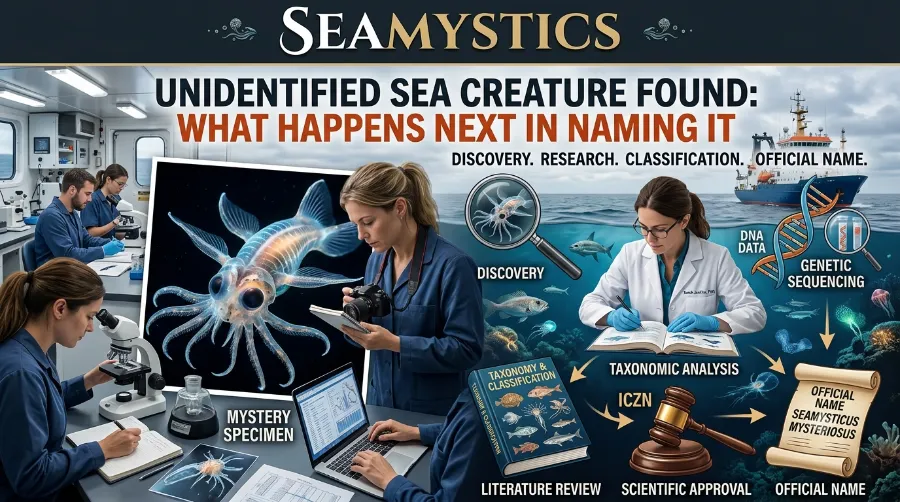
When an unidentified sea creature is found, it does not get a name overnight. A scientist collects or photographs it, compares it against known species, and if it truly is new, writes a formal description that follows strict international naming rules. The whole process, from discovery to an official Latin name, usually takes one to three years, sometimes longer.
Key Takeaways
| Step | What Happens | Typical Timeframe |
|---|---|---|
| Sighting or capture | Photo, video, or specimen collected in the field | Minutes to hours |
| Preliminary ID check | Compared against known species databases | Days to weeks |
| Specimen preservation | A holotype is designated and stored in a museum | Weeks |
| Formal scientific description | Written, peer-reviewed, and published | 6 months to 2 years |
| Official naming | Binomial name assigned under ICZN or ICBN rules | At publication |
| Public recognition | Common name adopted by media and public | Ongoing |
What Counts as an “Unidentified” Sea Creature?
Not every strange-looking animal pulled from the ocean is actually new to science. Sometimes it is a known species that simply looks unusual because of its depth, age, or lighting conditions. Marine biologists call this the difference between a “new record” and a genuinely new species.
A creature only earns the label unidentified creature awaiting classification once trained taxonomists confirm it does not match any species already described in scientific literature. This confirmation step matters, because roughly two thirds of ocean life has never been formally described. Researchers working in the Clarion-Clipperton Zone, a vast stretch of Pacific seafloor between Hawaii and Mexico, estimate around 5,600 species live there, with about 90 percent still undescribed. Discover Wildlife
The First Steps After a Sighting
Documentation in the Field
The moment a diver, fisher, or research crew encounters something unfamiliar, documentation becomes the priority. Photos from multiple angles, video footage, and precise GPS coordinates all matter later. Depth, water temperature, and surrounding habitat are recorded too, since these details help scientists understand where the animal actually lives.
If you want to see how this looks in practice, our roundup of 2026 deep-sea finds shows several expeditions that relied on exactly this kind of careful field logging.
Specimen Collection or Non-Invasive Recording
Whenever possible, researchers try to collect a physical specimen. This is not always easy. Deep-sea animals are often fragile, and bringing them to the surface can damage or destroy them before study is possible.
That is why remotely operated vehicles, or ROVs, have become so valuable. They allow scientists to observe, film, and sometimes gently collect animals at depths humans cannot safely reach. During a June 2026 expedition off the coast of Brazil, the Schmidt Ocean Institute’s research vessel Falkor (too) used exactly this approach and documented more than two dozen new marine species, including jellyfish, comb jellies, and a gossamer worm. Inside Climate News
From Discovery to Description: The Scientific Process
Comparing Against Known Species
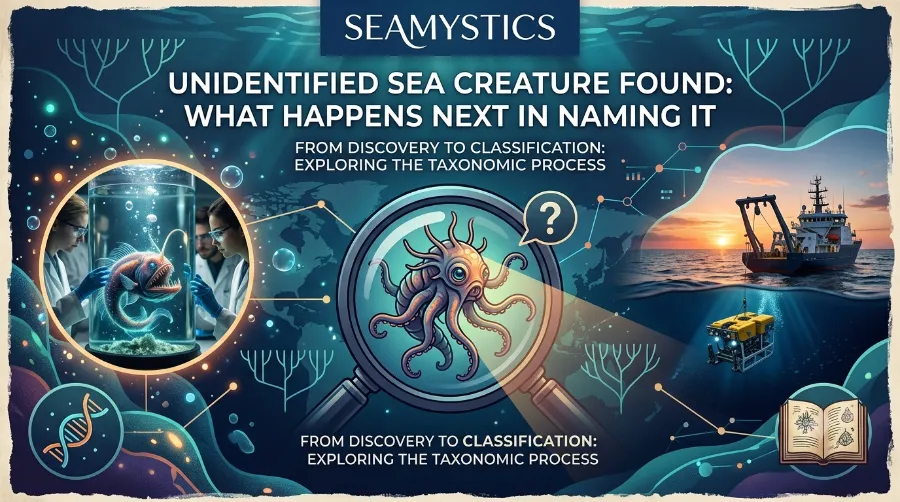
Once a specimen or clear footage exists, researchers begin cross-referencing it against existing taxonomic records. This involves museum collections, published papers, and increasingly, genetic databases. DNA barcoding has sped this stage up considerably over the last decade.
Designating a Holotype
If the animal appears to be genuinely new, one physical specimen is chosen as the holotype. This single specimen becomes the permanent reference point for the species, stored in a recognized museum or research institution. The Natural History Museum in London, for example, now cares for the type specimens of several newly named deep-sea amphipods, including one called Elimedon breviclunis, discovered as part of a project aiming to name 1,000 unknown Clarion-Clipperton Zone animals by 2030. Forbes
Peer Review and Publication
Here is where most people underestimate how long naming takes. A formal species description is not a blog post or a press release. It is a scientific paper, submitted to a peer-reviewed journal, checked line by line by other experts before anyone can call the name official.
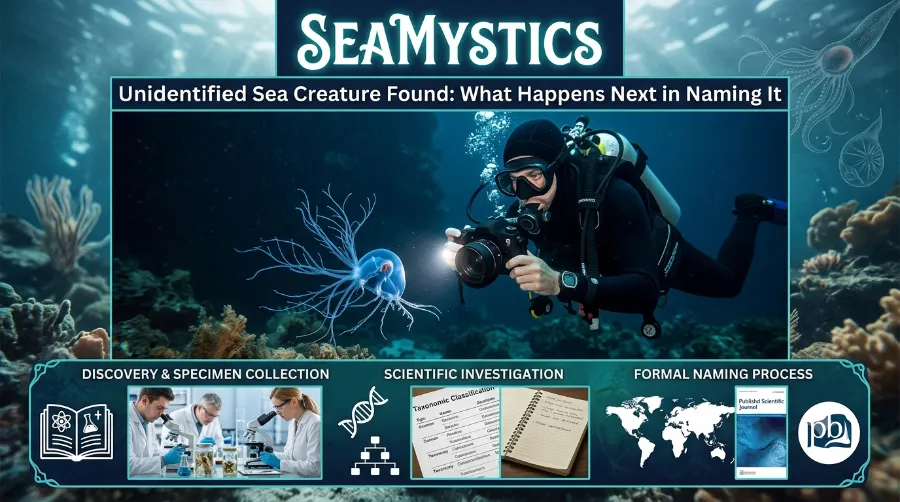
A strong recent example: 24 new amphipod species discovered in the Clarion-Clipperton Zone were not officially named until their descriptions were published on March 24, 2026, in an open-access ZooKeys special issue. The fieldwork behind those animals had happened years earlier. This gap between discovery and publication is completely normal in taxonomy. ScienceDaily
For a deeper explanation of how this publication stage works, see our newly identified ocean creature explainer.
How Scientists Actually Name a New Species
The Binomial System
Every animal on Earth gets a two-part Latin name once it is formally described, a genus name followed by a species name. This system, created by Carl Linnaeus centuries ago, still governs how an unidentified creature awaiting classification finally becomes an official, recognized species.
Who Holds the Naming Rights
The scientist or team that first publishes a valid description holds the right to choose the name. Rules for animals fall under the International Code of Zoological Nomenclature, commonly called the ICZN. Names can honor a person, describe a physical feature, reference the discovery location, or occasionally nod to pop culture.
A memorable case is Bathynomus vaderi, a giant isopod discovered by an international research team. It was named after Darth Vader because its head resembles his helmet, and it was first observed in 2022, though the formal description followed later. Naming choices like this are not random. They still have to follow strict formatting and uniqueness rules under the Code.
Family and Personal Tributes
Sometimes names carry deeply personal meaning for the researchers involved. When scientists described a brand-new evolutionary superfamily of amphipods in early 2026, lead researcher Dr. Tammy Horton named one new species, Mirabestia maisie, after her own daughter. Two other species in the same paper, Byblis hortonae and Byblisoides jazdzewskae, honored the researchers who first identified them. Forbes
Real Cases: How Recent Unidentified Sea Creatures Got Their Names
Here are several verified 2025 and 2026 examples that show the full timeline in action.
- Iskra’s glitter worm (Photinopolynoe iskrae): A shimmering, scale-covered worm found off the California coast in early 2026, described as part of ongoing Scripps Oceanography research into deep-sea chemosynthetic habitats.
- Ferreiraella populi: A chiton first found in 2024 in the Izu-Ogasawara Trench at roughly 5,500 meters deep. Its formal name was chosen through a public naming competition involving thousands of online participants, published in 2026. nus
- Bathynomus vaderi: First observed in 2022, formally described and named by 2025, honoring its resemblance to a well-known film character.
- 24 Clarion-Clipperton Zone amphipods: Discovered over several years of seafloor surveys, formally published and named in March 2026, including one entirely new superfamily.
You can track ongoing discoveries like these on our new deep-sea species 2026 tracker, which we update as fresh papers get published.
Why Naming Takes So Long
People often assume a strange creature gets a name within days of going viral online. In reality, several factors slow the process down considerably.
| Factor | Why It Delays Naming |
|---|---|
| Specimen condition | Damaged or partial specimens are harder to confirm as new |
| Taxonomist shortage | Very few trained specialists exist for many animal groups |
| Genetic sequencing | DNA comparison against databases takes time and funding |
| Peer review | Journals require multiple expert reviewers to approve findings |
| Backlog | Thousands of already-collected specimens await description |
The taxonomist shortage is a genuine bottleneck across the field. Researchers at the Natural History Museum have noted that the backlog of undescribed specimens keeps building because too few scientists have the specialized skills needed to work through them. That shortage is one reason projects now train students specifically in this kind of classification work. Forbes
Public Involvement: When You Can Help Name a Species
Naming is not always confined to a lab. Some research teams now invite the public into the process directly. The Ferreiraella populi naming competition mentioned earlier drew suggestions ranging from “Shooting star chiton” to a name referencing a Studio Ghibli character, before researchers settled on the final choice.
Citizen science platforms and museum outreach programs increasingly ask people to help sort footage, flag unusual sightings, or vote on shortlisted names. If you come across something unfamiliar yourself, our guide on first photos of new species explains exactly what details to capture to make your sighting scientifically useful.
Deep-Sea Mining and the Race to Name Species Faster
There is also a less romantic reason naming speed matters right now. Several ocean zones rich in unnamed species overlap directly with areas approved for mineral extraction. The Clarion-Clipperton Zone is a clear example, since it holds rare-earth metal deposits and has recently seen fast-tracked mining permits even as taxonomists race to document what lives there first. ScienceDaily
This creates real pressure. Once a habitat is disturbed, undocumented species can disappear before anyone ever gives them a name. That is part of why organizations like Ocean Census have set ambitious targets, including naming 1,000 previously unknown CCZ animals by 2030.
Frequently Asked Questions
How long does it take to officially name a newly found sea creature?
Most species take between six months and two years from formal description to publication, though the gap between initial discovery and that description can stretch several years longer.
Who decides the name of a new sea creature?
The researcher or team that first publishes a valid, peer-reviewed description holds naming rights, following rules set by the International Code of Zoological Nomenclature.
Can regular people suggest names for new species?
Yes, in some cases. Several 2026 discoveries used public naming competitions, where the public submitted suggestions before scientists made the final decision.
Does every unidentified sea creature turn out to be a new species?
No. Many turn out to be known species that simply looked unfamiliar due to depth, damage, or unusual coloring. Confirmation requires comparison against existing records and often genetic testing.
Why are so many new ocean species being found right now?
Better ROV technology, expanded funding through initiatives like Ocean Census, and coordinated international taxonomy workshops have all sped up discovery rates significantly in 2025 and 2026.
Conclusion
An unidentified sea creature found today rarely gets an instant name, no matter how viral the photo becomes. Real classification takes careful documentation, expert comparison, formal peer review, and strict naming rules that have existed for centuries. What has changed is the pace of discovery itself, with initiatives like Ocean Census identifying over a thousand new species in a single year. The ocean still holds far more mystery than certainty, and every unidentified creature awaiting classification is a small reminder of how much remains unmapped beneath the surface. For continuing coverage of these discoveries as they get named, explore our full library at Sea Mystics, including our guides on newly discovered ocean creatures, rare fish species found, and new shark species discovered.
References
- Ocean Census. “Over 1,100 New Marine Species Discovered.” May 19, 2026. https://oceancensus.org/press-release-scientists-discover-over-1100-new-marine-species-in-landmark-ocean-census/
- Natural History Museum, London. “Dozens of deep-sea species discovered as new crustaceans named.” March 2026. https://www.nhm.ac.uk/discover/news/2026/march/dozens-deep-sea-species-discovered-new-crustaceans-named.html
- ScienceDaily / Pensoft Publishers. “24 new deep-sea species found including a rare new branch of life.” March 25, 2026. https://www.sciencedaily.com/releases/2026/03/260325005912.htm
- ScienceDaily / Pensoft Publishers. “This weird deep-sea creature was named by thousands of people online.” 2026. https://www.sciencedaily.com/releases/2026/02/260207232242.htm
- National University of Singapore, Lee Kong Chian Natural History Museum. “New giant isopod species, Bathynomus vaderi.” March 26, 2025. https://www.science.nus.edu.sg/?p=78283
- Discover Wildlife / Schmidt Ocean Institute. “Deep-sea vehicle descends into South Atlantic Ocean and finds mysterious creatures in the darkness.” June 4, 2026. https://www.discoverwildlife.com/animal-facts/marine-animals/fortaleza-brazil-expedition
- Deep Sea Reporter. “Prehistoric ocean giant discovered in the U.S.” https://www.deepseareporter.com/prehistoric-ocean-giant-discovered-in-the-u-s/
- PADI Blog. “There is still more unknown than known in the sea.” https://blog.padi.com/there-is-still-more-unknown-than-known-in-the-sea/
- Arizona State University BioKIC. “Discovering New Species.” https://biokic.asu.edu/blog/discovering-new-species