
The ocean floor rarely makes headlines. But in early 2026, a spiky mollusk from nearly three miles underwater changed that. It went viral before scientists even finished naming it. Researchers now call it Ferreiraella populi. Its journey from a YouTube video to a peer-reviewed name is one of the stranger stories in recent marine biology.
learn more about newly named deep sea tips and expert advice.
This newly named deep-sea creature didn’t come from a random diver or a lucky photo. A real deep-sea expedition found it. Taxonomists reviewed it through formal channels. And more than 8,000 members of the public helped name it. Below, we break down what happened, why it matters, and what it says about the future of ocean science communication.
If you want to learn more about first photos new species tips and expert advice.
Key Takeaways
| Fact | Detail |
|---|---|
| Species name | Ferreiraella populi |
| Common description | Deep-sea chiton (marine mollusk) |
| Depth found | Roughly 5,500 meters (about 18,000 feet) |
| Location | Izu-Ogasawara Trench, off Japan |
| Year discovered | 2024 |
| Year officially named | 2026 |
| Public name submissions | Over 8,000 |
| Naming meaning | “Populi” is Latin for “of the people” |
| Lead institution | Senckenberg Ocean Species Alliance (SOSA) |
| Published in | Biodiversity Data Journal |
TL;DR: A rare deep-sea chiton turned up in Japan’s Izu-Ogasawara Trench in 2024. It went viral after appearing in Ze Frank’s YouTube series True Facts. Scientists at the Senckenberg Ocean Species Alliance then opened the naming process to the public. They received over 8,000 submissions and picked Ferreiraella populi, meaning “of the people.”
Unidentified Sea Creature Found: What Happens Next in Naming It
From Deep-Sea Discovery to Internet Sensation
Most new marine species stay quiet for years. Scientists find them, study them, and name them, often over a decade or two, long before the public hears a word. This creature took a different path.
Researchers first collected the animal using a deep-sea submersible while exploring the Izu-Ogasawara Trench off Japan in 2024. They brought it to the Senckenberg Ocean Species Alliance for study. Scientists confirmed it was a new species of chiton, a mollusk covered in a hinged, plated shell instead of one solid shell like a snail’s. Daily Galaxy
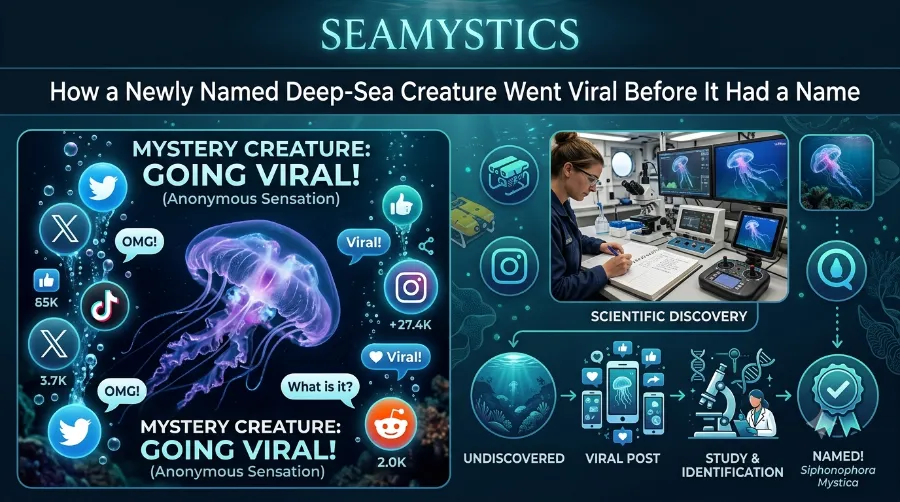
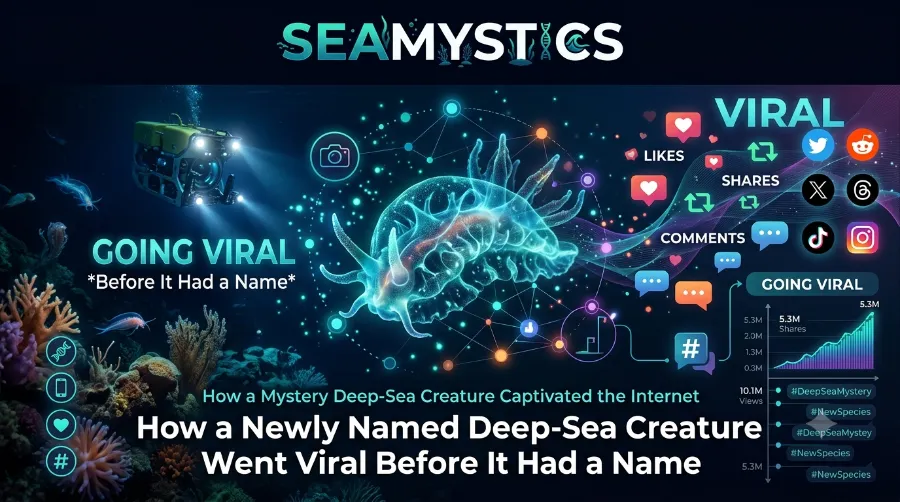
The animal gained fame after popular science YouTuber Ze Frank featured it on his long-running series True Facts, which started in 2012. That single video turned an obscure invertebrate into an internet talking point. This happened well before the creature had any official scientific name. Phys.org
Want the fuller picture? Our roundup of 2026 deep-sea finds tracks several similar stories from this year.
What Makes This Chiton So Unusual
Every deep-sea animal seems strange just because of where it lives. But this chiton stands out even among specialists, for a few clear reasons.
- It carries eight overlapping shell plates instead of a single shell, typical for chitons but still striking up close.
- It feeds with an iron-hardened radula, a tongue-like structure reinforced with iron minerals.
- It hosts small worms near its tail. These worms survive by eating the chiton’s waste.
- It belongs to the genus Ferreiraella, a rare group of mollusks that live almost exclusively on sunken wood on the deep seafloor. ScienceDaily
That last point matters more than it seems. Wood that sinks to the deep ocean creates rare habitat patches on an otherwise bare seafloor. Species like this one depend entirely on that wood to survive.
The Public Naming Contest, Explained
Naming a species isn’t casual. Scientists follow binomial nomenclature, the system Carl Linnaeus introduced in the 1750s. Every species gets a two-part Latin name: a genus and a species epithet.
This case differed in one key way. The public helped choose that second name.
The Senckenberg Ocean Species Alliance teamed up with scientific publisher Pensoft Publishers and Ze Frank. Together, they invited the public to submit name ideas for the new chiton through social media. The response blew past expectations. Earth.com
- Viewers proposed a name and wrote a short reason for it.
- More than 8,000 name ideas arrived through social media in about a week. A-Z Animals
- The research team reviewed the entries and picked Ferreiraella populi. Populi comes from Latin and means “of the people.” Earth.com
- Eleven different participants suggested that exact name independently. Earth.com
That last detail stands out. Thousands of people submitted creative entries. Yet more than a dozen strangers landed on the same Latin word on their own. The research team took that as a strong signal.
Other entries stuck out for different reasons. One popular pick was Ferreiraella stellacadens, meaning “shooting star chiton.” It nodded to how the animal “shot to fame” during the contest. Another was Ferreiraella ohmu, a reference to a chiton-like creature from Studio Ghibli and a nod to Japan, where researchers found the species. ScienceDaily
Curious how species names get approved in general? Our guide to newly identified ocean creatures walks through the review process step by step.
Why Naming a Species Actually Takes So Long
This story stands out because of how slow the process usually runs.
Julia Sigwart, co-chair of SOSA at the Senckenberg Research Institute and Natural History Museum Frankfurt, said scientists often need ten, if not twenty years, to study, describe, name, and publish a new species. That timeline usually involves anatomical study, DNA comparisons, peer review, and journal publication. EurekAlert!
SOSA compressed that entire process here. The team moved from discovery in 2024 to a published name in 2026. That’s a fast turnaround for deep-sea taxonomy, a field that stays chronically underfunded compared to how much of the ocean remains unexplored.
Why Scientists Are Letting the Public Name New Ocean Species
Faster naming isn’t just convenient. Unnamed animals are harder to track. They’re harder to discuss in research and policy. And people can overlook them entirely. EurekAlert!
Sigwart tied the naming effort directly to conservation. She said it matters for protecting marine diversity, especially given threats like deep-sea mining. That framing turned a fun internet moment into something with real regulatory weight. Unnamed species are effectively invisible in most environmental protection frameworks. ScienceDaily
It Wasn’t Just One Species
The team didn’t stop at this single animal. They also formally described two more chiton species. One lived on sponges off Madagascar. The other turned up in deeper water near Papua New Guinea, where it hunts small animals. EurekAlert!
Describing all three species together made one thing clear. The naming contest sat inside genuine scientific work, not beside it as a publicity stunt. Viral science moments often mark just the visible tip of much larger research programs. EurekAlert!
That pattern keeps showing up. Our newly discovered ocean creature coverage has tracked a similar wave of lesser-known species descriptions throughout 2026.
How This Fits Into a Bigger Year for Deep-Sea Discovery
Ferreiraella populi wasn’t the only headline-grabbing deep-sea find in 2026. A few months later, a separate discovery drew wide attention too.
In summer 2025, a JAMSTEC team used the crewed submersible Shinkai 6500 to descend nearly six kilometers into the Pacific. No light reaches that depth. Temperatures hover just above freezing, and the pressure crushes. There, the team photographed and collected a limpet at 5,922 meters, the deepest-living true limpet ever recorded. They named it Bathylepeta wadatsumi, after the sea god in Japanese mythology. Discover MagazineDiscover Magazine
Separately, researchers at Scripps Institution of Oceanography described two more standout species. People nicknamed them “Iskra’s glitter worm” and the “Elven abyss tunicate.” Both made the World Register of Marine Species’ 2025 Top 10 New Species list, announced around Taxonomist Appreciation Day on March 19, 2026.
Together, these finds point to a real surge in deep-sea taxonomy activity. Better submersible technology helps. So does growing public interest driven by social media. You can track more of this pattern in our pillar tracker of new deep-sea species discovered in 2026.
The pattern extends to other ocean animals under pressure too. Sharks have seen a mix of exciting discoveries and real conservation concerns this year. We cover one example in our piece on a newly discovered shark species. Researchers also identified a new hub shark species in Papua New Guinea. They already suspect it may be at risk of extinction, according to Natural World Facts. SciTechDaily
Why the Deep Sea Still Surprises Us
This story resonated for a simple reason. Most people know very little about deep-sea life. The seafloor beyond a few hundred meters remains one of the least explored places on Earth, despite covering most of the planet’s surface.
Ocean science groups have tried to close that gap for years. The nonprofit Shape of Life project documents just how much of the deep sea stays a mystery, even to specialists. The Deep Sea Biology Society maintains ongoing resources that catalog deep-sea life as new research comes in.
That knowledge gap explains why this chiton’s naming spread so fast. People weren’t just reacting to a strange-looking animal. They got a rare, accessible window into a world usually locked behind expensive submersibles and academic journals.
Want more comparisons? Our explainer on a newly discovered ocean creature and our coverage of a rare fish species found cover similar ground.
What This Means Going Forward
Science communicators will likely study this case for years. It shows a workable model. Public engagement and rigorous science don’t have to pull in opposite directions.
A few practical takeaways stand out for anyone following ocean science:
- Public involvement can speed up scientific processes without hurting accuracy, as long as institutions like SOSA keep final review in expert hands.
- Naming and classification aren’t just paperwork. They directly affect whether a species gets included in conservation policy.
- Viral science moments, handled carefully, can turn into real funding and public support for further research.
- Expect more of this kind of collaborative science. YouTube and other platforms keep reaching massive audiences interested in nature content.
FAQ
What is the newly named deep-sea creature everyone is talking about?
It’s a species of deep-sea chiton, a marine mollusk, officially named Ferreiraella populi in February 2026.
Where was it found?
Researchers first discovered it in 2024 in the Izu-Ogasawara Trench, at a depth of about 5,500 meters. ScienceDaily
Why did the public get to help name it?
SOSA partnered with Pensoft Publishers and YouTuber Ze Frank to run an open naming contest on social media. They received more than 8,000 submissions. Earth.com
What does “populi” mean?
It’s Latin for “of the people.” The team chose it because it honors public contributors, and 11 people suggested it independently.
Is this the only deep-sea species named this way?
No, but it stands as one of the most high-profile examples so far. Other 2026 discoveries, like Bathylepeta wadatsumi, followed more traditional academic naming paths.
Conclusion
This newly named deep-sea creature shows something rare in science. Public curiosity and rigorous taxonomy worked together instead of pulling apart. A strange animal in a YouTube video became a peer-reviewed scientific description. More than 8,000 ordinary people helped shape that outcome, simply because they found it fascinating. Deep-sea exploration technology keeps improving. Public interest keeps growing. This likely won’t be the last time the internet gets a direct hand in naming what lives at the bottom of the ocean.
References
- SciTechDaily, “The Internet Just Named a Brand-New Deep-Sea Creature Found Nearly 3 Miles Deep,” February 2026
- Earth.com, “Scientists poll the internet to name a strange new deep-sea creature discovered 18,045 feet,” April 2026
- EurekAlert!, “The internet names a new deep-sea species,” February 2026
- ScienceDaily, “This weird deep-sea creature was named by thousands of people online,” February 2026
- A-Z Animals, “This Iron-Toothed Sea Creature Found 18,000 Feet Down Has a Crowdsourced Name,” March 2026
- Daily Galaxy, “Nearly 6KM Down in the Pacific Abyss, Scientists Found a ‘Giant’ Creature Named After a Sea God,” May 2026
- Discover Magazine, “8,000 Suggestions Later, a Newly Discovered Deep-Sea Species Gets Its Name,” February 2026
- Phys.org, “From whale falls to 4,000 meters deep: Two new species spotlight deep-sea life,” March 2026
- SOSA, Chen C, Frank H, Kraniotis L, Nakadera Y, Schwabe E, Sigwart JD, Trautwein B, Vončina K (2026), “Ocean Species Discoveries 28–30,” Biodiversity Data Journal, 14: e180491