
Picture a soda can crushed flat by a single boot. Now imagine that same force pressing on every inch of a human chest. That is what water pressure at depth actually feels like far below the waves. Ocean pressure explained in simple terms comes down to one fact: water is heavy, and depth adds more of it fast. This article breaks down what happens to the human body as it sinks toward the dark zones of the sea, using real numbers and real cases rather than guesswork.
How Scientists Measure Ocean Depth Today
Here is a quick snapshot of everything this guide covers.
| Key Takeaway | What It Means |
|---|---|
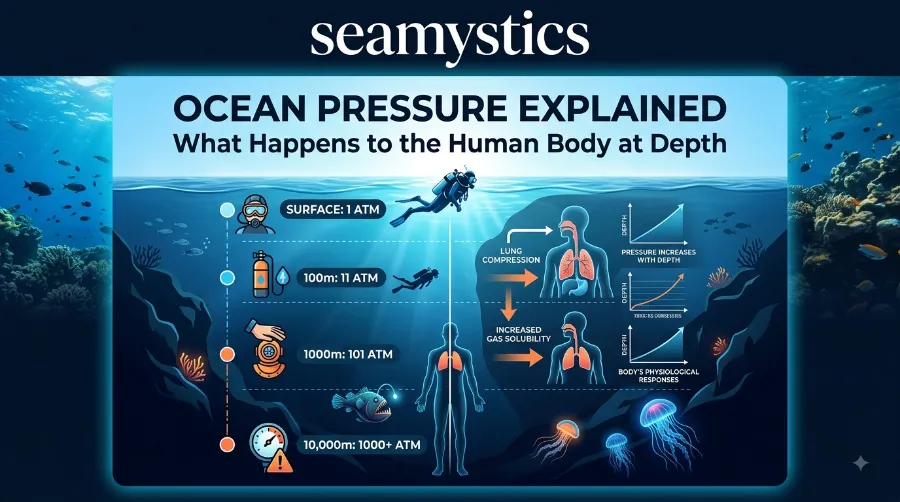
| Pressure rises fast | Water pressure increases by roughly 1 atmosphere (14.7 psi) every 10 meters (33 feet) |
| Lungs feel it first | Air spaces in the chest, ears, and sinuses compress before anything else does |
| Depth has hard limits | Unprotected human descent without gear typically stops well before 100 feet |
| Engineering saves lives | Submersibles and dive suits exist specifically to fight psi at ocean depth |
| Real accidents teach real lessons | The 2023 Titan submersible loss remains the clearest modern warning about deep sea pressure facts |
TL;DR: Ocean pressure builds by about one atmosphere for every 10 meters of depth. This means the human body faces crushing psi long before it reaches the seafloor. Air-filled spaces like lungs and sinuses collapse first, followed by risks such as barotrauma and nitrogen narcosis, and modern submersibles exist purely to buy the body time against forces it was never built for.
How Ocean Pressure Builds With Water Pressure at Depth
Everyone already lives under pressure, though nobody feels it. Air above us pushes down with about 14.7 pounds per square inch, known as one atmosphere. The moment a diver enters the water, that number starts climbing fast.
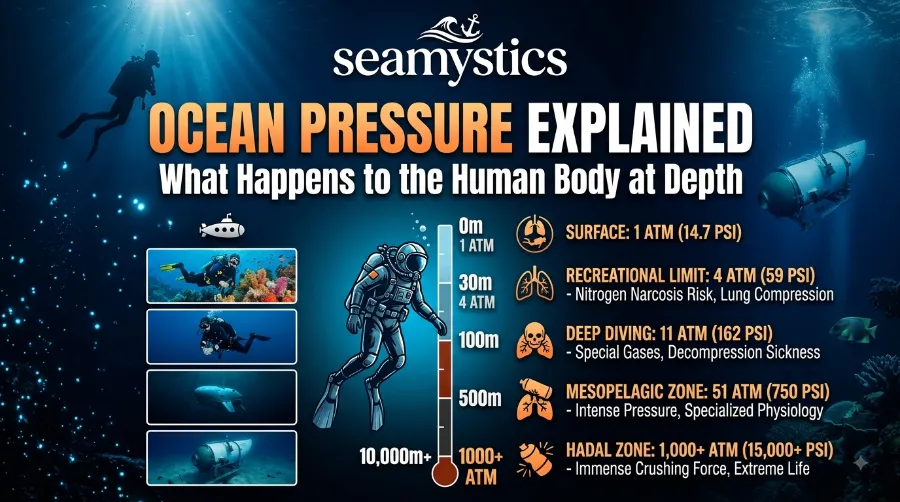
For every 10 meters, roughly 33 feet, the water adds another full atmosphere on top. At 10 meters the body feels 2 atmospheres. At 20 meters it feels 3, and the climb continues in a straight line. NOAA’s Ocean Service confirms this happens whether the water is fresh or salty, though seawater adds slightly more weight because of its density.
Pressure by Depth: The Numbers That Matter
Here is what that climb looks like in real figures.
| Depth | Pressure (atm) | Approx PSI | Real World Comparison |
|---|---|---|---|
| Surface | 1 | 14.7 | Standing on a beach |
| 10 m (33 ft) | 2 | 29.4 | Bottom of a hotel swimming pool |
| 30 m (100 ft) | 4 | 58.8 | Recreational scuba limit for most certifications |
| 100 m (330 ft) | 11 | 161.7 | Extreme technical diving territory |
| 332 m (1,090 ft) | 34 | 500 | Deepest scuba dive on record, Ahmed Gabr, Egypt, 2014 |
| 1,000 m (3,280 ft) | 101 | 1,485 | Sperm whale hunting depth |
| 3,800 m (12,467 ft) | 381 | 5,600 | Titanic wreck site, North Atlantic |
| 10,935 m (35,876 ft) | 1,086 | 15,750 | Challenger Deep, Mariana Trench |
These numbers can feel abstract until you connect them to something physical. Marine science writers often compare deep sea pressure to everyday objects for this reason. At the bottom of the Mariana Trench, the force on a single square inch matches an elephant balanced on a postage stamp, a comparison the Catalina Island Marine Institute uses when teaching hydrostatic force to students.
How Much Water Is Actually in the Ocean?
If you want a broader look at how depth zones shape ocean life, check our pillar guide on ocean oxygen production. It covers how sunlight, gas exchange, and pressure zones combine to shape marine ecosystems from the surface down.
What Happens to the Human Body at Depth in the Ocean
The human body is mostly water, and water barely compresses. That is good news, because tissue, muscle, and blood handle pressure surprisingly well. Trouble starts with anything containing air, since gas compresses far more than liquid does.
Underwater Sound Travel How Sound Moves Through the Ocean Compared to Air
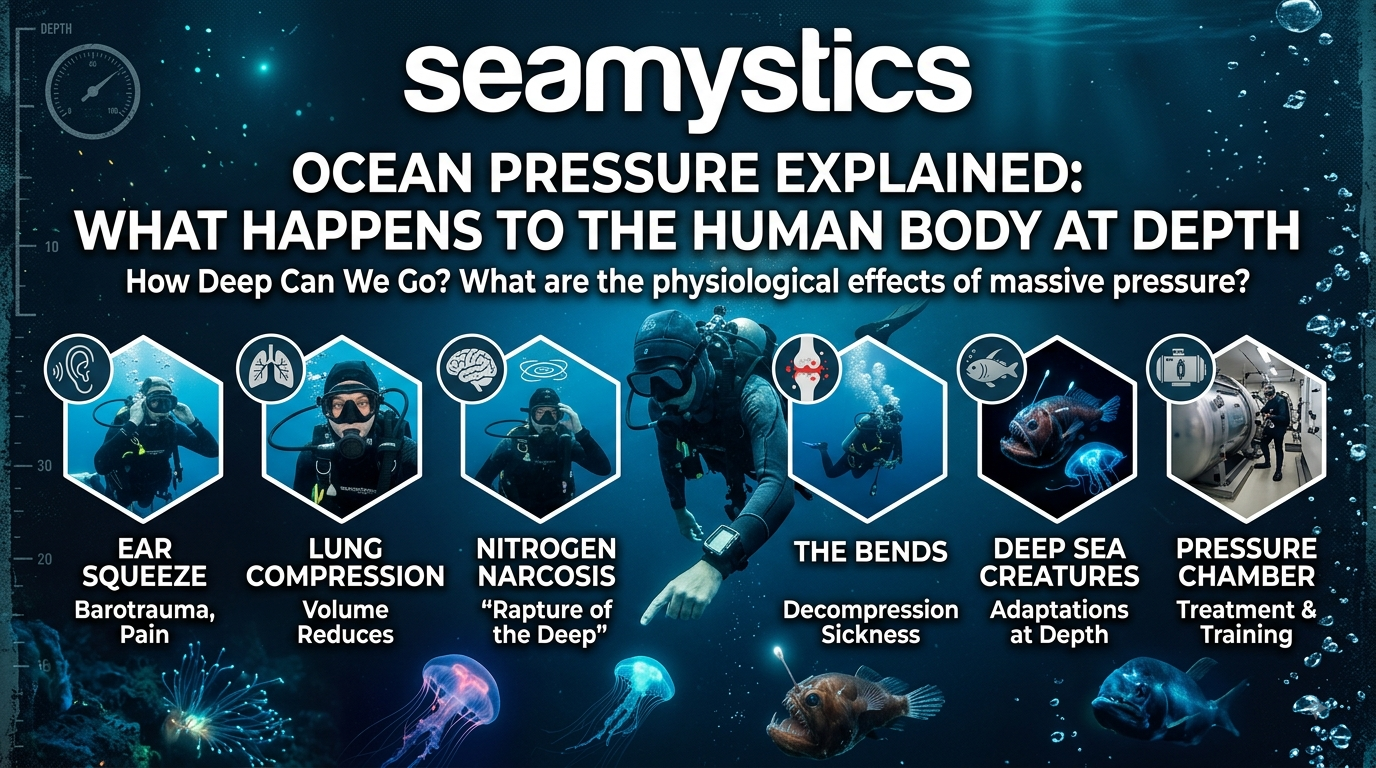
Lungs, sinuses, middle ears, and even small air pockets in teeth all react the moment pressure changes. As a diver descends, these spaces shrink. If the body cannot equalize fast enough, pressure pulls tissue inward and can tear it. This is why every certified diver learns to equalize early, usually by pinching the nose and blowing gently to push air back into the ears.
Barotrauma: The First Warning Sign
Doctors call this category of injury barotrauma. The Divers Alert Network reports it as one of the most common diving injuries every year. Left unmanaged, it can rupture eardrums, damage sinus lining, or cause lung tissue to bleed in severe cases.
What Causes Red Tide The Science Behind Toxic Algae Blooms
Deeper Risks: Narcosis, the Bends, and Oxygen Toxicity
Deeper water introduces a second problem tied to the breathing gas itself. These risks grow the longer and deeper a diver stays underwater.
- Nitrogen narcosis: Around 30 meters, nitrogen in the bloodstream can cause confusion, poor judgment, and a strange euphoria divers nickname “raptures of the deep.”
- Decompression sickness: Rising too fast lets nitrogen bubbles form in the blood and joints, commonly called “the bends.” It can turn life threatening without a hyperbaric chamber nearby.
- Oxygen toxicity: At extreme depths on certain gas mixes, oxygen itself becomes dangerous and can trigger underwater seizures.
These are not rare or theoretical risks. In 2012, Austrian freediver Herbert Nitsch suffered a stroke-like injury near Santorini, Greece, after surfacing too fast from a dive believed to exceed 800 feet. He survived, but recovery took years and left lasting motor damage. Freediving medical literature still cites his case as a warning about ascent speed, not depth alone.
The Titan Submersible: A Modern Case Study
Mechanical failure tells an even harsher story. On June 18, 2023, the OceanGate submersible Titan imploded near the Titanic wreck at roughly 3,800 meters, killing all five people aboard almost instantly. Investigators confirmed the pressure gap between inside and outside the hull made the event last only milliseconds, based on findings from Scientific American and the U.S. Coast Guard.
What Is Thermohaline Ocean Circulation? Earth’s Global Conveyor Belt Explained
The marine science team at CIMI explains this well in their breakdown of why pressure turns lethal. At extreme depth, the human body rarely fails first; the equipment around it usually does.
Ocean Freezing Point Explained Why the Sea Freezes Differently Than Fresh Water
If you want the physics side of deep sea engineering, The Fisheries Blog’s piece on life at 20,000 leagues shows how marine animals solve the same pressure problem that defeats human bodies and machines alike.
Step by Step: What the Body Experiences on the Way Down
- 0 to 10 meters: Ears and sinuses need active equalizing. Most first-time diver discomfort happens here.
- 10 to 30 meters: Nitrogen starts absorbing into tissue faster. Judgment can begin to blur slightly.
- 30 to 40 meters: Nitrogen narcosis risk climbs sharply for recreational divers without technical training.
- 40 to 100 meters: Only trained technical divers with mixed gas should operate here. Decompression injury risk rises fast.
- Beyond 100 meters: This becomes machine territory. It requires submersibles, atmospheric suits, or saturation diving systems.
Deep Sea Pressure Facts Every Diver Should Know
Some pressure facts surprise even experienced divers because they clash with instinct. Most people blame cold or darkness for deep sea danger. In reality, temperature and light barely matter next to compression forces, since pressure does almost all of the damage.
What Whales Teach Us About Pressure Limits
Marine mammals offer a useful contrast here, and studying them taught me more about human limits than any textbook did. Sperm whales regularly dive past 1,000 meters while hunting squid. Their ribcages use flexible cartilage that lets the chest collapse safely instead of fracturing. Human ribs are rigid by comparison, and the body never evolved that kind of give.
How Far Can Trained Humans Actually Go
Free divers push human limits closer to marine mammal territory than scuba divers ever will. They carry no tank and rely purely on trained lung control. Alexey Molchanov currently holds several no-limits and constant weight world records, with verified dives past 130 meters on a single breath through competitions in 2023 and 2024. These athletes train for years under strict medical supervision. Attempts without that preparation have ended fatally more than once in the sport’s history.
How Light Behaves Underwater The Science of Ocean Color Zones
A quick table puts professional versus recreational limits into perspective.
| Category | Typical Max Depth | Who Reaches It |
|---|---|---|
| Recreational scuba | 18 to 40 m | Certified open water and advanced divers |
| Technical scuba | 40 to 100 m | Trained technical divers with mixed gas |
| Elite freediving | 100 to 130+ m | World record competitive freedivers |
| Saturation diving | 300+ m | Commercial divers living in pressurized habitats |
| Submersible only | 1,000 m to 10,935 m | Engineered vehicles, not unprotected humans |
Commercial saturation divers on offshore oil rigs sometimes live inside pressurized chambers for weeks. They breathe specialized gas mixes so their bodies stay adjusted to depth pressure the whole time. This avoids repeated decompression cycles, though it also complicates any emergency evacuation. Saturation diving remains one of the highest paid and highest risk jobs in the offshore industry today.
PSI Ocean Depth Chart and How Engineering Fights Back
The human body clearly has limits, so engineers solve the ocean pressure problem instead. Submersible hulls, dive suits, and even camera housings get designed around one question: how much psi will this depth produce.
Machines Built to Survive Where Humans Cannot
Alvin, the famous deep sea submersible run by Woods Hole Oceanographic Institution, has completed thousands of dives since 1964. Its thick titanium hull withstands pressure down to 4,500 meters. The bathyscaphe Trieste reached the Challenger Deep itself in 1960, carrying Jacques Piccard and Don Walsh nearly 11 kilometers down inside a steel sphere thick enough to resist over 15,000 psi.
Why the Ocean Has Waves The Real Science Explained
Engineering teams studying deep sea pressure facts, including Mavigadget’s breakdown of ocean mysteries, note that small flaws in a pressure hull can turn catastrophic instantly rather than gradually. Investigators believe this is exactly what happened with Titan in 2023. Certified submersibles undergo repeated hull testing before every mission, a step OceanGate had controversially skipped for its experimental carbon fiber design.
Visualizing PSI Growth With Depth
A simple chart shows how fast psi ocean depth values scale.
PSI Growth With Depth (Approximate)
Surface     | 15 psi     ▏
100 ft      | 44 psi     ▍
1,000 ft    | 445 psi    ████
3,300 ft    | 1,470 psi  █████████████
12,467 ft   | 5,600 psi  ██████████████████████████████████████
35,876 ft   | 15,750 psi ████████████████████████████████████████████████████████████████████████████████████
This scale matters beyond curiosity. It shapes how researchers design equipment for ocean exploration and even seafloor climate monitoring instruments. For more on how pressure zones connect to marine life patterns, our related article on deep sea biodiversity explores how species adapt biologically to these same numbers.
Real World Lessons From Working Marine Biologists
Fieldwork changes how you read a pressure chart. During tagging expeditions with deep diving species, our team regularly reviews dive computer logs. These logs show animals crossing pressure zones that would instantly injure an unprotected human, and that contrast never stops feeling humbling.
It also reshapes how we brief new research divers before descents. Textbook numbers rarely prepare someone for how fast ear discomfort can escalate at just 12 meters if equalizing lags even slightly.
The One Habit That Prevents Most Injuries
Most diving injuries we have observed in research settings happen during rushed ascents or descents, not at extreme depth itself. Pressure change speed matters just as much as pressure itself. Slowing down remains the single most effective safety habit any diver can build, a point that lines up closely with published decompression sickness research. For anyone planning their first open water certification, this one habit prevents more injuries than any piece of gear does.
Frequently Asked Questions
How much does ocean pressure increase per meter?
Pressure increases by about one atmosphere, or roughly 1.47 psi, per meter. Most divers use the simpler benchmark of one full atmosphere every 10 meters.
Can the human body survive ocean floor pressure without protection?
No. Unprotected descent turns dangerous well before 100 meters and fatal much sooner without proper gas mixtures, equalizing, and a controlled ascent rate.
What is the deepest a human has ever gone in the ocean?
Crewed vehicles have reached the Challenger Deep in the Mariana Trench, at 10,935 meters, including the Trieste in 1960 and Victor Vescovo’s Limiting Factor in 2019.
Why did the Titan submersible implode in 2023?
Investigators found the vessel’s carbon fiber hull failed catastrophically under pressure near the Titanic wreck site. The extreme psi difference compressed the event into milliseconds
Does water pressure hurt marine animals the way it hurts humans?
Most deep sea species evolved flexible bodies, cartilage-based skeletons, or pressure resistant proteins. These adaptations let them function normally at depths that would instantly injure a human.
Conclusion
Ocean pressure explained simply comes down to weight, water, and time. Every meter downward adds force the human body was never built to handle alone. Ear discomfort starts at ten meters, judgment weakens soon after, and only engineering or elite physiological training can push those limits further. Whether you are a curious reader, a new diver, or someone fascinated by places like the Mariana Trench, these numbers turn abstract danger into something concrete and respectable. The deep sea remains one of the least explored places on Earth, and treating its pressure with real caution is still the smartest first step anyone can take before going near it.
References
- Scientific American, “See How Crushing Pressures Increase in the Ocean’s Depths,” 2023
- NOAA Ocean Service, “How does pressure change with ocean depth?”
- Woods Hole Oceanographic Institution, Alvin Submersible Program
- Catalina Island Marine Institute, “Under Pressure,” https://cimi.org/blog/under-pressure/
- Mavigadget, “Ocean Pressure: Uncovering the Mysteries of the Deep,” https://mavigadget.com/blogs/tech-gadgets/ocean-pressure-uncovering-the-mysteries-of-the-deep
- The Fisheries Blog, “Under Pressure: Life at 20,000 Leagues Under the Sea,” 2023, https://thefisheriesblog.com/2023/07/24/under-pressure-life-at-20000-leagues-under-the-sea/
- Wikipedia, “Mariana Trench” and “Challenger Deep,” accessed 2026
- U.S. Coast Guard, Marine Board of Investigation findings on OceanGate Titan, 2023-2024