
Dive just ten feet below the surface and hold up a red cut on your hand. It will not look red anymore. It will look almost grey or black, as if the color drained straight out of the water around you. That strange little moment is underwater light science in action, and it is one of the most fascinating puzzles in marine biology. So, why does the ocean swallow color the way it does, and what does that mean for the creatures that call it home?
How Scientists Measure Ocean Depth Today
This question sits at the heart of every dive, every research expedition, and honestly, every sunset photo taken from a boat. Understanding light penetration ocean scientists study every day helps explain why the sea looks the way it looks, why fish glow in certain colors, and why some parts of the ocean stay pitch dark even at noon. Once you understand the basics, you will never look at the ocean the same way again.
What Causes Red Tide The Science Behind Toxic Algae Blooms
TL;DR: Sunlight loses its warm colors first as it travels underwater, with red vanishing within the first 10 meters and blue traveling the farthest, sometimes past 200 meters in clear water. This creates layered ocean color zones known as the euphotic, disphotic, and aphotic zones, each shaping which animals and plants can survive there. Light, more than temperature or pressure, is the single biggest reason ocean life looks and behaves so differently at different depths.
Key Takeaways
| Topic | Quick Fact |
|---|---|
| First color to disappear | Red, gone within about 10 meters |
| Last color to disappear | Blue and green, visible past 100 to 200 meters in clear water |
| Sunlit zone (euphotic) | Surface to about 200 meters |
| Twilight zone (disphotic) | About 200 to 1,000 meters |
| Dark zone (aphotic) | Below 1,000 meters, permanent darkness |
| Clearest ocean water | Sargasso Sea and open Pacific, Jerlov Type I waters |
| Percent of ocean in darkness | Roughly 90 percent of ocean volume sits in the aphotic zone |
What Underwater Light Science Actually Studies
Underwater light science looks at how sunlight enters seawater, how it scatters, and how it eventually disappears with depth. It sounds simple, but the ocean is not just a big tank of clear water. It is full of salt, plankton, sediment, and dissolved organic material, and every one of those things bends or blocks light in a slightly different way.
Marine biologists and oceanographers rely on this science constantly. It explains where coral reefs can grow, why certain fish species never leave the top 50 meters, and why deep sea creatures had to invent their own light through bioluminescence. Without sunlight, nothing in the upper ocean would photosynthesize, and the entire marine food web would collapse.
If you have ever wondered how ocean pressure changes the environment for deep sea animals, light behaves in a similarly dramatic way, just with color instead of crushing force.
Sunlight Underwater Depth: Why Colors Vanish One by One
Not all light behaves the same way once it hits seawater. Each color in sunlight has a different wavelength, and water absorbs long wavelengths much faster than short ones. That single fact explains almost everything about ocean color as it relates to sunlight underwater depth.
Here is roughly how it plays out as you descend:
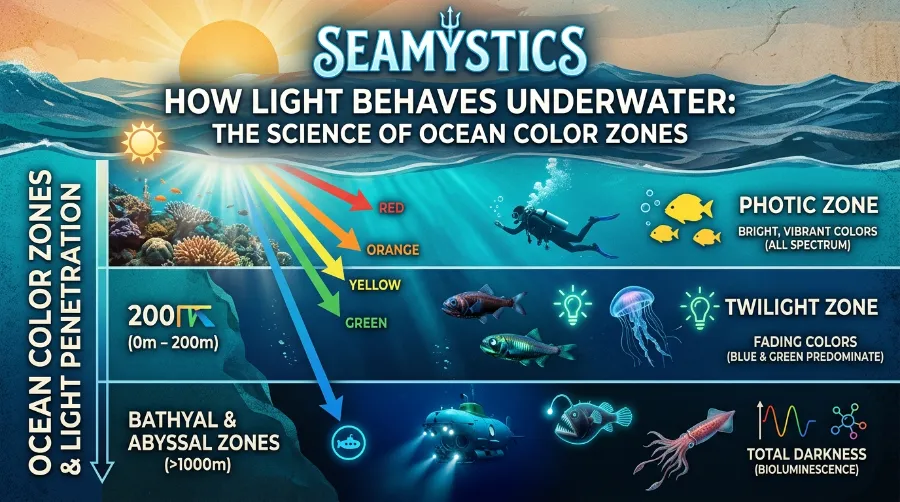
- Red light disappears first, usually within the top 10 meters, which is why a bleeding scrape or a red wetsuit patch turns dark and dull almost immediately below the surface.
- Orange light fades out by around 40 meters.
- Yellow light is mostly gone before 100 meters.
- Green light pushes deeper, staying visible past 100 meters in many parts of the ocean.
- Blue light travels farthest of all, sometimes penetrating past 200 meters in very clear water, which is exactly why the open ocean looks that iconic deep blue.
This order is not random. Longer wavelengths like red carry less energy per photon and get absorbed by water molecules almost immediately, with that absorbed energy simply turning into heat. Shorter wavelengths like blue and violet are absorbed far more slowly, so they scatter around the water column instead, which is the actual reason the sea looks blue rather than clear.
Photic Zone Explained: The Three Layers of Ocean Light
Scientists divide the ocean into layers based on how much light reaches them, and this is where the concept of a photic zone explained properly becomes genuinely useful. There are three main layers, and each one supports a completely different kind of life.
Euphotic Zone: The Sunlight Layer
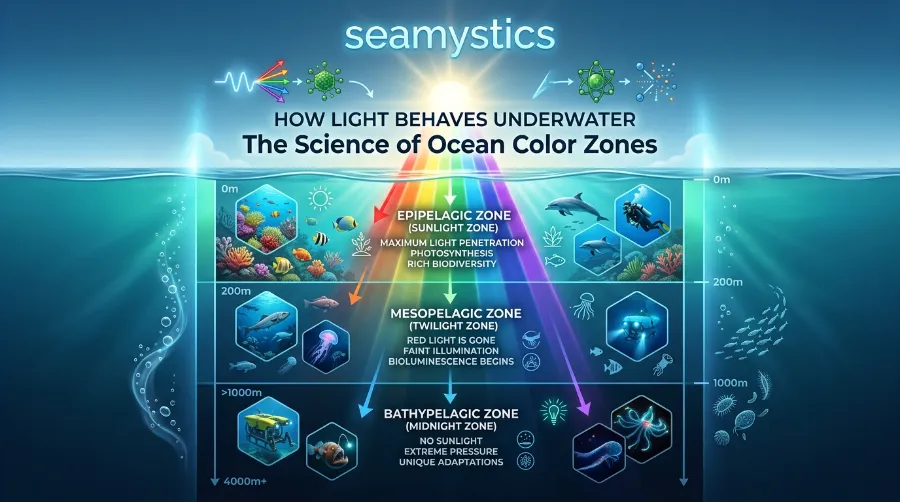
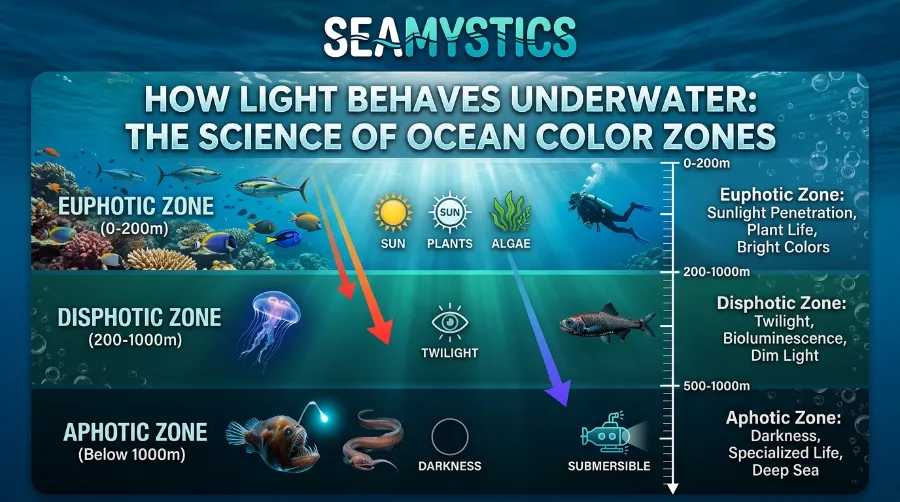
The euphotic zone runs from the surface down to roughly 200 meters, though in very clear tropical water it can stretch closer to 80 meters of strong, usable sunlight before intensity really starts to fall off, and in murky coastal or polar water it can shrink to just a few meters. According to NOAA Ocean Exploration, the upper 200 meters of the ocean is generally classified as the euphotic zone because enough sunlight reaches it to power photosynthesis. This is where the vast majority of marine plants, phytoplankton, and commercial fish stocks live, since this is the only zone with enough light for photosynthesis to outpace respiration.
Why the Ocean Has Waves The Real Science Explained
Disphotic Zone: The Twilight Layer
Below the euphotic zone sits the disphotic zone, often called the twilight zone, stretching from around 200 meters to about 1,000 meters. There is still light here, but not nearly enough for plants to photosynthesize efficiently. Predators in this zone rely on that faint blue glow to hunt by sight, while many species have developed huge eyes or light-sensitive organs just to make the most of what little light remains.
Robert Ballard Discoveries The Man Who Found the Titanic
Aphotic Zone: The Permanent Dark
Past 1,000 meters, sunlight essentially does not exist anymore. This is the aphotic zone, and it makes up the overwhelming majority of ocean volume on Earth. Any light down here comes from the animals themselves, through bioluminescence, rather than from the sun. If you have ever read about total ocean volume, it is worth remembering that most of that volume sits in permanent darkness, not sunlight.
Ocean Color Zones and Why the Sea Looks the Way It Does
Ocean color zones are really just the visible result of everything described above. Open ocean water, far from land, tends to look a rich sapphire blue because it is extremely clear and mostly free of particles, so blue light scatters and bounces back to our eyes while other colors get absorbed. Oceanographers even have a formal way of ranking this using something called Jerlov water types, where Type I waters are the clearest, letting around 10 percent of surface light reach depths near 90 meters.
HMS Challenger Expedition The Voyage That Founded Oceanography
Coastal water tells a different story. It often looks green, brown, or murky because of three main ingredients:
- Suspended sediment from rivers and coastal erosion, which scatters light unevenly and creates a cloudy or brownish tint.
- Dissolved organic matter, sometimes called gelbstoff, which absorbs blue light and gives water a yellow or tea colored tone, very common in estuaries and polar regions.
- High phytoplankton concentrations, which absorb red and blue light for photosynthesis while reflecting green, giving productive coastal waters their greenish hue.
The Sargasso Sea in the central North Atlantic is a textbook example of exceptionally clear open ocean water, prized by oceanographers precisely because it has so little sediment or plankton clouding the water column. Compare that to a spring phytoplankton bloom in the North Atlantic, where chlorophyll concentrations spike so dramatically that satellites can literally track the bloom’s green color from space.
What Changes Light Penetration in the Ocean
Several factors affect how deep light travels on any given day, and it is not just about wavelength. In practice, oceanographers usually point to these variables first:
- Sun angle, since sunlight hitting the water at a steep angle near the equator penetrates far more efficiently than the same light striking at a shallow angle near the poles.
- Water clarity, because sediment, algae, and dissolved matter scatter or absorb light before it can travel deep.
- Season and latitude, which change both day length and the sun’s angle throughout the year.
- Surface conditions, since choppy water reflects more light back into the atmosphere compared to a calm, glassy surface.
- Time of day, with the clearest light penetration happening between mid-morning and mid-afternoon when the sun sits closer to directly overhead.
These same variables influence broader ocean systems too. Water movement patterns described in thermohaline ocean circulation actually help redistribute nutrients and sediment that, in turn, affect how clear or murky a region’s water looks from one season to the next.
Life in Every Light Zone
Marine life has adapted to light availability in some remarkable ways, and this is genuinely one of the most rewarding parts of ocean biology to study up close. In the euphotic zone, fish and reef species often use bright, contrasting colors for communication and camouflage, because there is enough light for those colors to actually matter and be seen.
Once you drop into the disphotic zone, red actually becomes an excellent camouflage color, since red light disappears so early that a red colored shrimp or squid effectively looks black and invisible to predators hunting by sight. Many disphotic species, including lanternfish, also carry photophores, which are small light producing organs used for camouflage, communication, or luring prey.
In the aphotic zone, adaptation goes even further. Anglerfish dangle glowing lures to attract prey in total darkness, while other species have lost eyesight almost entirely and instead rely on vibration, smell, or pressure sensitivity. It is a genuinely extreme environment, made even more punishing when you factor in the crushing water pressure covered in our guide on ocean pressure.
A Closer Look at Depth and Color Loss
| Approximate Depth | Dominant Visible Light | What Divers or Instruments Typically See |
|---|---|---|
| 0 to 10 m | Full spectrum, red still visible | Natural, vivid colors |
| 10 to 40 m | Red gone, orange fading | Colors shift toward yellow and green tones |
| 40 to 100 m | Yellow fading, green strong | Mostly green-blue, muted warm tones |
| 100 to 200 m | Blue and green dominant | Deep blue haze, low light overall |
| 200 to 1,000 m | Faint blue only | Twilight, near total color loss |
| Below 1,000 m | None | Total darkness except bioluminescence |
Divers experience this firsthand on almost every deep dive. Photographers working past 30 meters routinely need artificial lighting or color correcting filters just to recover the reds and oranges that the water has already filtered out, which is part of why underwater lighting equipment has become such a specialized field. As one detailed breakdown from Ocean LED explains, artificial lighting is often described as the unsung hero of underwater visibility precisely because natural light alone cannot restore lost color at depth. Underwater lighting specialists at DeepSea have documented similar patterns, noting that dive lights need to be selected carefully based on expected depth and water clarity to compensate for this natural color loss. Interestingly, research on underwater lighting design has also shown that green wavelengths tend to perform especially well in low visibility conditions specifically because green light travels farther through water than most other colors.
Why This Science Matters Beyond the Ocean Itself
Understanding underwater light science is not just an academic exercise. It shapes commercial fishing decisions, coral reef conservation strategy, and even climate research, since satellites use ocean color data to track phytoplankton health across entire ocean basins. It also connects to bigger picture ocean systems, including the ocean oxygen production that phytoplankton in the euphotic zone generate, since roughly half of the planet’s oxygen originates from these light dependent, ocean dwelling organisms rather than from land based forests.
Meanwhile, temperature and light zones frequently overlap, and cold water regions closer to the poles often experience compressed light zones, similar to how extreme cold interacts with the ocean freezing point in polar seas. Wave activity matters here too, since rougher seas scatter and reflect more surface light, a dynamic explored further in our guide to ocean wave science.
Frequently Asked Questions
How deep does sunlight actually reach in the ocean?
Usable sunlight generally reaches down to about 200 meters in the euphotic zone, though faint traces of blue light have been detected as deep as 1,000 meters in extremely clear water before true darkness begins.
Why does the ocean look blue instead of clear?
Water absorbs red and orange wavelengths quickly, while blue and violet wavelengths scatter throughout the water column instead of being absorbed, and that scattered blue light is what reaches our eyes.
What is the difference between the photic zone and the euphotic zone?
The photic zone is a broader term covering both the euphotic zone, where photosynthesis can occur, and the disphotic zone, where light exists but is too weak to support photosynthesis efficiently.
Do all oceans have the same light penetration?
No. Clear open ocean water, like the Sargasso Sea, allows far deeper light penetration than murky coastal water loaded with sediment or algae.
Can fish see color in the deep sea?
Most deep sea fish have limited color vision since so little visible light reaches them, though some species have evolved highly sensitive eyes tuned specifically to detect faint blue light or bioluminescent flashes.
Conclusion
Underwater light science explains far more than why the ocean looks blue from a boat deck. It shapes where life can exist, how animals hunt and hide, and how entire ecosystems function from the sunlit surface down to the permanent darkness of the deep sea. Once you understand how each wavelength disappears at its own pace, the ocean stops looking like a single blue mass and starts looking like a series of distinct, living layers, each with its own rules written by light itself.
References
- NOAA Ocean Exploration, “How far does light travel in the ocean?”
- NOAA Ocean Service, Light Travel and Ocean Zones fact sheet
- Britannica, “Photic zone,” “Euphotic zone,” “Disphotic zone,” and “Seawater: Optical properties”
- University of Hawaii, Exploring Our Fluid Earth, “Light in the Ocean”
- Ocean LED, “The Hidden Hero of Underwater Lighting”
- DeepSea, “Understanding the Basics of Underwater Lighting”