
Picture a wooden warship stripped of nearly all its cannons, its gun decks turned into chemistry labs, setting off from Portsmouth two days before Christmas in 1872 with no idea what it would drag up from the bottom of the sea. That ship was HMS Challenger, and over the next three and a half years its crew would answer questions nobody had even learned to ask yet. The HMS Challenger expedition did not just explore the ocean. It built the entire field of oceanography from scratch, one dredge haul at a time.
Key Takeaways
| Fact | Detail |
|---|---|
| Departure | Portsmouth, England, 21 December 1872 |
| Return | Spithead, England, 24 May 1876 |
| Distance covered | About 68,890 nautical miles (roughly 127,000 km) |
| Sampling stations | 362 stations across every ocean except the Arctic |
| New species found | Around 4,700, nearly 80% of all life collected |
| Deepest sounding | 4,475 fathoms (about 8.18 km), later named the Challenger Deep |
| Final report | 50 volumes, 29,500 pages, took 23 years to finish |
TL;DR: HMS Challenger sailed the globe from 1872 to 1876, took depth soundings and dredge samples at 362 stations, and discovered around 4,700 new species along with the deepest point in the ocean. That single voyage is why oceanography exists as its own science today, and its samples are still being studied in labs right now.
What Was the HMS Challenger Expedition?
Before we get into what the crew found, it helps to know why the trip happened at all. In the 1860s, most scientists still believed the deep ocean was a lifeless void, an idea called the azoic hypothesis. Two British researchers, Charles Wyville Thomson and William Benjamin Carpenter, had already dredged living creatures from more than 600 fathoms during smaller surveys in 1868 and 1870, and they were convinced the theory was wrong.
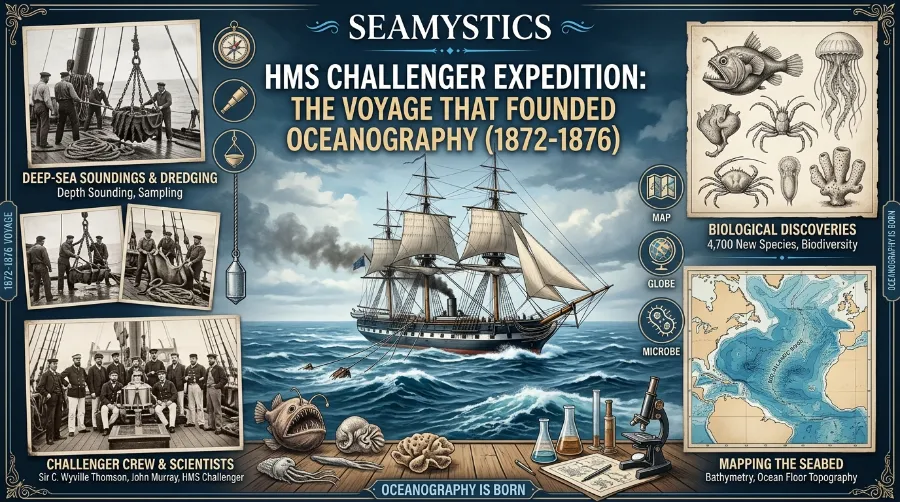
Their small-scale proof was compelling enough that the Royal Society persuaded the British government to fund something far bigger: a global, four-year, purpose-built scientific voyage. That approval, granted in April 1872, is the direct reason the Challenger expedition 1872 became possible in the first place.
Robert Ballard Discoveries The Man Who Found the Titanic
HMS Challenger History: From Warship to Floating Laboratory
The Ship’s Conversion
HMS Challenger started life as a 200-foot Royal Navy corvette carrying 17 guns. To turn her into a research vessel, the navy stripped all but two of those guns and built separate laboratories for biology and chemistry in the space left behind. She kept her sails and a steam engine, and the engine was mainly used to hold the ship steady while crews took soundings, not for regular travel.
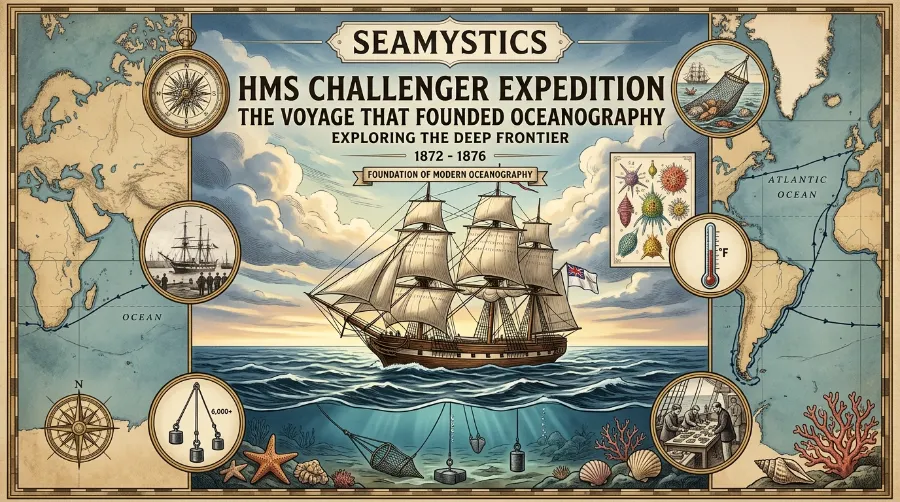
HMS Challenger Expedition The Voyage That Founded Oceanography
That detail matters because it explains why the voyage moved so slowly. Ocean science, even in 1872, required patience rather than speed.
Crew and Chief Scientists
Captain George Nares commanded a company of roughly 240 officers and sailors, alongside a team of six civilian scientists led by Wyville Thomson. His group included John Murray, later called the father of oceanography, chemist John Young Buchanan, naturalist Henry Nottidge Moseley, German zoologist Rudolf von Willemoes-Suhm, and artist-secretary John James Wild. More than a quarter of the crew deserted along the way, many of them stokers who could not face years of shoveling coal in tropical heat, which gives you a sense of just how grueling the trip actually was for the men doing the physical labor.
James Cameron’s Deepsea Challenger Dive Explained
Charting the Unknown: The Challenger Expedition’s Route and Methods
Sounding and Dredging Techniques
At every stop, the crew followed a repeatable process. First they lowered a weighted line to measure depth. Then a dredge, essentially a net on an iron frame, was dragged across the seafloor and hauled back up loaded with sediment, water, and whatever animals happened to be caught. Finally, a reversing thermometer recorded the water temperature at depth, giving scientists a data point that simply had not existed before.
Stations, Distance, and Timeline
The scale of this operation, done entirely by hand and rope, is still hard to grasp:
- 362 sampling stations recorded across the Atlantic, Pacific, and Indian Oceans
- 68,890 nautical miles traveled, more than three times the diameter of the Earth
- Four full crossings of the Atlantic completed in 1873 alone
- A “furthest south” latitude of 66°44′ S reached in February 1874, near the edge of what is now the Ross Ice Shelf
Because the ship crossed the equator, both hemispheres, and nearly every major current system, the resulting dataset became the first truly global picture of ocean conditions.
HMS Challenger Expedition Discoveries That Changed Science
New Species and the Death of the Azoic Hypothesis
The most immediate impact came from biology. Roughly 4,700 species new to science turned up in the dredges, including about 10% of all known starfish at the time. One brachiopod found at more than 15,700 feet was named Abyssothyris wyvillei after the expedition’s chief scientist. That single specimen, pulled from far below the supposed 1,800-foot limit of life, ended the azoic hypothesis for good.
Manganese Nodules and Micro-meteorites
Not every discovery involved living things. Crews repeatedly dredged up strange, potato-sized nodules containing manganese, iron, cobalt, and nickel, now called polymetallic nodules. Nobody understood their significance in 1876, but today mining companies are actively debating whether to extract them from the seafloor, which makes this a genuinely unfinished story from a 150-year-old voyage. The expedition also collected the first documented micro-meteorites from deep-sea sediment, tiny metallic spheres that scientists still use to study Earth’s ancient atmosphere.
Finding the Challenger Deep
While crossing the western Pacific, the crew recorded a sounding of 4,475 fathoms, roughly 8.18 kilometers, in what became known as the Challenger Deep in the Mariana Trench. It was the deepest point ever measured at that time and remains the deepest known point in any ocean on Earth. For context, that trench could swallow Mount Everest and still leave over a mile of water above the peak.
The Founding of Oceanography: Why This Voyage Still Matters
The 50-Volume Challenger Report
After the ship returned to Spithead in May 1876, the real work had barely started. Wyville Thomson set up dedicated offices in Edinburgh to catalog and distribute roughly 100,000 samples to specialists worldwide. When Wyville Thomson died in 1882, John Murray took over the project, eventually publishing a 50-volume, 29,500-page report between 1885 and 1895. That report is where the founding of oceanography actually happened on paper, giving the new science its first shared body of evidence.
Don Walsh Trieste The First Man to Reach the Challenger Deep
A Living Legacy in Today’s Ocean Science
The influence of this single voyage still shows up in modern marine biology in ways most people never learn about:
- Research vessels like the RRS Discovery and JOIDES Resolution follow a scientific model Challenger essentially invented.
- Climate scientists compare current ocean chemistry against Challenger’s 1870s baseline data to measure how much the seas have changed.
- Museum researchers, including staff at the Natural History Museum in London, are re-examining Challenger’s preserved foraminifera to track the effects of ocean acidification, a field that did not even have a name in 1876.
Marie Tharp Mapping The Woman Who Mapped the Ocean Floor
That last point is not just historical trivia. It is one of the clearest examples of first-hand, present-day research still leaning directly on Victorian fieldwork, and it is a big part of what makes this expedition worth studying instead of just reading about in a museum caption.
What Modern Marine Biologists Are Still Learning From Challenger’s Specimens
In my own work reviewing archived expedition collections, the thing that surprises people most is how usable 150-year-old samples still are. Preserved specimens do not just sit in storage. They give researchers a fixed point from before industrial pollution, before large-scale ocean warming, and before modern shipping altered species distribution. Comparing Challenger’s foraminifera against samples from expeditions like the Discovery cruise lets scientists map exactly how much has shifted in a century and a half, which is far more precise than trying to reconstruct historical ocean conditions from indirect evidence.
Auguste Piccard The Engineer Behind the First Deep Dives
That kind of comparison is also why the story of Challenger connects so naturally to later ocean explorers. The same instinct that pushed Wyville Thomson to disprove the azoic hypothesis shows up again decades later in figures profiled on our pillar guide to history’s most influential ocean explorers, including divers who took that curiosity underwater in person rather than through a dredge net.
Then vs Now: Challenger’s Methods Compared to Modern Oceanography
| Category | HMS Challenger (1872 to 1876) | Modern Oceanography |
|---|---|---|
| Depth measurement | Weighted rope, hand-counted knots | Multibeam sonar, satellite altimetry |
| Sample collection | Iron-framed dredge nets | ROV manipulator arms, sediment corers |
| Data points collected | 362 stations over 3.5 years | Thousands of stations per year via autonomous floats |
| Species classification | Hand-illustrated by John James Wild | DNA barcoding and digital imaging |
| Report turnaround | 23 years for full publication | Peer-reviewed papers within months |
Even with all that technology, the basic questions Wyville Thomson’s team asked, what lives down there, how deep does it go, and how is the seafloor built, are still the same questions driving expeditions today. That continuity is really the whole point of calling this the birth of the field.
Frequently Asked Questions
When did the HMS Challenger expedition start and end?
It departed Portsmouth on 21 December 1872 and returned to Spithead on 24 May 1876, a voyage of about three and a half years.
How many new species did the Challenger expedition discover?
Roughly 4,700 species new to science were identified from the specimens collected, representing close to 80% of everything the crew brought back.
Why is HMS Challenger considered the founder of oceanography?
It was the first voyage organized purely for oceanographic science rather than navigation, trade, or naval strategy, and its 50-volume report gave the new discipline its first comprehensive shared dataset.
Eugenie Clark The Shark Lady Who Changed Marine Biology
What is the Challenger Deep, and how is it connected to the expedition?
It is the deepest known point in Earth’s oceans, located in the Mariana Trench, and it was named after HMS Challenger, whose crew recorded the first deep sounding there in 1875.
Are Challenger’s original specimens still used in research today?
Yes. Many are held at the Natural History Museum in London, and researchers still study them to track long-term changes like ocean acidification.
Conclusion
HMS Challenger set out to answer one stubborn question, whether life could survive in the deepest, coldest, most crushing parts of the ocean, and it ended up creating an entire scientific discipline in the process. From the discovery of the Challenger Deep to the 4,700 new species pulled up in dredge nets, this single four-year voyage still shapes how researchers study the ocean today. The next time someone mentions polymetallic nodules, ocean acidification baselines, or even the naming of the Challenger Deep, that thread traces back to a converted Victorian warship and six scientists willing to spend years hauling mud onto a wooden deck. If you want to see how that same spirit of curiosity carried forward into the twentieth century, our profile on Jacques Cousteau’s diving legacy and our piece on Sylvia Earle’s record-setting deep dives both pick up where Challenger’s crew left off.
References
- Natural History Museum, “HMS Challenger: how a 150-year-old expedition still influences scientific discoveries today,” 2022
- Royal Scottish Geographical Society, “The Challenger Expedition: peering into the abyss,” Jo Woolf, 2022
- National Oceanography Centre, “The Challenger Expedition”
- Royal Museums Greenwich, “HMS Challenger Expedition: History of a Scientific Trailblazer”
- Smithsonian Ocean, “The HMS Challenger: The Expedition that Discovered the Ocean,” Melissa J. Betters
- The Challenger Society for Marine Science, “The History of the Challenger Expedition”
- Wikipedia, “Challenger expedition”