
Seven miles down, in total darkness, a window cracked. That was the moment Don Walsh and Jacques Piccard could have turned back. Instead, they kept going. A few hours later, they became the first human beings to touch the deepest point on the planet. The Don Walsh Trieste dive happened on January 23, 1960. More than sixty years on, it remains one of the boldest things anyone has done in the name of ocean science.
Don Walsh Trieste The First Man to Reach the Challenger Deep
Who actually reached the bottom of the ocean first? How did a homemade submarine from the 1950s manage something modern robots still struggle with? This is that story. It also holds real lessons for anyone curious about famous ocean explorers and how deep sea science got started.
Who Was Don Walsh?
Don Walsh grew up in San Diego and near Berkeley, California. He never set out to become the most famous submariner in history. Instead, he enlisted in the Navy in 1948 and first worked as an aircrewman. Later, he attended the US Naval Academy in Annapolis, and from there he moved into submarine service. Eventually, he commanded USS Bashaw. Then the Navy handed him an assignment with almost no precedent: become one of the world’s first bathyscaphe pilots.
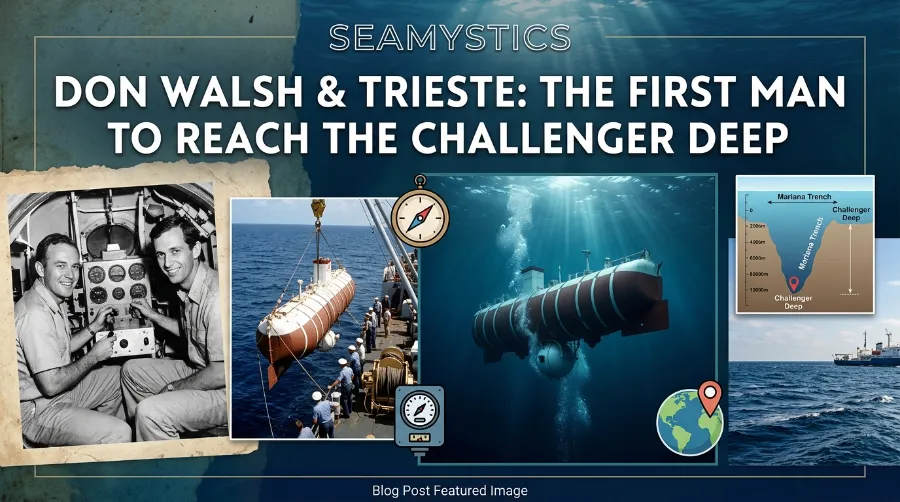
That last part matters more than it sounds. Only two working bathyscaphes existed on Earth in the late 1950s, and no training manual or established career path existed either. So the Navy put out a call for volunteers, and Walsh was one of only two men who answered. He later said the job simply sounded fun, an understated way to describe volunteering for an untested deep sea vehicle.
From Lieutenant to Ocean Policy Advocate
By 1960, Walsh held the rank of Lieutenant and commanded the Trieste on its historic dive. Afterward, he went on to earn a PhD in oceanography and eventually retired as a Navy Captain. For decades that followed, he consulted on ocean policy and exploration. He passed away in November 2023 at age 92, yet even in his final years he kept speaking publicly about deep sea research. Throughout, he kept pushing for funding to send scientists, not just robots, back into the trenches.
The Trieste Bathyscaphe Crew
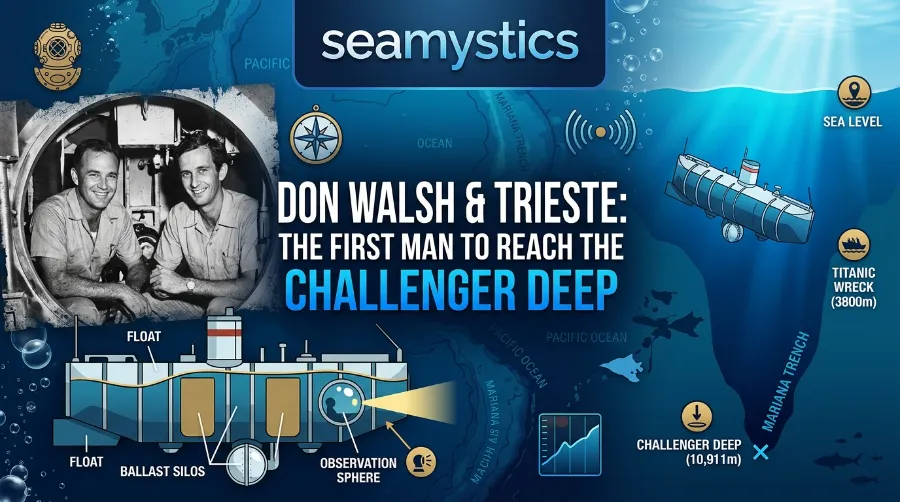
The word bathyscaphe means deep boat. Swiss physicist Auguste Piccard designed the concept, and his engineering ideas fed into the Auguste Piccard bathyscaphe lineage that Trieste belonged to. Rather than compressed air, the Trieste used a float chamber filled with gasoline, since gasoline is lighter than water and barely compresses under pressure. Beneath the float hung a small steel sphere, built with just enough room for two people and engineered to withstand crushing pressure at extreme depth.
Eugenie Clark The Shark Lady Who Changed Marine Biology
The Navy bought the Trieste from the Piccard family in 1958. The price came to around 250,000 dollars, modest for what became one of the most important vessels in oceanographic history. As part of the deal, Jacques Piccard, Auguste’s son, came along, already experienced in piloting a bathyscaphe. Together, Piccard and Walsh formed the Trieste bathyscaphe crew, and the Navy assigned them to Project Nekton, a series of increasingly deep test dives meant to prove the vessel could handle the Mariana Trench.
Key Design Features
A few details explain how the vessel actually worked:
- The crew cabin was a small steel sphere, the strongest shape for resisting pressure, and it held only two people at a time.
- Later versions used a specially engineered foam for buoyancy, though the 1960 Trieste relied mainly on gasoline flotation.
- The crew controlled descent and ascent using iron ballast, released at the bottom so the vessel could rise again.
- The Trieste carried no propulsion system for horizontal travel, so it essentially dropped straight down and floated straight back up.
None of it came from an existing playbook. In fact, no vendors existed, no spare parts suppliers existed, and no prior missions existed to learn from. Walsh put it simply in later interviews: the team had to write the book themselves.
The First Challenger Deep Dive
The mission began on January 20, 1960. A small convoy set out from Guam, including a command ship, a tug, and the Trieste itself. Their target was Challenger Deep, a valley at the southern tip of the Mariana Trench. The British survey ship HMS Challenger first measured it back in 1875, an expedition covered in our piece on the HMS Challenger expedition. Early 1950s sonar readings suggested the trench reached around 10,900 meters, though the command ship still needed to locate the exact deepest point before the dive could begin.
Early on January 23, Walsh and Piccard climbed down through the entrance tunnel into the tiny crew sphere. Here is roughly how the descent unfolded:
- First, the crew released buoyant gasoline to begin sinking, and the Trieste dropped into total darkness within the first few hundred meters.
- Then, at around 9,000 meters, a loud crack echoed through the cabin. An outer Plexiglas viewport had fractured under the pressure, though the inner hull held firm.
- Even so, Walsh and Piccard chose to continue rather than abort, since they were already within striking distance of the bottom.
- Finally, after roughly four hours and forty eight minutes, the Trieste touched down on the ocean floor.
Reaching the Bottom
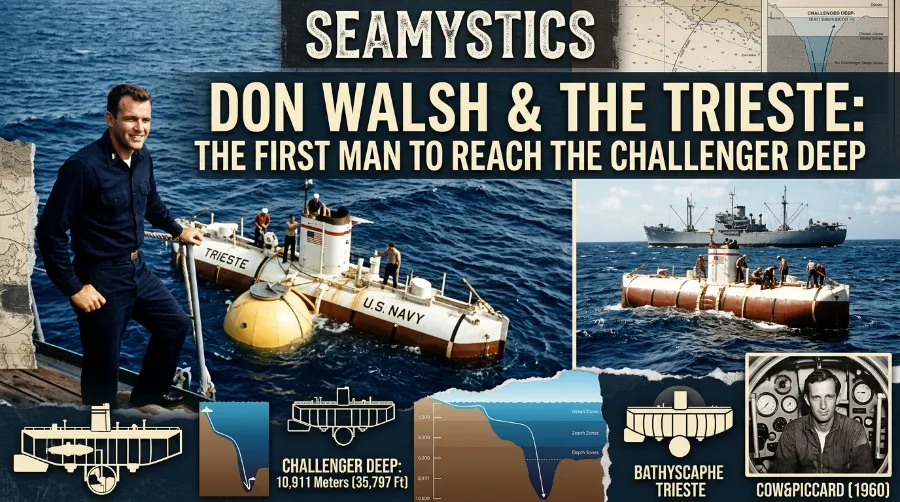
At 1:06 PM local time, the pair radioed the surface support ship to report that the Trieste had reached bottom at six thousand three hundred fathoms. Engineers later calculated the final depth at 10,916 meters, or about 35,814 feet. By comparison, modern sonar puts the deepest section of Challenger Deep somewhere between 10,911 and 10,935 meters, depending on the survey method.
Twenty Minutes on the Ocean Floor
They stayed on the bottom for only about 20 minutes, since a cracked window is not something you want to test twice. During that brief window, Piccard reportedly spotted a flatfish moving across the silt outside the porthole. That detail mattered scientifically, because it undercut the long standing theory that no complex life could survive such extreme pressure. Afterward, the ascent took about three hours and fifteen minutes, and the Trieste broke the surface again at 4:56 PM, nine hours after the mission began.
Why the Dive Still Matters
Mount Everest stands 8,849 meters tall, and Sir Edmund Hillary and Tenzing Norgay reached its summit in 1953. By contrast, Challenger Deep sits deeper below sea level than Everest stands above it. Even so, almost nine thousand climbers have summited Everest since Hillary’s ascent, while only a handful of people have ever reached Challenger Deep.
Here is a quick comparison of the deepest manned dives to the trench:
| Expedition | Year | Depth reached | Notes |
|---|---|---|---|
| Trieste, Walsh and Piccard | 1960 | 10,916 m | First manned descent, no scientific instruments carried |
| Deepsea Challenger, James Cameron | 2012 | 10,908 m | Solo dive, 52 years after Trieste |
| DSV Limiting Factor, Victor Vescovo | 2019 to 2022 | Up to 10,928 m | Multiple crewed dives, most detailed mapping to date |
| Fendouzhe, Chinese crewed submersible | 2020 | 10,909 m | First Chinese crewed descent |
A Record With Few Witnesses
For 52 years, nobody went back. That gap alone shows how difficult and expensive deep trench diving actually is, and it is a big part of why people still treat Walsh’s 1960 dive as a landmark, not a footnote. Eventually, James Cameron returned to Challenger Deep in March 2012, following a route that Walsh and Piccard had opened more than half a century earlier. Read more about that connection in our profile on James Cameron’s dive.
Later in life, Walsh spoke honestly about his disappointment that the dive had not sparked faster follow-up exploration. He once said he had hoped someone would return within a couple of months, which he believed would have proven trench science mattered to the wider oceanographic community. Instead, it took decades, and for long stretches the Trieste itself sat in the National Museum of the US Navy in Washington, DC, more monument than working vessel.
What the Dive Actually Proved
People sometimes treat the 1960 Challenger Deep dive as pure spectacle, a stunt with a good story attached. In reality, though, it settled a genuine scientific debate. Before 1960, many oceanographers assumed the deep trenches were essentially azoic, or lifeless, since the pressure seemed too extreme for anything to survive.
Proving Life Could Survive
Piccard’s brief glimpse of a flatfish at nearly 11,000 meters challenged that assumption directly. As a result, it helped set the stage for decades of deep sea biology, including the kind of work later carried on by researchers like Sylvia Earle and Robert Ballard.
From Trieste to Alvin
The dive also proved something practical: a crewed vehicle could survive the deepest pressure on the planet and return intact, even after visible structural damage. That confidence mattered enormously for the Navy’s later submersible program, and it directly influenced the design of Alvin, the deep sea vehicle Woods Hole Oceanographic Institution built not long after. Alvin went on to make thousands of dives, including the 1985 expedition that located the wreck of the Titanic, echoing the way pioneers like Jacques Cousteau built their own legacies.
There is a modern parallel worth mentioning too. Watchmaker Rolex supplied instruments used to test pressure resistance during Trieste era dives, and materials from Aquastar’s history of the Don Walsh dive still reference that heritage today, documenting the instrumentation angle in more detail than most general histories do.
The Legacy Don Walsh Left Behind
Walsh spent the rest of his career making sure people did not treat the Trieste dive as a one-off curiosity. Consequently, he consulted on ocean policy for decades and remained a visible advocate for returning humans, not only robots, to the deep ocean. The Marine Technology Society honored him extensively for this body of work, and their tribute lays out how much of modern ocean exploration policy traces back to conversations Walsh personally took part in, covered well in the Marine Technology Society’s retrospective on his achievements.
Numbers Behind the Legacy
A few numbers put his broader legacy into perspective:
- Only around 30 people total have ever reached Challenger Deep, compared to nearly 9,000 who have summited Everest.
- The Trieste’s total dive to Challenger Deep lasted about 9 hours round trip, an extraordinarily long mission for 1960s technology.
- Walsh lived to see the 60th anniversary of his dive celebrated at the National Museum of the US Navy in January 2020, by which point he was the last surviving pilot able to speak about it firsthand.
Scientists with the fanciest titles do not always write exploration history. After all, Walsh was simply a working naval officer, one of only two volunteers willing to take an enormous, poorly understood risk. Arguably, that willingness, more than any single piece of technology, made the first Challenger Deep dive possible at all. For a broader sense of how mapping the ocean floor became possible in the first place, our piece on Marie Tharp’s ocean floor mapping work is a natural next read.
Frequently Asked Questions
Who was the first person to reach the Challenger Deep? Don Walsh, a US Navy lieutenant, and Jacques Piccard, a Swiss oceanographer, made the descent together aboard the bathyscaphe Trieste on January 23, 1960.
How deep is the Challenger Deep? Most modern measurements put it between roughly 10,911 and 10,935 meters, or about 35,800 to 35,900 feet. The exact figure shifts slightly depending on the survey method used.
How long did the 1960 Trieste dive take? The full round trip took about 9 hours. Descent took roughly 4 hours and 48 minutes, while ascent took about 3 hours and 15 minutes. In between, the crew spent roughly 20 minutes on the ocean floor.
Did anything go wrong during the dive? Yes. At around 9,000 meters, an outer Plexiglas viewport cracked under the pressure. Even so, the crew chose to continue rather than abort, since they were close enough to the bottom that turning back carried its own risks.
Was Don Walsh the only person to ever reach Challenger Deep? No, but he was the first. James Cameron reached it solo in 2012, and several more crewed missions have followed since, including Victor Vescovo’s DSV Limiting Factor dives between 2019 and 2022.
Conclusion
Don Walsh’s dive to Challenger Deep did not come from a large, well funded institution with years of preparation behind it. Instead, it came from two men, a homemade steel sphere, a cracked window, and a decision to keep going anyway. More than sixty years later, that decision still shapes how oceanographers think about risk and exploration, and it still shapes what it takes to understand the deepest, least visited place on the planet. If you want to keep reading about the wider world of ocean exploration this dive helped launch, start with the pillar guide to famous ocean explorers.
References
- IEEE Spectrum, “Don Walsh Describes Trip to the Bottom of the Mariana Trench”
- USNI News, “Don Walsh, Deep Sea Submariner and Ocean Explorer, Dies at 92”
- Office of Naval Research, “History-Making Oceanographer and Ret. Navy Captain Dies at 92”
- Naval History Magazine, US Naval Institute, “The Trieste’s Deepest Dive,” February 2020
- AAAS, “Back to the Challenger Deep”
- Marine Technology Society, tribute to Don Walsh, 2023
- Aquastar, “Worn by Don Walsh”
- Heritage Auctions, “The Last Seven Miles”: ha.com (no direct URL found — worth double-checking on ha.com directly)