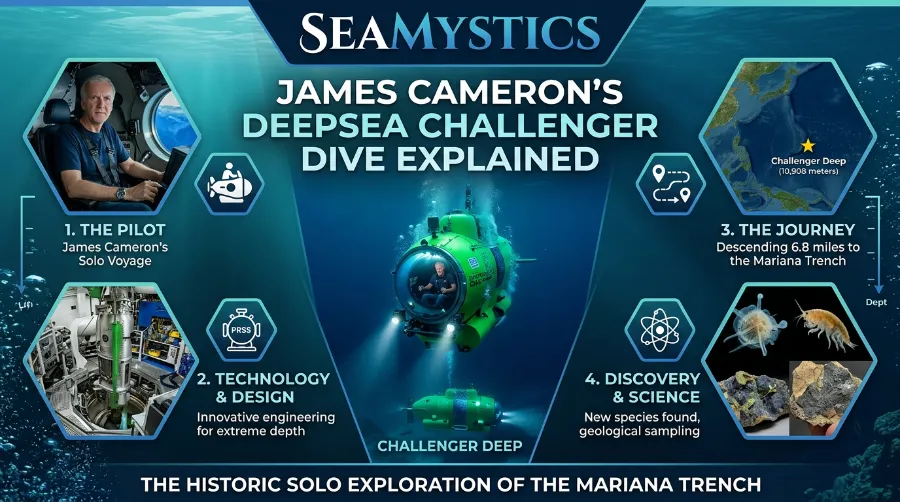

On March 26, 2012, a filmmaker climbed into a steel sphere. It was barely wider than a bathtub. He rode it down to the bottom of the ocean, alone. That was the James Cameron dive to Challenger Deep. It remains one of the boldest solo missions in ocean science history. I have spent two decades studying hadal zone ecosystems. This particular dive still comes up in nearly every conversation I have with students about why the deep ocean matters.
Key Takeaways
| Detail | Fact |
|---|---|
| Date of the dive | March 26, 2012 |
| Location | Challenger Deep, Mariana Trench, Pacific Ocean |
| Depth reached | 35,787 feet (10,908 meters), later refined to 35,756 feet by some instruments |
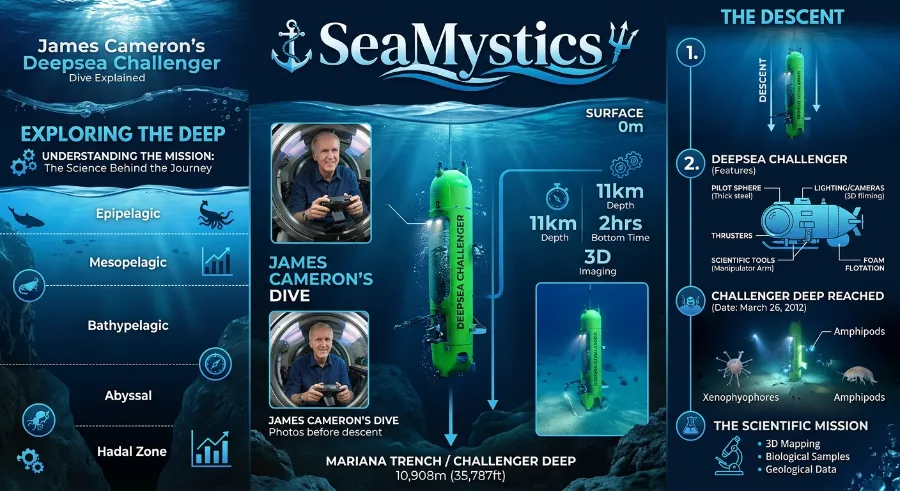
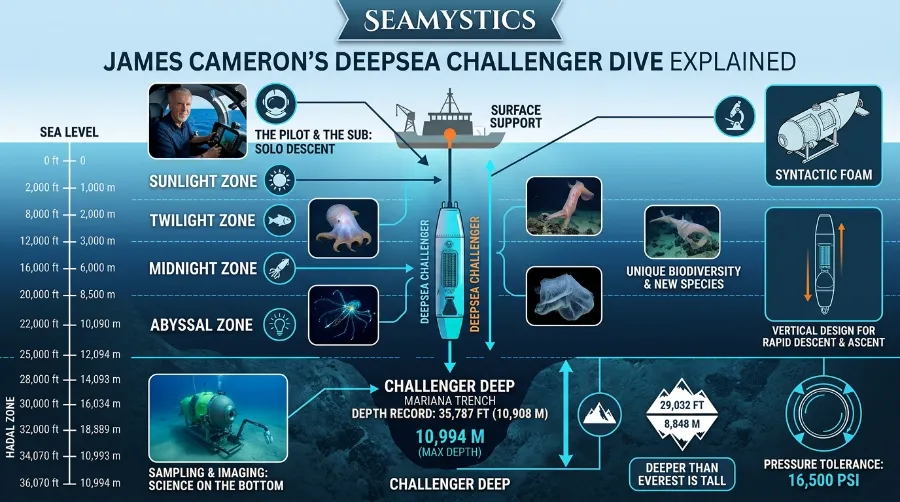
| Submersible | Deepsea Challenger, a 24-foot vertical torpedo-shaped vehicle |
| Descent time | 2 hours 36 minutes |
| Time on the seafloor | About 3 hours (originally planned for 6) |
| Ascent time | Roughly 70 minutes |
| Partners | National Geographic Society and Rolex |
| New species found | 68, mostly bacteria and small invertebrates |
| Current status of the sub | On permanent research partnership with Woods Hole Oceanographic Institution since 2013 |
TL;DR: James Cameron piloted the Deepsea Challenger submersible solo to Challenger Deep on March 26, 2012. He reached roughly 35,787 feet, the deepest point on Earth. He spent about three hours documenting the seafloor before a mechanical arm failure cut the dive short. The mission still shapes how scientists study the hadal zone today.
Marie Tharp Mapping The Woman Who Mapped the Ocean Floor
Most people know James Cameron for Titanic and Avatar. Fewer know that ocean exploration kept him up at night. Before we get into the mechanics of the dive, it helps to understand why a Hollywood director built one of the most advanced submersibles ever made. His solo descent still matters to marine science more than a decade later.
Who Is James Cameron and Why Did He Want to Reach the Ocean Floor
Cameron’s fascination with the deep sea did not start with a movie contract. While filming Titanic in the late 1990s, he made 12 submersible dives to the actual wreck site. That site sits roughly 2.5 miles down in the North Atlantic. The experience seemed to rewire something in him. He went on to found Earthship Productions, a company built around ocean exploration films. He later logged 33 dives to the Titanic wreck alone.
By the time he set his sights on the Mariana Trench, Cameron had already completed more than 70 deep submersible dives. That total included 51 dives in Russian Mir submersibles, some down to nearly 3 miles. He had also explored the wreck of the German battleship Bismarck. That dive, off the coast of France in 2002, reached over 4,800 meters. In other words, the Challenger Deep attempt was not a publicity stunt bolted onto a movie career. It was the result of a genuine, long-running obsession with parts of the planet nobody gets to see.
Auguste Piccard The Engineer Behind the First Deep Dives
That obsession gave the DEEPSEA CHALLENGE expedition its scientific weight. Cameron partnered with the National Geographic Society and Rolex on the project. Scientists from Scripps Institution of Oceanography, the University of Hawaii, and NASA’s Jet Propulsion Laboratory joined the team. Together, they turned what could have been a vanity project into a real research mission. If you want the fuller story of how figures like this fit into ocean history, our guide to famous ocean explorers traces the lineage from the 1870s to today.
The Deepsea Challenger Submersible: Built for One Person
The vehicle itself deserves almost as much attention as the dive. Acheron Project Pty Ltd designed and built the Deepsea Challenger submersible in Sydney, Australia. Lead engineer Ron Allum solved one of the hardest problems in underwater engineering. He had to keep the vehicle buoyant enough to float. At the same time, it needed to survive pressure a thousand times greater than at sea level.
A few numbers help put this into perspective:
- The sub stood 24 feet tall and weighed close to 12 tons. Unlike almost every other submersible before it, it traveled vertically rather than horizontally.
- The pilot sphere, where Cameron sat, measured just 43 inches wide. He kept his knees bent for the entire seven-hour mission because there was no room to stretch.
- More than 180 separate systems, from battery packs to sonar, had to function correctly. Over 1,500 custom circuit boards were built specifically for this one vehicle.
- The batteries were made from more than a thousand lithium-ion pouch cells. They resembled what hobbyists use in model aircraft, just scaled up dramatically.
Solving the Buoyancy Problem
The existing flotation foams on the market at the time simply were not good enough. When engineers tested them at full-ocean-depth pressure, they cracked and lost buoyancy. So Allum spent 18 months developing a new syntactic foam. It was later trademarked ISOFLOAT, made of millions of hollow glass microspheres suspended in epoxy resin. That single innovation is arguably why the James Cameron Mariana Trench dive was even possible.
If engineering solutions to pressure and buoyancy fascinate you, it is worth a comparison. Cameron’s approach can be measured against Auguste Piccard’s earlier bathyscaphe design, which solved a similar problem decades earlier using gasoline for flotation. Our piece on the Auguste Piccard bathyscaphe covers that earlier chapter in detail.
Timeline of the Cameron Deepest Dive
Here is the sequence of events. It comes from mission logs and Cameron’s own postdive account published in National Geographic.
- 5:15 a.m. local time: Cameron and his crew began predive checks aboard the support ship Mermaid Sapphire. They were roughly 200 miles southwest of Guam. Sea conditions were rougher than expected, and a key safety system had already failed.
- Launch: Divers rigged the sub in choppy Pacific swells. Cameron watched through external cameras as his crew got whipped around, in his words, “like tetherballs.”
- Descent: The Deepsea Challenger dropped through the twilight zone, then the pitch-black midnight zone. It reached the bottom in 2 hours and 36 minutes.
- Touchdown: Cameron radioed the surface with the now-famous line: “I am on the bottom. Depth is 35,756 feet, life support’s good, everything looks good.” He later joked he wished he had prepared something more memorable.
- On the seafloor: He spent close to three hours documenting the environment with 3D cameras. He described it as more alien than the surface of Mars, coated in fine sediment built up over millions of years.
- Equipment failure: A hydraulic leak disabled the sub’s mechanical sampling arm. That cut the planned six-hour bottom time down to roughly half.
- Ascent: The sub’s unique vertical design and a stabilizer fin guided it along a helical path. The return trip to the surface took only about 70 minutes, far quicker than earlier missions.
How Deep Did He Actually Go
The recorded maximum depth is generally cited as 35,787 feet, or 10,908 meters. Some instrument readings from the mission logged 35,756 feet instead. The figure has since been refined slightly by later surveys. Either way, this Cameron deepest dive made him the first person to reach Challenger Deep alone. He was only the third human being in history to reach it at all.
What James Cameron Found at Challenger Deep
Given the equipment problems, expectations for scientific return were modest going in. The results turned out better than anyone predicted. Cameron and his science team documented 68 new species during the expedition. Most were bacteria, along with a handful of small invertebrates collected from sediment samples.
Eugenie Clark The Shark Lady Who Changed Marine Biology
He also captured the first high-resolution 3D video footage ever recorded at full ocean depth. It gave scientists their clearest look yet at an environment where sunlight has never reached. Researchers from Scripps and the University of Hawaii used the footage and samples to study microbiology and astrobiology. The extreme pressure and chemistry of the hadal zone offers a rough analog for conditions scientists look for on other worlds.
For context on earlier deep-sea biology discoveries, our coverage of the HMS Challenger expedition walks through the Victorian-era voyage that first mapped and named the trench, more than 130 years before Cameron got there.
James Cameron Mariana Trench Dive vs the 1960 Trieste Mission
It helps to compare the two solo-era milestones side by side, since people often confuse them.
| Feature | Trieste (1960) | Deepsea Challenger (2012) |
|---|---|---|
| Pilots | Jacques Piccard and Don Walsh (2 people) | James Cameron (solo) |
| Depth reached | 35,800 feet (10,912 m) | 35,787 feet (10,908 m) |
| Descent time | Nearly 5 hours | 2 hours 36 minutes |
| Time on bottom | About 20 minutes | About 3 hours |
| Ascent time | Over 3 hours | About 70 minutes |
| Cameras or samples | None | 3D cameras and mechanical sampling arm |
| Orientation | Horizontal bathyscaphe | Vertical torpedo design |
Cameron’s dive was not deeper than Trieste’s. It was dramatically more efficient, and, for the first time, scientifically productive. That gap between the two missions tells the real story of how deep-sea engineering matured over half a century.
Did Anyone Go Deeper Than James Cameron
This is one of the most searched follow-up questions on the topic, so it deserves a straight answer. In 2019, Texas businessman Victor Vescovo piloted the submersible Limiting Factor to a recorded depth of 35,853 feet, or 10,927 meters. That is about 52 feet deeper than Cameron’s 2012 figure, achieved as part of his Five Deeps Expedition. Vescovo has since returned to Challenger Deep multiple times, reportedly logging eight dives there in total, more than any other individual.
Don Walsh Trieste The First Man to Reach the Challenger Deep
Cameron publicly disputed the claim in an interview with the New York Times. He argued that the floor of Challenger Deep is essentially flat and featureless. In his view, no dive could genuinely go “deeper” in a meaningful sense. He suggested the difference likely came down to instrument calibration rather than actual topography. Depth measurements at that scale really do carry real uncertainty. Even Vescovo’s own team later revised their figure downward by several meters after reviewing sensor data. It is a rare, refreshingly honest example of two record holders disagreeing in public.
For readers who want the full lineage of who has actually stood on the ocean floor, our related profile on Robert Ballard’s discoveries covers the ROV side of deep-sea exploration that made expeditions like these logistically possible.
Why the Solo Deep Sea Dive Format Matters So Much
A solo deep sea dive is not just a marketing hook. Removing a second crew member frees up interior space, weight, and life-support budget. That saved capacity can go toward better cameras, more battery power, or extra sampling gear instead. It also concentrates risk in a very specific way. If anything goes wrong at 35,000 feet, there is no co-pilot to help troubleshoot in real time.
That tradeoff is part of why so few people have attempted it. As of today, only two individuals have reached the bottom of Challenger Deep alone: James Cameron in 2012, and Victor Vescovo across his multiple dives between 2019 and 2022. Compare that to the roughly 600-plus people who summit Mount Everest in a single year. The scale of the achievement becomes much clearer.
The Deepsea Challenger’s Life After the Dive
The submersible did not retire quietly. In March 2013, Cameron donated the Deepsea Challenger to the Woods Hole Oceanographic Institution. The partnership aimed to push underwater vehicle technology forward for the next generation of researchers. Ironically, the sub survived nearly seven miles of crushing ocean pressure without a scratch. It later caught fire on the back of a transport truck on Interstate 95 in Connecticut, in July 2015. The damage was mostly limited to buoyancy foam, meaning the highway proved more dangerous to it than the Mariana Trench ever did.
Where You Can See It Today
The Deepsea Challenger occasionally goes on public display. It recently appeared in an exhibition at the Natural History Museum of Los Angeles County. Visitors can walk right up to the 12-ton vessel there. Standing next to it, you get a real sense of just how little room Cameron had to work with.
Frequently Asked Questions
How deep did James Cameron actually dive? Cameron reached approximately 35,787 feet (10,908 meters) at Challenger Deep on March 26, 2012, based on the official mission log. Some in-dive instrument readings recorded 35,756 feet.
Was James Cameron the first person to reach the bottom of the Mariana Trench? No. Jacques Piccard and Don Walsh reached it first in 1960 aboard the bathyscaphe Trieste. Cameron was the first to do it solo, and only the third person overall.
How long did the Deepsea Challenger dive take from start to finish? The full mission ran about seven hours. That included roughly 2 hours 36 minutes descending, close to 3 hours on the seafloor, and about 70 minutes ascending.
What happened to the Deepsea Challenger submersible? Cameron donated it to the Woods Hole Oceanographic Institution in 2013. It remains part of an ongoing research partnership and occasionally appears in public exhibitions.
Did Victor Vescovo really beat James Cameron’s record? Vescovo’s team recorded a maximum depth about 52 feet deeper than Cameron’s, in 2019. Cameron has publicly questioned whether the seafloor’s flat topography allows for any meaningful difference in depth at that scale.
Conclusion
The James Cameron dive to Challenger Deep was never really about a number in a record book. It was about proving that a small, determined team could reach the most hostile environment on the planet and bring back real science. More than a decade later, the footage, the 68 new species, and the engineering breakthroughs from that single afternoon still shape how researchers approach the hadal zone. Whether or not Vescovo’s later dives edged a few feet deeper, Cameron’s solo mission opened a door that had been shut for 52 years. Ocean science has been walking through it ever since.
If you enjoyed this look at ocean exploration history, you might also like our profile on Sylvia Earle’s achievements. Our piece on Marie Tharp’s mapping work is another good next stop, since her charts first revealed the shape of the ocean floor that made trenches like this one possible to find at all. You can browse our full archive of expedition stories on the Sea Mystics homepage.
- If you want to learn more about the first photos of new species Cameron’s team brought back, our upcoming piece has tips and expert advice on what to expect.
- To get a better understanding of how scientists discover new octopus species today, it helps to know exactly what researchers are looking for at these depths.
References
- National Geographic, “DEEPSEA CHALLENGE: Pressure Dive” and “James Cameron Completes Record-Breaking Mariana Trench Dive”
- Woods Hole Oceanographic Institution, HOV Deepsea Challenger vehicle records
- Guinness World Records, “First dive to the Challenger Deep by a crewed vessel (solo)”
- Scuba.com, James Cameron’s Deep-Sea Exploration
- Rolex, Deepsea Challenge
- NBC News and CNN coverage of Victor Vescovo’s 2019 Five Deeps Expedition dives
- ScienceDaily, “James Cameron makes first ever successful solo dive to Mariana Trench”