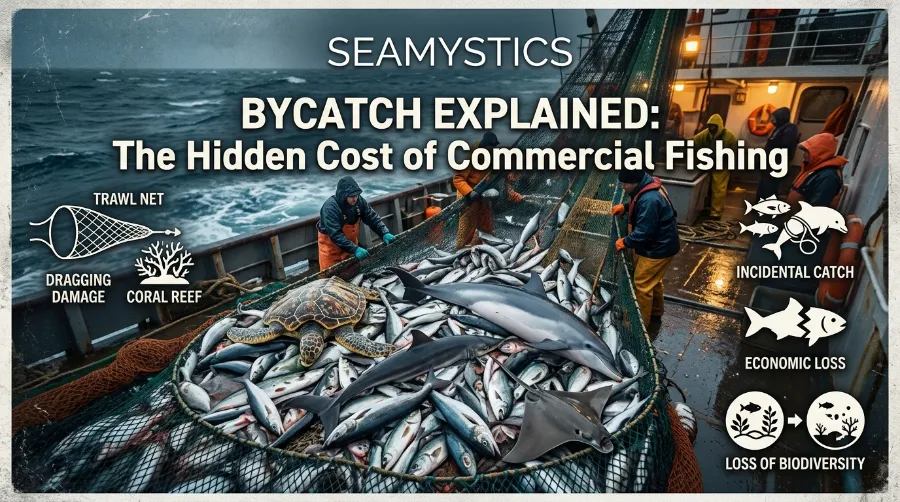

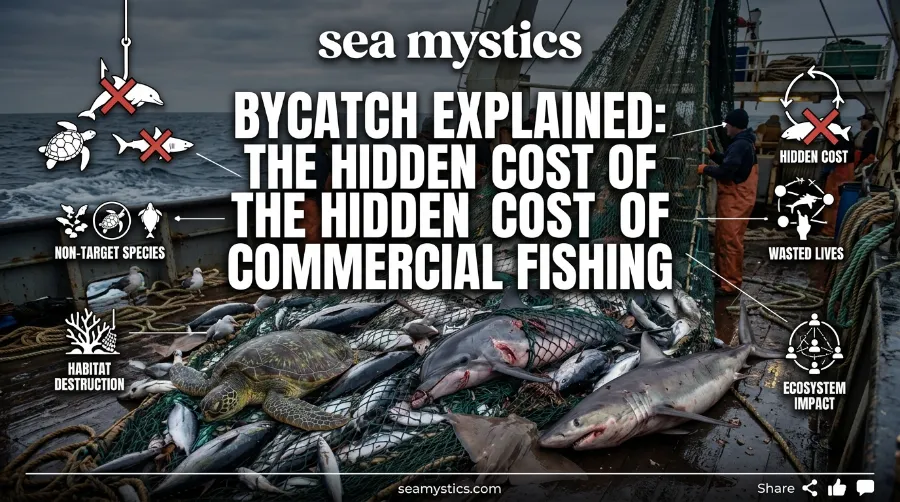
Picture a shrimp trawler off the Gulf coast tonight. The crew hauls up the net. For every pound of shrimp inside, several pounds of something else often come up too: a fish nobody ordered, a ray, maybe a young sea turtle. Most of it will not survive the trip back overboard. This is the fishing bycatch problem, and it quietly shapes fisheries across the United States, the United Kingdom, and Europe. Dr. Rabica has pulled nets alongside fishing crews and reviewed observer data for two decades, and one thing stands out clearly: bycatch is not a rare accident. Much of the world’s fishing gear simply catches more than it targets, and fixing that starts with understanding what actually happens under the waterline.
TL;DR: Bycatch means catching marine life that fishing crews never intended to catch, and it makes up roughly 10 to 20 percent of the world’s total catch depending on the fishery. It kills sharks, sea turtles, dolphins, and seabirds by the hundreds of thousands every year. Proven tools like turtle excluder devices and circle hooks cut those numbers fast once fisheries actually use them.
Key Takeaways
| Topic | What the Data Shows |
|---|---|
| Global scale | Fisheries discard around 9.1 million tonnes of catch worldwide each year, close to 10.8% of total global catch |
| US fisheries | Researchers estimate US fleets discard 17 to 22% of their catch annually, close to 2 billion pounds |
| Worst offenders | Shrimp trawling can produce 4 to 10 pounds of bycatch for every pound of shrimp landed |
| Shark bycatch | Shark-fin fisheries discard up to 92% of what they catch |
| A working fix | Turtle excluder devices cut turtle bycatch in shrimp trawls by roughly 45 to 89%, depending on the fishery |
| Economic cost | Wasted catch and bycatch mitigation together cost the industry billions of dollars a year |
What Is Bycatch, Really?
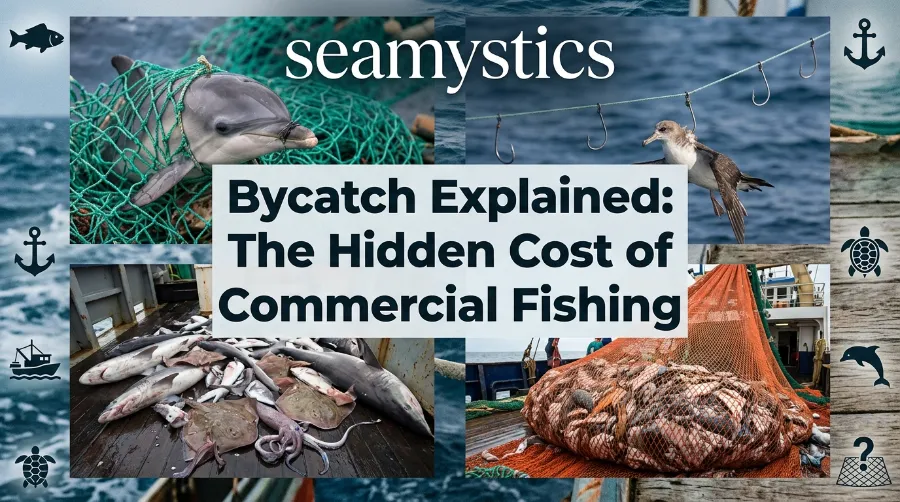
Bycatch explained simply: it is any marine animal that fishing gear catches by accident, not the species crews meant to catch. Crews often cannot legally or practically keep it. That includes fish tossed back for being the wrong size, plus turtles, dolphins, seabirds, and sharks caught in nets, lines, or traps meant for something else.
Textile Cone Snail vs Geography Cone: Comparing the Deadliest Shells
NOAA defines it as catch that crews discard at sea because it has low economic value, or because regulations block them from keeping it. NOAA runs a bycatch monitoring program that tracks this across hundreds of US fisheries every season. The pattern holds steady year after year: some gear types simply catch more of the wrong things than others.
Bycatch falls into a few overlapping categories:
- Non-target fish species, caught alongside the intended catch and often too small or low-value to sell
- Protected marine animals, including sea turtles, marine mammals, and seabirds
- Juvenile fish of the target species itself, caught before they can reproduce
- Sensitive habitat, like deep-sea coral, that bottom-contact gear damages or removes
Commercial fishing bycatch also varies widely by gear type. A well-managed pot fishery might discard a small fraction of its catch. A poorly regulated trawl fishery can discard more than it keeps.
Why Accidental Fishing Catch Happens So Often
Fishing gear rarely sorts species on its own. A trawl net dragged along the seafloor cannot tell a market-size flounder from a hatchling sea turtle. A longline baited across dozens of miles of open ocean attracts sharks and seabirds just as easily as tuna. The accidental fishing catch problem usually comes down to a few root causes.
Non-Selective Gear Design
Builders designed older gear for volume, not precision. Standard gillnets and unmodified trawl nets scoop up whatever swims into their path. That is exactly why gear innovation has become the centerpiece of most bycatch reduction programs over the past 30 years.
Fire Coral Facts: Why It Burns and How to Treat It
Overlapping Habitats
Target species and vulnerable wildlife often share the same water at the same time of year. Shrimp grounds in the Gulf of Mexico overlap with sea turtle nesting migrations. Swordfish longlines cross paths with loggerhead turtles and leatherbacks feeding in the same currents.
Weak or Inconsistent Enforcement
Even where the law requires bycatch reduction devices, compliance falls short in practice. A 2014 review of the Gulf shrimp fishery found that turtle excluder devices cut turtle catches by around 45 percent in some fleets. That marks real progress, but it falls short of elimination, partly because some crews tie devices shut or fit them incorrectly.
Cone Snail Facts: The Shell That Can Kill in Minutes
Bycatch Marine Animals: Who Pays the Price
Most people picture dolphins caught in tuna nets when they think of bycatch, and that image holds some truth. But the list of bycatch marine animals runs much longer and includes some of the ocean’s most vulnerable species.
- Sea turtles – NOAA Fisheries calls bycatch the single leading threat to sea turtle populations worldwide, largely from shrimp trawls and longlines.
- Sharks and rays – Longline and gillnet fisheries catch an estimated 1 million sharks a year as bycatch in tuna fisheries alone. Shark-finning operations discard as much as 92% of total catch.
- Seabirds – Longlines and trawl cables kill an estimated several hundred thousand seabirds annually, including threatened albatross species.
- Marine mammals – Gillnets regularly trap dolphins, porpoises, and seals, and this gear type produces some of the highest marine mammal bycatch rates of any method.
- Juvenile target fish – Crews frequently discard juvenile cod, halibut, and other commercially important species, which undercuts the very stocks the fishery depends on.
A California set gillnet fishery review found crews discarded more than 30,000 sharks and rays over a three-year period, alongside valuable fish they could not legally keep. Numbers like that push fisheries scientists to treat bycatch as both a wildlife issue and a fisheries management issue.
Box Jellyfish Facts: The Most Dangerous Jellyfish in the Ocean
The Real Cost of Commercial Fishing Bycatch
Commercial fishing bycatch carries an economic cost too, not just an ecological one. Every animal that crews haul up and toss back burns fuel, costs crew hours, and wears down gear for nothing landed at the dock. Industry estimates put the value of wasted catch in the billions of dollars worldwide each year.
A slower, harder-to-see cost follows close behind. Discarding juvenile fish before they can spawn depletes future stock. That is part of why some fisheries struggle to rebuild even after regulators introduce strict quotas. The Northeast US groundfish fishery and several European stocks have both faced this exact feedback loop, where today’s bycatch becomes tomorrow’s shortage.
Bycatch damages industry reputation too, even for operators trying hard to modernize. Fishermen who already use circle hooks, escape panels, or seasonal closures often get lumped in with fleets that skip those steps. That makes public trust harder to rebuild across the board.
What Actually Works: Bycatch Reduction in Practice
Here is the genuinely good news: bycatch reduction technology has a strong track record when fisheries commit to using it properly.
- Turtle Excluder Devices (TEDs): Metal grids inside shrimp trawl nets let turtles escape through a trap door while shrimp pass through to the back of the net. Early NOAA trials recorded turtle separation rates around 89 percent, with minimal shrimp loss.
- Circle hooks: Swapping traditional J-hooks for circle hooks on longlines cuts deep-hooking injuries in sea turtles and seabirds. Several US longline fleets now use them as standard practice.
- Bird-scaring lines (tori lines): Simple streamer lines towed behind longline vessels keep seabirds away from baited hooks as they sink. Crews credit these lines with cutting albatross bycatch across Southern Ocean longline fleets.
- Acoustic pingers: These devices attach to gillnets and emit sound to warn dolphins and porpoises away. Fleets in the Gulf of Maine and the Bay of Biscay use them with real success.
- Time and area closures: Regulators restrict gear by season or location to keep it away from known turtle nesting migrations or seabird colonies during peak vulnerability windows.
NOAA’s Bycatch Reduction Engineering Program has funded gear research since 2008. The agency put roughly $2.5 million toward new device development in 2012 alone. The EU runs similar public-private partnerships under the Common Fisheries Policy’s landing obligation rules.
Blue-Ringed Octopus Facts: Small, Beautiful, and Deadly
A Real Case: The Atlantic Sea Scallop Fishery
The Atlantic sea scallop fleet offers one of the clearest success stories in US fisheries. Working with the Coonamessett Farm Foundation over the past decade, the fishery developed turtle excluder devices that regulators made mandatory on all scallop dredge vessels in 2013. Turtle interactions dropped in a real, measurable way, and the fishery kept its value as one of the country’s most profitable. It proves bycatch reduction and profitability do not have to work against each other.
Bycatch by the Numbers: A Quick Comparison
| Fishery Type | Estimated Bycatch Rate | Primary Species Affected |
|---|---|---|
| Shrimp trawl (tropical) | 4:1 to 10:1 bycatch-to-target ratio | Juvenile fish, sea turtles, rays |
| Shark-fin longline | Up to 92% of total catch discarded | Non-target sharks, rays |
| Southeast US snapper-grouper longline | 66% discarded | Sharks (400,000+ in one year) |
| California set gillnet | 65% of animals discarded | Sharks, rays, marine mammals |
| Well-managed pot and trap fisheries | Under 5% | Minimal, mostly undersized target species |
These figures come from Oceana’s fishery-level analysis and NOAA’s National Bycatch Report data. Exact ratios shift year to year, but the pattern across gear types has held remarkably steady for over a decade.
Frequently Asked Questions
Is bycatch illegal? Not usually. Regulators treat most bycatch as a legal, regulated part of commercial fishing, though many countries require specific reduction devices or reporting once catch hits certain thresholds.
Which fishing method causes the most bycatch? Shrimp trawling and gillnetting consistently produce the highest bycatch rates of any commonly used commercial gear, largely because both methods struggle to sort species by nature.
Can bycatch reach zero? No fishing method sorts species perfectly. But well-designed gear and real enforcement can cut bycatch by well over half in many fisheries, as the TED data shows.
Does buying “sustainable” seafood actually reduce bycatch? Yes, in most cases. Fisheries with credible sustainability certification must monitor and limit bycatch, so shopping with a sustainable seafood guide genuinely shifts demand toward lower-impact fleets.
Are UK and EU fisheries better or worse than the US on bycatch? Both regions face similar core challenges. The EU’s landing obligation policy pushed gear innovation forward after regulators introduced it to curb discarding, but enforcement and reporting gaps persist on both sides of the Atlantic.
Quick Quiz: Test What You Just Learned
1. What percentage of global catch ends up discarded as bycatch each year? A) About 1% B) Roughly 10-11% C) Nearly 50% Answer: B. Fisheries worldwide discard close to 9.1 million tonnes annually, about 10.8% of total catch.
2. Which device gets credit for dramatically reducing sea turtle bycatch in shrimp trawls? A) Acoustic pingers B) Turtle excluder devices (TEDs) C) Circle hooks Answer: B. TEDs let turtles escape through a trap door while shrimp continue into the net.
3. Roughly how much of a shark-fin-only fishery’s total catch typically gets discarded? A) 10% B) 40% C) Up to 92% Answer: C. Shark-fin-focused fisheries post some of the highest discard rates of any fishery type.
4. What share of US catch gets discarded annually, according to researchers? A) 1-2% B) 17-22% C) Over 60% Answer: B. Researchers estimate US bycatch at roughly 17 to 22 percent of total catch, close to 2 billion pounds.
5. What gear change helps reduce seabird bycatch on longlines? A) Bird-scaring (tori) lines B) Bigger hooks C) Faster boats Answer: A. Tori lines keep seabirds away from baited hooks as they sink, which cuts seabird deaths significantly.
The Path Forward
Bycatch will not disappear on its own. Pretending it is already solved helps nobody, not the fishing communities trying to stay profitable and not the wildlife caught in the crossfire. Thirty years of data actually tell a more hopeful story than most headlines suggest. Selective gear works. Enforcement works. Fisheries that adopt both tend to keep their catch and their reputation intact.
The next decade of ocean health in the US, UK, and Europe will likely hinge on how widely fleets adopt these proven tools, and how loudly consumers ask for them. Anyone who eats seafood already plays a part in this. It shows up as a daily choice at the counter, and it starts with understanding what bycatch explained ocean issues actually mean for the fish on the plate.
To dig deeper into how sourcing decisions ripple through fleets, explore our sustainable seafood guide, or visit the Sea Mystics homepage for more ocean science coverage. Our related piece on discarded gear, covered in our ghost net investigation, looks at how that same equipment keeps killing long after crews lose it at sea.
References
- eMLab UC Santa Barbara, “Fishing Solutions: Tackling Bycatch and a Changing Ocean” – https://emlab.ucsb.edu/blog/fishing-solutions-tackling-bycatch-changing-ocean
- Oceana, “Wasted Catch: Unsolved Problems in U.S. Fisheries” – https://usa.oceana.org/reports/wasted-catch-unsolved-problems-us-fisheries/
- North Pacific Fishery Management Council, “Bycatch” – https://www.npfmc.org/fisheries-issues/bycatch/
- NOAA Fisheries, “History of Turtle Excluder Devices” – https://www.fisheries.noaa.gov/southeast/bycatch/history-turtle-excluder-devices
- FAO, “Discards and Bycatch,” Food Loss and Waste in Fish Value Chains
- Pérez Roda et al., “Benchmarking global fisheries discards,” Scientific Reports