
I still remember the first sting slide a colleague handed me during a field season in Queensland. The tentacle fragment was smaller than a shoelace. Yet it carried enough venom to stop a human heart. That single moment is why box jellyfish facts matter to every swimmer, diver, and coastal traveler, not just to marine biologists like me.
Box jellyfish are not the slow, drifting blobs most people picture. Instead, they hunt, they see, and in a few species, they can kill an adult in under five minutes. So this guide walks through the real, research backed box jellyfish facts. You will learn about their anatomy, their habitat, and how to treat a sting, before you ever step into warm coastal water.
Key Takeaways
| Fact | Detail |
|---|---|
| Species count | Around 50 to 51 described species in the class Cubozoa |
| Most dangerous species | Chironex fleckeri, the Australian box jellyfish, also called the sea wasp |
| Bell size | Up to 30 cm (about 1 foot) across |
| Tentacle length | Up to 3 meters (10 feet) per tentacle |
| Eyes | 24 eyes arranged in four clusters, some with lenses and retinas |
| Swim speed | Up to 4 knots (about 4.6 mph), unusual for a jellyfish |
| Estimated deaths per year | Roughly 40 to over 100 worldwide, likely underreported |
| Time to fatal outcome | As little as 3 to 5 minutes in severe Chironex stings |
| Range | Indo-Pacific, northern Australia, parts of the Atlantic, Gulf of Mexico, and the Mediterranean |
TL;DR: Box jellyfish, especially Chironex fleckeri, carry venom that can trigger cardiac arrest within minutes. What’s more, these animals live far beyond Australia, including waters off Florida, California, and even the Mediterranean. Still, most stings are painful rather than fatal if you rinse with vinegar and get medical help fast. Above all, knowing where these animals live gives you the best chance of avoiding a sting altogether.
Textile Cone Snail vs Geography Cone: Comparing the Deadliest Shells
What Is a Box Jellyfish, Really
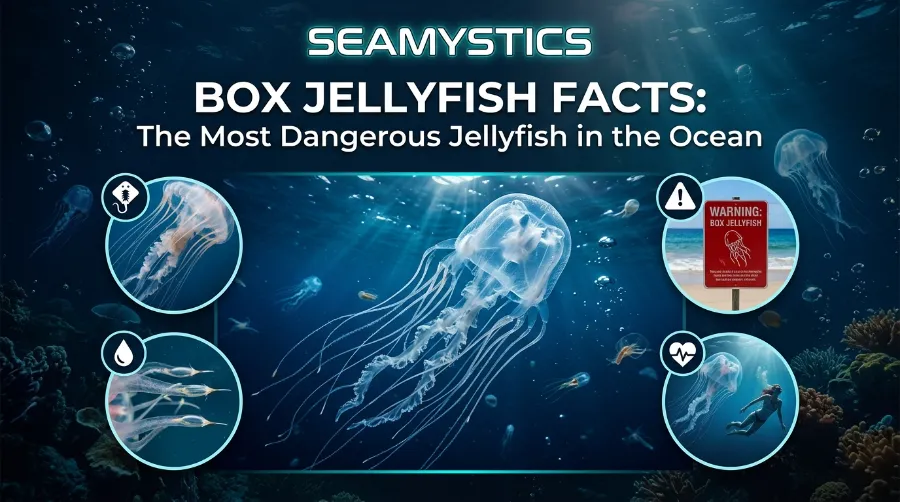
Box jellyfish belong to the class Cubozoa. Scientists chose that name because of the cube shaped bell, not the rounded, umbrella shape you see on a true jellyfish. So far, researchers have identified between 50 and 51 species worldwide. However, only a handful of those carry venom strong enough to threaten a human life. The rest sting about as much as a bee, or barely at all.
Fire Coral Facts: Why It Burns and How to Treat It
One feature truly sets box jellyfish apart: the pedalium. This muscular pad sits at each of the four bottom corners of the bell. One or more tentacles attach to each pedalium, and depending on the species, that adds up to four or as many as sixty trailing tentacles. Each tentacle works like a needle factory. It carries thousands of microscopic stinging capsules, called nematocysts, that fire on contact.
Weever Fish Facts: The Hidden Danger Buried in Sand
Unlike true jellyfish, which mostly ride the current, box jellyfish swim with real purpose. They hold a steady heading, dodge pier pilings, and chase down small fish and shrimp. That hunting drive, combined with a nearly invisible body, explains why so many swimmers get caught off guard every year.
Box Jellyfish Facts About Their Eyes
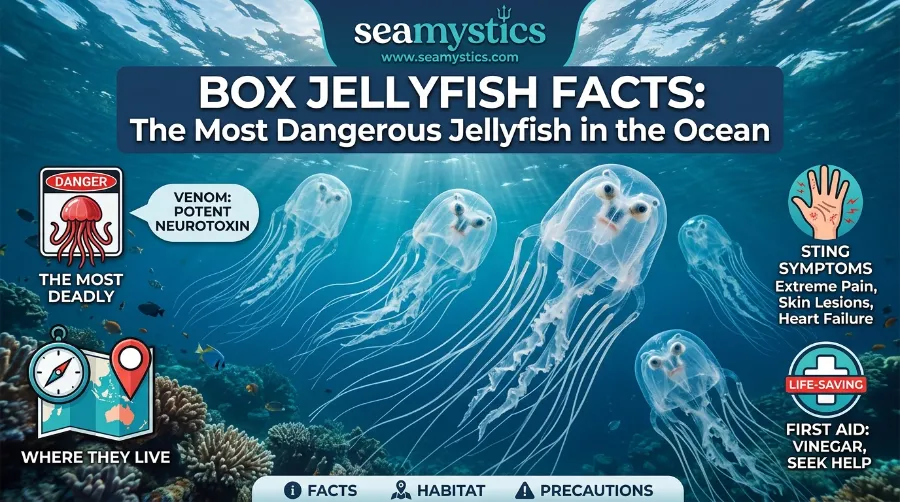
Among all the box jellyfish facts I share with students, the eyes get the biggest reaction every time. These animals carry 24 eyes, grouped into four sensory clusters called rhopalia. Remarkably, some of those eyes include a lens, a retina, and a cornea, much like a simplified human eye. Researchers publishing in Nature found that this optical system helps the animal dodge obstacles, even though it has no centralized brain, only a distributed nerve net.
Cone Snail Facts: The Shell That Can Kill in Minutes
Where Box Jellyfish Live, and Why the Range Is Growing
Most people assume box jellyfish are strictly an Australian problem. That assumption held up better a generation ago. Today, warming coastal waters push several species further north and west than old records show.
- Indo-Pacific and northern Australia: Home to Chironex fleckeri, the most dangerous species, along with the Irukandji jellyfish.
- Florida and the Gulf of Mexico: The mangrove box jelly, Tripedalia cystophora, turns up near Boca Raton. Meanwhile, Chiropsalmus quadrumanus appears seasonally in Texas bays between August and October, as a field report from the Texas Saltwater Fishing Magazine on the box medusa explains.
- California: Carybdea confusa shows up off the southern coast, though its sting is mild compared to its Indo-Pacific cousins.
- Hawaii: Three Carybdea species, including Alatina alata, appear seasonally and follow lunar spawning cycles.
- The Mediterranean and Sea of Japan: Warmer summers now let milder box jelly species establish small populations here too.
Oceana, the ocean conservation group, has tracked box jellyfish encounters for over a decade. In fact, their team once shared a firsthand account of a surfing lesson gone wrong in Australia, describing the box jellyfish sting as painful enough to make walking difficult for days. That account lines up closely with what Queensland emergency departments report each summer.
This range expansion is not an isolated oddity. Rather, it fits alongside other ocean stress signals we track at Sea Mystics, including shifting fish stocks covered in our sustainable seafood guide, and unintended marine life capture explored in our piece on the fishing bycatch problem. As oceans warm and acidify, they reshuffle entire food webs. As a result, jellyfish tend to win while fish and coral lose ground.
Stingray Sting Facts: What Actually Happens During a Sting
Why Box Jellyfish Are So Dangerous
Scientists widely regard the venom of Chironex fleckeri as the most potent venom any marine animal produces. This is one of the box jellyfish facts that deserves careful attention rather than sensational headlines. Each tentacle carries roughly 5,000 stinging cells. Therefore, researchers estimate that six meters of tentacle contact, with a full nematocyst discharge, delivers enough venom to kill an adult.
NOAA’s Ocean Service reports that the venom attacks the heart, the nervous system, and skin cells all at once. This explains why symptoms escalate so quickly compared to other marine stings. The agency notes that a sting victim may experience paralysis, cardiac arrest, and death within minutes, details it lays out on its official page about the box jellyfish.
Encyclopaedia Britannica backs this up too. Severe stings can cause extreme pain, paralysis, and cardiac arrest in as little as five minutes. Worldwide fatalities land somewhere between 40 and over 100 people annually, though underreporting in remote coastal regions makes an exact figure nearly impossible to pin down.
Blue-Ringed Octopus Facts: Small, Beautiful, and Deadly
Real Case Studies With Dates
Numbers alone rarely tell the full story. So here are documented, dated cases that show the pattern clearly.
- February 2024, Queensland, Australia: A teenager died after a box jellyfish sting at a Queensland beach. Notably, this marked the first fatality from the species in the region in 15 years, according to reporting picked up by The Guardian.
- November 2025, Langkawi, Malaysia: A two year old boy died after a sting. Consequently, the Kedah Fisheries Department issued renewed public safety notices.
- August 2025, Kota Kinabalu, Malaysia: A seven year old girl died from a box jellyfish sting, marking the second fatal case reported in Malaysia that year.
- Since 2008, Thailand: At least 15 recorded deaths from box jellyfish envenomation, including both residents and tourists, appear in regional toxicology reviews.
- Historical Australia total: At least 67 documented deaths trace back to box jellyfish stings. Of those, the last 12 fatalities involved children, based on toxicology library records.
How Box Jellyfish Compare to Other Dangerous Marine Species
| Species | Venom Severity | Typical Region | Time to Severe Symptoms |
|---|---|---|---|
| Chironex fleckeri (Australian box jellyfish) | Extremely high | Northern Australia, Indo-Pacific | 3 to 5 minutes |
| Irukandji jellyfish | High, delayed onset | Northern Australia | 20 to 30 minutes |
| Portuguese man o’ war | Moderate | Atlantic, Gulf of Mexico | Minutes, rarely fatal |
| Tripedalia cystophora (mangrove box jelly) | Mild | Florida, Caribbean | No serious symptoms |
| Carybdea confusa | Mild to moderate | California coast | Minutes, painful not lethal |
What To Do If You Are Stung
Marine safety agencies broadly agree on a short list of steps. Getting the order right actually matters.
- Call emergency services right away if the sting covers a large area, or if breathing becomes difficult.
- Rinse the area generously with vinegar to deactivate any nematocysts that have not yet fired. Never use fresh water, alcohol, or urine, since these can trigger more stinging cells to fire.
- Remove any remaining tentacle fragments with a gloved hand, a stick, or a stiff card. Never touch them with bare fingers.
- Apply hot water immersion or an ice pack for pain relief, but only once you clear away the tentacles fully.
- Seek medical evaluation even if symptoms feel mild at first, since some venom effects show up later.
The aquarium retailer Jellyfish Art breaks this protocol down in more detail. Their guide to the box jellyfish also explains why vinegar works for box jellies but not for every jellyfish species, and documents how far some species have spread into United States coastal waters.
Sea Wasp Facts: Australia’s Most Feared Ocean Animal
Practical Prevention Tips for Swimmers and Divers
- Check local beach warning flags before entering the water, especially in northern Australia during stinger season, which typically runs from October through May.
- Wear a full body stinger suit, or even simple pantyhose over exposed skin. Lifeguards in Australia have used this trick for decades, since nylon blocks the chemical trigger nematocysts respond to.
- Avoid swimming at dusk or right after heavy rain, since runoff can push jellyfish closer to shore.
- Carry a small bottle of vinegar if you travel to a known box jellyfish region, since a fast response changes outcomes.
- Ask local dive operators about recent sightings, since box jellyfish populations can spike suddenly during warm water events.
Box Jellyfish Facts and the Bigger Ocean Picture
None of this happens in isolation. As global sea surface temperatures climb, species ranges shift, breeding seasons stretch longer, and coastal communities that never worried about box jellyfish now need updated safety protocols. This mirrors the same pressure we track across Sea Mystics, from shifting seafood sustainability questions to the silent damage caused by abandoned fishing gear. So if you want the fuller picture of how ocean predators and prey adapt to a warmer sea, our sustainable seafood guide makes a good next stop.
Portuguese Man O’ War Facts: Not a Jellyfish at All
As a working marine biologist, I want to be direct here: most box jellyfish encounters are not fatal, and fear should never replace informed caution. Even with Chironex fleckeri, most stings cause intense pain and scarring rather than death, particularly when you treat them quickly. In fact, panic often makes things worse, since it can add cardiovascular strain to a body already dealing with venom exposure.
Frequently Asked Questions
Is a box jellyfish the most dangerous jellyfish in the world? Yes. Scientists widely consider the Australian box jellyfish, Chironex fleckeri, the most venomous marine animal on Earth. It can cause death within minutes in severe cases.
How many people die from box jellyfish stings each year? Estimates range from about 40 to over 100 deaths annually worldwide. However, poor reporting in remote regions means the real number likely runs higher.
Are box jellyfish found in the United States? Yes. Several milder species live in Florida, California, and the Gulf coast of Texas. That said, none match the potency of the Indo-Pacific Chironex fleckeri.
What should I never do after a box jellyfish sting? Never rinse the area with fresh water, alcohol, or urine. Also, avoid rubbing the sting with sand or a towel, since both actions can release more venom from unfired nematocysts.
Do box jellyfish attack humans on purpose? No. Humans are not prey. Instead, stings happen when a swimmer accidentally brushes against a nearly invisible tentacle while the animal hunts small fish and shrimp.
Test Your Box Jellyfish Knowledge
- How many eyes does a box jellyfish have? a) 8 b) 24 c) 2 Answer: b) 24
- Which species is considered the most venomous marine animal on Earth? a) Portuguese man o’ war b) Moon jellyfish c) Chironex fleckeri Answer: c) Chironex fleckeri
- What is the recommended first response to a box jellyfish sting? a) Rinse with fresh water b) Rinse with vinegar c) Rub the area with sand Answer: b) Rinse with vinegar
- About how many box jellyfish species have scientists identified worldwide? a) Around 50 b) Around 500 c) Around 5 Answer: a) Around 50
- Which U.S. state has documented mangrove box jellies in mangrove habitat? a) Maine b) Florida c) Oregon Answer: b) Florida
Conclusion
Box jellyfish facts go far beyond nature documentary trivia. They shape real beach safety decisions for families across the United States, the United Kingdom, and coastal Europe, especially as warmer waters push new species into places they never used to reach. Respect the animal, learn the warning signs, and carry vinegar if you head somewhere known for stings. Treat every clear, cube shaped drifter in the water as something to avoid touching. The ocean is not out to get you, but a box jellyfish sting is one hazard where a little preparation genuinely saves lives.
References
- NOAA Ocean Service. Box Jellyfish. https://oceanservice.noaa.gov/facts/box-jellyfish.html
- Encyclopaedia Britannica. Box Jellyfish. https://www.britannica.com/animal/box-jellyfish
- Oceana USA. Fact of the Day: Box Jellyfish. https://usa.oceana.org/blog/fact-day-box-jellyfish/
- Jellyfish Art. The Box Jellyfish. https://www.jellyfishart.com/blogs/news/theboxjellyfish
- Texas Saltwater Fishing Magazine. The Box Medusa. https://www.texassaltwaterfishingmagazine.com/fishing/education/fishy-facts/the-box-medusa
- LITFL Toxicology Library. Box Jellyfish (Chironex fleckeri). https://litfl.com/box-jellyfish-chironex-fleckeri/
- A-Z Animals. The World’s Most Dangerous Jellyfish. https://a-z-animals.com/articles/the-worlds-most-dangerous-jellyfish/