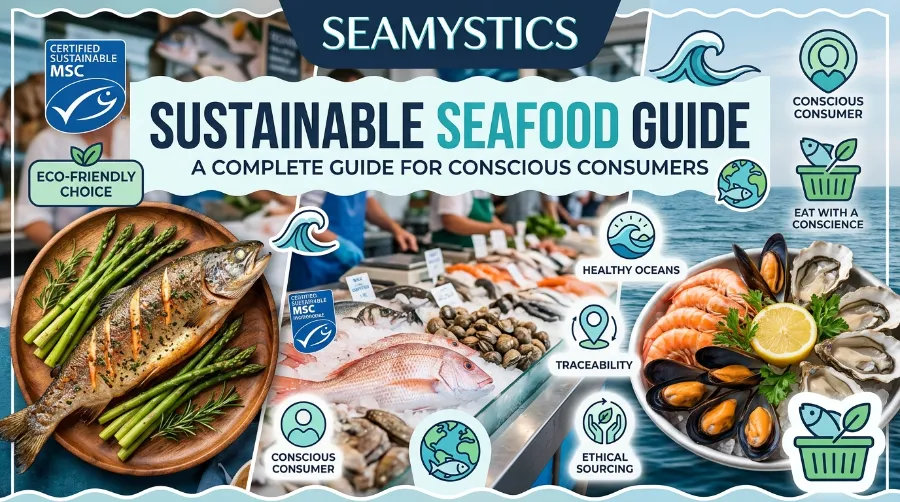

The fish counter should not feel like a guessing game. Yet most shoppers stand there holding a salmon fillet, wondering if it helped or hurt the ocean it came from. That confusion is exactly why a clear, honest sustainable seafood guide matters right now, because the choices you make at checkout ripple all the way back to the reef, the trawler, and the fish farm.
This guide breaks down what “sustainable” actually means, why it matters more in 2026 than it did a decade ago, and exactly how to make better seafood sustainability guide-level decisions without a marine biology degree. Everything below is grounded in the latest fisheries data, real certification numbers, and documented fraud cases, not vague eco-marketing.
Key Takeaways
| Topic | What You Need to Know |
|---|---|
| Overfishing today | Roughly 35.5% of assessed fish stocks worldwide are overfished, while about 64.5% remain within biologically sustainable limits |
| Deep-sea species | Only about 29% of deep-sea fish stocks are fished sustainably, making them among the riskiest choices |
| Seafood fraud | Roughly one in five fish sampled in the US has been mislabeled, with restaurants and small markets showing the highest rates |
| Trusted labels | Fisheries in the MSC program now represent about a fifth of the global wild marine catch |
| Best fix | Traceability works: EU rules helped cut seafood fraud from 23% down to 8% between 2011 and 2015 |
TL;DR
- A genuine sustainable seafood guide looks at three things together: the species, the fishing or farming method, and where it came from.
- Overfishing has not disappeared, but roughly two-thirds of monitored global fish stocks are still within safe biological limits, so informed choices still make a real difference.
- Labels like MSC (wild-caught) and ASC (farmed) are currently the most reliable shortcuts, though no label is perfect and mislabeling still happens.
- Asking two or three simple questions at the counter, about species, origin, and catch method, cuts your odds of buying something harmful or mislabeled.
What “Sustainable Seafood” Actually Means
Sustainable seafood is fish or shellfish caught or farmed in a way that leaves enough behind for the population to recover, while limiting damage to the surrounding habitat and other marine life. It sounds simple, but the details get complicated fast, because a species can be sustainable in one ocean region and badly overfished in another.
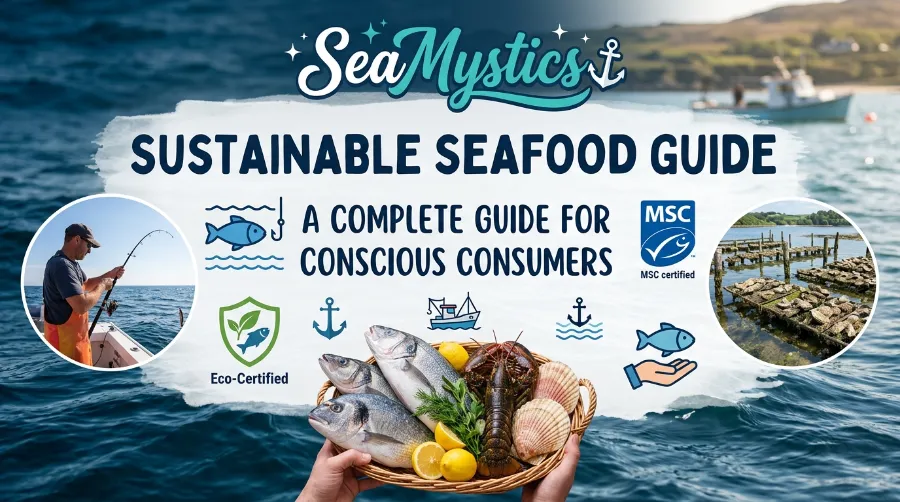
That is why a proper seafood sustainability guide never judges a species alone. It always looks at the combination of species, location, and fishing method, since a wild Alaskan salmon and an Atlantic salmon farmed in an open net pen are worlds apart in impact, even though both say “salmon” on the label.
Wild-Caught Versus Farmed: Weighing the Trade-Offs
Neither wild-caught nor farmed seafood is automatically the better sustainable seafood choice. Each comes with its own risks and benefits, and the right answer usually depends on the specific species and farming or fishing method involved.
- Wild-caught pros: No feed inputs, natural diet, often lower disease risk.
- Wild-caught cons: Bycatch, habitat damage from certain gear types, and stock depletion risk.
- Farmed pros: Reduces pressure on wild stocks, can be more predictable and traceable.
- Farmed cons: Pollution and disease risk from crowded pens, and some farmed fish still rely on wild-caught fish for feed.
Why Your Sustainable Seafood Choices Matter More Than Ever
Global appetite for seafood keeps climbing. Humans pulled an estimated 235 million tons of seafood from the ocean in 2024, a record high, and that demand is not slowing down. Every additional pound landed adds pressure to fisheries that are already stretched thin. worldanimalfoundation
The good news is more nuanced than headlines suggest. In the most recent UN assessment, 64.5% of fish stocks were fished within biologically sustainable levels, while 35.5% were classified as overfished. That is not a crisis everywhere, but it is a crisis somewhere, and deep-sea species carry the sharpest risk. theearthandi
Cone Snail Facts: The Shell That Can Kill in Minutes
The Overfishing Numbers Behind the Plate
Deep-sea fish reproduce slowly and recover even more slowly once a population is depleted. Only about 29% of deep-sea stocks are currently fished at sustainable levels, though deep-sea populations in Antarctic waters are a notable exception, with all of those stocks sustainably managed. That single statistic explains why species like orange roughy and some deep-water sharks routinely appear on “avoid” lists. theearthandi
Bycatch compounds the problem. An estimated 40% of what fishing vessels catch worldwide is not the target species at all, and roughly 650,000 whales, dolphins, and seals are killed each year after becoming trapped in fishing gear. Choosing seafood caught with selective methods, like pole-and-line tuna or trap-caught crab, directly reduces this toll. worldanimalfoundation
Seafood Fraud: When “Sustainable” Isn’t What You Think
Even a shopper doing everything right can still be misled, because mislabeling is widespread. A 2026 FAO report put the probability of seafood fraud at roughly 20.6%, notably higher than the fraud rate for meat at 13.4% or fruits and vegetables at 10.4%. Seafood, it turns out, is one of the easiest foods to fake. seafoodsource
The pattern is consistent across investigations. In one large US-based Oceana study, about 21% of the 449 fish samples tested were mislabeled, with sea bass and snapper mislabeled 55% and 42% of the time respectively, and restaurants and small markets showing far higher mislabeling rates than large chain grocery stores. In plain terms: the fancier the menu description, the more skepticism it deserves. oceana
There is a real fix, and it has already worked. After the European Union tightened traceability requirements, seafood fraud rates there dropped from 23% to 8% between 2011 and 2015. Traceability regulation, not consumer guilt, is what actually moves the needle at scale, though individual choices still matter for demand signals. foodmanufacturing
Bycatch Explained: The Hidden Cost of Commercial Fishing
How to Buy Sustainable Fish: A Step-by-Step Guide
Buying better seafood does not require memorizing hundreds of species names. A short, repeatable checklist gets you most of the way there.
- Check for a credible label first. Look for MSC (wild-caught) or ASC (farmed) on packaging, since these are currently the most independently verified certifications available in US and European markets.
- Ask where and how it was caught. A fishmonger or server who can answer confidently is a good sign; a shrug is a warning sign.
- Favor smaller, faster-reproducing species. Sardines, mackerel, and mussels bounce back faster than slow-growing species like Chilean sea bass.
- Use a regional guide app. Seafood Watch and similar programs update recommendations by region, since sustainability status shifts as stocks recover or decline.
- Be cautious with generic names. “Snapper” or “white fish” on a menu, with no species or origin listed, correlates strongly with mislabeling.
Reading Labels and Certifications
Labels are a shortcut, not a guarantee, but they remain the fastest way to make an eco friendly seafood choice under real-world time pressure. The two labels worth learning are:
- MSC (Marine Stewardship Council): Covers wild-caught fisheries. Fisheries in the MSC program represent about a fifth of the global wild marine catch, and the certified fleet supplies roughly 80% of the world’s whitefish catch and 60% of the wild salmon catch. msc
- ASC (Aquaculture Stewardship Council): The equivalent standard for farmed seafood, covering feed sourcing, water quality, and disease management on fish farms.
MSC’s own growth numbers are worth knowing, since they show the certification system scaling meaningfully rather than staying niche. As of the 2025/2026 reporting year, 600 fisheries were certified to the MSC standard, with a record 115 recertified that year, and the volume of ecolabeled seafood sold reached 1.5 million tonnes worth roughly $1.6 billion. In the UK specifically, 17 fisheries currently hold MSC certification, together landing over 184,590 tonnes of certified seafood in 2024, about a quarter of the UK’s total catch. The organization is not stopping there either, MSC has set a public goal of getting 30% of global reported catch engaged in its program by 2030. Record Number of Fisheries Engaged in MSC Global Program – Perishable … +2
Questions to Ask Your Fishmonger or Server
Three short questions filter out most of the risk:
- “What species is this, exactly?” (Not just “white fish” or “snapper.”)
- “Was this wild-caught or farmed, and where?”
- “Is this MSC or ASC certified?”
If two of the three answers are vague, consider it a signal to pick something else on the menu or counter.
Eco Friendly Seafood Choices Across the US, UK, and Europe
Sustainability status is regional, so a smart eco friendly seafood pick in Boston is not automatically the right pick in London. A few reliable, widely available choices for 2026:
- United States: Alaskan wild salmon, Pacific sardines, farmed rainbow trout, and Gulf blue crab are consistently strong choices, largely because US fisheries management has improved traceability over the last decade.
- United Kingdom: Cornish sardines, North Sea herring, and MSC-certified brown shrimp and cockles are solid picks, reflecting the smaller-scale fisheries the UK has certified in recent years.
- Continental Europe: Baltic herring, mussels from Spain and the Netherlands, and MSC-certified Icelandic cod are commonly available and well documented.
Rule of thumb across all three regions: smaller, faster-growing, lower-on-the-food-chain species tend to bounce back faster and carry a lighter footprint than large predatory fish.
Blue-Ringed Octopus Facts: Small, Beautiful, and Deadly
What Real-World Change Looks Like
Numbers on a page can feel abstract, so it helps to look at what happens when the system actually works. The Peruvian giant squid fishery, the largest squid fishery on Earth, entered the MSC’s formal Improvement Program in 2025 rather than being certified outright, since roughly 4,500 artisanal vessels needed better stock monitoring first before earning full certification. That kind of staged accountability, rather than an all-or-nothing label, is a more honest picture of how ocean recovery actually happens.
Box Jellyfish Facts: The Most Dangerous Jellyfish in the Ocean
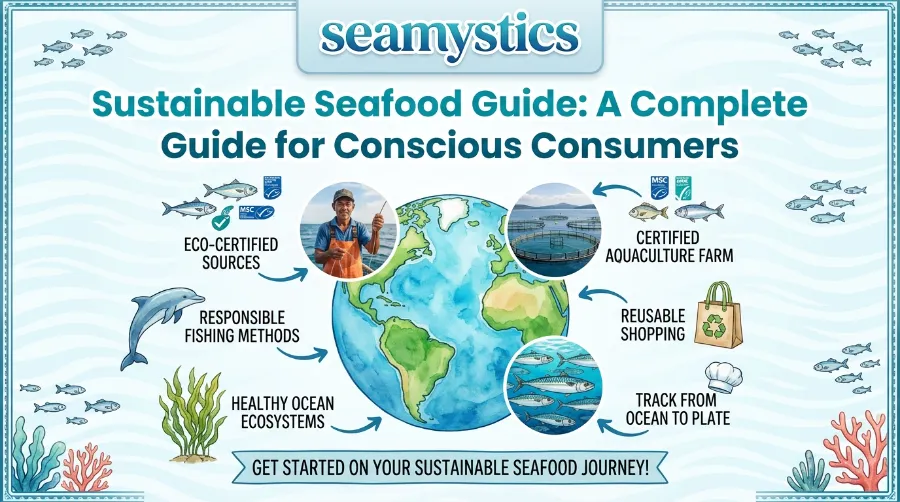
New Zealand’s hoki fishery tells a longer story. It has now been recertified five times under MSC standards, spanning 25 years in the program, which shows that sustainability certification is not a one-time badge but an ongoing commitment that fisheries have to keep earning.
Frequently Asked Questions
Is farmed fish ever more sustainable than wild-caught?
Yes, in specific cases. Farmed mussels, oysters, and clams require no feed input at all and can even improve local water quality, making them some of the most eco friendly seafood options available anywhere.
Why does deep-sea fish get flagged so often on guides?
Deep-sea species grow slowly and reproduce infrequently, so once a population drops, recovery can take decades rather than years. Roughly seven in ten deep-sea stocks worldwide are not currently fished sustainably.
Are MSC and ASC labels ever wrong or misused?
Certification systems are not perfect and occasional controversies do arise, but they remain far more reliable than no label at all, since they require third-party audits rather than self-reporting.
Does buying sustainable seafood actually make a difference if I’m just one shopper?
Individually, the impact is small, but demand signals matter at scale. Retailer sourcing decisions shift in response to aggregate consumer preference, which is part of why certified seafood sales keep growing year over year.
What is the single easiest change I can make this week?
Ask for the species name and origin instead of accepting a generic menu description. It takes ten seconds and immediately cuts your odds of ending up with a mislabeled or unsustainable fish.
Is canned tuna a sustainable seafood choice?
It depends heavily on the catch method. Pole-and-line or troll-caught tuna, often marked on the can, involves far less bycatch than tuna caught with large purse seines using fish-aggregating devices.
Quick Quiz: Test Your Sustainable Seafood Knowledge
- What percentage of global fish stocks were classified as overfished in the most recent UN assessment?
a) 10% b) 35.5% c) 60% d) 90%
Answer: b) 35.5% - Which certification label applies specifically to farmed seafood?
a) MSC b) ASC c) USDA Organic d) Fair Trade
Answer: b) ASC - What caused seafood fraud in the EU to drop from 23% to 8% between 2011 and 2015?
a) A shopping boycott b) New traceability regulations c) A tuna shortage d) Lower demand
Answer: b) New traceability regulations - Roughly what share of seafood fraud investigations found sea bass mislabeled?
a) 5% b) 20% c) 55% d) 90%
Answer: c) 55% - Why are deep-sea fish species considered especially high-risk for overfishing?
a) They taste better b) They grow and reproduce slowly c) They are cheaper d) They live in warmer water
Answer: b) They grow and reproduce slowly
Conclusion
Sustainable seafood is not a purity test, it is a habit of asking better questions before you buy. The ocean data shows real progress alongside real risk: certification programs are growing, traceability rules are working where they exist, and roughly two-thirds of the world’s fish stocks remain within safe limits. Your part is small but not meaningless, because every time you ask for a species name, check for an MSC or ASC label, or pick the sardines over the swordfish, you are voting with real demand. Keep this guide bookmarked, check back before your next grocery run, and explore our full ocean conservation library for deeper species-by-species breakdowns, our piece on ghost nets and the silent damage they cause, and more expert marine biology writing at Sea Mystics.
References
- Seafood Watch, seafoodwatch.org
- Oceana, Sustainable Seafood Guide
- Monterey Bay Aquarium, Northeast Seafood Guide
- Marine Stewardship Council, 2025/2026 Annual Report
- UN Food and Agriculture Organization, Global Fisheries Report 2025
- Oceana, National Seafood Fraud Investigation