
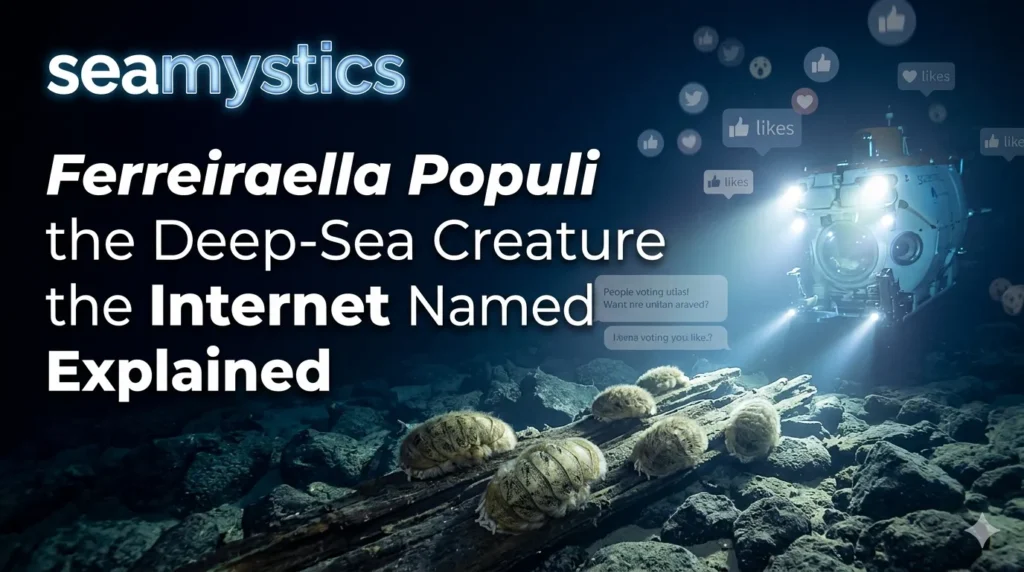

The ocean remains one of Earth’s greatest mysteries. Even today, scientists continue to discover species living in extreme environments thousands of meters below the surface. One recent discovery has captured worldwide attention: Ferreiraella populi the deep-sea creature the internet named.
Unlike most newly discovered species, this unusual marine animal received its scientific name through public participation. Thousands of people from around the world submitted suggestions, making the naming process a unique example of science and community collaboration. As a result, Ferreiraella populi quickly became one of the most talked-about marine discoveries of 2026.
What Is Ferreiraella Populi?
Ferreiraella populi is a newly described species of chiton. Chitons are marine mollusks that possess eight overlapping shell plates. Although they belong to the same broad group as snails and clams, they look very different.
Scientists discovered this species on sunken wood deep within the Izu-Ogasawara Trench near Japan. The animal lives approximately 5,500 meters below sea level, where sunlight never reaches.
Quick Facts
| Feature | Details |
|---|---|
| Scientific Name | Ferreiraella populi |
| Animal Group | Chiton (Marine Mollusk) |
| Discovery Year | 2024 |
| Official Description | 2026 |
| Location | Izu-Ogasawara Trench, Japan |
| Depth | About 5,500 meters |
| Habitat | Sunken wood ecosystems |
| Naming Method | Public online contest |
Sources:
Why Did the Internet Name This Deep-Sea Creature?
The story behind the name is what makes this species special.
Science communicator and YouTube creator Ze Frank featured the unusual animal in his popular “True Facts” series. Afterward, viewers were invited to suggest a scientific name for the newly discovered species.
The response exceeded expectations. More than 8,000 suggestions arrived within a week. Researchers carefully reviewed every submission before selecting “populi,” a Latin word meaning “of the people.” Interestingly, 11 different participants independently suggested the winning name.
Naming Contest Statistics
| Metric | Result |
|---|---|
| Total Suggestions | 8,000+ |
| Winning Meaning | “Of the People” |
| Contributors Suggesting Winner | 11 |
| Public Participation Time | About 1 Week |
Source:
Unique Characteristics of Ferreiraella Populi
This species possesses several remarkable traits.
Eight Protective Shell Plates
Like other chitons, Ferreiraella populi has eight armored plates covering its back. These plates help protect the animal from predators and harsh environmental conditions.
Lives on Sunken Wood
Most people imagine deep-sea creatures living near hydrothermal vents. However, Ferreiraella populi depends on sunken wood that sinks from forests and rivers into the ocean depths.
These wooden structures create miniature ecosystems where specialized animals survive.
Hosts Tiny Worm Communities
Researchers observed small worms living near the animal’s tail. These worms feed on waste materials produced by the chiton, creating a fascinating example of symbiosis.
Deep-Sea Habitat and Survival
The deep ocean presents extreme challenges.
Conditions at 5,500 Meters
| Environmental Factor | Condition |
|---|---|
| Sunlight | None |
| Pressure | Extremely High |
| Temperature | Very Cold |
| Food Availability | Limited |
| Oxygen | Low |
Despite these harsh conditions, Ferreiraella populi thrives. Scientists believe its specialized adaptations help it survive where few animals can.
Habitat Visualization
Ocean Surface
█████████████████████

Sunlight Zone
██████████████

Twilight Zone
████████

Midnight Zone
██████

Deep Ocean
████

Izu-Ogasawara Trench
██  ← Ferreiraella populi
How Scientists Officially Name New Species
Every newly discovered species must receive a formal scientific name.
Scientists follow a system called binomial nomenclature, originally developed by the Swedish naturalist Carl Linnaeus.
The process generally follows these steps:
- Discover a potentially new species.
- Study its anatomy and genetics.
- Compare it with known species.
- Publish findings in a scientific journal.
- Assign an official scientific name.
In the case of Ferreiraella populi, researchers added a public naming competition before the final publication stage.
Why This Discovery Matters
Many people wonder why scientists become excited about a small deep-sea mollusk.
The answer involves biodiversity.
Conservation Benefits
Scientists estimate that millions of marine species remain undiscovered. Some may disappear before researchers even document them.
Therefore, every new discovery improves our understanding of ocean ecosystems and strengthens conservation efforts.
Faster Scientific Recognition
Traditionally, species descriptions can take ten to twenty years.
However, researchers formally described Ferreiraella populi only two years after its discovery. This faster timeline helps conservation organizations identify vulnerable ecosystems sooner.
Comparison With Other Deep-Sea Discoveries
| Species | Discovery Year | Notable Feature |
|---|---|---|
| Ferreiraella populi | 2026 Description | Named by the internet |
| Dulcibella camanchaca | 2024 | Deep-sea predator |
| Various Snailfish Species | Recent | Extreme depth survival |
| Deep-Sea Squid Species | Ongoing | Unique adaptations |
Sources:
Public Participation in Modern Science
The success of Ferreiraella populi demonstrates how public involvement can support scientific research.
Today, scientists frequently use:
- Citizen science projects
- Public wildlife observations
- Online biodiversity databases
- Community naming campaigns
- Social media outreach
As a result, more people become interested in conservation and scientific discovery.
Frequently Asked Questions
What does Ferreiraella populi mean?
The word “populi” comes from Latin and means “of the people.” Scientists selected it after a public naming contest.
Is Ferreiraella populi a fish?
No. It is a chiton, which belongs to a group of marine mollusks.
Where was Ferreiraella populi discovered?
Researchers found it in the Izu-Ogasawara Trench near Japan at a depth of approximately 5,500 meters.
Why is this species important?
It improves scientific knowledge of deep-sea biodiversity and highlights the value of public participation in research.
How many naming suggestions were submitted?
More than 8,000 suggestions arrived during the public naming campaign.
Discover Ferreiraella populi, the deep-sea creature the internet named. Learn its story, habitat, unique features, and scientific importance.
Conclusion
Ferreiraella populi is much more than another newly discovered marine species. It represents a rare moment when scientists and the public worked together to shape scientific history. Because thousands of people participated in the naming process, this deep-sea chiton became a symbol of collaboration, curiosity, and ocean conservation. As researchers continue exploring the deep ocean, discoveries like Ferreiraella populi remind us how much of our planet remains unexplored.