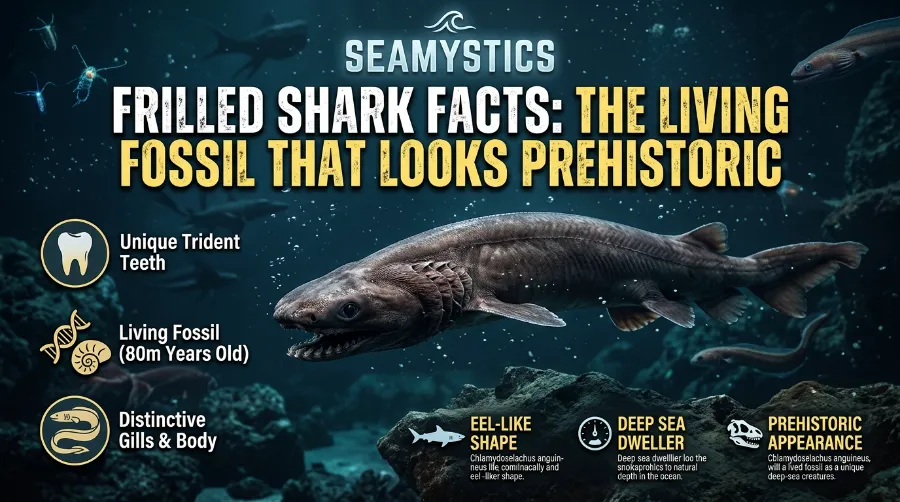

If a shark could audition for a dinosaur movie without any special effects, it would be this one. The frilled shark looks like it swam straight out of the Jurassic and never got the memo that time had moved on. These frilled shark facts explain why marine biologists still get a little giddy every time one turns up in a net or on camera, and why this eel-bodied hunter is one of the strangest survivors in the entire ocean.
Dumbo Octopus Facts: The Deep-Sea Animal Named After an Elephant
I have spent two decades studying deep-sea elasmobranchs, and the frilled shark, Chlamydoselachus anguineus, still surprises me. It barely resembles a shark at first glance. Long, snake-like, and dark chocolate brown, it hides in cold water far below where sunlight ever reaches, and it has done so, more or less unchanged, for tens of millions of years.
TL;DR: The frilled shark is a deep sea, eel-shaped predator that has barely changed in tens of millions of years, which is why scientists call it a living fossil. It lives mostly between 160 and 4,900 feet down, hunts with 300 backward-curving teeth, and carries its pups for up to three and a half years, the longest known gestation period of any vertebrate. It is rarely seen alive and poses no real threat to humans.
Key Takeaways
| Frilled Shark Fact | Detail |
|---|---|
| Scientific name | Chlamydoselachus anguineus |
| Typical depth | 160 to 4,900 feet (50 to 1,500 m), sometimes deeper |
| Size | 4.5 to 6.6 feet (1.3 to 2 m) |
| Teeth | About 300, in 25 rows, backward-curving |
| Diet | Mostly squid, plus fish and other sharks |
| Gestation period | Up to 3.5 years, the longest of any vertebrate |
| Lifespan | Estimated around 25 years |
| First filmed alive | 2004, off Japan |
| Conservation status | Reassessed by the IUCN in recent years, after earlier “Near Threatened” listings |
What Is a Frilled Shark? A Quick Look at Its Appearance
The frilled shark’s appearance is the reason it gets called a living fossil in almost every documentary that features it. Instead of the torpedo shape most people picture, this species has a long, flexible, eel-like body. It can reach up to 6.6 feet in length. Its head is broad and flat, its snout is short and round, and its mouth sits at the very front of the head rather than underneath. That placement alone sets it apart from most other sharks.
Body Shape and Color
Its coloring runs from dark brown to grey, which works perfectly as camouflage in a world with almost no light. The body needs very little muscle for fast swimming, so it stays soft, and the skeleton is mostly cartilage, much like other sharks but even more pronounced here. It also carries an oversized, oil-rich liver. That liver keeps it buoyant without wasting energy, which matters when food is scarce and swimming costs a lot at depth.
Giant Isopod Facts: The Deep-Sea Relative of the Pill Bug
The Frilled Gills
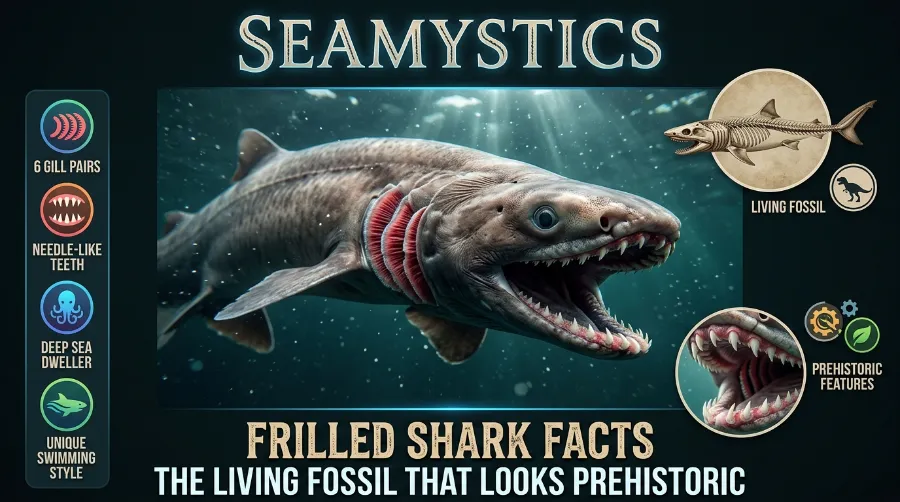
The frilled shark’s name actually comes from its throat rather than its face. It has six pairs of gill slits instead of the usual five, and the first pair meets across the front of the throat to form a fringed, frilly collar. According to Shark Angels’ species profile, that collar is where the name comes from. It remains one of the more distinctive features in the entire shark family.
Coffinfish Facts: The Deep-Sea Fish Nobody Expects
This is far from the only oddly built creature down there. If unusual body plans fascinate you, our bizarre sea creatures guide rounds up several more species that look like they escaped from a different geological era.

Teeth and Jaw
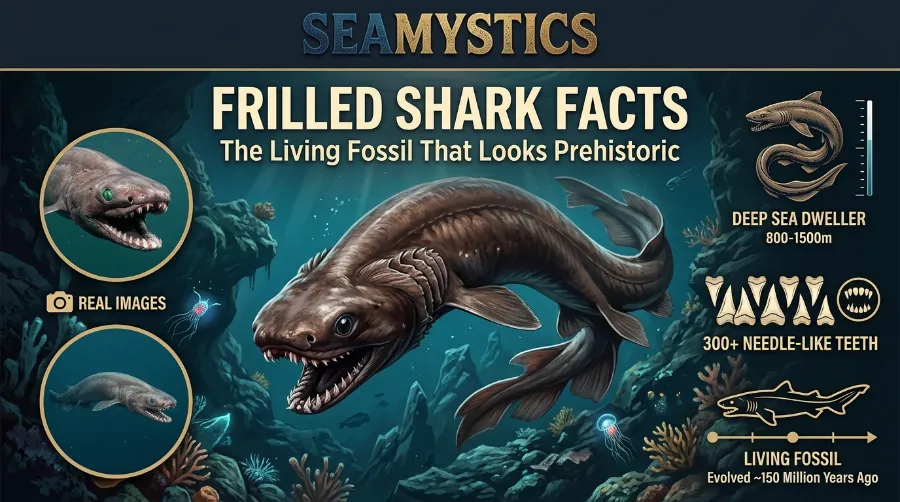
Roughly 300 small, needle-thin, three-pronged teeth line its mouth in around 25 rows. Every tooth points backward. Once the shark catches its prey, escape is nearly impossible. Combined with a jaw that opens unusually wide for its size, this mouth works like a trap door rather than a bite. That single detail explains a lot about how this fish survives on so little food, so far down.
Frilled Shark Habitat: Where This Deep-Sea Ghost Lives
The frilled shark habitat spans a strange, patchy map that stretches across almost every ocean on Earth. Yet the species itself remains rare almost everywhere it turns up. It generally lives along outer continental shelves and upper continental slopes, typically between 160 and 4,900 feet down. Some individuals have reached depths of 5,150 feet, and a few have turned up near the surface.
Confirmed sightings and catches come from a wide but scattered set of locations, including:
- The eastern Atlantic, from northern Norway down through the British Isles, Ireland, France, and West Africa
- The western Atlantic, off New England, Georgia, and Suriname
- Suruga Bay in Japan, where fishers catch it more often than almost anywhere else on Earth
- The western Pacific near southeastern Australia, Tasmania, and New Zealand
- The eastern Pacific off California and northern Chile
According to the Marine Biological Association’s MarLIN database, frilled sharks have even turned up in scattered offshore records northwest of the British Isles. That confirms this is not purely a Pacific curiosity but a genuine, if elusive, presence in European waters too. Suruga Bay is unusually shallow for the species, often only 160 to 660 feet, which is part of why so many rare live sightings happen there.

As Ocean Conservancy notes, this patchy, worldwide-but-thin distribution is exactly why the species stays so poorly understood. A shark that mostly lives a mile down, in cold, high-pressure water, is not easy to study. Most of what scientists know comes from dead specimens caught by accident in fishing gear, rather than from direct observation in the wild.
Barreleye Fish Facts: The Fish With a Transparent Head
Prehistoric Shark Facts: Why It Is Called a Living Fossil
Among prehistoric shark facts, the frilled shark’s claim to fame is simple. Its basic body plan has barely changed in roughly 80 million years. Fossil evidence places early relatives of this lineage back into the Cretaceous period. Something very close to this exact shark was likely swimming the oceans while dinosaurs still walked on land.
The Deep-Sea Slug That Baffled Scientists: Pink See-Through Fantasia
Sharks in the order Hexanchiformes, which includes the frilled shark, split off from other shark lineages extremely early in shark evolutionary history. Deep, cold water changes far more slowly than surface habitats, so there has been far less pressure to change body shape, hunting style, or reproduction. In a sense, the deep ocean acted like a time capsule, and the frilled shark never had a strong reason to leave the mold.
Zombie Worm Facts: The Creature That Eats Whale Bones
Some researchers, including those at the Shark Research Institute, have floated an intriguing idea. Historic sea serpent legends may trace back to sightings of frilled sharks or their larger prehistoric relatives, rather than to any mythical creature at all. A long, snake-like body breaking the surface briefly would look convincingly monstrous to sailors with no frame of reference for what they were seeing.
It helps to be precise here rather than romantic. The frilled shark is not literally a dinosaur-era animal walking around unchanged cell for cell. Its lineage and general body plan have instead remained remarkably stable while the world around it transformed completely, which is still an extraordinary evolutionary story on its own.
Sea Pig Facts: The Deep-Sea Cucumber That Looks Like a Toy
What Does a Frilled Shark Eat?
Diet is one area where direct observation has actually taught scientists a fair amount. Most of that comes from stomach content analysis in specimens caught as bycatch. Squid make up roughly 60 percent of the frilled shark’s diet, a striking number given how hard squid are to catch compared to slower prey.
Fangtooth Fish Facts: The Small Fish With the Biggest Teeth
Its hunting strategy likely resembles a snake more than a typical shark. With a flexible spine and reduced fins, it can coil its body and strike forward in a fast lunge, something few other sharks can do. Deep water offers very little ambient light and few places to hide, so this ambush style probably works better than a long chase ever could.
Beyond squid, the Shark Research Institute’s species notes point to stomach contents that have also turned up:
- Deep-sea fish species
- Octopus and cuttlefish, not unlike the newly discovered octopus species researchers keep finding at similar depths
- Smaller sharks, including other frilled sharks on occasion
- Nudibranchs, or sea slugs, though far less commonly
Researchers have almost never observed live frilled sharks feeding in the wild. Virtually everything known about this behavior comes from indirect evidence rather than firsthand footage, and that gap is one of the more honest limitations in frilled shark research today.
Reproduction: The Longest Pregnancy in the Animal Kingdom
If there is one fact that tends to stop people mid-scroll, it is this one. Frilled sharks may carry their young for up to three and a half years before giving birth, which researchers currently consider the longest gestation period of any vertebrate on the planet, longer even than an elephant’s roughly two-year pregnancy.
Pups are born fully developed, typically measuring 16 to 24 inches (40 to 60 cm) long, in litters ranging from two to fifteen, with six being a rough average. There is no clear breeding season, which fits with a species living somewhere with almost no seasonal light or temperature change to signal timing.
Researchers link this incredibly slow reproductive rate to metabolic pressures at depth, where cold temperatures slow down nearly every biological process. It also explains why the species is considered vulnerable to overfishing even though it is rarely targeted directly. A shark that reproduces this slowly cannot recover quickly from population losses, even accidental ones.
Rare Sightings and Human Encounters
For most of scientific history, the frilled shark existed almost entirely as dead specimens pulled up in trawl nets. That changed on August 27, 2004, when fishermen off Japan’s Shizuoka coast spotted a live frilled shark swimming near the surface and alerted Awashima Marine Park, which managed to capture and film it. The animal survived only a few hours in captivity, but the footage remains one of the most cited pieces of deep-sea shark media in the world, precisely because sightings like it are so uncommon.
Another notable event, documented by Shark Guardian, occurred in 2003, when a suspected mating aggregation was disrupted by trawlers in the Atlantic, resulting in 34 individuals being caught at once, an unusually large number for a species normally encountered alone or in pairs.
Encounters with humans are almost always accidental, and the frilled shark poses essentially no danger to swimmers or divers simply because its habitat and human activity rarely overlap. The handful of documented injuries involve researchers or fishers handling a specimen after capture, where the shark’s backward-curving teeth can cause an accidental cut, rather than any kind of aggressive encounter.
Is the Frilled Shark Endangered? Conservation Status Explained
Conservation status for this species has actually shifted over time, and being upfront about that shift matters more than pretending the science has always agreed. Earlier IUCN assessments listed the frilled shark as Near Threatened, largely due to concerns about bycatch combined with its extremely slow reproduction. More recent IUCN evaluations, referenced by groups such as Shark Angels, have reclassified the species as Least Concern, reflecting its wide global range and the relatively low volume of targeted fishing.
That said, regional pictures can differ. New Zealand’s own Threat Classification System listed the species as “At Risk, Naturally Uncommon” in 2018, a reminder that global status and local vulnerability are not always the same thing. Because this is a shark that is rarely targeted directly but still shows up as bycatch in deep trawl fisheries, monitoring its numbers remains genuinely difficult, and population trends are still officially listed as unknown by most assessments.
Groups like Shark Guardian and Ocean Conservancy continue to highlight the frilled shark specifically because deep-sea bycatch reduction, rather than any single dramatic threat, is likely the single most useful lever for protecting species like this one over the long run.
Frilled Shark Facts vs Other Deep-Sea Sharks
It helps to see how the frilled shark stacks up against a couple of other unusual deep-water species people often compare it to.
| Species | Typical Depth | Notable Trait | Danger to Humans |
|---|---|---|---|
| Frilled shark | 160 to 4,900 ft | Eel-like body, 300 backward-curved teeth | None documented |
| Goblin shark | 330 to 4,300 ft | Extendable jaw | None documented |
| Greenland shark | 660 to 7,200 ft | Lives 250+ years | Very rare |
Seen side by side like this, it becomes clear that the frilled shark is not an outlier because it is dangerous. It is an outlier because it has essentially frozen a much older shark body plan in place while its neighbors kept evolving new tricks for the same deep, dark environment.
Frequently Asked Questions
Is the frilled shark actually a dinosaur? No. It did not live alongside dinosaurs in its exact current form, but its lineage split off from other sharks an extremely long time ago, and its body plan has changed very little since, which is why the “living fossil” label sticks.
How big does a frilled shark get? Most individuals measure between 4.5 and 6.6 feet long, with females generally growing larger than males.
Can a frilled shark hurt a person? Direct encounters are essentially unheard of because the species lives far too deep for divers or swimmers to reach. Almost all recorded injuries have happened to researchers or fishers handling a captured specimen.
Why was the frilled shark not filmed alive until 2004? Its deep, dark habitat, solitary behavior, and extreme rarity near the surface make live observation extraordinarily difficult, so the first confirmed video came only after a chance encounter near Japan.
Are frilled sharks endangered? Assessments have shifted over time. Earlier evaluations listed the species as Near Threatened, while more recent IUCN reviews list it as Least Concern globally, though some regional bodies still treat it as vulnerable due to its slow reproduction.
Conclusion
The frilled shark earns every bit of its living fossil reputation, not through myth or exaggeration but through cold, simple biology. It carries an ancient body plan into the modern ocean, hunts with a mouth built like a trap, and reproduces so slowly that a single pregnancy can outlast a presidential term. Every rare sighting, from the 2004 footage off Japan to the odd trawler bycatch report, adds one more small piece to a puzzle that is still far from complete. For a species this old, this strange, and this poorly understood, that mystery might be the most fitting trait of all.
If bizarre, ancient-looking ocean animals are your thing, you can browse more deep-sea profiles like this one over at seamystics.com.
If you want to learn more about the first photos and expert tips coming out of new ROV expeditions, that guide pairs well with this one, especially since so much of what we know about elusive species like the frilled shark now comes from the same kind of deep-sea camera work.
References
- Shark Angels, “Species in Focus: Frilled Shark”
- Shark Guardian, “Frilled Shark”
- Ocean Conservancy, “Frilled Shark”
- IUCN Red List of Threatened Species, iucnredlist.org
- Marine Biological Association, MarLIN, “Chlamydoselachus anguineus”