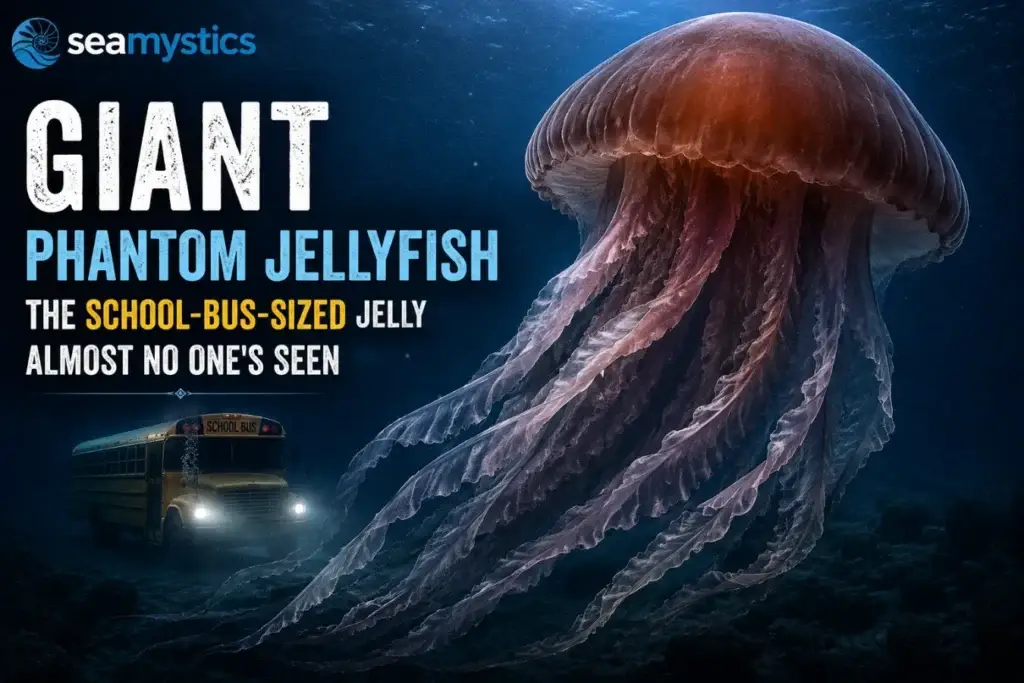

The ocean still hides countless mysteries. Among them, the Giant Phantom Jellyfish the School-Bus-Sized Jelly Almost No One’s Seen stands out as one of the rarest creatures ever recorded. Scientists have explored only a small part of Earth’s oceans, and this enormous jellyfish remains one of the most fascinating discoveries of the deep sea.
Although researchers first identified this species decades ago, sightings remain extremely rare. As a result, every encounter provides valuable information about life in the deep ocean. Furthermore, its incredible size and ghost-like appearance continue to capture public attention worldwide.
What Is the Giant Phantom Jellyfish?
The Giant Phantom Jellyfish (Stygiomedusa gigantea) is a deep-sea jellyfish known for its enormous bell and unusually long oral arms. Unlike many jellyfish species, it lacks traditional tentacles.
Quick Facts
| Feature | Details |
|---|---|
| Scientific Name | Stygiomedusa gigantea |
| Maximum Bell Width | Around 1 meter (3.3 feet) |
| Oral Arm Length | Up to 10 meters (33 feet) |
| Habitat | Deep Ocean Waters |
| First Described | 1910 |
| Typical Depth | 600–6,700 meters |
The species appears dark reddish-brown, which helps it blend into the darkness of the deep sea.
Why Is This Jellyfish So Rare?
Scientists have recorded fewer than 150 confirmed sightings over more than a century. Therefore, many marine experts consider it one of the rarest large jellyfish species on Earth.
Several factors contribute to its rarity:
- It lives in extremely deep water.
- Humans rarely explore its habitat.
- Traditional fishing equipment seldom reaches its depth.
- The jellyfish is fragile and difficult to collect.
Moreover, deep-sea conditions make observation expensive and technically challenging.
Deep-Sea Habitat and Distribution
Where Does It Live?
Researchers have observed this species in:
- Pacific Ocean
- Atlantic Ocean
- Indian Ocean
- Gulf of Mexico
- Monterey Bay
These observations suggest a nearly global distribution.
Habitat Depth Chart
| Depth Range | Observation Frequency |
|---|---|
| 0–500 m | Very Rare |
| 500–1,500 m | Common Sighting Zone |
| 1,500–3,500 m | Frequent |
| 3,500–6,700 m | Occasional |
Text-Based Depth Visualization
Surface          |
500m             | ##
1000m            | #######
1500m            | ##########
3000m            | ########
5000m            | ####
6700m            | ##
How Big Is the Giant Phantom Jellyfish?
The phrase “school-bus-sized” often refers to the full span created by its long arms.
Size Comparison
| Object | Approximate Length |
|---|---|
| Average Human | 1.7 m |
| Great White Shark | 4–6 m |
| Giant Phantom Jellyfish Arms | Up to 10 m |
| School Bus Length | 10–12 m |
Consequently, the jellyfish can appear as large as a school bus when fully extended.
Unique Physical Characteristics
Several features distinguish this species from other jellyfish.
1. No Traditional Tentacles
Most jellyfish use tentacles for feeding. However, this species relies on four ribbon-like oral arms.
2. Massive Bell
Its bell can exceed one meter in width, making it one of the largest deep-sea jellyfish known.
3. Ghost-Like Appearance
Because of its flowing arms and dark coloration, it appears almost supernatural when illuminated by underwater vehicles.
4. Slow Movement
Instead of active swimming, it drifts gracefully through ocean currents.
How Scientists Discover These Rare Creatures
Modern technology has transformed deep-sea exploration.
Feeding Behavior
Researchers believe the Giant Phantom Jellyfish uses its long oral arms to capture prey.
Likely food sources include:
- Small fish
- Zooplankton
- Crustaceans
- Deep-sea invertebrates
Additionally, scientists have observed small fish living among its arms. These fish may gain protection while helping clean parasites from the jellyfish.
Real-Life Sightings and Discoveries
2022 Deep-Sea Observation
A research expedition in the Pacific Ocean recorded a remarkable encounter with the species at significant depth. The footage provided scientists with clearer views of its feeding structures.
2023 Ocean Exploration Missions
Several deep-sea surveys reported additional sightings using remotely operated vehicles. As a result, researchers expanded knowledge about its global distribution.
2024 Research Updates
Marine biologists continued reviewing historical footage and newly collected observations. Consequently, scientists gained a better understanding of how frequently the species appears in different ocean regions.
Comparison With Other Giant Jellyfish
| Species | Bell Size | Length |
|---|---|---|
| Lion’s Mane Jellyfish | 2.3 m | 36 m |
| Nomura’s Jellyfish | 2 m | 5 m |
| Giant Phantom Jellyfish | 1 m | 10 m |
| Moon Jellyfish | 0.4 m | 1 m |
Although it is not the largest jellyfish by total length, its rarity makes it exceptionally important.
Why This Species Matters to Marine Science
Deep-sea ecosystems remain largely unexplored.
The Giant Phantom Jellyfish helps scientists:
- Understand deep-ocean food webs.
- Study jellyfish evolution.
- Explore biodiversity.
- Learn how species adapt to extreme pressure.
Furthermore, each observation improves knowledge of Earth’s least understood environments.
conservation Concerns
While researchers lack sufficient population data, several threats could affect deep-sea species.
Potential Risks
- Deep-sea mining
- Ocean pollution
- Climate change
- Habitat disruption
Therefore, marine scientists continue advocating for expanded ocean research and conservation efforts.
Frequently Asked Questions
Is the Giant Phantom Jellyfish dangerous to humans?
No confirmed cases suggest significant danger to humans. The species lives far below normal diving depths.
How often is it seen?
Scientists have recorded fewer than 150 sightings over more than a century.
Why is it called a phantom jellyfish?
Its dark color, flowing arms, and rare appearances create a ghost-like impression.
Can it be found near beaches?
No. It lives in deep ocean environments thousands of meters below the surface.
What is its scientific name?
Its scientific name is Stygiomedusa gigantea.
Latest Research Summary
| Research Area | Current Understanding |
|---|---|
| Population Size | Unknown |
| Global Distribution | Widespread |
| Feeding Behavior | Partially Understood |
| Reproduction | Largely Unknown |
| Conservation Status | Not Fully Assessed |
Conclusion
The Giant Phantom Jellyfish the School-Bus-Sized Jelly Almost No One’s Seen remains one of the ocean’s most mysterious creatures. Its enormous size, deep-sea habitat, and extremely rare appearances make every sighting valuable to science. As technology improves, researchers will likely uncover even more secrets about this remarkable jellyfish and the hidden world it inhabits.