
The ocean does not play by the rules of the surface world. Down where sunlight never reaches, evolution has built animals that glow. Some turn themselves inside out to scare off predators. Meanwhile, one jellyfish can, in a sense, refuse to die. If you have ever searched for a weird sea animals list and come away confused, this guide fixes that. After all, I work as a marine biologist, and I have spent years reading survey logs and watching ROV footage. In addition, I have seen many of these animals firsthand on research cruises, and they still surprise me.
Dumbo Octopus Facts: The Deep-Sea Animal Named After an Elephant
This guide walks through the strangest ocean creatures on record. It also explains why they look and behave the way they do. Furthermore, it folds in the newest species descriptions from 2025 and 2026, so you are not reading a list that stopped updating a decade ago.
Key Takeaways
| Topic | What You Need to Know |
|---|---|
| Deepest bizarre creature featured | Game of Thrones Shrimp, found 4,026 meters down off Australia |
| Most venomous animal on this list | Blue-ringed octopus, no bigger than a golf ball |
| Newest scientific discoveries cited | Species described in 2025 and early 2026, including Poseidon’s Squid |
| Undescribed ocean life remaining | An estimated 91 percent of ocean species are still undocumented |
| Best places to learn more | Marine species databases, aquarium field guides, and licensed research vessel logs |
TL;DR: Bizarre ocean animals are not rare exceptions. Instead, they are a normal outcome of life adapting to extreme pressure, cold, and darkness. From the immortal jellyfish to the newly named Poseidon’s Squid, the deep sea keeps producing creatures stranger than fiction, and scientists are still describing new ones every year.
Sea Pig Facts: The Deep-Sea Cucumber That Looks Like a Toy
Why the Deep Ocean Breeds Such Bizarre Ocean Animals
Pressure, darkness, and food scarcity shape almost everything about deep-sea biology. Because sunlight cannot reach past roughly 1,000 meters, animals there cannot rely on vision the way we do, so many swapped eyesight for other tools. For example, bioluminescence is not a rare party trick. In fact, a majority of deep-sea animals produce their own light in some form, and they use it to lure prey, confuse predators, or find a mate in total blackness.
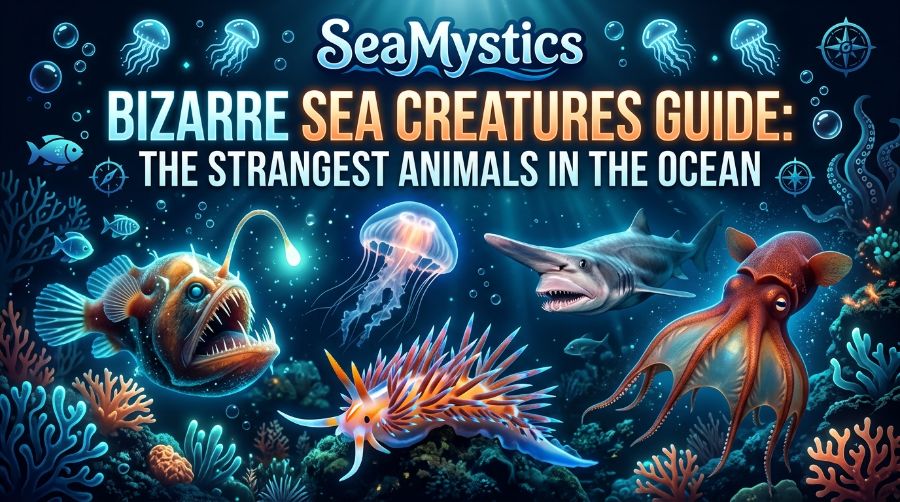
Similarly, food is scarce at depth, so bizarre ocean animals guide their own survival through extreme efficiency. Many deep-sea fish carry massive, hinge-like jaws that let them swallow prey larger than their own bodies, since a meal might not come around again for weeks. Others, on the other hand, slow their metabolism so far down that a single feeding can sustain them for months. For further reading, NOAA Ocean Exploration keeps an updated overview of deep-sea adaptations.
Frilled Shark Facts: The Living Fossil That Looks Prehistoric
The Strangest Ocean Creatures: A Weird Sea Animals List
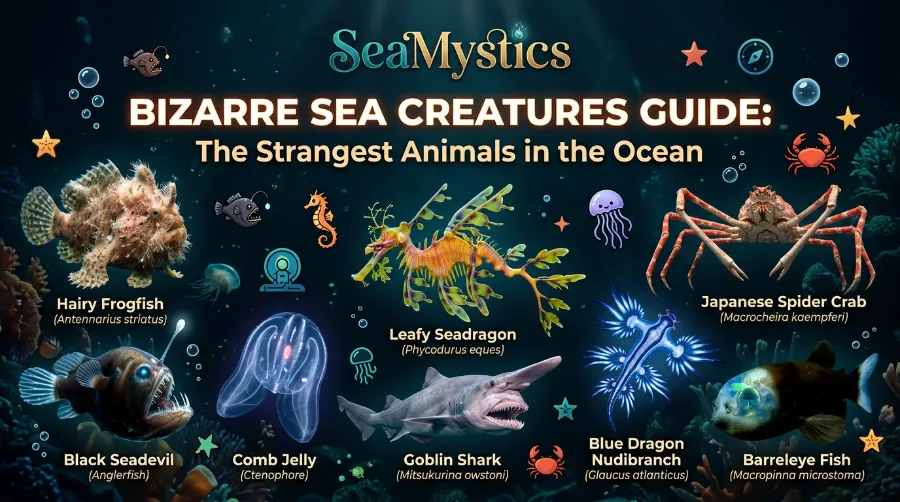
Here is where the fun starts. Below is a working list of the strangest sea creatures I return to again and again, especially when people ask me for real examples rather than just anglerfish memes.
- Anglerfish – Uses a glowing lure called an esca, powered by symbiotic bacteria, to draw prey toward its jaws in total darkness.
- Blobfish – Only looks like a sad, melting face at the surface. At depth, under crushing pressure, its gelatinous body works fine and looks unremarkable.
- Vampire Squid – Despite the name, it feeds on marine snow, not blood, and can turn itself almost fully inside out when threatened.
- Blue-Ringed Octopus – Carries enough tetrodotoxin to kill an adult human, yet fits in the palm of your hand.
- Immortal Jellyfish (Turritopsis dohrnii) – Reverts its cells back to an earlier life stage when stressed or injured, which essentially resets its biological clock.
- Yeti Crab (Kiwa hirsuta) – Farms bacteria on its hairy claws for food. Scientists found it near hydrothermal vents in the South Pacific.
- Goblin Shark – Shoots its jaw forward out of its mouth to snatch prey, a trait almost unique among living sharks.
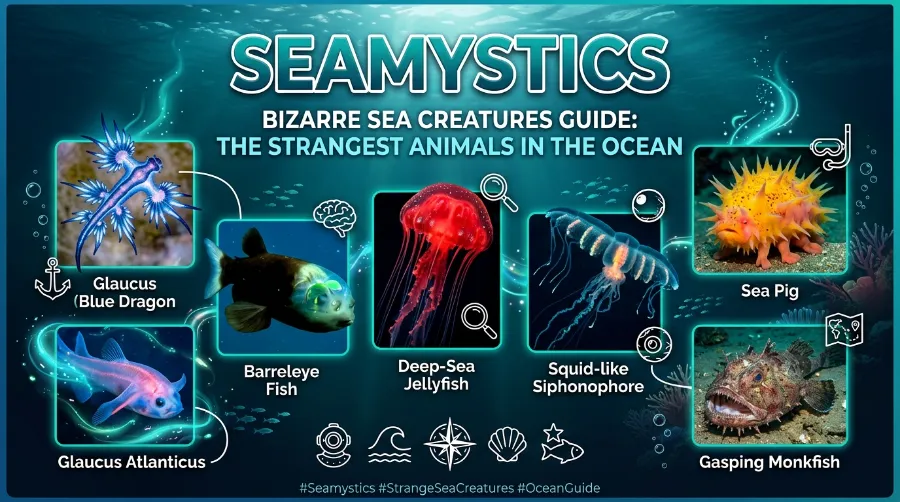
- Barreleye Fish – Carries a transparent, fluid-filled head with tubular eyes that rotate upward to spot prey silhouetted above it.
Overall, each of these strangest ocean creatures solves the same three problems. They need to find food, avoid becoming food, and reproduce in an environment most animals could never survive.
Giant Isopod Facts: The Deep-Sea Relative of the Pill Bug
New Discoveries: Bizarre Sea Creatures Found in 2025 and 2026
Marine science is not a closed book. Instead, researchers regularly bring back specimens that turn out to be entirely new to science, and the last two years have been especially active.
- Poseidon’s Squid (Mobydickia poseidonii) – Scientists described this species in 2025, after realizing a specimen collected back in the 1950s did not match any known deep-sea squid genus.
- Iskra’s Glitter Worm (Photinopolynoe iskrae) – A shimmering, scale-covered worm found off California in whale falls, wood falls, and methane seeps. A Scripps Oceanography team described it in Marine Biodiversity in November 2025.
- Game of Thrones Shrimp (Greyjoyella mundugalae) – A 2.5-millimeter shrimp-like crustacean collected off Jervis Bay, Australia, at a depth between 3,881 and 4,026 meters. CSIRO’s RV Investigator program announced it at the end of 2025.
- Carnivorous “Death-Ball” Sponge (Chondrocladia sp.) – The ROV SuBastian found this sponge near Antarctica, as one of roughly 30 new deep-sea species uncovered after a massive iceberg calved from a floating glacier.
- Darth Vader Supergiant Isopod (Bathynomus vaderi) – This newly named giant isopod appeared in the World Register of Marine Species’ 2025 roundup, since its armored head reminded researchers of the famous helmet.
Meanwhile, in June 2026, an expedition off the coast of Brazil aboard the research vessel Falkor (too) added more than two dozen new marine species to the list, including new jellyfish, comb jellies, and a rarely seen octopus filmed alive for the first time. Overall, scientists estimate that around 91 percent of ocean species remain formally undescribed, which is worth remembering any time someone claims we already know what lives down there.
The Deep-Sea Slug That Baffled Scientists: Pink See-Through Fantasia
Unusual Sea Life Facts Worth Knowing
A few unusual sea life facts tend to surprise people the most, especially when I bring them up on dives or in talks:
- The hagfish can tie its own body into a knot, then slide the knot down its length to escape a predator’s grip or to scrape off excess slime.
- The mantis shrimp can strike prey with an acceleration comparable to a bullet leaving a gun, and the strike is fast enough to create a brief flash of light called sonoluminescence.
- The cookiecutter shark removes circular plugs of flesh from much larger animals, including whales, and leaves behind a distinctive crater-shaped scar.
- The Greenland shark can live for several centuries. In fact, researchers estimated one at over 270 years old, based on eye-lens analysis published in Science in 2016.
Overall, these are not internet myths. Rather, peer-reviewed journals document these behaviors, and repeated expeditions confirm them.
Zombie Worm Facts: The Creature That Eats Whale Bones
How Scientists Find These Bizarre Ocean Animals
Most of the discoveries above did not come from a lucky net haul. Instead, remotely operated vehicles, or ROVs, found them, since these machines can descend thousands of meters and stream live video back to a ship. If you want more detail, our related piece on how ROVs are finding new deep-sea species every year breaks down the hardware and the discovery pipeline further.
Coffinfish Facts: The Deep-Sea Fish Nobody Expects
Additionally, manned submersibles still matter. Programs like Scripps Oceanography’s ROV-based scaleworm survey, and China’s crewed submersible Jiaolong, each contributed new species descriptions in the past year alone. Typically, a specialized taxonomist needs months, sometimes years, to confirm that a specimen is genuinely new.
Fangtooth Fish Facts: The Small Fish With the Biggest Teeth
A Quick Comparison: Depth, Danger, and Discovery Year
| Creature | Depth Found | Danger Level | Year Described or Highlighted |
|---|---|---|---|
| Blue-Ringed Octopus | Shallow reefs and tide pools | Extremely venomous | Long known, still widely misunderstood |
| Game of Thrones Shrimp | 3,881 to 4,026 meters | Harmless to humans | 2025 |
| Poseidon’s Squid | Deep open ocean | Unknown, likely low | 2025 |
| Goblin Shark | 270 to 960 meters | Low, rarely encountered | Long known |
| Iskra’s Glitter Worm | Whale falls, methane seeps | Harmless | 2025 |
| Immortal Jellyfish | Coastal and open waters | Mildly venomous sting | Long known, biology still studied |
Practical Takeaways If You Want to See These Animals Yourself
You do not need a research vessel to encounter genuinely strange marine life. Instead, a few practical steps help:
- Book a guided night dive, since many bizarre ocean animals become more active after dark.
- Visit an aquarium with a dedicated deep-sea or cephalopod exhibit, rather than a general tropical fish tank.
- Follow research institutions that livestream ROV dives, since several expeditions now broadcast footage publicly.
- Read species descriptions from marine biodiversity databases, because the field moves fast and older lists go stale.
Additionally, if ghost nets and marine debris drew you to this topic, read our companion piece on ghost nets and the silent damage they cause in the deep ocean, since many strange-looking species also rank among the most vulnerable to entanglement.
Barreleye Fish Facts: The Fish With a Transparent Head
A Note From the Field
On a research trip years ago, I watched a barreleye fish drift past a submersible viewport, its transparent dome-shaped head catching the sub’s lights in a way no photograph ever quite captures. Reading a species description is one thing, but watching an animal solve a problem is another. It stayed almost perfectly still, using rotating eyes to track a faint shape above it, in water so dark our own lights felt intrusive. That gap, between reading about bizarre sea creatures and actually observing them, explains why new species still surprise people who have spent a career in this field.
Frequently Asked Questions
What is the most bizarre sea creature ever discovered? There is no single answer, since new candidates emerge almost every year. However, marine biologists frequently cite the immortal jellyfish, the vampire squid, and the newly described Poseidon’s Squid as strong contenders.
Are bizarre ocean animals dangerous to humans? Most are not. A small number, including the blue-ringed octopus and certain jellyfish, carry potent venom and should never be handled, while the vast majority of deep-sea species never encounter humans at all.
How many new sea creatures are discovered each year? The number varies, but recent expeditions alone have added dozens of new species annually. In addition, researchers estimate roughly 91 percent of ocean species remain formally undescribed.
Why do so many deep-sea animals glow? Bioluminescence helps animals attract prey, confuse predators, and find mates in an environment where sunlight never reaches, and it shows up far more often in the deep sea than most people realize.
Where can I see bizarre sea creatures in person? Public aquariums with dedicated deep-sea exhibits, guided night dives in tropical reef areas, and livestreamed ROV expeditions all offer realistic ways to see unusual marine life without a research budget.
Conclusion
The ocean has not run out of surprises, and based on how quickly new species keep getting named, it will not run out anytime soon. Every glowing lure, inside-out defense trick, and centuries-long lifespan on this list makes one thing clear: most of the planet’s strangest biology hides in plain sight, just out of reach of sunlight. Therefore, if this guide gave you a new favorite bizarre ocean animal, explore the wider Sea Mystics archive, where new expedition findings and species profiles arrive as the research comes in.
References
- World Register of Marine Species, “Ten Remarkable New Marine Species from 2025,” marinespecies.org, March 2026.
- CSIRO, “Memorable New Species Discovered by RV Investigator,” csiro.au, April 2026.
- Schmidt Ocean Institute and Nekton Ocean Census, species reports, oceana.org and discoverwildlife.com, 2025 to 2026.
- Phys.org, “From Whale Falls to 4,000 Meters Deep: Two New Species Spotlight Scripps Research,” March 2026.
- Original Diving, “Top Five Strange Sea Creatures”
- Monterey Boats, “10 of the Strangest Sea Creatures”
- Back to the Sea, “It’s Spooky Sea Son”