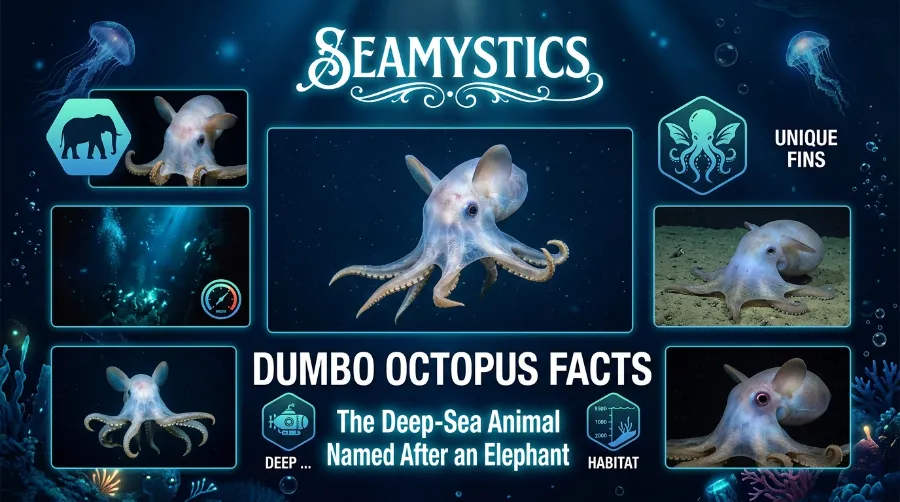

Picture an animal so soft it has no bones. Now picture it living deeper than almost any other octopus on Earth. That is the dumbo octopus, and dumbo octopus facts like these get stranger the closer you look. Scientists gave it its name for one simple reason: its fins look like a cartoon elephant’s ears. Below, you will find out where it lives, what it eats, how big it really gets, and why researchers keep finding new species of it today.
Frilled Shark Facts: The Living Fossil That Looks Prehistoric
TL;DR: The dumbo octopus belongs to the genus Grimpoteuthis, and it lives deeper than any other known octopus, sometimes past 6,000 meters. Scientists recognize at least 17 to 18 species, most no bigger than a dinner plate, and in fact they confirmed a brand-new species in the Pacific in 2025. It poses no danger to humans, it eats small worms and crustaceans, and ghost nets, mining, and microplastics quietly threaten it.
| Key Takeaway | The Fact |
|---|---|
| Depth range | 100 to over 7,000 meters below the surface |
| Number of species | At least 17 to 18 known species of Grimpoteuthis |
| Average size | 20 to 30 cm (8 to 12 inches) |
| Largest ever recorded | 1.8 meters (nearly 6 feet), weighing 5.9 kg (13 lbs) |
| Lifespan | Roughly 3 to 5 years |
| Blood color | Blue, from a copper-based protein called hemocyanin |
| Newest species | Grimpoteuthis feitiana, confirmed in the Pacific in 2025 |
| Danger to humans | None. It has no ink sac and cannot bite through skin |
What Is a Dumbo Octopus?
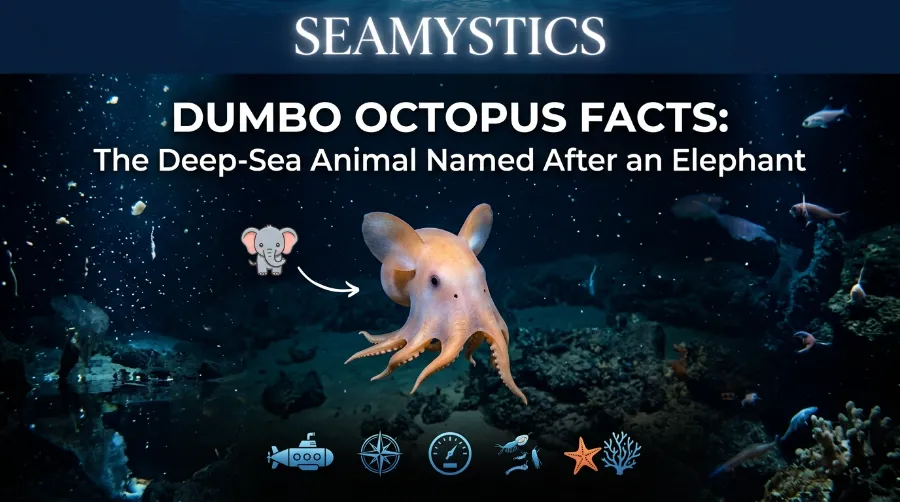
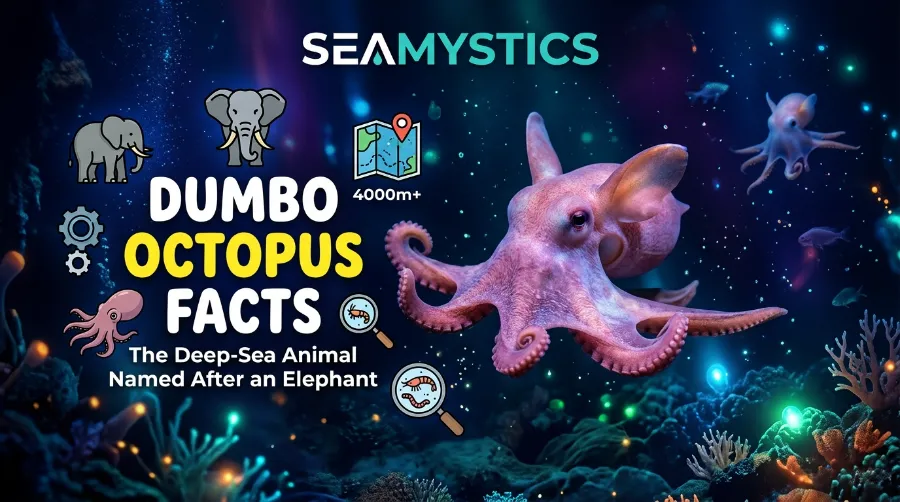
“Dumbo octopus” does not name one animal. Instead, it names an entire genus, Grimpoteuthis, made up of finned, deep-sea octopuses. The genus takes its name from the Disney elephant that flew by flapping its ears, and similarly, this octopus flaps its own ear-like fins to glide across the ocean floor. It typically lives between 3,000 and 4,000 meters down, in oceans all around the world.
Guy Robson, a former curator at London’s Natural History Museum, named the genus decades ago. Since then, researchers collected two of the original specimens during the historic Challenger expedition, and the museum’s mollusca collection still holds both today. That detail shows how long this animal sat quietly in scientific archives before it became an internet favorite.
Meanwhile, if you enjoy strange ocean animals like this one, the full guide to bizarre sea creatures on Sea Mystics rounds up several, and some are far stranger than an octopus with elephant ears.
Dumbo Octopus Habitat: Where This Deep-Sea Animal Lives
The dumbo octopus habitat is one of the most extreme places any octopus calls home. Eighteen known species make up the genus, and together they range from 100 to 7,000 meters deep, or 328 to 22,965 feet. That range covers everything from the continental slope down toward the hadal zone.
Coffinfish Facts: The Deep-Sea Fish Nobody Expects
The deepest confirmed sighting pushes the story even further. In 2020, researchers filmed one nearly 7,000 meters down in the Java Trench. As a result, that sighting hints that dumbo octopuses might even survive in the hadal zone, the ocean’s deepest layer. For comparison, that depth beats the height of Mount Everest.
No sunlight reaches this habitat, and temperatures hover near freezing while pressure would crush most animals instantly. So how does the dumbo octopus survive down there? A few adaptations make it possible:
- A soft, semi-gelatinous body with internal cartilage instead of rigid bone, so it flexes rather than cracks under pressure
- Blue, copper-based blood that carries oxygen efficiently in cold, low-oxygen water
- Huge eyes relative to its body, which help it catch faint traces of bioluminescent light
- No ink sac at all, since predators rarely show up in total darkness anyway
Here, then, is how that depth stacks up against a few other deep-sea residents.
The dumbo octopus edges out most competitors, and only the Mariana snailfish routinely goes deeper. Overall, that makes this “cutest deep sea animal” one of the true champions of deep-sea living. For more expert insight into this environment, the Ocean First Institute’s creature feature on the dumbo octopus covers useful tips and background on what makes this habitat so unforgiving.
Giant Isopod Facts: The Deep-Sea Relative of the Pill Bug
Dumbo Octopus Species: How Many Are There?
Most people assume one species carries this name, but that assumption misses the mark. In reality, scientists recognize at least 17 known dumbo octopus species, all sharing similar traits but varying in size, color, and depth preference. Some researchers even count 18, since fresh evidence keeps shifting the taxonomy.
Barreleye Fish Facts: The Fish With a Transparent Head
A New Species Joins the List
That number grew again in October 2025. Specifically, Yan Tang and a team at the Institute of Oceanology, Chinese Academy of Sciences, confirmed a new species in the deep Pacific. Dumbo octopuses belong to the cirrate group, and they move by flapping fins rather than jet propulsion. This new species follows the same pattern, hovering and drifting close to the seafloor in what biologists call a benthic lifestyle. Consequently, the journal Organisms Diversity & Evolution published the findings, and the discovery reminds researchers that this genus still holds surprises, even now.
The Deep-Sea Slug That Baffled Scientists: Pink See-Through Fantasia
Here, for comparison, is how the dumbo octopus measures up against the common octopus most people picture:
| Feature | Dumbo Octopus (Grimpoteuthis) | Common Octopus |
|---|---|---|
| Habitat depth | 100 to 7,000+ meters | Surface to around 200 meters |
| Locomotion | Fin flapping, gentle hovering | Jet propulsion, arm crawling |
| Ink sac | None | Yes, used for defense |
| Body texture | Soft, semi-translucent, gelatinous | Firm, muscular, changes color and texture |
| Lifespan | 3 to 5 years | 1 to 2 years |
| Known species | 17 to 18 in the genus | 1 species, Octopus vulgaris |
What Makes It the Cutest Deep-Sea Animal?
Search for the cutest deep sea animal, and the dumbo octopus shows up almost every time, and it earns that title honestly. Two prominent, ear-like fins sit above its squat, bell-shaped body, and they flap gently as it glides through the water. That look, in turn, echoes the floppy-eared elephant behind its name.
Zombie Worm Facts: The Creature That Eats Whale Bones
Jon Ablett, Senior Curator of Mollusca at London’s Natural History Museum, has watched plenty of them come up from the deep. He describes them as “very blobby and gelatinous, which gives them an otherworldly alien-like look.” Together, huge eyes, a soft round body, and flappy fins trigger what scientists call the “baby schema” response, the same instinct that makes puppies look adorable to us. That instinct, therefore, explains why the dumbo octopus outperforms flashier ocean animals online, even though almost nobody will ever see one in person.
Sea Pig Facts: The Deep-Sea Cucumber That Looks Like a Toy
Diet, Behavior, and Survival Tricks
Despite its cuddly appearance, the dumbo octopus hunts for a living, though it does so slowly. It feeds mainly on small, slow-moving prey, including tiny crustaceans, marine worms, snails, and copepods, and it hoovers these directly off the seafloor. Because food stays scarce at these depths, it cannot afford to be picky, so it will also scavenge the carcasses of larger animals when the chance arises.
Fangtooth Fish Facts: The Small Fish With the Biggest Teeth
How It Hunts
Its hunting style stays almost gentle compared to other cephalopods. A dumbo octopus hovers just above the seafloor, then engulfs prey inside its webbed arms before swallowing the meal whole. Each arm, meanwhile, carries sixty or more suckers, and hair-like sensory filaments called cirri line those suckers to help the animal feel and sweep food toward its mouth in near-total darkness.
How It Reproduces
Reproduction stays low-key too. Dumbo octopuses reach sexual maturity around one to two years old, and unlike most marine animals, they follow no fixed breeding season. Instead, females simply lay eggs whenever conditions allow, and that flexibility likely helps the species survive such an unpredictable environment.
In 2018, for instance, scientists achieved something remarkable tied to this exact stage of life. Back in 2005, an international research team filmed a dumbo octopus hatching from its egg, off the U.S. East Coast. Liz Shea of the Delaware Museum of Natural History led the resulting study, and she called it the first time researchers had directly observed a deep-sea octopus hatching. Eventually, the team published the findings on February 19, 2018, in the journal Current Biology. Thirteen years passed between the filming and the publication, and that gap shows just how slowly deep-sea research moves.
Real-Life Sightings That Rewrote the Record Books
A handful of expeditions changed what scientists know about this animal, each tied to a specific date:
- 2005 – A research team off the U.S. East Coast films a dumbo octopus hatching from its egg for the first time, though the study waits until 2018 for publication.
- 2020 – Researchers record a dumbo octopus almost 7,000 meters down in the Java Trench, the deepest confirmed sighting of the species.
- October 2025 – A Chinese Academy of Sciences team confirms Grimpoteuthis feitiana, a brand-new dumbo octopus species, in the deep Pacific.
Notably, remotely operated vehicles or submersibles captured every one of these moments, since no human diver can safely reach these depths alone. In other words, scientists find most new deep-sea species this same patient way, one camera-equipped dive at a time.
Threats Facing the Dumbo Octopus
An animal living seven kilometers down should feel safe from human impact, yet it is not. Every ecosystem stays delicate, and specialized habitats like this one grow vulnerable fast once disturbed. Deep-sea mining ranks among the clearest risks, because it disturbs animals living close to the seabed, exactly where dumbo octopuses spend their entire lives.
Pollution Reaches Even This Depth
Pollution, surprisingly, travels further than most people picture. Researchers recently examined a common fangtooth from the same bathyal zone as the dumbo octopus and found microplastics in its stomach. The fangtooth had eaten prey that had already swallowed plastic, so that chain suggests the material keeps moving steadily up the food web. Meanwhile, abandoned fishing gear, often called ghost nets, sinks and drifts through these same depths for years, silently entangling anything unlucky enough to cross its path.
A few practical concerns worth flagging:
- Deep-sea mining equipment can destroy seafloor habitat before scientists finish cataloging what lives there
- Microplastics already turn up in the stomachs of animals sharing the dumbo octopus’s habitat
- Ghost nets and lost fishing lines keep drifting through deep water long after crews abandon them
- The IUCN Red List does not currently classify the dumbo octopus, mainly because researchers lack enough population data
That last point matters. After all, missing data does not mean an animal stays safe, it simply means nobody has measured the risk yet, and that gap makes ongoing deep-sea research more urgent, not less.
More Deep Sea Octopus Facts Worth Knowing
A few final deep sea octopus facts round out the picture. Dumbo octopuses carry blue blood, thanks to a copper-based protein called hemocyanin, whereas human blood runs red from iron-based hemoglobin instead. In fact, hemocyanin transports oxygen more efficiently in cold, low-oxygen water. Additionally, researchers have documented dumbo octopuses off Australia, California, the Philippines, and New Guinea, and that spread shows how widely this genus lives, even though almost nobody ever encounters one.
Want to understand how scientists actually find new octopus species, and what to expect from future deep-sea surveys? This feature on the dumbo octopus covers that ecological angle well. Alternatively, if you prefer a plain-language species overview, ThoughtCo’s profile works as a solid starting point. And if strange-looking predators interest you more than cute ones, the frilled shark facts guide on Sea Mystics covers a deep-sea animal that looks straight out of prehistory.
Frequently Asked Questions
What is a dumbo octopus?
It is a deep-sea octopus from the genus Grimpoteuthis, named for its ear-like fins. At least 17 to 18 known species live around the world.
How deep do dumbo octopuses live?
Most live between 100 and 7,000 meters down, and researchers confirmed a sighting near 7,000 meters in the Java Trench in 2020.
Are dumbo octopuses dangerous to humans?
No. They carry no ink sac, no strong bite, and they live so deep that human contact almost never happens.
What do dumbo octopuses eat?
Mostly small crustaceans, worms, snails, and copepods, though they also scavenge carcasses when food runs scarce.
How big is the largest dumbo octopus ever recorded?
The largest confirmed specimen measured about 1.8 meters, nearly 6 feet long, and weighed 5.9 kg, or roughly 13 pounds.
Is the dumbo octopus endangered?
The IUCN Red List does not currently classify it, mainly because scientists still lack enough population data to assess its status.
Conclusion
The dumbo octopus proves that some of the ocean’s most fascinating animals stay gentle and misunderstood at the same time. It survives one of the harshest environments on the planet using nothing but soft tissue, flapping fins, and patience, and somehow it still manages to look endearing while doing it. As remotely operated vehicles keep exploring deeper trenches, expect more surprises like the 2025 Pacific discovery. Each find, ultimately, gives us one more reason to protect a habitat most of us will never personally see. To keep exploring the ocean’s strangest residents, visit the Sea Mystics homepage for more deep-sea profiles written from a working marine biologist’s perspective.
References
- National Geographic, Dumbo Octopus Facts
- Natural History Museum, London, “Dumbo octopus: The murky world of the deepest octopus species”
- Bureau of Ocean Energy Management (BOEM), “Dumbo Octopus: The Whimsical Survivor of the Deep”
- Oceana, “Dumbo Octopus”
- Woods Hole Oceanographic Institution, “Rare Find from the Deep Sea”
- Mary Bates, PhD, “The Creature Feature: 10 Fun Facts About the Dumbo Octopus”
- Earth.com, “Biologists discover a new species of Dumbo octopus in the very deep Pacific” (2025)
- Ocean First Institute, “Creature Feature: Dumbo Octopus”