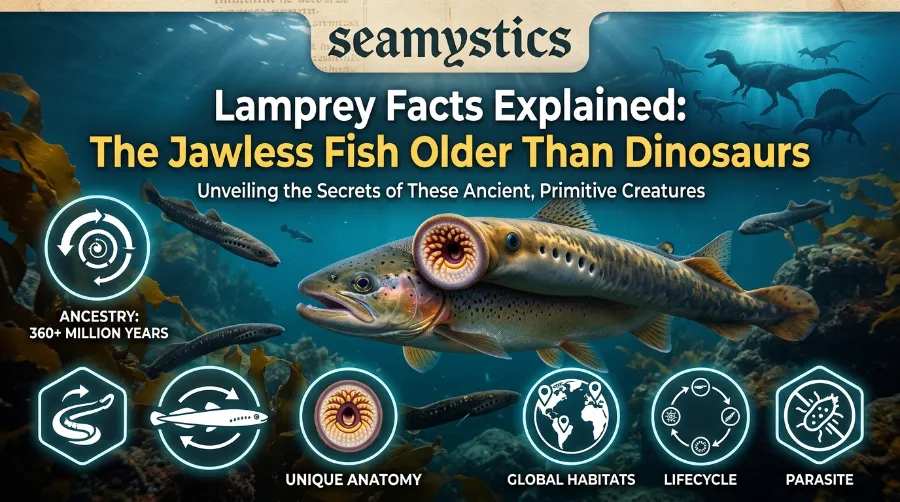

Lamprey Facts Explained: The Jawless Fish Older Than Dinosaurs
Picture a fish with no jaws, a mouth like a round saw blade, and a family tree that reaches back 360 million years. That animal is the lamprey, and it swam in the water long before the first dinosaur walked on land. These lamprey facts explained in plain words will show you how a creature this old still survives in rivers, lakes, and seas across the United States and Europe. I’m Dr. Rabica, and I have spent many years watching these animals in rivers, so I’ll share what the textbooks often miss.
TL;DR: A lamprey is a jawless, eel-shaped fish that has barely changed in hundreds of millions of years. Some species feed on the blood of other fish, while others never feed as adults at all. Lampreys live in cool rivers, lakes, and oceans, and scientists study them to learn about immunity, nerve repair, and the early history of vertebrates.
Key Takeaways at a Glance
| Topic | Quick Answer |
|---|---|
| Age of the group | About 360 million years in the fossil record |
| Number of species | Roughly 40 worldwide |
| Jaws | None, only a round sucking mouth with horny teeth |
| Skeleton | Cartilage and a flexible rod called a notochord |
| Diet | Blood and body fluids for parasitic species, algae and tiny particles for larvae |
| Habitat | Cool rivers, lakes, and coastal seas in the Northern and Southern Hemispheres |
| Life span | Often 5 to 10 years, mostly spent as a buried larva |
| Famous problem | The sea lamprey invasion of the Great Lakes |
What Is a Lamprey? Understanding the Lamprey Jawless Fish
A lamprey is a lamprey jawless fish, which means it belongs to the oldest living group of vertebrates. Most people call it an eel, but it is not an eel at all. Eels have jaws, paired fins, and bony skeletons. Lampreys have none of those things.
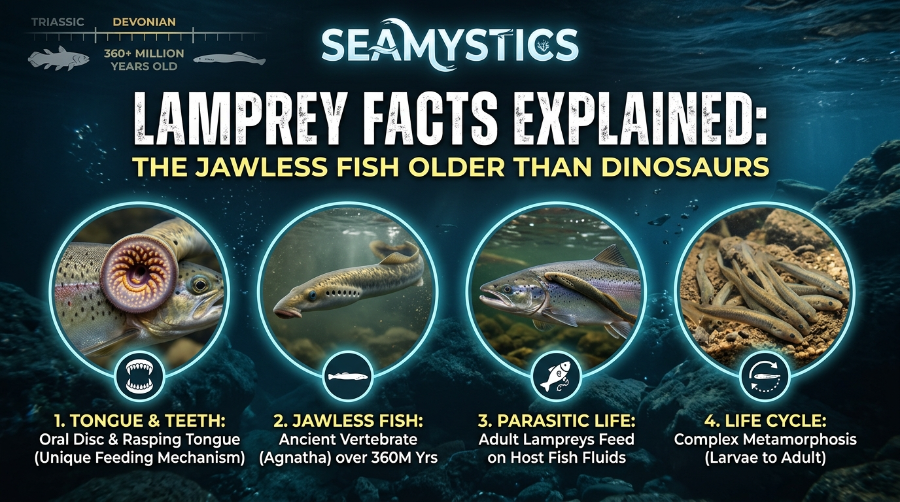
Lampreys belong to a group called cyclostomes, a word that means “round mouths.” The only other living members of this group are hagfish. Together, these two lineages show what early vertebrates looked like before jaws evolved.
An adult lamprey has a long, smooth body with no scales. It has a single nostril on top of its head and seven small gill openings along each side. Its eyes work well in adults, but the larvae are nearly blind. Many people feel uneasy when they first see one, but I find the design clever.
In my own river surveys, new volunteers often mistake larvae for worms. The larvae look like pale, soft tubes with tiny mouths. That is why many fish counts in the past missed them. Once you learn to spot a larva in the silt, you start seeing how common they are.
Ancient Fish Species: How Old Is a Lamprey Really?
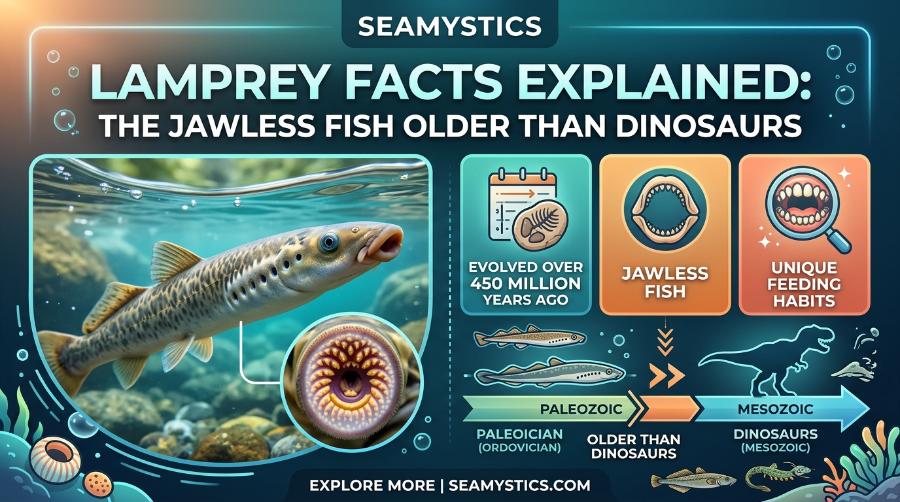
Lampreys rank among the most famous ancient fish species on Earth. Fossil lampreys from South Africa, such as Priscomyzon, date to about 360 million years ago. Another fossil, Mayomyzon, comes from Illinois and is about 300 million years old. Both animals already look like modern lampreys.
Dinosaurs appeared roughly 230 million years ago. That means lampreys were swimming for well over 100 million years before the first dinosaur existed. They also lived through all five major mass extinctions, and that alone is remarkable.
Here is a simple chart that shows the time gap. Each block stands for about 20 million years.
Lamprey fossils      ██████████████████ 360 million years ago
First dinosaurs      ███████████▌       230 million years ago
T. rex era           ███▍                68 million years ago
First modern humans ▏ 0.3 million years ago| Group | Approximate First Appearance |
|---|---|
| Jawless fish (early vertebrates) | About 500 million years ago |
| Lampreys in the fossil record | About 360 million years ago |
| Sharks (early forms) | About 400 million years ago |
| Dinosaurs | About 230 million years ago |
| Flowering plants | About 130 million years ago |
You might wonder why lampreys survived so long. The short answer is that their body plan works. They breathe, swim, feed, and breed with very few moving parts, so evolution had little reason to rebuild them.
If you love old survivors, you will also enjoy our guide to ancient sea creatures, which covers other living fossils from the deep.
Lamprey Anatomy: Built Without Jaws
A lamprey’s body is simple, but each part has a clear job.
- Oral disc: A round, funnel-shaped mouth lined with sharp, horny teeth.
- Notochord: A flexible rod that gives the body support in place of a true backbone.
- Cartilage skeleton: Soft but strong tissue, similar to what makes up your ears and nose.
- Gill pouches: Seven pairs that let water flow in and out, even while the animal clings to a host.
- No paired fins: Lampreys swim with an eel-like wave of the whole body.
A sea lamprey usually grows 16 to 24 inches long, and some European individuals can top 3 feet. The skin has no scales, and it is covered in mucus. That slime helps the animal glide through rocks and holds off germs in dirty water.
One detail surprises many readers. Lampreys have a tiny structure that looks like the first stage of a backbone, but it is not a full spine. Scientists use that clue to study how vertebrae first appeared.
Lamprey Feeding Facts: Parasite, Filter Feeder, or Both?
Lamprey feeding facts depend on the species and the life stage. Larvae and adults eat very different things, so it helps to look at each one separately.
How Larvae Eat
Larval lampreys, called ammocoetes, live buried in soft river mud. They filter algae, tiny plants, and bits of dead material from the water. A larva stays hidden for years, and in my surveys I usually find them in calm bends where the current drops.
How a Parasitic Adult Feeds
About half of all lamprey species are parasites as adults. The sea lamprey is the best known. It attaches to a fish with its sucker mouth, then scrapes through the skin using a rasping, tooth-covered tongue.
Its saliva contains a natural anticoagulant, so the host’s blood keeps flowing. The lamprey drinks blood and body fluids for hours or days. According to the Great Lakes Fishery Commission, a single sea lamprey can kill up to 40 pounds of fish during its feeding stage. You can read more about this animal’s feeding behavior in a keeper’s view from the Greater Cleveland Aquarium, where staff explain five things they learned about the sea lamprey.
Species That Never Feed as Adults
Many lampreys never eat once they become adults. Brook lampreys, for example, lose their working gut and live only to breed. They emerge from the mud, build nests, spawn, and die within weeks.
This is a strong reminder that “lamprey” does not always mean “vampire.” The parasite story gets the headlines, but the quiet, non-feeding species make up a large share of the family.
| Feeding Style | Example Species | Diet |
|---|---|---|
| Larval filter feeder | All species | Algae and tiny particles |
| Parasitic adult | Sea lamprey, Pacific lamprey | Blood and body fluids |
| Non-feeding adult | Brook lampreys | Nothing, lives on stored energy |
Lamprey Habitat Facts: Where These Fish Live
Lamprey habitat facts start with one big rule: lampreys love cool, clean water. They live in the temperate zones of both hemispheres, so you will find them in North America, Europe, parts of Asia, Chile, Australia, and New Zealand. Tropical waters almost never hold them.
Many species are anadromous. That word means they live part of life in the sea and swim up rivers to breed. Others stay in fresh water for their entire lives, like the brook lampreys.
What a Good Lamprey Stream Looks Like
Lampreys need two kinds of habitat close together.
- Gravel beds with clean, flowing water for nests and eggs.
- Soft silt or sand in slower stretches for larvae to burrow.
When a dam or culvert cuts off a river, adults cannot reach the gravel. When pollution fills the silt with toxins, larvae suffer. This is why lampreys act as a good sign of river health, and why local fisheries teams track them.
Lamprey Species by Region
| Region | Common Species | Notes |
|---|---|---|
| North Atlantic and Great Lakes | Sea lamprey | Native to the Atlantic, invasive in the Great Lakes |
| Pacific Northwest | Pacific lamprey | Culturally important to many Indigenous nations |
| Southeast United States | Several brook and chestnut lampreys | North Carolina alone holds multiple species |
| United Kingdom and Western Europe | River, brook, and sea lamprey | Protected in many rivers |
If you want to see how many different lampreys can live in one state, the NC Fishes site offers a clear look at lamprey diversity in North Carolina.
The Lamprey Life Cycle in Six Steps
The lamprey life cycle looks strange at first, but it follows a clear order.
- Spawning: Adults build a nest by moving stones with their mouths. A female sea lamprey can lay 60,000 to 100,000 eggs.
- Hatching: Eggs hatch in a few weeks, and the tiny larvae drift downstream.
- Burrowing: Larvae dig into soft silt and start filter feeding.
- Growing: They stay buried for several years. Many species take 3 to 7 years, and some take longer.
- Metamorphosis: The larva grows eyes, teeth, and a sucker mouth. This change can take months.
- Adult life: Parasitic species head to a lake or sea to feed. Then they return to a river to spawn and die.
Most lampreys breed once and die soon after. That all-in strategy is called semelparity, and it puts every scrap of energy into one big spawning event.
Lamprey Facts Explained Through the Great Lakes Case Study
Nothing explains the power of this animal better than the Great Lakes story. It is the best real case study we have of how a single ancient fish can reshape an ecosystem.
The sea lamprey is native to the Atlantic Ocean. It reached Lake Ontario naturally, but Niagara Falls blocked it from the upper lakes. After the Welland Canal was improved in 1829, the barrier slowly weakened. The sea lamprey reached Lake Erie by 1921, then spread to Lake Huron, Lake Michigan, and Lake Superior by the late 1930s.
| Event | Approximate Date |
|---|---|
| Welland Canal improved | 1829 |
| Sea lamprey recorded in Lake Erie | 1921 |
| Spread into Lakes Huron and Michigan | Mid to late 1930s |
| Reached Lake Superior | Late 1930s |
| Great Lakes Fishery Commission founded | 1955 |
| Lampricide control begins | Late 1950s |
The results were harsh. Commercial lake trout catches in Lake Michigan fell from about 5.5 million pounds in 1946 to almost nothing by the early 1950s. Whitefish, chubs, and other species suffered too. Fishing towns lost jobs, and food webs changed.
The Great Lakes Fishery Commission now leads a control program that uses barriers, traps, and a targeted lampricide. According to the commission, this work has cut sea lamprey numbers by about 90 percent in most areas. You can explore their programs at the Great Lakes Fishery Commission.
Here is my practical view. Control works best when teams treat the larvae in streams, because larvae stay in one place for years. Fighting adults in open water is far harder. This is a classic example of how knowing the life cycle leads to better results.
Lampreys in Europe and the United Kingdom
Europe sees lampreys very differently. In many rivers, they are protected animals, and conservation groups work to open fish passages for them. The sea lamprey, river lamprey, and brook lamprey all live across the continent.
Lampreys also carry a long food history. English tradition says that King Henry I died in 1135 after eating too many lampreys. The city of Gloucester has long sent a lamprey pie to the monarch, and the custom continued for the 2022 Platinum Jubilee. In Portugal, arroz de lampreia remains a seasonal favorite in spring.
So the same animal can be a pest in Michigan and a protected treasure in Portugal. That contrast is one of my favorite teaching points. It shows that a species is not good or bad by itself. Place and context decide the story.
Other ancient animals have similar stories of survival and human interest. If you enjoy this angle, read our guides on horseshoe crab facts and nautilus facts explained.
Pacific Lampreys and Indigenous Knowledge
On the Pacific coast of North America, the Pacific lamprey carries deep cultural meaning. Many Indigenous nations in the Columbia River basin harvested it for food for thousands of years, and they call it by names such as “eels.” Numbers have dropped in many rivers because of dams, poor water quality, and lost habitat.
Tribal and government teams now work to rebuild lamprey passage at dams and to restore spawning streams. The Columbia Insight feature on the amazing ancient lamprey tells that story well. It is a good reminder that conservation sometimes means protecting a fish people have misunderstood.
Why Scientists Study Lampreys
Lampreys sit near the base of the vertebrate tree, so they act like a time window. Researchers study them for three main reasons.
- Immune system: Lampreys use a different kind of immune receptor than jawed animals. This helps scientists learn how adaptive immunity first evolved.
- Nerve repair: A lamprey can recover from a cut spinal cord and swim again. Teams study how its nerve cells regrow.
- Genome clues: The sea lamprey genome helps map how early vertebrates built brains, skulls, and body plans.
None of these fields promise instant medical cures. Still, each gives real insight, and the lamprey keeps appearing in respected journals for that reason.
Lamprey vs Hagfish vs Shark: A Quick Comparison
| Feature | Lamprey | Hagfish | Shark |
|---|---|---|---|
| Jaws | No | No | Yes |
| Skeleton | Cartilage with a notochord | Cartilage, no true vertebrae | Cartilage with vertebrae |
| Eyes | Well developed in adults | Very simple | Well developed |
| Habitat | Fresh water and sea | Deep sea | Mostly sea |
| Defense | Slime and speed | Large amounts of slime | Speed and teeth |
This table clears up a common mix-up. Lampreys and hagfish share jawless bodies, but they are separate lineages. Sharks belong to the jawed fish, which arose later.
Common Myths About Lampreys
Myth 1: Lampreys attack swimmers. Attacks on people are extremely rare. A lamprey wants a fish with the right skin and blood, and a human is not a normal target.
Myth 2: All lampreys are parasites. Many species never feed as adults.
Myth 3: Lampreys are eels. They are not. Eels have jaws and a bony skeleton.
Myth 4: Lampreys are harmful everywhere. Only the sea lamprey in the Great Lakes became a major invasive problem. In its home range, it plays a normal role in the food web.
How to Spot a Lamprey in the Wild
If you walk a river in spring, you can sometimes see adults at work. Here is a short checklist from my own field notes.
- Look for shallow, gravelly stretches in cool, clean water.
- Watch for clusters of stones that look newly moved.
- Check for long, dark bodies resting against rocks.
- Keep a safe distance and never handle protected species.
If you find a lamprey in an area where it should not live, report it to your local fish and wildlife office. Do not move any animal between waterways.
Are Lampreys Endangered?
The answer depends on the species and the place. Some lampreys, such as the Pacific lamprey in parts of its range, have fallen sharply. Several European populations also face pressure from dams and pollution. In the Great Lakes, though, the sea lamprey is a target of control.
Three actions help the most.
- Remove or modify barriers so adults can reach spawning beds.
- Keep streams clean and silty beds healthy for larvae.
- Support local monitoring, since many lamprey counts rely on volunteers and small research teams.
Frequently Asked Questions
Are lampreys older than dinosaurs?
Yes. Lamprey fossils date to about 360 million years ago, while the first dinosaurs appeared around 230 million years ago.
Do lampreys have jaws?
No. They have a round sucking mouth with horny teeth, which is why scientists call them jawless fish.
What do lampreys eat?
Larvae filter algae and tiny particles. Parasitic adults feed on the blood and fluids of fish, and some adult species do not eat at all.
Where do lampreys live?
They live in cool rivers, lakes, and coastal seas across the Northern and Southern Hemispheres, mainly in temperate zones.
Are lampreys dangerous to humans?
No. Attacks on people almost never happen, and lampreys do not seek humans as prey.
How long do lampreys live?
Most live about 5 to 10 years, and they spend most of that time as larvae buried in the silt.
Are lampreys and eels related?
No. They only look similar. Eels are jawed, bony fish, and lampreys belong to a far older, jawless lineage.
Test Yourself: 5 Question Quiz
1. How old are the oldest known lamprey fossils?
A) 36 million years
B) 360 million years
C) 3.6 billion years
2. Which life stage of a lamprey filters food from the water?
A) Adult
B) Egg
C) Larva
3. Which lake did sea lampreys reach last, according to the standard timeline?
A) Lake Erie
B) Lake Michigan
C) Lake Superior
4. True or false: All lampreys feed on blood as adults.
5. True or false: Lampreys and hagfish are the only living jawless fish.
Answers: 1) B. 2) C. 3) C. 4) False, since many species never feed as adults. 5) True.
Conclusion
Lampreys prove that old designs can last. These jawless fish outlived dinosaurs, survived mass extinctions, and still swim in rivers on both sides of the Atlantic. These lamprey facts explained here show a creature that can be a pest in one place and a treasured, protected animal in another. Next time you stand by a cool river in spring, look closely at the gravel, because a 360-million-year-old story may be playing out at your feet.
References
- Great Lakes Fishery Commission, sea lamprey biology and control program information
- Greater Cleveland Aquarium, “5 Things I Learned About the Sea Lamprey”
- NC Fishes, “Lamprey Family Petromyzontidae: Diversity in North Carolina”
- Columbia Insight, “The Amazing Ancient Lamprey”
- Gess, R. W., Coates, M. I., and Rubidge, B. S. (2006). A lamprey from the Devonian period of South Africa. Nature