
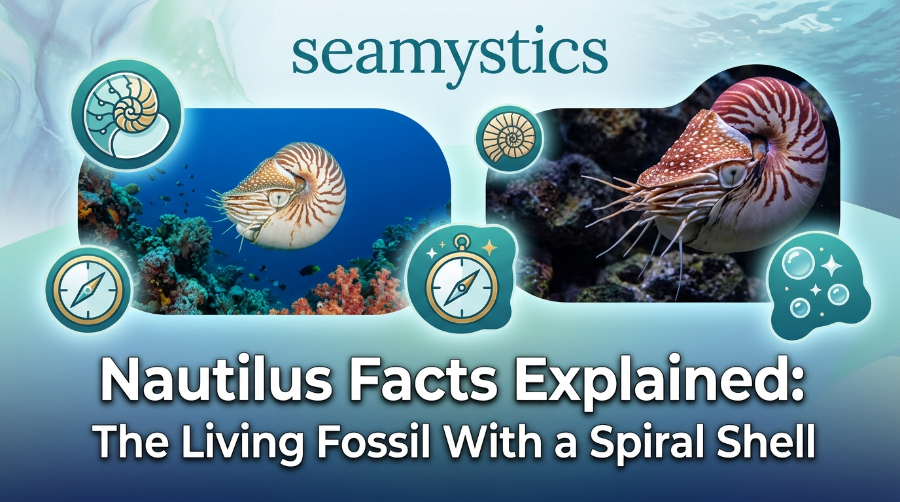
Nautilus Facts Explained: The Living Fossil With a Spiral Shell
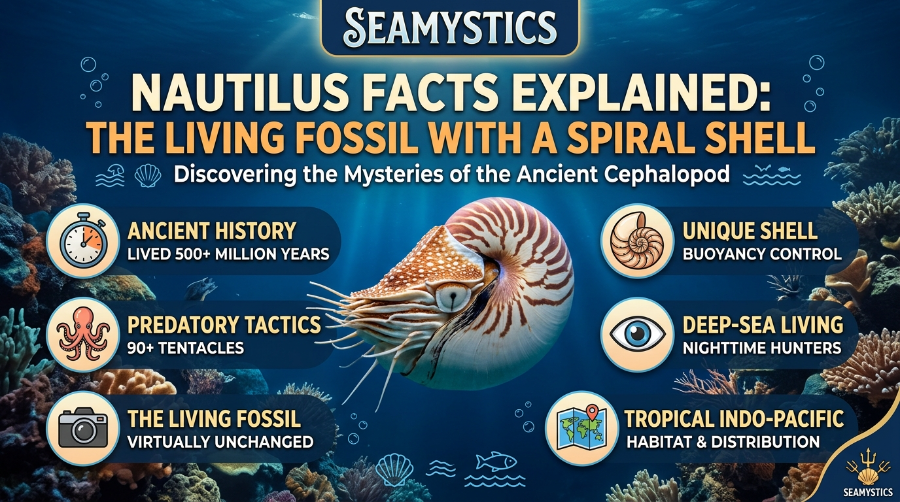
Picture a night dive off the coast of Palau. Suddenly, your light catches a pale, striped shell rising out of the dark, with dozens of thin arms trailing behind it. That animal is a nautilus, and nautilus facts explained simply are stranger than most people expect. For one thing, it breathes through gills and steers with a water jet. In addition, it floats on gas stored inside its own home, and its family has been swimming since long before the first dinosaur.
TL;DR: The chambered nautilus is a shelled cephalopod from the deep Indo-Pacific, and its group is over 500 million years old. Its spiral shell works like a buoyancy tank. Because it lives slowly and breeds slowly, however, it needs trade limits to survive.
Key Takeaways at a Glance
| Topic | Quick Answer |
|---|---|
| Animal group | Cephalopod, related to squid, octopus and cuttlefish |
| Age of the group | About 500 million years (nautiloids) |
| Home range | Indo-Pacific reefs, from the Philippines to Fiji and northern Australia |
| Usual depth | About 100 to 700 meters |
| Shell chambers | Around 30 in an adult |
| Tentacles | Up to about 90 small arms called cirri, with no suckers |
| Lifespan | Roughly 15 to 20 years |
| Main threat | Fishing for the shell trade |
| Trade rules | Listed under CITES Appendix II since 2017 |
What Is a Nautilus?
A nautilus is a marine animal with a coiled shell and a soft body inside. Like octopus and squid, it belongs to the cephalopods. However, it looks very different from its relatives, because most cephalopods lost their outer shells over time. The nautilus, on the other hand, kept its shell and built its whole life around it.
Scientists usually place living nautiluses in two genera, Nautilus and Allonautilus. Experts still disagree on the exact species count, and most lists land between six and nine. This is common in deep-sea biology, since the animals are hard to reach and hard to study.
You will often hear the name “chambered nautilus.” That label comes from the inner design of the shell. Next, let us look at that design, because it explains almost everything about how the animal lives.
Chambered Nautilus Facts: Body and Senses
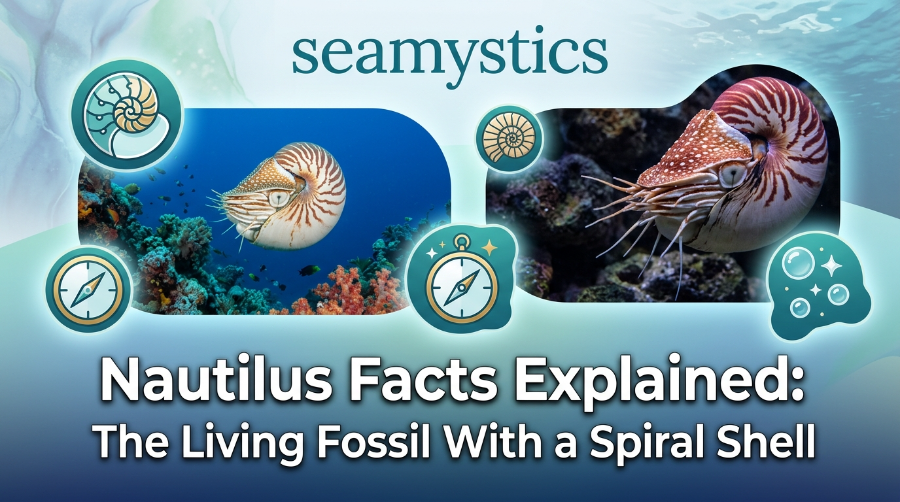
The body of a nautilus is simple but clever. A hooded head sits at the front of the shell opening, and a crown of arms surrounds it. Scientists call these arms cirri, and an adult can have close to 90. Unlike an octopus, a nautilus has no suckers. Instead, its cirri are sticky and ridged, so they grip food well.
Its eyes are even more unusual. A nautilus has a pinhole eye with no lens, so water flows in and out of it. As a result, light passes through a small opening like in a basic camera, and the picture is weak and blurry. Smell therefore matters more than sight in the dark. In fact, the animal can detect food odors from far away, which is why baited cameras work so well in field studies.
Another surprise is that a nautilus makes no ink. Squid and octopus squirt a dark cloud to escape, but this animal simply pulls into its shell. Then it closes the opening with a leathery hood, which works like a door.
Movement comes from a muscular tube called the hyponome. By pushing water through it, the animal moves by jet. Because it can aim the tube in different directions, it can go forward, backward or sideways. Even so, a nautilus stays slow. Bursts of speed are rare.
Nautilus Shell Science: How the Spiral Really Works
At first glance, the shell looks like a simple shield. In reality, it is a floating machine.
The animal lives only in the last and largest chamber. As it grows, it moves forward and builds a new wall behind its body. After that, the sealed room joins the buoyancy system. A thin tube called the siphuncle runs through every chamber, and it lets the animal pump fluid out and let gas in. Therefore, more gas gives more lift, while more fluid adds weight.
Here is the process in simple steps:
- First, the nautilus grows and moves forward in its shell.
- Next, it seals the empty room behind it with a new wall.
- Then the siphuncle pulls liquid out of that new chamber.
- After that, gas slowly fills the space.
- Finally, the animal tunes its balance and floats with almost no effort.
This system saves energy. Because the shell does the lifting, the nautilus does not need to swim nonstop just to stay up.
Two main layers form the shell. On the outside, you can see the famous cream and orange-brown stripes. These work as counter-shading, so a predator looking down sees dark stripes that blend with deep water. Meanwhile, a predator looking up sees a pale underside that blends with faint light from above. Inside, a smooth, hard layer of nacre, also called mother-of-pearl, lines the shell.
The Golden Ratio Myth
Many websites claim the nautilus shell follows the golden ratio. That story is popular, but real shells do not match it well. A nautilus grows in a logarithmic spiral, which means each turn grows by a steady proportion. In fact, measured shells vary, and their growth rates usually sit well below 1.618. So the shell is beautiful and mathematical, but it is not a golden ratio spiral. This small correction is a good reminder to check a claim before sharing it.
Pressure Limits and Depth Facts
The shell also sets a depth limit. Water pressure rises fast as you go down, and every 10 meters adds roughly one extra atmosphere. Below a certain depth, therefore, the shell walls can crack inward in a failure called implosion. Research on shell strength points to a danger zone below about 800 meters.
| Depth (meters) | Approximate Pressure | What It Means for a Nautilus |
|---|---|---|
| 0 to 100 | 1 to 11 atmospheres | Warm water, mostly avoided in daytime |
| 100 to 300 | 11 to 31 atmospheres | Night feeding zone |
| 300 to 700 | 31 to 71 atmospheres | Typical daytime resting zone |
| Below 800 | Over 80 atmospheres | Shell failure risk |
This is why nautilus habitat facts matter so much to scientists. Since the animal lives close to its physical limit, a small change in depth or temperature can change where it survives.
Nautilus Habitat Facts: Where the Animal Lives
You can find nautiluses around the Philippines, Indonesia, Papua New Guinea, Fiji, Palau, the Great Barrier Reef and parts of the Andaman Sea. They prefer steep reef slopes, because deep drop-offs give quick access to cool, dark water.
Their day follows a clear pattern. During daylight, they rest several hundred meters down. At night, however, they rise toward the upper slope to hunt. Since they avoid water warmer than about 25 degrees Celsius, they rarely go too high. This is why you will almost never see one on a shallow reef dive during the day.
In baited camera footage, the pattern is easy to spot. Often, the first nautilus arrives within the first half hour of a night recording. Soon after, more can appear, drawn by the same scent. Although each clip is short and quiet, every one shows the same slow, careful approach to the bait.
For more background, the University of Texas Marine Science Institute radio feature on the nautilus gives a short and clear introduction from researchers. Likewise, the Wise Oceans creature feature on the nautilus offers a friendly look at its deep-water life.
What Does a Nautilus Eat?
A nautilus is both a scavenger and a light hunter. Small crustaceans, shrimp, hermit crabs and bits of dead fish make up most of its menu. Besides that, it eats molted shells from crabs and lobsters, and a strong beak helps it break small hard parts.
Because its metabolism is slow, a nautilus can go weeks, and possibly longer, without a large meal. That ability helps in the deep sea, where food is patchy. On the downside, it also means the animal grows and breeds slowly, which matters a lot in the conservation section below.
Nautilus Living Fossil Status: Is the Label Fair?
The phrase “living fossil” is popular, and there is some truth to it. Nautiloids appeared around 500 million years ago, which is much older than the dinosaurs. If you like animals with long histories, our ancient sea creatures guide covers several more.
Still, the label needs care. Today’s nautilus is not an unchanged copy of an ancient animal, since modern species have evolved for millions of years like every other living group. What has stayed stable is the basic body plan. The outer shell, the chambers and the siphuncle all follow a design that has worked for a very long time.
Survival is another reason for the title. Ammonites, a related group with coiled shells, vanished about 66 million years ago in the same mass extinction that ended the non-bird dinosaurs. Nautiluses, in contrast, made it through. Scientists have offered a few ideas for why. One idea says nautilus eggs and hatchlings are large and develop in deeper water. Another suggests that a slow metabolism lets them live on little food. Although neither idea is fully proven, both fit the evidence we have.
Similarly, you may enjoy our horseshoe crab facts, because that animal is another well-known survivor from deep time.
Life Cycle: Slow Growth, Few Babies
A nautilus does not live fast. Reaching maturity takes roughly a decade or more. After that, adults lay only a few large eggs per season, and they attach them to hard surfaces. Because the eggs take about a year to hatch, the wait is long for any marine animal.
When the young finally hatch, they already look like tiny adults. Unlike many fish or crabs, they skip the drifting larval stage. As a result, they stay close to where they were born, and this habit matters for the next sections.
| Life Stage | Approximate Timing | Notes |
|---|---|---|
| Egg | About 12 months | Attached to rocks or hard surfaces |
| Juvenile | Several years | Small shell, similar look to adults |
| Maturity | Around 10 to 15 years | Slow compared with fish and squid |
| Adult lifespan | Around 15 to 20 years | Many studies suggest this range |
Real Research: What Field Studies Tell Us
Over the past 15 years, field work has changed what we know about nautiluses. Here are three well-known cases.
Genetic isolation near the Great Barrier Reef. In 2011, Dunstan and colleagues compared nautiluses from different parts of Australia and Papua New Guinea. They found clear genetic differences across fairly short distances. Therefore, deep water seems to work as a barrier, and a local group cannot easily be refilled by animals from far away.
Baited camera surveys across the Pacific. In 2014, Barord and colleagues used baited cameras to compare nautilus numbers in the Philippines, Australia, Fiji and American Samoa. Sites with the heaviest fishing history held far fewer animals. For this reason, many researchers see the study as a clear warning that local fishing can deplete a population.
Trade controls under CITES. After years of concern about the shell trade, countries added nautiluses to CITES Appendix II in 2017. This listing does not ban trade. Instead, it requires permits and proof that trade does not harm wild populations. Overall, it is a big step, since global rules now cover the shell trade for the first time.
Taken together, these cases show a simple pattern. Nautiluses live in small local groups, grow slowly and have few young. Consequently, they cannot bounce back quickly after heavy fishing.
Threats to Nautiluses Today
Above all, the shell trade is the biggest threat. Buyers want nautilus shells for décor, jewelry and souvenirs. Meanwhile, fishers set baited deep traps, catch the animals alive and sell the shells. Most of the time, they throw the meat away. A high shell price then pushes even more traps into the water, so the cycle feeds itself.
Other risks also matter:
- Habitat change from warming oceans and shifting depth zones
- Deep-sea mining plans in the Pacific
- Bycatch from other deep trap fisheries
- Poor data, which makes safe catch limits hard to set
The IUCN Red List tracks the status of each species. Since assessments get updated, it is wise to check the current entry before you cite it.
How You Can Help Protect Nautiluses
You do not need to be a scientist to help. In fact, small choices can make a real difference.
- Skip the shell. Avoid nautilus shell jewelry and décor, and walk away if a seller cannot show legal paperwork.
- Ask questions. Before buying, ask where a shell came from and whether it has the right permits.
- Support research groups. Many small teams run cameras and surveys in the Pacific with limited funding.
- Share accurate facts. Gently correct myths such as the golden ratio claim.
- Choose responsible travel. When you dive or snorkel in nautilus regions, pick operators that follow clear wildlife rules.
For a quick companion read, the ThoughtCo guide to nautilus facts covers the basic traits in a short format.
Why the Nautilus Matters Beyond Its Shell
Science, culture and conservation all gain from this animal. For researchers, it offers a living model of how early cephalopods may have worked. Engineers also study its buoyancy method, because a system that adjusts lift with gas and fluid holds clear lessons for underwater vehicles. In culture, Jules Verne named Captain Nemo’s submarine after it in 1870, and in 1954 the US Navy launched the first nuclear submarine, USS Nautilus.
Most of all, the nautilus shows that old does not mean safe. A species that outlived 500 million years of change can still be lost in a few decades of heavy trade.
Frequently Asked Questions
How old is the nautilus group?
Nautiloids are about 500 million years old. Modern species are younger, but they keep a very old body plan.
Is the nautilus an octopus?
No. Both are cephalopods, but the nautilus has an outer shell and many arms without suckers. An octopus, by contrast, has eight arms with suckers and no outer shell.
How deep does a nautilus live?
Most live between about 100 and 700 meters. Below about 800 meters, their shells can fail.
How long does a nautilus live?
Most estimates say 15 to 20 years, which is long for a cephalopod.
Can a nautilus make ink?
No, because it lacks the ink system that squid and octopus use.
Is it legal to buy a nautilus shell?
Rules differ by country and species. Since nautiluses are listed under CITES Appendix II, international trade needs permits, so check your local laws first.
Why is the nautilus called a living fossil?
It belongs to a very old group and keeps an ancient design. Even so, modern species have still evolved over time.
Test Your Knowledge: 5 Question Quiz
Question 1. What is the tube that links the shell chambers called?
A) Hyponome
B) Siphuncle
C) Cirrus
Question 2. About how many chambers does an adult nautilus shell have?
A) About 10
B) About 30
C) About 100
Question 3. Which statement is true about the nautilus shell shape?
A) It follows the exact golden ratio
B) It follows a logarithmic spiral
C) It is a perfect circle
Question 4. In what year did nautiluses gain CITES Appendix II protection?
A) 1990
B) 2005
C) 2017
Question 5. True or false: A nautilus can squirt ink to escape predators.
Answers: 1. B, 2. B, 3. B, 4. C, 5. False.
Conclusion
Nautilus facts explained in plain words show an animal that is both simple and amazing. Its shell is a floating chamber, its eyes work like a pinhole camera, and its family tree reaches back about 500 million years. Yet its slow life and its value in the shell trade make it fragile today. So if we share accurate facts, avoid shell products and back careful research, we give this old traveler a real chance to keep drifting through the deep.
References
- University of Texas Marine Science Institute. Nautilus radio program. utmsi.utexas.edu
- Wise Oceans. Creature Feature Friday: Nautilus. wiseoceans.com
- ThoughtCo. Fascinating Facts About the Nautilus. thoughtco.com
- CITES. Appendices and trade listings. cites.org
- IUCN Red List of Threatened Species. iucnredlist.org
- Dunstan, A. et al. (2011). Population genetic studies of Nautilus in Australia and Papua New Guinea.
- Barord, G. J. et al. (2014). Comparative population assessments of Nautilus using baited remote underwater video. PLoS ONE.