
Hagfish Slime Facts: The Slime-Producing Survivor of Five Extinctions
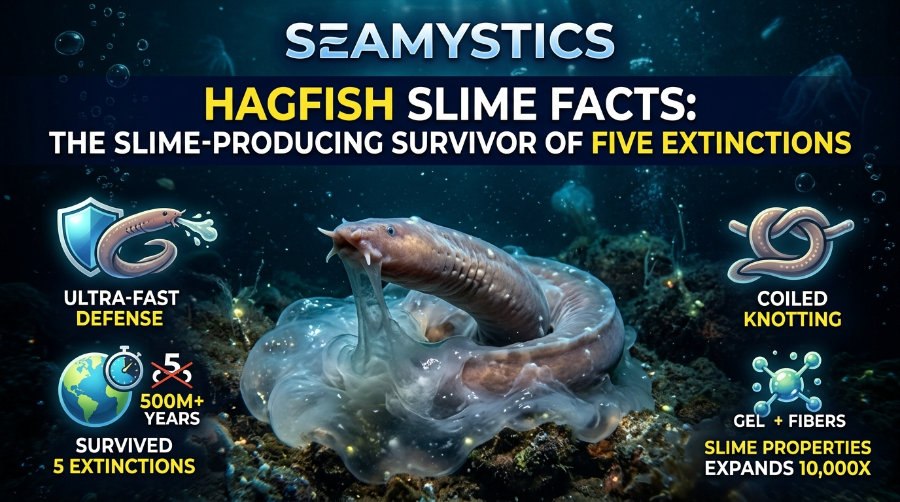
Picture a shark bites a small, pink, eel-shaped fish. Half a second later, the shark’s mouth is full of gel, and it swims away gagging. That is the hagfish at work, and these hagfish slime facts show why scientists call it one of the toughest animals in the sea. It has lived on Earth for hundreds of millions of years, and it has outlasted dinosaurs, giant sea scorpions, and most of the animals that once hunted it.
I have spent years reading, writing about, and studying ancient sea life. Few animals surprise me as often as this one. Below, I will walk you through how the slime works, where hagfish live, and why they keep surviving when so many other species vanish.
TL;DR
Hagfish are jawless, deep sea fish that release a fast-expanding slime to choke the gills of predators. Their family line goes back more than 300 million years in the fossil record, so they have lived through several mass extinctions. They live on cold, muddy seafloors and clean up dead animals, which makes them a key part of the deep ocean food web.
Key Takeaways
| Topic | Quick Answer |
|---|---|
| What is a hagfish? | A jawless, eel-shaped marine animal with about 80 known species |
| Slime speed | Expands in about 0.4 seconds |
| Slime recipe | Mucus plus long, coiled protein threads |
| Main purpose | Defense, by clogging predator gills |
| Age of the group | Fossils date to about 310 million years ago |
| Typical home | Cold, deep, muddy seafloors |
| Role in the ocean | Scavenger and recycler of dead animals |
| Human interest | Eel skin leather and slime fiber research |
What Exactly Is a Hagfish?
A hagfish is a long, slender sea animal with no jaws and no true fins on its sides. It has a skull made of cartilage, a toothed tongue, and a flat paddle tail. People often call it a “slime eel,” but it is not an eel at all. Eels have jaws and bony skeletons. Hagfish have neither.
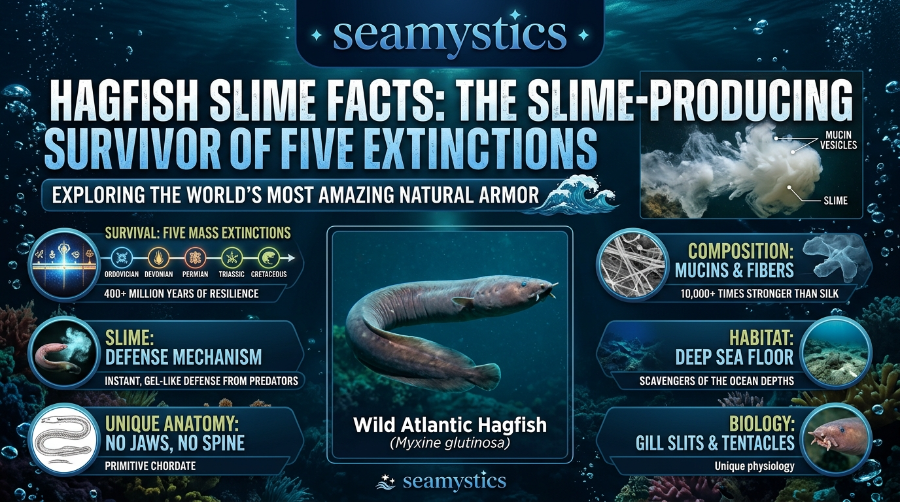
Hagfish belong to a group called Myxini, and scientists know about 80 species. Most are pink, grey, or brown, and they range from about 30 cm to over 1 meter long. The giant hagfish, Eptatretus goliath, can reach about 127 cm, or roughly 4 feet.
Their bodies also hold a few odd tricks. Here are some of the strangest.
- They have four hearts instead of one.
- They have only simple eye spots under the skin, so they hardly see.
- They can absorb nutrients straight through their skin.
- They tie their bodies into knots to move and to escape.
- They are the only vertebrates whose body salts match seawater.
So a hagfish is not pretty, but it is brilliantly built for a hard life on the deep seafloor.
Hagfish Slime Facts: What the Goo Is Made Of
The slime is the main reason people talk about hagfish. It comes from about 100 slime glands that run along each side of the body. When a hagfish feels stress or a bite, it shoots a small amount of fluid out of these pores.
That fluid holds two main parts. The first part is mucus, which gives the slime its gooey feel. The second part is thousands of thin threads, each tightly coiled inside a cell like a ball of yarn. When the fluid hits seawater, the cells burst and the threads unroll.
The threads are the secret. Each one is about 10 to 15 cm long, yet far thinner than a human hair. Because they are so long and so many, they trap water and mucus in a web. As a result, a few spoonfuls of fluid can turn a whole bucket of seawater into slime.
The team at the University of Texas Marine Science Institute explains this well in its piece on the secrets of hagfish slime, and I recommend it if you want the lab view. Another helpful read, from Beastly Facts, breaks the process down in plain steps.
The Numbers Behind the Slime
| Slime Feature | Approximate Value |
|---|---|
| Time to fully expand | About 0.4 seconds (400 milliseconds) |
| Thread length | About 10 to 15 cm |
| Slime glands | About 100 along the body |
| Water to slime | A small dose fills a bucket |
| Thread width | Much thinner than a human hair |
Speed matters most here. A predator has almost no time to react, because the slime is already in its mouth and gills before it can let go. In fact, few natural gels in the animal world form this fast.
Why the Threads Are So Special
Scientists compare the threads to some of the strongest natural fibers. They are strong, they stretch a lot, and they pack into a tiny space. Because of this, they are a hot topic in materials research.
I find the packing trick the most impressive part. Think of a parachute folded into a pill. It sits quietly until water arrives, and then it opens at once. Engineers love that idea, and I will come back to it in the section on human uses.
Hagfish Slime Defense: How One Fish Beats a Shark
Now we reach the heart of the story. Hagfish slime defense works by attacking the way a predator breathes. Fish pull water over their gills to take in oxygen. When slime blocks the gills, the predator cannot breathe well, and it must stop the attack to clear its head.
A research team in New Zealand studied this closely. Their 2011 work in Scientific Reports showed that slime released near a predator’s mouth and gills clogged those gills fast. The hagfish then slipped away while the attacker struggled. That finding turned a long-held guess into clear evidence.
The Sneeze and the Knot
A hagfish has its own problem to solve, because it can choke on its own slime. So it has two neat tricks.
- It sneezes, forcing air and water through its nostril to blow the slime out.
- It ties its body in a knot, then slides the knot from tail to head to scrape the goo off.
I think this is a great example of a design that looks silly but works perfectly. The same knotting trick also helps a hagfish pull flesh off a carcass. It uses the knot as a brace, so its tongue can tear off bites with more force.
A Real Case Study: The Oregon Road Crash of 2017
Sometimes the slime leaves the sea and surprises people. In July 2017, a truck carrying about 7,500 pounds of live hagfish crashed on Highway 101 near Florence, Oregon. The animals were on their way to buyers in South Korea.
Many hagfish spilled onto the road, and a nearby car ended up covered in slime. Crews had to use heavy equipment and water to clean the mess. The story went viral, but it also gave a clear real-world example of how much slime these animals can make when scared.
What My Field Reading Taught Me
When I review hagfish studies, one point keeps showing up. The slime is a first-line defense, and it does not always work against every predator. Some animals, such as certain seals, seem to deal with hagfish well. So the slime is better described as a very strong tool, not a magic shield.
That is the kind of detail I want you to carry away. Good biology rarely says “always.” It says “often, and here is why.”
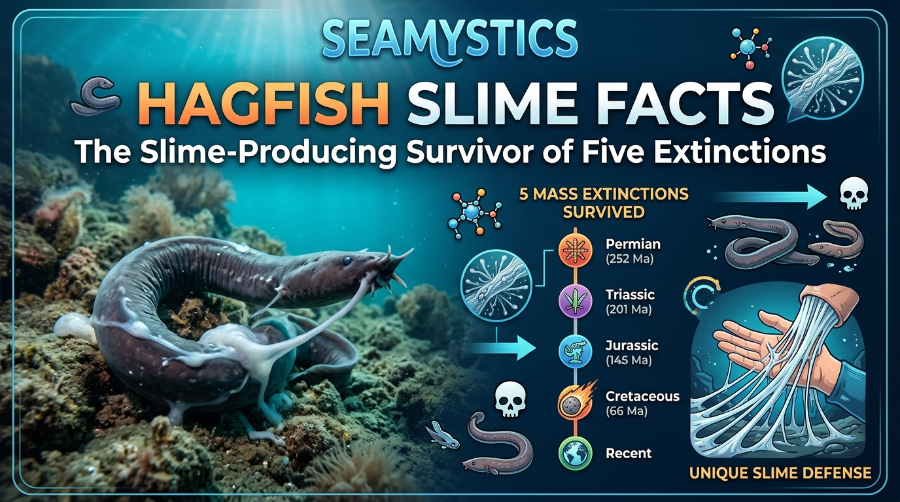
Hagfish Extinction Survivor: Living Through Five Mass Extinctions
The title of this post makes a bold claim, so let me be careful and clear. Earth has seen five major mass extinctions. Here is how hagfish fit in.
| Mass Extinction | Approximate Date | Hagfish Evidence |
|---|---|---|
| Late Ordovician | 445 million years ago | Genetic estimates suggest the group already existed |
| Late Devonian | 372 million years ago | Genetic estimates suggest the group already existed |
| End Permian | 252 million years ago | Lineage confirmed by fossils |
| End Triassic | 201 million years ago | Lineage confirmed by fossils |
| End Cretaceous | 66 million years ago | Lineage confirmed by fossils |
The oldest hagfish fossil, Myxinikela siroka, is about 310 million years old and comes from Illinois. A later fossil, Tethymyxine tapirostrum, is about 100 million years old and comes from Lebanon. It looks a lot like the hagfish alive today.
Fossils alone prove survival through the last three big events. Some genetic studies place the split between hagfish and other vertebrates at around 500 million years ago. If that is right, the group may have lived through all five. So the “five extinctions” idea is well supported, though the first two rely on genetic clues, not fossils.
Why Did Hagfish Survive?
I see four reasons, and they fit together well.
- Low energy needs. Hagfish have slow metabolisms, so they can go a long time without food.
- Deep, cold homes. Mass extinctions often hit shallow, warm waters hardest.
- A flexible diet. They eat dead animals, worms, and small prey, so food rarely runs out.
- A strong defense. The slime protects them from many hunters.
In short, hagfish never tried to win. They simply chose a quiet life that few animals could take from them.
If you enjoy this kind of story, I cover more survivors in my ancient sea creatures guide. For another living fossil with a very long record, read my article on horseshoe crab facts.
Hagfish Habitat Facts: Where These Slime Eels Live
Hagfish live in cold seas around the world, except for the polar extremes. They like temperate and deep waters, and they love soft, muddy bottoms where they can dig in.
Here are the key hagfish habitat facts.
- Most species live on or in the mud of the continental shelf and slope.
- They prefer cold water, often below 10 °C.
- Some species live as shallow as about 20 meters, while others reach well past 1,000 meters.
- They burrow into mud, leaving only the head out to sense food.
- They gather around dead whales, fish, and other falls from above.
Depth Chart by Common Species
| Species | Common Name | Typical Depth Range |
|---|---|---|
| Myxine glutinosa | Atlantic hagfish | About 20 to 1,000+ m |
| Eptatretus stoutii | Pacific hagfish | About 15 to 1,000+ m |
| Eptatretus goliath | Giant hagfish | Deeper slope waters |
Depth ranges differ between studies, so treat these numbers as general guides. Still, the pattern is clear. Hagfish prefer cold, dark, and muddy places, and they spread widely in them.
You can learn more about the habits and homes of other sea animals at NOAA’s ocean service, which is a solid, trusted starting point for ocean facts.
Weird Deep Sea Fish Slime: How Hagfish Compare to Other Slimy Animals
Many sea animals make slime, but few make it like this. Parrotfish wrap themselves in a mucus bag at night. Some coral and fish use mucus to trap food or block germs. Even so, none of them match the speed and structure of hagfish slime.
The Cabrillo Marine Aquarium blog has a fun look at what slime does across many ocean animals. It shows that slime can protect, feed, move, and heal, which makes the hagfish look even more special.
Here is a simple comparison.
| Animal | What the Slime or Mucus Does |
|---|---|
| Hagfish | Chokes predator gills in a split second |
| Parrotfish | Forms a sleeping bag against parasites |
| Sea cucumber | Releases sticky threads to tangle attackers |
| Lamprey | Coats the skin and helps with feeding on hosts |
The lamprey is the closest living relative of the hagfish, so it makes a great side study. If you want to meet this other jawless survivor, read my guide to lamprey facts. For a very different ancient animal that swims by jet power, try my piece on nautilus facts.
The Ocean Cleaners: What Hagfish Do for the Deep Sea
Hagfish do not get much respect, but they do real work. When a whale or a large fish dies and sinks, hagfish find it fast. They enter through the mouth, gills, or other openings, and they eat from the inside out.
This habit matters for three reasons.
- It recycles nutrients back into the food web.
- It clears dead matter before it rots in the mud.
- It feeds a whole community that comes after the hagfish.
Think of them as the clean-up crew of the deep. Without them, dead animals would sit longer, and fewer small creatures would get a meal. So the next time you see a picture of a pink, slimy hagfish, remember that the deep ocean quietly depends on it.
How Humans Use Hagfish Today
People have found several uses for these animals, and some of the ideas are exciting.
Eel Skin Leather
Hagfish skin is tough, soft, and thin. For decades, makers have turned it into “eel skin” leather for wallets, belts, and bags. A large part of this trade has long gone through South Korea, which is why that Oregon truck was heading there.
Slime Science
Researchers study the threads as a future material. The big idea is a strong, light, bio-based fiber that could one day replace some plastic or synthetic textile threads. Because hagfish threads are made of protein, they could be a cleaner choice than oil-based fibers.
Some labs have also tried to grow the proteins in the lab, so no animals need to be farmed. This line of work is still young, but the early results are promising.
Possible Medical and Safety Uses
Scientists have also looked at the slime for protective gels, soft tissue ideas, and even fire safety coatings. Most of these ideas are still in testing. I always tell readers to treat early lab results with care, because many exciting ideas never reach the market.
Threats and Conservation: Is the Survivor Still Safe?
A group that lived through five extinctions can still be hurt by people. Hagfish face a few pressures today.
- Fishing. Strong demand for skin and meat has led to heavy fishing in some places.
- Slow growth. Many hagfish grow slowly and breed in small numbers, so they recover slowly.
- Bottom trawling. Trawls can wreck the muddy bottoms they call home.
- Warming seas. Rising temperatures can push cold-water species into deeper or narrower ranges.
Most assessed species are listed as low concern or data deficient on the IUCN Red List, though some local populations have faced stress. The key word there is “data deficient.” We simply do not know enough about many species yet. So better surveys and careful fishing limits are the smartest next steps.
Practical Insights From Following the Research
After years of reading deep sea studies, I have a few opinions I try to share with new readers.
First, do not judge an animal by its looks. The hagfish seems gross, but it is one of the best-designed survivors on the planet.
Second, always check the date of a study. Hagfish science has changed fast in the last 15 years, especially in genetics and materials research.
Third, look for numbers and sources. A claim like “slime expands 10,000 times” sounds fun, but I prefer the solid timing and thread data from lab papers, which is why I lean on university sources.
Frequently Asked Questions
What is the main fact about hagfish slime?
Hagfish slime is a mix of mucus and tiny coiled threads that expands in about 0.4 seconds to block predators’ gills.
Are hagfish really fish?
Yes, they are jawless fish. They are not true eels, and they sit on a very old branch of the vertebrate family tree.
Can hagfish suffocate in their own slime?
They can if the slime stays on them, so they sneeze and tie themselves in knots to scrape it away.
Where do hagfish live?
They live on cold, muddy seafloors around the world, from shallow shelf waters to depths beyond 1,000 meters.
How old is the hagfish group?
The oldest fossils are about 310 million years old, and genetic studies hint at an even older origin.
Do people eat hagfish?
Yes, in some countries, especially in parts of East Asia, and the skin also goes into eel skin leather.
Conclusion
Hagfish look odd, but every strange part of them has a purpose. The fast, gill-choking slime protects them, the cold deep mud shelters them, and their slow, thrifty bodies let them survive when others disappear. These hagfish slime facts show that real toughness often looks quiet and a little weird.
If this story made you curious, keep exploring the deep. Start with my ancient sea creatures hub, then pick the next survivor that catches your eye. The ocean still holds many surprises, and I am glad to guide you through them.
Quick Quiz: Test What You Learned
1. About how fast does hagfish slime expand? (Multiple choice)
A) 4 seconds
B) 0.4 seconds
C) 40 seconds
2. How many hearts does a hagfish have? (Multiple choice)
A) One
B) Two
C) Four
3. What do hagfish do to clear slime from their bodies? (Multiple choice)
A) Tie knots and sneeze
B) Dive to the surface
C) Rub on coral
4. Name the type of fossil site where the 310 million year old hagfish Myxinikela was found. (Short answer)
5. Why does hagfish slime stop most predators? (Short answer)
Answers
- B
- C
- A
- Illinois, in the United States
- It clogs the predator’s gills, so the predator cannot breathe well and has to let go
References
- University of Texas Marine Science Institute, “The Secrets of Hagfish Slime”
- Beastly Facts, “Hagfish Slime: How It Works”
- Cabrillo Marine Aquarium, “What’s All That Slime For Anyway?”
- Zintzen, V., et al. (2011). Hagfish predatory behaviour and slime defence mechanism. Scientific Reports
- Miyashita, T., et al. (2016). Tethymyxine tapirostrum, a Cretaceous hagfish fossil from Lebanon
- Bardack, D. (1991). First fossil hagfish (Myxinoidea): a record from the Pennsylvanian of Illinois. Science
- IUCN Red List of Threatened Species
- NOAA National Ocean Service