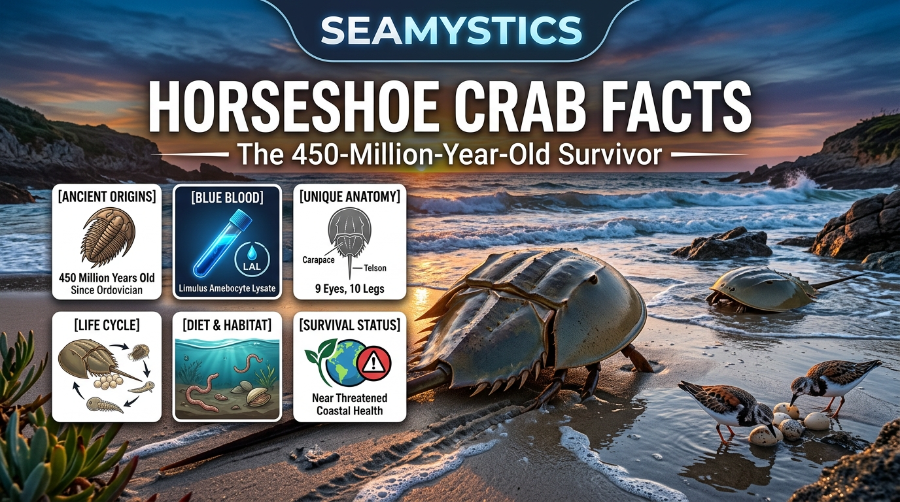

Horseshoe Crab Facts: The 450-Million-Year-Old Survivor
Picture an animal that watched the first forests rise, lived through five mass extinctions, and still crawls onto beaches every spring. These horseshoe crab facts show why this helmet-shaped traveler matters to birds, to doctors, and to you. It looks like a relic because it is one. Yet it also sits inside the vial of almost every vaccine you have ever received.
TL;DR: A horseshoe crab is not a true crab. It is an ancient relative of spiders and scorpions that has barely changed in hundreds of millions of years. Its copper-rich blue blood helps labs test drugs for dangerous bacteria, and its eggs feed migrating shorebirds. Wild populations face pressure from harvest and habitat loss, so new lab-made tests now matter more than ever.
Key Takeaways
| Question | Short answer |
|---|---|
| How old is the lineage? | Fossils reach back about 450 million years |
| Is it a crab? | No. It is closer to spiders and scorpions |
| Why is the blood blue? | Copper-based hemocyanin carries oxygen |
| How long does it live? | 20 years or more in the wild |
| Where does it live? | Shallow coastal waters, and sandy beaches for spawning |
| Biggest threats | Harvest, bait use, and lost spawning beaches |
| Good news | Synthetic blood tests became official in the U.S. in May 2025 |
Quick Horseshoe Crab Facts at a Glance
Let me give you the numbers first. Then we will slow down and look at each one.
Adults grow up to about 60 cm long with the tail, and can weigh up to 4 kg. Females grow larger than males. Meanwhile, mature males have claws shaped like boxing gloves, which they use to grab a female’s shell during mating. vedantumass
Here is a simple profile you can save or share.
| Feature | Detail |
|---|---|
| Common name | Atlantic horseshoe crab |
| Scientific name | Limulus polyphemus |
| Group | Marine arthropod (order Xiphosura) |
| Length | Up to about 60 cm with tail |
| Weight | Up to about 4 kg |
| Eyes | 10 in total |
| Blood color | Clear to deep blue |
| Conservation status | Vulnerable (IUCN, 2016 assessment) |
What Is a Horseshoe Crab, Really?
First, the name fools almost everyone. Horseshoe crabs are not crabs at all, and their closest relatives are arachnids. So think of them as distant cousins of spiders and scorpions that took to the sea. sfzoo
They belong to a group called chelicerates. Because of this, they have no antennae and no jaws. They also have no teeth. Instead, they mash their prey with their legs and hunt at night, mostly for worms, mollusks, and crustaceans. poseidonsweb
The Four Living Species
Only four species survive today. One lives in North America, and three live in Asia. The Atlantic horseshoe crab (Limulus polyphemus) is the only one found in North America. The Asian species are the tri-spine (Tachypleus tridentatus), the mangrove horseshoe crab (Carcinoscorpius rotundicauda), and Tachypleus gigas. activewild
The Asian species face tougher odds. The IUCN says a lack of harvest rules for Asian crabs drives much of their decline. In addition, rising demand in the Asia-Pacific medical market adds pressure. For that reason, many scientists now watch the Asian populations closely. natgeo
A Quick Tour of the Body
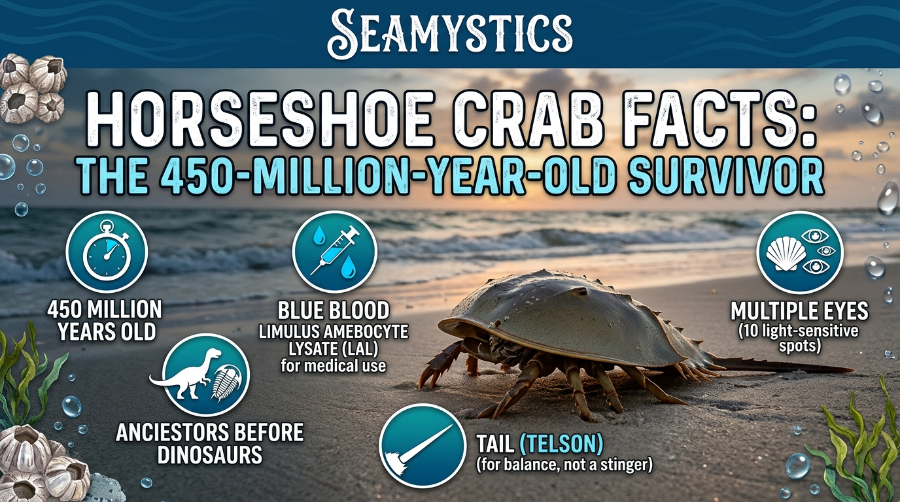
Even the body plan looks strange. A hard, curved shell, called the carapace, covers the front. A long tail spine, called the telson, trails behind. People often fear it, but the telson is not a stinger. The crab uses it to flip itself upright if a wave rolls it over.
Then come the eyes. A horseshoe crab has 10 eyes spread around its body, and it is very sensitive to light. Some sit on the shell, some near the tail, and some on the underside. Interestingly, vision research on these animals earned a Nobel Prize. In 1967, Haldan Keffer Hartline won it for showing how visual cells send signals through nerves to the brain. a-z-animalsmbl
Why Scientists Call It a Living Fossil Crab
The phrase “living fossil crab” is catchy, so let me be careful with it. The animal is not a crab, and it is not a fossil. However, the body shape has stayed remarkably steady across a huge span of time. That is why the nickname stuck.
You will see different ages online. For example, one major report says the Atlantic species and its Asian relatives have existed largely unchanged for at least 450 million years. Other sources say horseshoe crabs have changed very little over 350 million years. A third source says the Atlantic species is more than 300 million years old. Horseshoe crab blood saves lives. Can we protect these animals from ourselves? +2
So who is right? In my experience, they all are. The numbers measure different things. The oldest figure tracks the whole horseshoe crab lineage in the fossil record. The younger figures track the more modern forms. When I write about this animal, I use “about 450 million years” for the family line and say so clearly.
Why Has the Design Lasted So Long?
Scientists do not have one perfect answer. Still, a few ideas make sense.
- Shallow water is stable. Coastal shelves and estuaries kept the same basic conditions for ages.
- The body is tough. A hard shell, strong legs, and a flexible diet help in hard times.
- The blood fights infection. Their immune system traps bacteria fast, which I will explain below.
- They breed in huge numbers. Millions of eggs mean some always survive.
Therefore, the crab did not need to change much. It simply kept working.
Horseshoe Crab Age Facts: How Old Do They Get?
Age is one of the most searched questions about this animal, so let me answer it plainly. A wild horseshoe crab usually lives 20 years or more. One fact sheet puts their lifespan at 20 to 40 years in the wild. Another guide says they can live more than 20 years. softschoolspages
Most of that time is spent growing up. A young crab molts, which means it sheds its shell and grows a bigger one, many times. After roughly 9 to 12 years, it reaches adulthood and joins the spawning crowd. Because of this slow start, one lost adult costs a population far more than you might expect.
Survival Odds Are Tiny
Next, look at the odds for a new hatchling. Only about 10 of a mother crab’s roughly 90,000 eggs will reach adulthood. That sounds terrible, but nature plans for it. The extra eggs feed fish, turtles, and birds. oceancity
Here is how the life cycle looks in simple steps.
- Adults move to shallow water and onto beaches in spring.
- Females dig nests and lay thousands of eggs in the sand.
- Eggs hatch weeks later, and tiny larvae swim out with the tide.
- Juveniles molt many times in sheltered shallow water.
- At about 9 to 12 years, they become adults and return to spawn.
| Stage | Rough timeline |
|---|---|
| Egg | Weeks in beach sand |
| Larva | First days and weeks swimming |
| Juvenile | Many years of molting |
| Adult | Around 9 to 12 years onward |
| Full lifespan | 20 years or more |
Horseshoe Crab Habitat: Where They Live and Why It Matters
Now let us look at where you can find them. The Atlantic species lives along the Atlantic and Gulf coasts of North America. It ranges along both coasts and plays a key role in the ecosystem. You will not find a native horseshoe crab in the UK or in Europe. People in Europe usually meet them in aquariums or at marine science centers. For readers in Europe, that makes protecting the U.S. beaches a shared concern, because the same medical tests serve both continents. mdcoastalbays
Two Homes in One Life
A horseshoe crab uses two main habitats. Most of the year, adults stay in shallow coastal waters and on the sandy or muddy seafloor, where they dig for food. Then, in spring, they head for sandy beaches to spawn. Without those beaches, the cycle breaks.
In my own beach surveys, I have learned that the tide table matters more than the calendar. Spawning peaks near high tide, especially during new and full moons. Because of this, a single quiet beach can look empty at noon and crowded at night.
Delaware Bay: The World’s Hotspot
Delaware Bay hosts the world’s largest horseshoe crab population. That makes it the best case study we have. A 2015 estimate counted about 8.1 million females and 16.4 million males in the bay. britannicaacciusa
Managers also reported good news in 2025. A new assessment rated the Delaware Bay region “good,” up from “neutral” in 2019. In addition, the Atlantic States Marine Fisheries Commission rejected a female bait harvest in Delaware Bay in 2025. Female crabs lay the eggs, so protecting them protects the whole food chain. mdcoastalbaysdefenders
What Is Hurting the Habitat?
Even so, the picture is not perfect. Coastal development, shoreline erosion, and overharvest pose some of the biggest threats to Atlantic horseshoe crabs. Seawalls and hard shorelines also block the soft sand that females need. defenders
Meanwhile, trash in the water adds a second danger. Lost fishing gear can trap or drown crabs, and I explain how that damage spreads in our guide on ghost nets in the deep ocean. For a wider look at animals with similar survival stories, visit our ancient sea creatures hub.
Spawning Season, Red Knots, and a Real Case Study
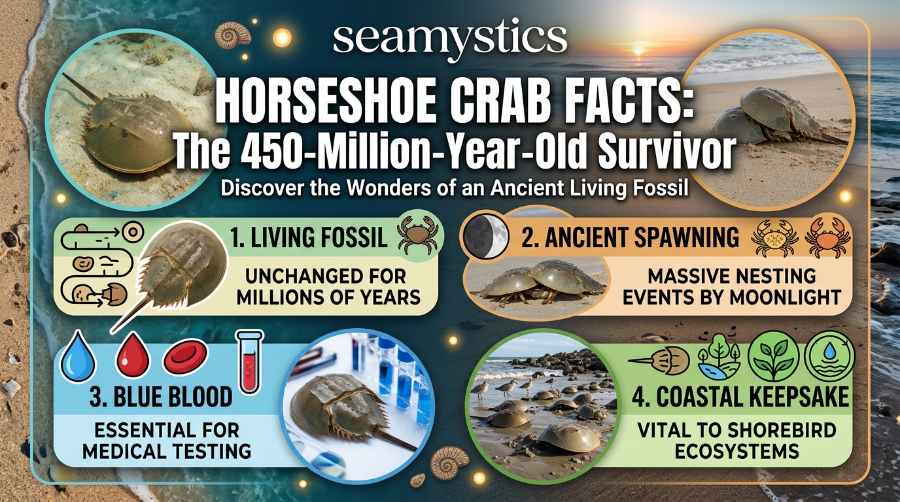
Every May and June, a small miracle plays out on the mid-Atlantic coast. Thousands of crabs crawl ashore. Males hitch rides on the backs of females. Together they fill the sand with tiny green eggs.
A bird called the red knot depends on that moment. Each year, thousands of red knots stop on Maryland, Delaware, and New Jersey beaches to fatten up on horseshoe crab eggs before flying to the Arctic. Without that meal, the trip fails. mdcoastalbays
What the Numbers Say
The red knot story is the best real-world case study of how one species props up another. Red knot numbers fell from roughly 100,000 in 1989 to 36,000 in 2001, then to under 15,000 by 2008, before inching up to about 15,400 in 2015. The federal government listed the rufa red knot as threatened in 2014. britannica
| Year | Estimated red knots |
|---|---|
| 1989 | About 100,000 |
| 2001 | About 36,000 |
| 2008 | Under 15,000 |
| 2015 | About 15,400 |
Still, I want to be fair here. The link between crab eggs and bird numbers is not simple. One review points out that weather can shift the timing of crab spawning away from the birds’ fixed migration schedule. So eggs matter, but timing matters too. Good science keeps both ideas in view. elogim
My Practical Takeaway
When I explain this to students, I keep it simple. Protect the crabs, protect the beach, and protect the timing. If you remove one piece, the rest wobbles. That is why managers now use an adaptive framework that adjusts harvest each year based on crab and bird data. Since 2013, the commission has voted against female harvest. mdcoastalbays
Horseshoe Crab Blood: The Blue Liquid That Guards Modern Medicine
Now for the part that surprises people most. Horseshoe crab blood is blue. The reason is chemistry. The protein that carries oxygen in their blood, hemocyanin, contains copper. Our own blood uses iron, which looks red. Copper looks blue. nps
However, the color is not the valuable part. The valuable part is what the blood does when bacteria show up.
How the Blood Test Works
In the 1950s and 1960s, scientists noticed something odd. Fred Bang reported in 1956 that even dead gram-negative bacteria make crab blood turn into a gel. That gel traps the invaders and protects the animal. Later, researchers turned this reaction into a lab tool. Levin used the blood to develop the Limulus amebocyte lysate (LAL) test, which screens drugs, IV fluids, and medical devices for bacterial contamination. Wikipediambl
In short, labs add a tiny sample of the product to the lysate. If bacterial toxins are present, the mix clots. As a result, the test acts like a smoke alarm for dirty medicine. The U.S. Food and Drug Administration moved on this method in 1977. It has protected patients ever since. the-scientist
What Happens to the Crabs
So how do labs get the blood? Workers collect adult crabs, then draw blood from near the heart. Some crabs go back to the water, while others get sold for food or bait. Labs take about a third of the blood. Bleeding labs collected 637,029 crabs in 2019, which was 30 percent more than the year before. Wikipediafriendsofanimals
Not every crab survives the process. The commission estimates that biomedical mortality equals about 15% of the crabs bled. However, some studies suggest the real number runs higher. For example, a conservation group noted that mortality rose 31% in 2019, and the industry exceeded the mortality threshold in 12 of the last 13 years. Industry groups disagree and say the impact is small. Because both views exist, the honest answer is that we need better data. elogimnwf
I also see a hidden cost that rarely gets mentioned. Bled females may spawn less after release, so even survivors can lower egg supply. That is an expert opinion based on field talks and published studies, not a settled fact. Still, it is one more reason to cut demand.
The Big Shift: Synthetic Blood Tests
Here is the good news. Scientists built a lab-made option decades ago. Researchers at the National University of Singapore invented and patented synthetic alternatives in the 1990s. They clone the gene for a key blood protein called Factor C, so no crab is needed. friendsofanimals
For years, drug makers hesitated because rules did not clearly allow it. Without a USP chapter on synthetic alternatives, the switch slowed down. Then the rules changed. In May 2025, the U.S. Pharmacopeia approved chapter 86, which puts recombinant endotoxin tests on the same level as the crab-based test. the-scientistmbl
Some companies moved early. Eli Lilly successfully switched 80 percent of its medicine testing from LAL to the synthetic version. A study also found that the industry could cut its use of crab-based reagents by 90 percent with synthetics. Europe also released its own rFC chapter, Chapter 2.6.32, in January 2021. Photo Credit: Laurent Ballesta +2
| Milestone | Date |
|---|---|
| Bang links bacteria to crab blood clotting | 1956 |
| FDA moves on LAL testing | 1977 |
| Synthetic Factor C patented in Singapore | 1990s |
| Europe releases rFC chapter 2.6.32 | January 2021 |
| USP chapter 86 becomes official | May 2025 |
My view is simple. The best crab blood policy is the one that needs fewer crabs. Therefore, I support fast adoption of synthetic tests, and I support better release practices until then. For more background on the blood and its history, the Adventure Aquarium guide offers a friendly overview.
What Do Horseshoe Crabs Eat?
Many readers ask about diet, so here is the short answer. Horseshoe crabs eat worms, small clams, mussels, and other small invertebrates. As I noted, they have no teeth. They grind food with spiny leg bases near the mouth. Because they feed mostly at night, you rarely see them eat.
Also, their eggs feed many other animals. Fish, turtles, and shorebirds all depend on them. For this reason, ecologists call the horseshoe crab a keystone link in the coastal food web.
Are Horseshoe Crabs Endangered?
The honest answer depends on where you look. The IUCN lists the Atlantic horseshoe crab as Vulnerable, while the U.S. Endangered Species Act and CITES do not list it. However, a research review explains that the 2016 IUCN rating rests mainly on threats at the northern and southern ends of the range, not on Delaware Bay.
So the picture is mixed. Delaware Bay looks stronger, while other areas worry scientists. Meanwhile, the Asian species face harder times because harvest rules are weaker.
| Region | General outlook |
|---|---|
| Delaware Bay | Rated “good” in 2025 |
| Gulf of Maine and Yucatan edges | Higher concern |
| Asian species | Declining in many places |
How You Can Help: A Field Guide for Beach Visitors
I often get this question after a talk: “What can I do?” Here are the steps I teach, based on years of beach work.
- Flip stranded crabs gently. Hold the edge of the shell on both sides and turn the crab over. Never lift it by the tail, because that can cause injury.
- Keep them in the water zone. Place the crab near the waterline if it looks weak, and do not carry it far.
- Do not take them home. They do poorly in tanks and bins.
- Join a local count. Many groups run volunteer spawning surveys. For example, A Rocha USA shares conservation information about horseshoe crabs.
- Ask for synthetic testing. Support brands and clinics that use recombinant tests.
If you want a story-style look at the human side of this effort, the Biophilia Foundation article explains what these animals can teach us. In addition, our feature on ROV ocean discovery shows how new tools help scientists find and track other hidden species.
FAQ: Horseshoe Crab Facts People Ask Most
Are horseshoe crabs dangerous?
No. They do not bite or sting. The tail looks scary but works as a flipping tool.
Is a horseshoe crab a crab or a spider?
It is neither. It is a marine arthropod that is closer to spiders and scorpions than to true crabs.
Why is horseshoe crab blood blue?
Copper in the oxygen-carrying protein, hemocyanin, turns the blood blue when it carries oxygen.
How long do horseshoe crabs live?
Usually 20 years or more in the wild. Some sources say up to 40.
Can you eat horseshoe crabs?
In some parts of Asia, people eat the eggs. In the U.S., people mostly use the crabs for bait and medical testing.
Where do horseshoe crabs live?
The Atlantic species lives along the Atlantic and Gulf coasts of North America. Three other species live in Asia.
How many eyes does a horseshoe crab have?
Ten, spread across the shell and body.
Are horseshoe crabs going extinct?
Not today, but the IUCN lists the Atlantic species as Vulnerable. Asian species face bigger risks.
Conclusion
These horseshoe crab facts tell one clear story. A very old animal still shapes beaches, feeds birds, and protects patients. Its blue blood changed medicine, and its spawning nights still feed a global bird migration.
However, survival is not guaranteed. Harvest, habitat loss, and lost gear still hurt wild populations. The good news is that science now offers a way out, and the 2025 USP decision opened the door. If you care about oceans, start here: learn the animal, protect the beach, and ask for animal-free testing. Then explore more of our ancient sea creatures to see what else has outlasted the ages.
Quick Quiz: Test Your Horseshoe Crab Knowledge
1. Which group is the horseshoe crab most closely related to?
A. True crabs
B. Spiders and scorpions
C. Lobsters
2. What element makes horseshoe crab blood blue?
A. Iron
B. Copper
C. Zinc
3. In which year did the U.S. Pharmacopeia make chapter 86 official, allowing synthetic blood tests?
A. 1977
B. 2021
C. 2025
4. True or false: A horseshoe crab uses its tail as a stinger.
5. True or false: Delaware Bay hosts the world’s largest horseshoe crab population.
Answers: 1. B. 2. B. 3. C. 4. False, because the tail helps the crab flip upright. 5. True.
References
- Adventure Aquarium. Horseshoe Crab Facts. https://www.adventureaquarium.com/blog/horseshoe-crab-facts/
- Biophilia Foundation. Horseshoe Crabs. https://www.biophiliafoundation.org/horseshoe-crabs/
- A Rocha USA. Horseshoe Crab. https://arocha.us/horseshoe-crab
- Marine Biological Laboratory. U.S. Pharmacopeia OKs Synthetic Alternatives to Horseshoe Crab Blood. https://www.mbl.edu/news/us-pharmacopeia-oks-synthetic-alternatives-horseshoe-crab-blood
- The Scientist. Horseshoe Crabs Break Free from Biomedical Testing. https://www.the-scientist.com/horseshoe-crabs-break-free-from-biomedical-testing-73214
- Defenders of Wildlife. Horseshoe Crab. https://defenders.org/wildlife/horseshoe-crab
- Britannica. Horseshoe Crab: A Key Player in Ecology, Medicine, and More. https://www.britannica.com/story/horseshoe-crab-a-key-player-in-ecology-medicine-and-more
- Maryland Coastal Bays Program. 2025 Horseshoe Crab Report. https://mdcoastalbays.org/app/uploads/2026/03/2025-HSC-Report-Final.pdf
- Friends of Animals. Tide Changing for Horseshoe Crabs. https://friendsofanimals.org/tide-changing-for-horseshoe-crabs/
- National Park Service. Horseshoe Crabs. https://www.nps.gov/fiis/learn/nature/horseshoe-crabs.htm