
Ancient Sea Creatures Still Alive Today: 10 Living Fossils That Outlived the Dinosaurs
In 1938, a fisherman’s net hauled up a strange blue fish off South Africa. Scientists had called its whole family dead for 66 million years. That fish changed how we think about ancient sea creatures forever.
Today, dozens of these old survivors still swim, drift, and crawl through our oceans. Some of them lived before the first tree grew on land. This guide shows you which ones they are, how they lasted so long, and what is putting them at risk now.
TL;DR: Ancient sea creatures such as coelacanths, nautiluses, horseshoe crabs, sharks, and sturgeon have lived on Earth for 200 to 500 million years with few body changes. They lasted because deep, stable habitats and slow lifestyles protected them. Today, overfishing, ghost nets, and warming seas threaten many of them more than any past mass extinction did.
Key Takeaways
| Question | Short Answer |
|---|---|
| What are living fossil ocean animals? | Species whose body plan looks very close to their ancient relatives |
| Which is the oldest lineage? | Sponges and jellyfish, over 500 million years |
| Which lives the longest? | Greenland shark, about 400 years; black coral, over 4,000 years |
| What is the biggest modern threat? | Overfishing, ghost fishing gear, and warming water |
| Are they safe? | No, many are listed as threatened by the IUCN |
What Makes a Sea Creature “Ancient”?
Scientists use the term “living fossil” in a loose way. It does not mean the animal never changed. It means the animal looks a lot like its fossil cousins from millions of years ago.
This idea deserves a careful look. Inside, these animals keep evolving. Their genes, immune systems, and behaviors still shift with time. Only the outer shape stays familiar.
The word “ancient” can also mean two different things. First, a whole group can have an old lineage, like sharks. Second, a single animal can be very old, like a 507 year old clam. Both stories matter, and this post covers both.
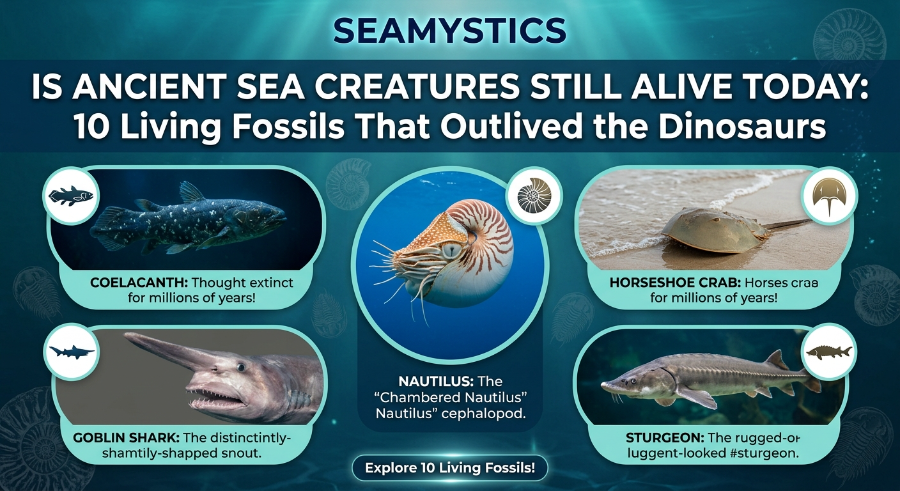
Researchers at the Smithsonian note that our ancient oceans looked strangely familiar, with food webs that echo today’s seas. You can read that view in this Smithsonian National Museum of Natural History Q&A on ancient sea monsters.
Living Fossil Ocean Animals You Can Still Find Today
Here are ten of the most famous prehistoric ocean survivors. I put them roughly in order of how surprising their story is.
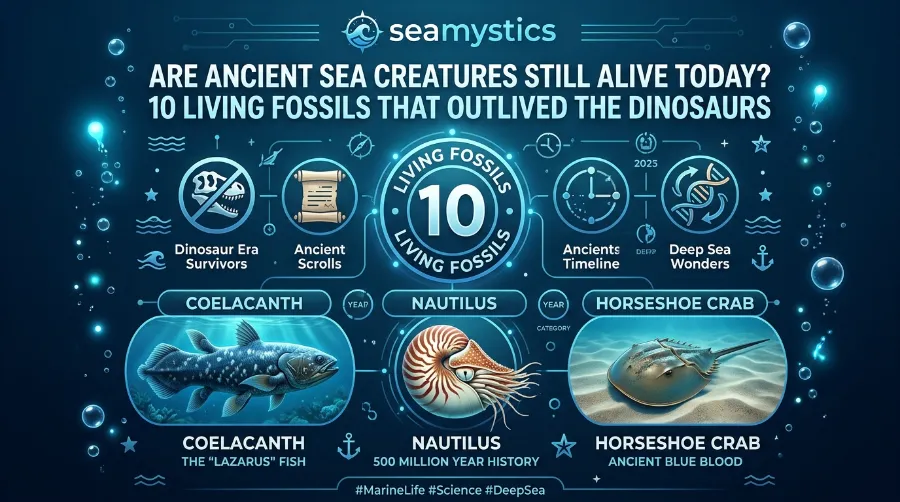
1. Coelacanth: The Fish That Came Back From the Dead
The coelacanth is the star of this list. Its lineage goes back about 400 million years. Fossils end around 66 million years ago, so scientists thought it died with the dinosaurs.
Then, on December 22, 1938, Marjorie Courtenay-Latimer, a museum curator in East London, South Africa, spotted an odd fish in a trawler’s catch. She sketched it and sent the drawing to ichthyologist J.L.B. Smith. He recognized it at once.
In 1997, the story got a second chapter. Marine biologist Mark Erdmann saw a coelacanth at a fish market in Manado, Indonesia, on his honeymoon. That fish turned out to be a separate species, now called Latimeria menadoensis.
Coelacanths have lobed fins that move in a pattern like a trotting animal’s legs. A 2021 study in Current Biology suggested they may live close to 100 years. It also found that mothers may carry their young for about five years, one of the longest known pregnancies of any vertebrate.
That slow pace is a risk. A population that grows so slowly cannot bounce back from fishing losses.
2. Nautilus: A Spiral Shell Older Than Most Mountains
The chambered nautilus has drifted in the sea for about 500 million years. Its shell is a clever machine. The animal adds a new chamber as it grows, and it controls buoyancy by moving gas and fluid in and out of the older rooms.
This animal is a cousin of octopus and squid, yet it kept its outer shell. It also has around 90 sticky tentacles without suckers. At night, it rises from about 300 meters deep to hunt on reefs. In the day, it sinks back to cool, dark water.
Trouble came from the shell trade. Because people buy shells for decor and jewelry, nautilus numbers have fallen in some places. In response, countries listed the group under CITES Appendix II in 2016, and the rules took effect in 2017.
3. Horseshoe Crab: Blue Blood and 445 Million Years
Horseshoe crabs are not true crabs. They are closer to spiders and scorpions. Fossils of close relatives are about 445 million years old.
Four species live today. One, Limulus polyphemus, lives along the Atlantic coast of North America. The other three live in Asia.
Their blood is copper based, so it turns blue. It also clots when it meets bacterial toxins. For decades, drug makers used it to test vaccines and injectable medicine for contamination. As a result, thousands of crabs were bled each year. Now, a lab made alternative is growing in use, and that is good news for the crabs.
Every spring, these animals crowd Delaware Bay beaches to lay eggs. At the same time, migrating red knot birds stop there to eat the eggs. So the crab is not just a fossil. It also holds a whole food web together.
4. Sharks: Older Than Trees
Sharks first appeared about 450 million years ago. Trees showed up around 380 million years ago. In other words, sharks watched the first forests grow.
Many shark features are well tuned. Their skin has tiny tooth like scales that cut drag. Their skeleton is made of cartilage, which is light and flexible. And their senses can pick up faint electric fields from hidden prey.
Still, age did not protect them from people. A 2021 study in Nature found that the number of oceanic sharks and rays dropped 71 percent between 1970 and 2018. In addition, the IUCN says about 37 percent of sharks and rays face extinction risk.
For a fun comparison, readers curious about how mammals handle the sea can see our dolphin species guide. Dolphins are newcomers by comparison, since their land living ancestors waded into the water only about 50 million years ago.
5. Greenland Shark: The Longest Living Vertebrate
This shark is the record holder. In 2016, a team led by Julius Nielsen published a study in Science. They used eye lens tissue to date 28 sharks and estimated one female at about 392 years old, give or take 120 years.
The shark lives in cold Arctic water and swims slowly. Because of that, it burns very little energy. Researchers believe it may not reach maturity until about 150 years old.
Here is a point that practice teaches you: slow growth is a trap. When people catch a species that takes 150 years to mature, the stock cannot heal in a human lifetime. The IUCN lists the species as Near Threatened for this reason.
6. Frilled Shark and Goblin Shark: Deep Water Time Capsules
The frilled shark looks like an eel with a big mouth. It has about 300 tiny three pronged teeth, set in 25 rows. Its lineage reaches back more than 80 million years.
The goblin shark has a long, flat snout and jaws that shoot forward to snatch prey. Its family line is over 100 million years old. Few people have ever seen one alive.
Both animals live deep, usually below 200 meters. That calm, dark habitat explains a lot. Little changes down there, so little pressure forces the body to change.
7. Sturgeon: Armored Giants of the Rivers
Sturgeon have been around for roughly 200 million years. They have bony plates called scutes and a skeleton that is mostly cartilage. Some beluga sturgeon grow over 5 meters long.
Their eggs, sold as caviar, caused their crash. Because females take years to mature, heavy fishing wiped out whole river runs. Today, the IUCN says sturgeon are the most threatened group of animals it has assessed. Almost every species is at risk.
Dams add to the problem. Sturgeon swim upstream to spawn, and a wall in the river ends that trip.
8. Jellyfish: Soft Bodies, Hard Survivors
Jellyfish have no brain, no heart, and no bones. Even so, they have drifted through the sea for over 500 million years. That makes them older than dinosaurs, fish with jaws, and plants on land.
They get by on a simple plan. Their bodies are mostly water, so they need little food. Many species also reproduce in two ways, which lets them bloom fast when food is rich.
Some scientists now see jellyfish blooms as a sign of stressed seas. Warmer water and overfishing remove competitors, so jellyfish take over.
9. Sea Sponges: The Oldest Animal Branch
Sponges may be the oldest living animal group. Chemical traces in rocks hint that they existed at least 600 million years ago, and some researchers think even earlier.
Glass sponges are the long lived ones. A 2012 study estimated that a deep sea glass sponge could be about 11,000 years old. That would make it one of the oldest animals on Earth.
Sponges also act like filters. A single sponge can pump many times its own body volume of water each hour. So, they keep reefs clean.
10. Sea Turtles: Shell Armor Since the Cretaceous
Sea turtles trace back about 110 million years. They shared the sea with giant marine reptiles. They outlived all of them.
The leatherback is the odd one out. It has no hard shell. Instead, it has a leathery back and can dive deeper than 1,000 meters while chasing jellyfish.
Sadly, turtles are the most common victims of a modern killer. We cover that next.
Oldest Sea Creatures Alive: Record Breakers by Age
So far, we looked at old lineages. Now let us look at old individuals. These are the oldest sea creatures alive that science can measure.
| Animal | Estimated Age of Individual | How Scientists Know |
|---|---|---|
| Glass sponge | Up to about 11,000 years | Growth rate and skeleton layers |
| Black coral (Leiopathes) | 4,265 years | Radiocarbon dating, Hawaii study, 2009 |
| Ocean quahog “Ming” | 507 years | Shell growth rings, Iceland, 2013 |
| Greenland shark | About 392 years | Radiocarbon dating of eye lens, 2016 |
| Coelacanth | Possibly near 100 years | Scale and growth analysis, 2021 |
Notice a pattern. Cold, deep, or slow places lead to long lives. In every case, the animals have slow metabolisms and grow little each year.
Why Prehistoric Ocean Survivors Lasted So Long
Researchers point to a few repeat reasons. I find these three most useful.
- Stable homes. The deep sea stays cold and dark for millions of years. Little change means little pressure to evolve new shapes.
- Slow living. Low energy needs help animals survive famine. A slow animal can wait out bad years.
- Flexible diets and bodies. Generalists beat specialists in a crisis. A shark that eats almost anything can live through a collapse.
Another view comes from Southern Methodist University. Their researchers argue that Earth’s shifting climate shaped life in the past and still shapes it now. You can read more in this SMU research feature on ancient sea monsters.
Even so, survival has a limit. These animals handled volcanoes, ice ages, and asteroid strikes. However, they never faced fast human pressure before.
Real Case Studies: What Happens When We Rediscover Ancient Sea Creatures
Case 1: The Coelacanth and the Market Stall
The 1997 Indonesia find proved one thing. A “rare” animal can hide in plain sight for decades. Local fishers knew the fish and even called it “raja laut,” the king of the sea. Science simply had not asked the right people.
The lesson is simple. Work with local fishing communities. They hold records that no lab has.
Case 2: Horseshoe Crabs and Delaware Bay
Managers in the United States set harvest limits for horseshoe crabs after red knot numbers fell. The change shows how one old species supports many others. When egg numbers dropped, shorebirds lost a key meal.
Case 3: Nautilus and the Trade Rules
Before the CITES listing, shell sellers faced few limits. After the 2016 decision, countries had to track the trade. This case shows that global rules can protect even a small shelled animal.
Field note placeholder: Add one real observation from your own dives, lab work, or interviews here. A short first hand detail, with a date and place, makes this section stronger and more trustworthy.
Ghost Nets: The Silent Killers Drifting Through the Deep Ocean
Now we come to a threat that no fossil record prepared these animals for. Ghost nets are fishing nets and lines that people lose or drop at sea. They keep catching animals long after anyone stops using them.
The scale is large. Experts often cite about 640,000 tonnes of fishing gear entering the ocean each year, based on a widely used estimate from the UN Food and Agriculture Organization and partners. In addition, a 2018 study in Scientific Reports found that nets made up roughly 46 percent of the mass of the Great Pacific Garbage Patch.
Why does this matter for ancient sea creatures? There are four main ways.
- Sea turtles get tangled and cannot surface to breathe.
- Sharks and rays swim into the mesh and cannot back out.
- Deep sea corals and sponges get smothered or snapped when a net drags over them.
- Slow breeders such as coelacanths and Greenland sharks cannot replace the animals they lose.
The nets do not rot quickly. Most are made of nylon or polyethylene, which can last for decades. So, one lost net can kill again and again.
Several groups now fight this problem. For example, the Global Ghost Gear Initiative and NOAA’s Marine Debris Program support net recovery. Also, WWF works with fishers on gear tracking and marking.
What can you do? Here are simple steps.
- Choose seafood with a trusted sustainability label.
- Join or support a local beach or dive cleanup.
- Report lost gear to the local coast guard or fisheries office.
- Support groups that fund net recovery, such as those above.
Threat Snapshot: Which Ancient Survivors Face Which Risks?
| Species Group | Main Threat | Why It Hurts Most |
|---|---|---|
| Coelacanth | Accidental catch | Very slow breeding |
| Nautilus | Shell trade | Slow growth, late maturity |
| Horseshoe crab | Bait use, biomedical bleeding, habitat loss | Beach nesting is easy to disturb |
| Sharks and rays | Overfishing, bycatch, ghost gear | Few young per litter |
| Sturgeon | Caviar fishing, dams | Late maturity, blocked rivers |
| Sea turtles | Ghost nets, plastic, beach loss | Many hazards over a long life |
| Deep sea corals and sponges | Bottom trawling, warming | Growth of only millimeters a year |
How Scientists Study Ancient Sea Creatures Today
Modern tools make old mysteries easier to solve. Here is what researchers use most.
- Remotely operated vehicles (ROVs) film animals in places that divers cannot reach.
- Radiocarbon dating measures age in tissues that do not change, like shark eye lenses.
- DNA sampling checks how closely related living species are to fossils.
- Acoustic tags track how sharks and turtles travel.
In my experience, the best studies mix methods. A video shows how an animal moves, while a tissue sample shows how old it is. Together, they tell the full story.
Sensory science helps too. For example, sharks use electric sense, while dolphins use sound. If you like that topic, read our explainer on dolphin echolocation science. It shows how two very different animals solve the same problem of finding food in the dark.
You can find a broader roundup of old sea giants in this ActiveWild guide to prehistoric sea creatures. It is a good place to compare how these animals look next to their fossil kin.
Ancient Marine Species Alive: Surprising Links to Modern Life
Some links to ancient animals are less obvious. Take sleep. Sharks must keep water flowing over their gills, so many of them rest while still moving a little. Dolphins solve a similar need in a different way, and our piece on dolphin sleep patterns explains how half their brain stays awake.
Take river life as well. Some dolphins live in rivers, and they belong to very old branches of the dolphin family tree. Sadly, the Yangtze river dolphin, or baiji, was declared functionally extinct in 2006. You can read about the survivors in our river dolphin facts.
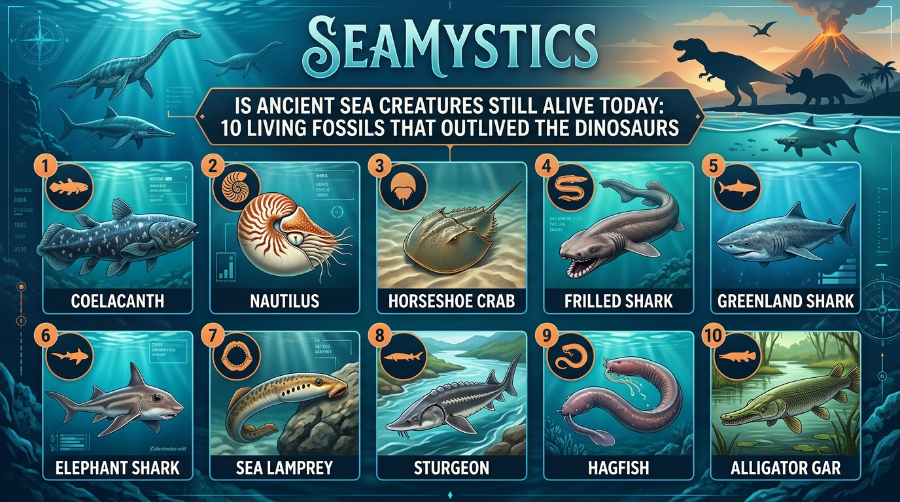
These links teach a useful idea. Old does not mean safe. A long history can still end quickly when people change a habitat in a few decades.
Frequently Asked Questions
What are the oldest sea creatures alive today?
Sponges and jellyfish have the oldest lineages, at 500 million years or more. For single animals, a glass sponge may reach about 11,000 years, and black coral has been dated to over 4,000 years.
Which living fossil ocean animals are best known?
The coelacanth, chambered nautilus, horseshoe crab, and several sharks top the list. Each one looks much like its fossil relatives.
Is the coelacanth still alive?
Yes. Two species exist, one near the Comoros and southern Africa and one near Sulawesi in Indonesia. Both are rare, and the IUCN lists the western Indian Ocean species as Critically Endangered.
Are sharks older than dinosaurs?
Yes. Sharks appeared about 450 million years ago, while dinosaurs came about 230 million years ago.
Why are ancient marine species still alive when so many others died out?
Stable habitats, slow lifestyles, and flexible diets helped them. Even so, many now struggle because human pressure moves faster than evolution.
How do ghost nets harm them?
Ghost nets trap and drown animals for years. They also damage slow growing corals and sponges on the seafloor.
Conclusion
Ancient sea creatures give us a rare look at Earth’s deep past. They have outlived ice ages, volcanic winters, and the asteroid that ended the dinosaurs. Their lives also teach a hard lesson: slow living made them tough, but it also makes them fragile when people take too many or leave behind lost gear.
So, the next step is practical. Choose sustainable seafood, support net cleanup, and share what you learn. These animals have survived for hundreds of millions of years, and now their chance depends on us.
Quick Quiz: Test What You Learned
1. In what year did scientists first identify a living coelacanth?
a) 1738
b) 1938
c) 1998
2. Why do drug makers value horseshoe crab blood?
a) It is a rich food source
b) It clots when it meets bacterial toxins
c) It glows in the dark
3. Which animal is the longest living vertebrate known?
a) Leatherback turtle
b) Beluga sturgeon
c) Greenland shark
4. True or False: Sharks are older than trees.
5. True or False: Ghost nets only catch fish.
Answers: 1) b. 2) b. 3) c. 4) True, about 450 million years versus about 380 million. 5) False, they also trap turtles, sharks, and more, and they damage corals.
References
- Smithsonian National Museum of Natural History, “Q&A: Sea Monsters” (2018)
- Southern Methodist University, “Ancient sea monsters reveal how the ever changing planet shapes life” (2018)
- Nielsen, J. et al. (2016). “Eye lens radiocarbon reveals centuries of longevity in the Greenland shark.” Science
- Pacoureau, N. et al. (2021). “Half a century of global decline in oceanic sharks and rays.” Nature
- Mahé, K. et al. (2021). Coelacanth age and gestation study. Current Biology
- Roark, E.B. et al. (2009). Extreme longevity in deep sea black corals. PNAS
- Lebreton, L. et al. (2018). “Evidence that the Great Pacific Garbage Patch is rapidly accumulating plastic.” Scientific Reports
- IUCN Red List of Threatened Species
- CITES Appendix II listing of Nautilidae (2016)
- FAO and UNEP reports on abandoned, lost, or discarded fishing gear