
The ocean covers more than 71% of Earth’s surface, yet scientists have explored only a small part of it. For centuries, people believed the deep ocean was an empty, lifeless place. Everything changed when the first deep sea expedition began to reveal a hidden world beneath the waves. Instead of darkness and silence, researchers found strange animals, unknown ecosystems, and clues about Earth’s history that nobody expected.
Today, modern submarines, robotic vehicles, and advanced mapping systems continue the work started more than 150 years ago. Every new discovery traces its roots back to one historic voyage that transformed marine biology forever. This article explores how that groundbreaking expedition reshaped science, inspired future exploration, and continues to influence ocean research in 2026.
Key Takeaways
| Topic | Key Insight |
|---|---|
| Historic Expedition | HMS Challenger (1872–1876) became the world’s first global scientific deep-sea expedition. |
| Ocean Depth | Scientists measured ocean depths with unprecedented accuracy. |
| Marine Life | More than 4,700 previously unknown marine species were discovered. |
| Scientific Legacy | The expedition created the foundation of modern oceanography. |
| Technology | Simple rope soundings evolved into sonar, autonomous vehicles, and AI-powered mapping. |
| Why It Matters Today | Climate research, fisheries, biodiversity, and deep-sea conservation all build upon Challenger’s discoveries. |
Why the First Deep Sea Expedition Changed Everything
Before the late nineteenth century, scientists knew surprisingly little about the deep ocean. Ships sailed across vast oceans every day, yet almost nobody understood what existed thousands of meters below the surface.
Many respected researchers believed deep water could not support life because of crushing pressure, freezing temperatures, and complete darkness. This idea became known as the Azoic Theory, proposed by Professor Edward Forbes during the 1840s.
However, a growing number of discoveries suggested that this theory might be wrong. Fishermen occasionally pulled unusual animals from great depths. Engineers laying underwater telegraph cables also recovered mysterious organisms attached to equipment from the seabed.
These surprising findings encouraged scientists to organize a dedicated scientific expedition unlike anything attempted before.
From Rope Soundings to AI-Powered Ocean Exploration
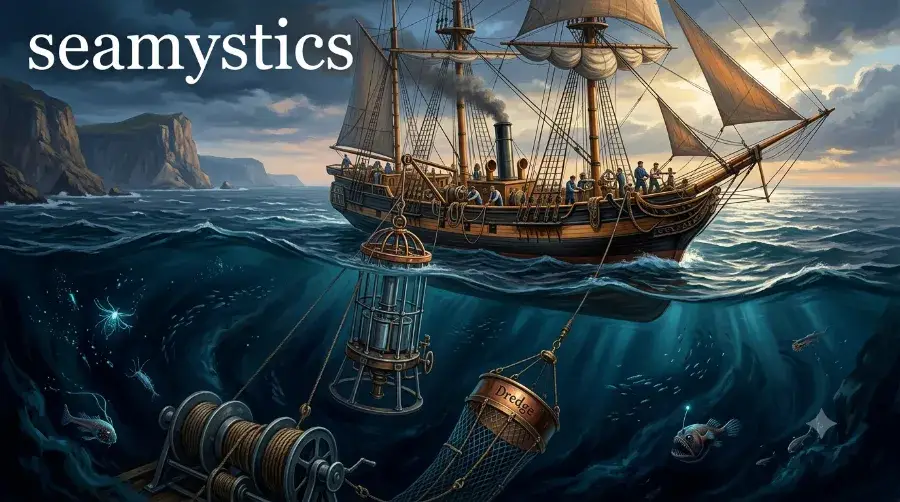
The world has changed dramatically since HMS Challenger completed its historic voyage in 1876. Scientists no longer rely on hemp ropes, simple thermometers, or manually operated dredges. Instead, they use advanced technology to explore places that humans cannot safely reach.
Modern oceanographic research combines robotics, satellite communication, artificial intelligence (AI), high-resolution sonar, and autonomous underwater vehicles. Even with these innovations, researchers still follow the scientific principles introduced during the Challenger Expedition: observe carefully, collect reliable data, and compare findings across different parts of the ocean.
Then vs. Now: Ocean Exploration Technology
| 1872–1876 (HMS Challenger) | Modern Ocean Science (2026) |
|---|---|
| Hemp sounding lines | Multibeam sonar mapping |
| Mercury thermometers | Digital CTD sensors |
| Manual dredges | Remotely Operated Vehicles (ROVs) |
| Handwritten observations | Cloud-based scientific databases |
| Sail-powered vessel | AI-assisted research ships |
| Sample preservation in alcohol | DNA sequencing and environmental DNA (eDNA) |
Today’s research vessels can map thousands of square kilometers of seafloor during a single expedition. Scientists also use remotely operated vehicles to collect samples from depths greater than 6,000 meters without placing people at risk.
How the First Deep Sea Expedition Influences Marine Biology Today
Although more than 150 years have passed, many modern marine biology projects still rely on the methods pioneered during the Challenger Expedition.
Researchers continue to study:
- Deep-sea biodiversity
- Coral reef ecosystems
- Ocean circulation
- Marine pollution
- Climate change
- Carbon storage in deep sediments
- Hydrothermal vent communities
For example, scientists compare present-day ocean temperatures with measurements collected during historical expeditions. These comparisons help researchers understand long-term climate trends and how marine ecosystems have changed over time.
Likewise, specimens collected by the Challenger Expedition remain valuable. Museums still examine these preserved samples using modern genetic tools, revealing information that nineteenth-century scientists could not have imagined.
Why Deep-Sea Research Matters More Than Ever
The deep ocean is no longer viewed as a distant frontier. Instead, it plays a vital role in Earth’s climate, biodiversity, and natural resources.
Scientists estimate that the deep ocean stores vast amounts of carbon, helping regulate the planet’s temperature. It also contains unique ecosystems that support thousands of species found nowhere else.
Furthermore, researchers continue to discover organisms that may contribute to medicine, biotechnology, and environmental science.
Modern Benefits of Deep-Sea Research
| Research Area | Real-World Impact |
| Climate Science | Better climate prediction models |
| Medicine | Discovery of new bioactive compounds |
| Fisheries | Sustainable fish stock management |
| Biodiversity | Protection of endangered marine species |
| Geology | Improved understanding of plate tectonics |
| Conservation | Better management of Marine Protected Areas |
Because oceans influence weather, food security, and global biodiversity, understanding the deep sea benefits every nation—not just coastal countries.
Challenges Facing the Deep Ocean
Even though technology has advanced rapidly, the deep sea remains one of Earth’s least explored environments.
Scientists face several challenges:
- Extreme water pressure.
- Freezing temperatures.
- Complete darkness.
- High exploration costs.
- Limited access to research vessels.
- Growing human impacts, including deep-sea mining and plastic pollution.
As exploration expands, balancing scientific discovery with environmental protection has become increasingly important.
Lessons from the Challenger Expedition
The Challenger Expedition teaches several lessons that remain relevant today.
1. Curiosity Drives Discovery
Scientists questioned long-standing assumptions about the deep ocean. Their willingness to test accepted ideas led to groundbreaking discoveries.
2. Careful Data Collection Matters
Every temperature reading, sediment sample, and biological specimen contributed to a larger understanding of the oceans.
3. Collaboration Creates Better Science
Marine biology, chemistry, geology, and physics worked together during the expedition. Modern oceanography continues to rely on this multidisciplinary approach.
4. Exploration Never Truly Ends
Even today, researchers estimate that most of the deep ocean remains unexplored. Every expedition uncovers new species, geological formations, and ecological processes.
Latest Ocean Exploration Snapshot (2026)
The pace of ocean exploration continues to grow as governments and research organizations invest in new technologies.
| Metric | Latest Status |
| Earth’s surface covered by oceans | ~71% |
| Estimated explored seafloor | Less than one-third mapped in high resolution |
| Known marine species | More than 240,000 described |
| Estimated undiscovered marine species | Hundreds of thousands more likely remain |
| Active deep-sea expeditions | Conducted annually by international research organizations |
These figures highlight how much remains unknown despite more than a century of scientific progress.
Ocean Exploration Timeline
1843  Edward Forbes proposes the Azoic Theory
   │
1872  HMS Challenger departs Portsmouth
   │
1875  Challenger records one of the deepest known ocean soundings
   │
1876  Expedition returns with thousands of specimens
   │
1880–1895  Scientific reports published in 50 volumes
   │
1960  First crewed descent to Challenger Deep
   │
2026  AI, ROVs, eDNA, and autonomous systems expand deep-sea research
Frequently Asked Questions
What was the first deep sea expedition?
The HMS Challenger Expedition (1872–1876) is widely recognized as the first global scientific expedition dedicated to studying the world’s oceans. It established the foundations of modern oceanography.
Why was the Challenger Expedition important?
It proved that life exists in the deep ocean, collected thousands of marine specimens, measured ocean depth, studied seawater chemistry, and transformed ocean science into a modern scientific discipline.
How many new species did the expedition discover?
Scientists described approximately 4,700 previously unknown marine species, dramatically expanding knowledge of ocean biodiversity.
What technologies do scientists use today?
Modern expeditions use multibeam sonar, remotely operated vehicles (ROVs), autonomous underwater vehicles (AUVs), satellite navigation, artificial intelligence, environmental DNA (eDNA), and advanced ocean sensors.
Is the deep ocean fully explored?
No. Large areas of the seafloor remain poorly mapped and scientifically unexplored, making the deep ocean one of the last great frontiers on Earth.
Conclusion
The first deep sea expedition marked a turning point in human understanding of the oceans. Before HMS Challenger, the deep sea was largely a mystery filled with assumptions and speculation. After the expedition, it became a place of scientific discovery, rich biodiversity, and endless opportunity for research.
More than 150 years later, its influence remains visible in every modern research vessel, every autonomous underwater robot, and every new species discovered beneath the waves. As scientists continue exploring Earth’s final frontier, the spirit of the Challenger Expedition lives on—reminding us that curiosity, careful observation, and international collaboration can transform the way we understand our planet.
HMS Challenger: The Voyage That Started Modern Oceanography
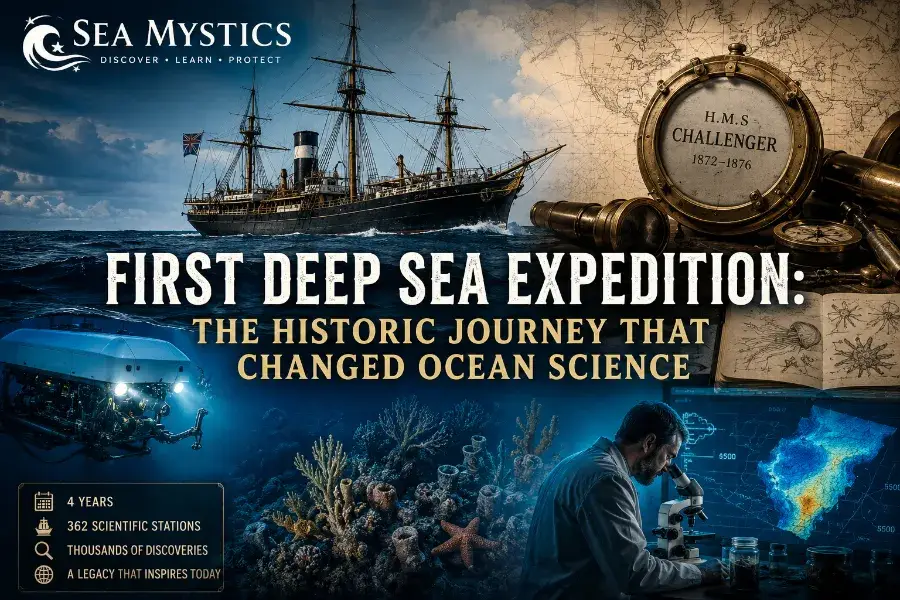
In December 1872, the British Royal Navy converted the HMS Challenger, originally a naval warship, into a floating scientific laboratory.
Instead of carrying weapons, the vessel transported laboratories, scientific instruments, microscopes, preservation equipment, and dozens of researchers representing several scientific disciplines.
The expedition lasted almost four years, making it one of the longest scientific ocean voyages in history.
Expedition Facts
| Detail | Information |
| Ship | HMS Challenger |
| Expedition Years | 1872–1876 |
| Distance Traveled | About 127,600 km (68,890 nautical miles) |
| Scientific Stations | 362 |
| Ocean Soundings | More than 490 |
| Biological Samples | Thousands collected |
| New Species | Approximately 4,700 described |
Unlike earlier voyages that focused on trade or military objectives, Challenger had one clear mission: understand the world’s oceans through systematic scientific observation.
That decision changed marine science forever.
The Vision Behind the Expedition
The expedition brought together experts from different scientific fields.
The team included:
- Marine biologists
- Zoologists
- Chemists
- Geologists
- Physicists
- Meteorologists
- Oceanographers
This multidisciplinary approach was revolutionary.
Rather than studying only fish or coastlines, researchers examined every part of the marine environment.
They investigated:
- Ocean temperature
- Water chemistry
- Salinity
- Ocean currents
- Deep-sea sediments
- Marine biodiversity
- Seafloor geology
This broad approach later became the standard model for oceanographic expeditions worldwide.
Exploring the Unknown Ocean
During the nineteenth century, scientists lacked sonar, satellites, GPS, and underwater robots.
Instead, crews relied on simple but carefully designed equipment.
Some of the most important tools included:
- Hemp sounding lines
- Thermometers protected against pressure
- Water sampling bottles
- Dredges
- Bottom trawls
- Sediment corers
- Chemical testing equipment
Although these tools appear primitive by today’s standards, they represented cutting-edge technology at the time.
Each sample collected expanded humanity’s understanding of the oceans.
A Journey Around the World
The expedition crossed every major ocean except the Arctic.
Researchers explored regions including:
- North Atlantic
- South Atlantic
- Indian Ocean
- Southern Ocean
- Pacific Ocean
The ship visited hundreds of locations, allowing scientists to compare marine environments across different climates.
This global perspective proved invaluable because ocean systems are interconnected.
Instead of isolated observations, Challenger produced the world’s first comprehensive picture of Earth’s oceans.
Discovering Life in the Deep Ocean
Perhaps the expedition’s greatest achievement involved proving that complex life existed at extreme depths.
Scientists recovered:
- Deep-sea corals
- Sea stars
- Brittle stars
- Sea cucumbers
- Crustaceans
- Deep-water fish
- Giant worms
- Mollusks
- Microscopic organisms
Many species looked unlike anything previously documented.
These discoveries permanently overturned the Azoic Theory.
Scientists finally understood that life could survive enormous pressure, freezing temperatures, and complete darkness.
That realization transformed marine biology.
Mapping the Deep Seafloor
The expedition also produced remarkably accurate depth measurements.
Crew members repeatedly lowered weighted ropes until they touched the seabed.
Although this method required patience, it generated one of history’s first detailed maps of ocean depth.
Researchers identified:
- Deep ocean basins
- Underwater mountains
- Continental slopes
- Ocean trenches
One particularly famous measurement helped identify what later became known as the Mariana Trench, Earth’s deepest ocean location.
Modern sonar has greatly improved mapping accuracy, yet today’s work still builds upon these pioneering measurements.
Scientific Discoveries That Still Matter Today
The Challenger Expedition created a scientific legacy that continues to influence research in 2026.
Its findings helped establish several branches of marine science, including:
Marine Biology
Scientists gained the first global understanding of deep-sea biodiversity.
Oceanography
Researchers began studying oceans as connected systems rather than isolated bodies of water.
Marine Geology
Seafloor sediments revealed clues about Earth’s geological history.
Climate Science
Ocean temperature measurements became valuable reference points for long-term climate comparisons.
Marine Chemistry
Water samples improved understanding of salinity, dissolved gases, and nutrient cycling.
Together, these discoveries laid the groundwork for modern ocean science.
Timeline of the Expedition
| Year | Major Milestone |
| 1872 | HMS Challenger leaves Portsmouth. |
| 1873 | First major deep-ocean sampling campaigns begin. |
| 1874 | Scientists expand research across the Pacific Ocean. |
| 1875 | Record-setting deep sounding reaches Challenger Deep region. |
| 1876 | Expedition returns after completing global survey. |
How the Expedition Influenced Today’s Ocean Research
The principles introduced during the Challenger Expedition continue to guide modern marine science.
Researchers still collect standardized measurements, compare different ocean regions, and study the interactions among water, geology, chemistry, and marine life. Today’s autonomous underwater vehicles, remotely operated vehicles (ROVs), and deep-diving submersibles use advanced technology, but they follow the same scientific philosophy established more than 150 years ago.