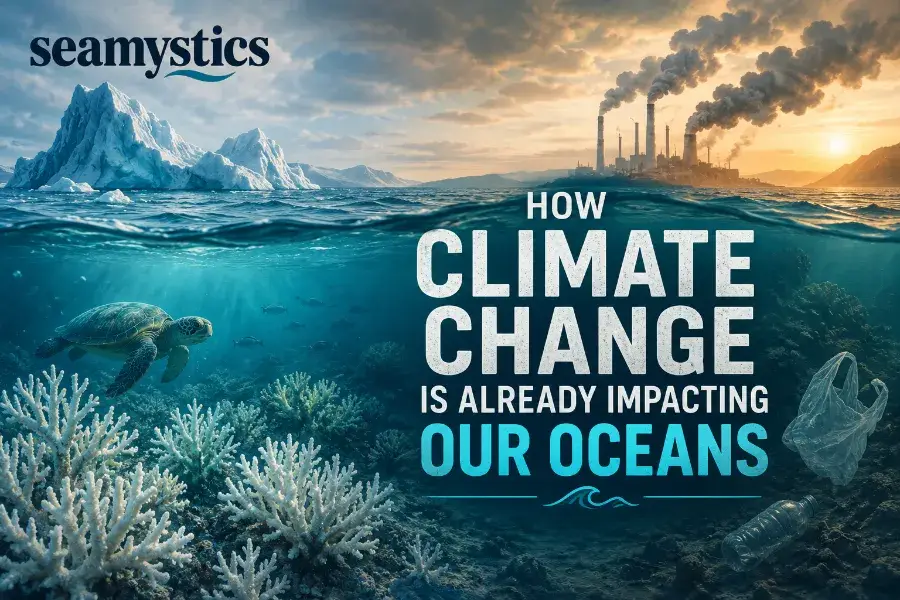

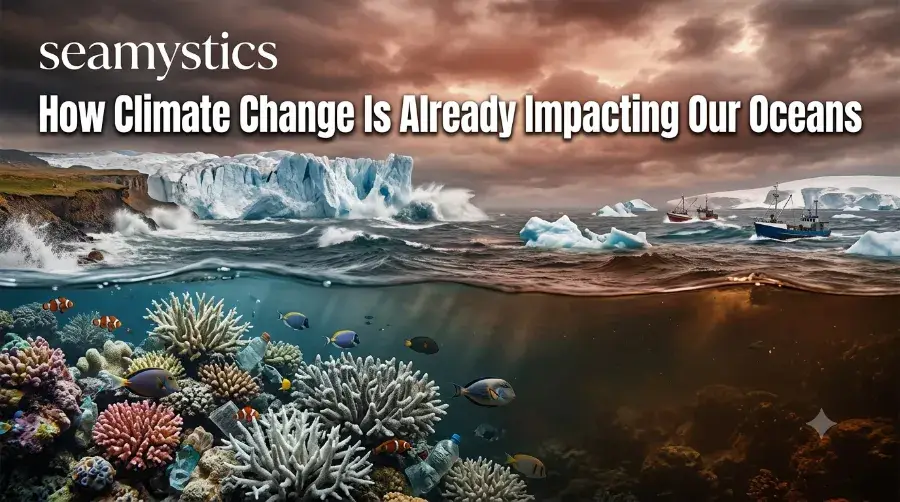
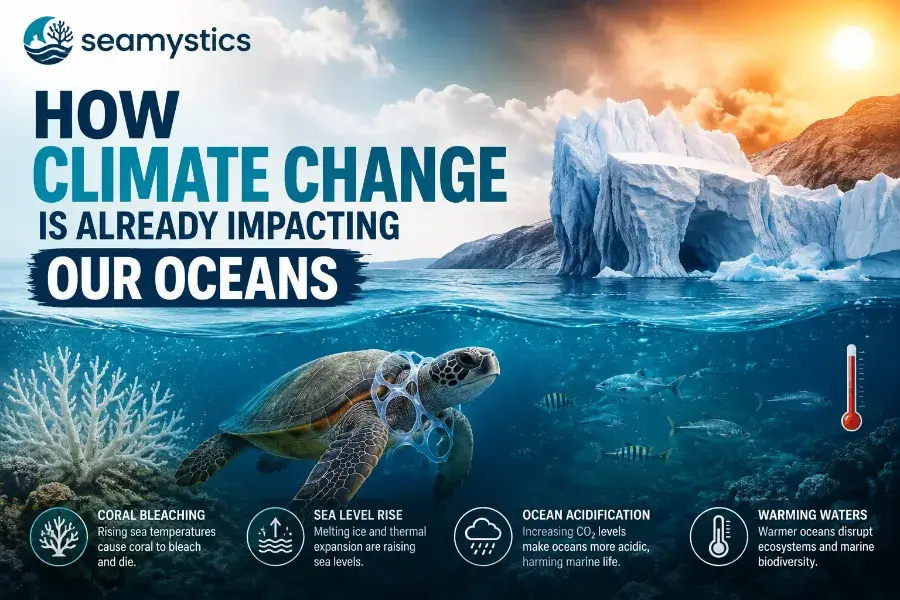
Have you ever looked out at the vast, blue expanse of the ocean and felt it was entirely unchanging? For centuries, humanity treated our oceans as an infinite, resilient buffer. Today, as a working marine biologist, I see a completely different reality beneath the surface. The reality is that climate change ocean impact is no longer a distant threat for the year 2050. It is a unfolding crisis altering our seas right now, changing everything from microscopic plankton to the migration paths of massive whales.
In this comprehensive deep sea dive, we will examine the latest scientific data from 2025 and 2026. We will look at exactly how rising greenhouse gases are transforming marine chemistry, disrupting food webs, and threatening coastal communities across the United States and Europe.
you read our blog How to Protect Our Oceans
Key Takeaways of Current Ocean Impacts
| Impact Factor | Current Observed Change | Primary Ecosystem At Risk |
| Ocean Warming | Global sea surface temperatures hit record highs in 2024–2025 | Coral reefs, Arctic marine mammals |
| Acidification | 30% increase in surface ocean acidity since the industrial era | Shellfish, pteropods, plankton foundations |
| Deoxygenation | 2% loss of global ocean oxygen content since 1960 | Deep-sea fisheries, hypoxic “dead zones” |
| Sea Level Rise | Accelerated to roughly 4.5 mm per year globally | Coastal salt marshes, human infrastructure |
The Rising Heat: Global Sea Surface Temperatures Are Breaking Records
The ocean absorbs more than 90% of the excess heat trapped in our atmosphere by greenhouse gas emissions. Because of this massive heat absorption, our oceans are warming at an unprecedented rate. During 2023 and 2024, the National Oceanic and Atmospheric Administration (NOAA) recorded some of the highest global sea surface temperatures in history. This extreme heat trend stretched well into 2025, leaving marine life with little time to adapt.
Global Ocean Heat Content (0-2000m depth) Trend:
1960 ────────────────────────► Baseline
2000 ───────────────► +150 Zettajoules
2024 ──────────────────────────────────────────► +350+ Zettajoules
When water temperatures stay too high for too long, it triggers marine heatwaves. These underwater heatwaves act exactly like wildfires on land, wiping out vast kelp forests along the California coast and devastating coral reefs in the Florida Keys. If you want to understand how these thermal shifts alter basic marine environments, check out our [/related-guide/ocean-warming-basics].
The Tragedy of Global Coral Bleaching
Coral reefs support more than 25% of all marine life, despite covering less than 1% of the ocean floor. When water temperatures rise even $1^\circ\text{C}$ above the normal summer maximum, corals experience severe stress. This thermal stress forces them to expel the microscopic, colorful algae called zooxanthellae that live inside their tissues.
-
Loss of Food: The algae provide up to 90% of the coral’s energy through photosynthesis.
-
The Bleaching Effect: Without the algae, the coral turns stark white and begins to starve.
-
Mass Mortality: In 2024, the Great Barrier Reef suffered its fifth mass bleaching event in just eight years, killing large swaths of ancient coral.
Ocean Acidification: The Silent Chemistry Crisis
While rising temperatures are easy to visualize, another invisible threat is reshaping our oceans. The burning of fossil fuels releases billions of tons of carbon dioxide ($CO_2$) into the atmosphere. The ocean naturally absorbs roughly 25% to 30% of this gas. When carbon dioxide mixes with seawater, it creates carbonic acid, driving down the pH of the water.
This process is known as ocean acidification. Since the start of the Industrial Revolution, the average pH of surface ocean waters has fallen from approximately 8.21 to 8.10. Because the pH scale is logarithmic, this seemingly small drop represents a massive 30% increase in acidity.
The Dissolving Foundations of the Food Web
This changing chemistry directly affects calcifying organisms. Creatures like oysters, clams, crabs, and tiny sea snails called pteropods need carbonate ions to build their protective shells.
-
Chemical Depletion: Higher acidity reduces the availability of carbonate ions in seawater.
-
Shell Weakening: Organisms must expend far more energy just to grow their shells, leaving less energy for reproduction.
-
Direct Dissolution: In highly acidic waters, thin shells actually begin to dissolve alive.
According to a study published by the Intergovernmental Panel on Climate Change (IPCC), these disruptions at the bottom of the food chain create a domino effect. If pteropods decline, commercial fish species like salmon, herring, and cod lose their primary food source, threatening seafood supplies across North America and Europe.
Shifting Ecosystems and Migrating Species
Marine life does not stay stationary when its environment becomes unlivable. Instead, thousands of species are actively migrating toward the poles in search of cooler water. This massive geographical shift is rewriting the rules of marine ecology and disrupting established fishing industries.
Economic Disruptions in the US and Europe
In the United States, the lucrative Atlantic lobster fishery has experienced a massive northward shift. Over the last two decades, the center of the lobster population moved out of Southern New England and into the deeper, cooler waters of the Gulf of Maine.
Similarly, in Europe, traditional fish stocks like mackerel and herring are moving north toward Iceland and the Arctic Circle. This migration has sparked political disputes over fishing quotas between neighboring nations. You can read more about how these shifting populations alter coastal economies in our [/related-guide/commercial-fisheries-impact].
Rising Sea Levels and Coastal Suffocation
Climate change ocean impact is also transforming the physical boundaries where the sea meets the land. Sea levels are rising due to two main factors: the melting of land-based glaciers and ice sheets, and thermal expansion (warm water naturally expands and takes up more space).
The Loss of Critical Coastal Buffers
Coastal wetlands, mangroves, and salt marshes act as natural buffers, protecting inland areas from severe storms. However, the current accelerated rate of sea level rise is drowning these vital habitats.
Sea Level Rise Acceleration Rate:
┌──────────────────┬────────────────────────┐
│ 1900 - 1990      │ ~1.4 mm / year         │
├──────────────────┼────────────────────────┤
│ 2000 - 2015      │ ~3.2 mm / year         │
├──────────────────┼────────────────────────┤
│ 2016 - 2026      │ ~4.5 mm / year         │
└──────────────────┴────────────────────────┘
Furthermore, as the oceans warm, they hold less dissolved oxygen. Global ocean oxygen levels have dropped by about 2% since the mid-20th century. This deoxygenation creates expanding “dead zones” where fish and crustaceans cannot survive, forcing them to flee or suffocate. To explore how coastal communities are adapting to these structural changes, read our [/related-guide/coastal-adaptation-strategies].
Frequently Asked Questions
How exactly does climate change ocean impact human lives?
The ocean regulates our global weather patterns and generates over half of the oxygen we breathe. A disrupted ocean leads to more severe hurricanes, failing commercial fisheries, and increased coastal flooding in major cities.
Can marine ecosystems recover if we reduce emissions now?
Yes, marine life shows incredible resilience. If global communities drastically lower carbon emissions and establish protected marine areas, many ecosystems, including coral reefs, can slowly adapt and recover over time.
Why is ocean acidification called the “other carbon problem”?
It is called the other carbon problem because it happens independently of global warming. It is a direct chemical reaction between carbon dioxide and seawater, meaning it would occur even if atmospheric temperatures did not rise.
Conclusion
The data clearly shows that climate change ocean impact is shifting the balance of marine life across the globe. From record-setting ocean temperatures to the steady acidification of our waters, the oceans are sending us an urgent warning. Protecting our seas requires reducing global carbon emissions and actively supporting marine conservation efforts. By understanding the science behind these changes, we can take meaningful steps to safeguard our blue planet for generations to come.
About the Author
Dr. Alyssa Rabica is a senior marine biologist and research editor for Sea Mystics, possessing over 20 years of experience studying oceanic climate shifts. She frequently collaborates with international research groups across the United States and Europe to document the impacts of warming waters on pelagic ecosystems.