
The ocean covers more than 70% of Earth’s surface, yet scientists have explored only a small part of it. For thousands of years, people crossed the seas, caught fish, and traded goods. However, they could only imagine what existed beneath the waves. The history of ocean exploration tells an exciting story of curiosity, courage, and scientific progress. From simple diving bells to powerful deep-sea exploration submersibles, each invention helped people discover a hidden underwater world. Today, ocean exploration supports marine conservation, climate research, and the search for new species.
Key Takeaways
| Topic | Key Information |
|---|---|
| Primary Focus | History of ocean exploration |
| First Diving Tool | Primitive diving bells used over 2,000 years ago |
| Major Turning Point | Development of diving suits during the 1800s |
| Deepest Human Dive | Challenger Deep, nearly 11,000 meters |
| Modern Technology | Submersibles, ROVs, AUVs, sonar, satellite mapping |
| Importance | Marine science, climate research, biodiversity, conservation |
Why Ocean Exploration Matters
The ocean regulates Earth’s climate, produces much of the oxygen we breathe, and supports millions of species. Nevertheless, scientists estimate that more than 80% of the ocean remains unmapped and unexplored. Every expedition improves our understanding of marine ecosystems and helps protect fragile habitats.
Ocean exploration also benefits everyday life. Researchers discover new medicines, improve weather forecasting, and monitor changing ocean temperatures. As technology advances, scientists continue to uncover remarkable secrets beneath the surface.
Early Human Curiosity About the Ocean
Long before modern science existed, people wanted to understand the sea. Ancient civilizations relied on the ocean for food, transportation, and trade. Consequently, they developed basic methods for exploring shallow waters.
Divers from ancient Greece, Egypt, and Persia collected pearls, sponges, and shells. Many of these divers trained from childhood and could hold their breath for several minutes. Although their equipment remained simple, their skills laid the foundation for underwater exploration.
Early Ocean Uses
- Pearl harvesting
- Sponge diving
- Ship repair
- Harbor construction
- Military reconnaissance
These early activities inspired inventors to create tools that allowed people to stay underwater longer.
The First Diving Bells
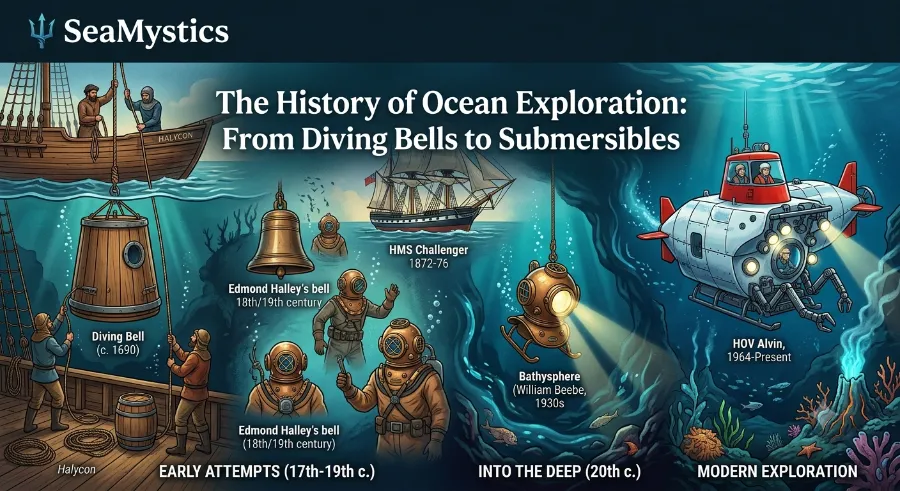
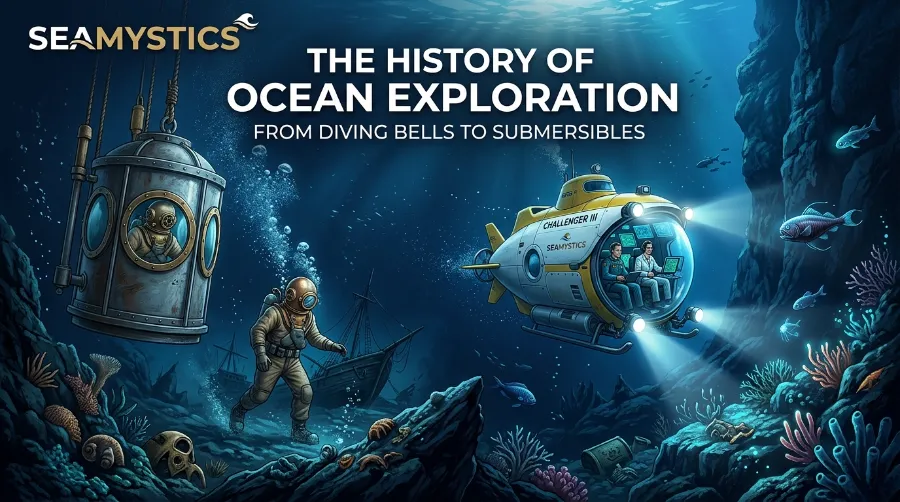
One of the earliest underwater technologies was the diving bell. Historical records suggest that simple diving bells appeared more than 2,000 years ago.
A diving bell worked by trapping air inside a large upside-down chamber. Workers lowered the bell into the water, where the trapped air allowed divers to breathe for short periods.
Advantages
- Extended underwater time
- Better visibility than free diving
- Supported underwater construction
Limitations
- Limited oxygen supply
- Heavy and difficult to move
- Suitable only for shallow depths
Even with these drawbacks, diving bells represented a major milestone in underwater exploration.
Renaissance Innovation Changed Ocean Exploration
During the Renaissance, European inventors improved underwater equipment. Engineers sketched designs for breathing devices, diving suits, and underwater vessels.
One famous example came from Leonardo da Vinci, who designed concepts for underwater breathing equipment. Although many of his ideas remained theoretical, they inspired later inventors.
At the same time, improved shipbuilding allowed explorers to travel farther across the oceans. Better navigation tools also encouraged scientific observations during long voyages.
Scientific Exploration Begins
By the 1600s and 1700s, curiosity shifted from exploration for trade toward scientific discovery.
Natural philosophers began collecting:
- Marine plants
- Shells
- Coral samples
- Fish specimens
- Ocean sediments
Scientists wanted to understand how ocean life functioned. As a result, expeditions increasingly included researchers instead of only sailors.
Better Diving Equipment During the 1800s
The Industrial Revolution transformed underwater exploration.
Engineers developed stronger metal diving helmets connected to surface air pumps. These suits allowed divers to remain underwater for much longer than before.
Improvements Included
| Innovation | Benefit |
| Copper helmets | Better protection |
| Air pumps | Longer dives |
| Waterproof suits | Improved safety |
| Communication ropes | Better coordination |
Professional divers soon repaired bridges, recovered shipwrecks, and inspected underwater structures.
The 1800s marked the beginning of practical underwater engineering.
The HMS Challenger Expedition Changed Marine Science
Between 1872 and 1876, one expedition transformed ocean science forever.
The HMS Challenger Expedition traveled nearly 69,000 nautical miles, making thousands of scientific observations.
Researchers collected:
- Over 4,700 new marine species
- Ocean temperature data
- Water chemistry samples
- Deep-sea sediments
- Ocean depth measurements
This expedition became the foundation of modern oceanography.
Key Discoveries
| Achievement | Result |
| Deep ocean sounding | Improved maps |
| Marine species collection | Expanded biodiversity knowledge |
| Water chemistry studies | Better understanding of seawater |
| Temperature measurements | Early climate observations |
Scientists still reference many Challenger findings today.
Timeline of Major Ocean Exploration Milestones
| Year | Milestone |
| Ancient Times | Breath-hold diving begins |
| Around 300 BC | Diving bells become known |
| 1500s | Renaissance underwater designs emerge |
| 1800s | Standard diving suits developed |
| 1872–1876 | HMS Challenger scientific expedition |
| 1930s | Bathysphere reaches greater depths |
| 1960 | Human reaches Challenger Deep |
| 2000s | Advanced robotic exploration expands |
How Ocean Exploration Continued to Evolve
By the early twentieth century, scientists realized that traditional diving equipment could not safely reach the deepest parts of the ocean. Pressure increased rapidly with depth, making ordinary diving suits ineffective. Therefore, engineers began designing enclosed vehicles that could protect explorers while allowing them to observe life in the deep sea.
These innovations marked the beginning of a new era. Instead of relying only on divers, researchers started using specially built underwater craft that could travel farther, remain underwater longer, and safely withstand enormous pressure. Those breakthroughs eventually led to the development of bathyspheres and, later, modern submersibles that transformed marine science.
The Bathysphere Opened a New Window to the Deep Ocean
By the early 1900s, scientists wanted to explore depths that ordinary diving suits could never reach. Engineers responded by building the bathysphere, a heavy steel sphere lowered into the ocean by a cable. Although it looked simple, this invention changed marine science forever.
The bathysphere protected its occupants from the crushing pressure of the deep sea. Thick steel walls and small quartz windows allowed explorers to observe marine life that no human had seen before.
In 1930, American engineer Otis Barton completed successful deep dives using the bathysphere. Soon after, marine zoologist William Beebe joined these missions, documenting strange deep-sea animals with remarkable detail. Their observations challenged the belief that little life existed in the deep ocean.
Bathysphere Specifications
| Feature | Description |
|---|---|
| Material | Cast steel |
| Weight | About 2.25 tons |
| Maximum Depth Achieved | Approximately 923 meters (3,028 feet) |
| Occupants | Two people |
| Air Supply | Compressed oxygen with carbon dioxide removal |
Although the bathysphere relied on a cable from the surface, it proved that humans could safely visit the deep sea.
Jacques Cousteau Changed Underwater Exploration
The next great breakthrough came during the 1940s. French naval officer and explorer Jacques-Yves Cousteau, together with engineer Émile Gagnan, developed the Aqua-Lung in 1943.
Unlike earlier diving systems, the Aqua-Lung allowed divers to swim freely without remaining connected to the surface. This invention became the world’s first successful open-circuit scuba system.
As a result, scientists could spend more time underwater while studying coral reefs, fish, and underwater ecosystems.
Why the Aqua-Lung Was Revolutionary
- Greater freedom underwater
- Longer diving times
- Lower operating costs
- Easier scientific observation
- Improved underwater photography
The invention also made recreational scuba diving possible, introducing millions of people to the underwater world.
The Race to Reach the Deepest Ocean
As technology improved, engineers began building self-powered underwater vehicles called submersibles. These craft differed from the bathysphere because they could move independently instead of hanging from a cable.
The most famous early deep-diving submersible was the Trieste.
The Historic Dive of 1960
On January 23, 1960, Swiss engineer Jacques Piccard and U.S. Navy Lieutenant Don Walsh descended into the Challenger Deep, the deepest known point in the world’s oceans.
Their dive reached nearly 10,916 meters (35,814 feet) below sea level in the Mariana Trench.
The pressure at this depth exceeded 1,000 times the atmospheric pressure at sea level. Despite these extreme conditions, the Trieste survived the journey.
Why This Dive Was Important
- First human visit to Earth’s deepest known location
- Confirmed life exists in extreme environments
- Advanced deep-sea engineering
- Inspired future generations of ocean scientists
The mission remains one of the greatest achievements in marine exploration.
The Rise of Modern Submersibles
After the success of Trieste, engineers designed smaller, more advanced research vehicles.
Modern submersibles include:
- Better navigation systems
- High-definition cameras
- Robotic arms
- Scientific laboratories
- Powerful lighting
Unlike early designs, today’s submersibles can carefully collect rock samples, biological specimens, and water from extreme depths.
Popular Research Submersibles
| Name | Country | Maximum Depth |
| Alvin | United States | About 6,500 meters |
| Shinkai 6500 | Japan | 6,500 meters |
| Jiaolong | China | Over 7,000 meters |
| Limiting Factor | United States | Full ocean depth |
These vehicles continue to support scientific discoveries around the globe.
Sonar Revolutionized Ocean Mapping
Exploring the ocean requires more than underwater vehicles. Scientists also need accurate maps.
This challenge led to the development of SONAR, which stands for Sound Navigation and Ranging.
Instead of using light, sonar sends sound waves through the water. The returning echoes reveal the location of underwater mountains, valleys, shipwrecks, and marine animals.
Types of Sonar
| Type | Purpose |
| Single Beam | Basic depth measurement |
| Multibeam | High-resolution seafloor mapping |
| Side Scan | Shipwreck and habitat imaging |
| Imaging Sonar | Object identification |
Today, sonar has mapped millions of square kilometers of the ocean floor.
Satellite Technology Improved Ocean Research
Although satellites cannot see the ocean floor directly, they measure tiny changes in sea surface height.
These measurements help scientists estimate:
- Underwater mountain ranges
- Ocean trenches
- Seafloor ridges
- Ocean currents
- Sea level changes
Satellite observations also support weather prediction and climate research.
The Age of Remotely Operated Vehicles (ROVs)
Human divers cannot safely reach the deepest oceans every day. Therefore, scientists increasingly rely on ROVs.
An ROV is connected to a research ship by a long cable. Operators control the vehicle from the surface using cameras and robotic arms.
Main Advantages
- No danger to human divers
- Very long operating times
- Excellent image quality
- Precise sample collection
- Reliable performance in harsh environments
ROVs now inspect underwater pipelines, study hydrothermal vents, and investigate shipwrecks.
Autonomous Underwater Vehicles (AUVs)
Unlike ROVs, Autonomous Underwater Vehicles (AUVs) operate without a tether.
Scientists program these robotic vehicles before launch. Once underwater, they navigate independently using sensors and onboard computers.
Common Scientific Uses
- Mapping unexplored seafloor
- Measuring ocean temperature
- Tracking ocean currents
- Monitoring pollution
- Studying marine ecosystems
AUVs can cover hundreds of kilometers during a single mission, making them valuable tools for large-scale surveys.
Comparing Ocean Exploration Technologies
| Technology | Human Onboard | Mobility | Maximum Use |
| Diving Bell | Yes | Very Limited | Shallow work |
| Diving Suit | Yes | Moderate | Coastal exploration |
| Bathysphere | Yes | None (Cable) | Deep observation |
| Submersible | Yes | Excellent | Scientific research |
| ROV | No | Excellent | Industrial and scientific missions |
| AUV | No | Fully Autonomous | Long-distance surveys |
Ocean Exploration Has Improved Marine Conservation
As exploration technology advanced, scientists discovered fragile ecosystems that required protection.
For example, researchers found:
- Deep-sea coral forests
- Hydrothermal vent communities
- Cold-water sponge reefs
- Underwater volcano ecosystems
- Rare deep-sea fish
Many of these habitats contain species found nowhere else on Earth.
Because scientists can now study these ecosystems more closely, governments have expanded marine protected areas and strengthened conservation efforts.
Key Innovations That Changed Ocean Science
- Diving bells extended underwater time.
- Copper diving suits improved safety.
- The bathysphere reached unprecedented depths.
- Scuba equipment increased underwater mobility.
- Submersibles enabled independent deep-sea exploration.
- Sonar transformed ocean mapping.
- ROVs reduced risks to human researchers.
- AUVs automated large-scale ocean surveys.
Looking Ahead
Ocean exploration continues to advance at an impressive pace. Artificial intelligence, machine learning, and next-generation robotics are helping scientists investigate places that were once impossible to reach.
Future expeditions will likely reveal thousands of new marine species, improve our understanding of climate change, and uncover geological processes that shape our planet. Even after centuries of exploration, the deep ocean remains one of Earth’s
The Modern Era of Ocean Exploration
Today, ocean exploration combines cutting-edge engineering, artificial intelligence (AI), robotics, satellite technology, and advanced computing. Modern research vessels operate as floating laboratories, allowing scientists to study marine life, ocean chemistry, geology, and climate in real time.
Researchers now explore places that were once considered impossible to reach. High-definition cameras, laser scanners, robotic arms, and environmental sensors collect enormous amounts of information during every expedition. Consequently, discoveries happen much faster than ever before.
Governments, universities, and private organizations also work together on international projects. This cooperation has accelerated ocean mapping, biodiversity research, and climate monitoring across the globe.
Major Ocean Exploration Technologies Used Today
| Technology | Main Purpose | Typical Working Depth |
|---|---|---|
| Human-Occupied Submersibles | Scientific observation | Up to full ocean depth |
| ROVs | Sample collection and inspections | Up to full ocean depth |
| AUVs | Autonomous seafloor mapping | 6,000+ meters |
| Multibeam Sonar | Ocean floor mapping | Entire ocean |
| Satellite Altimetry | Global ocean monitoring | Surface observations |
| Underwater Gliders | Long-term ocean monitoring | Up to 1,000 meters |
These technologies complement one another, providing scientists with a more complete understanding of the world’s oceans.
How Ocean Exploration Supports Climate Research
Ocean exploration is no longer limited to discovering new species. Today, it also plays a critical role in understanding Earth’s changing climate.
Scientists monitor:
- Ocean warming
- Sea-level rise
- Ocean acidification
- Melting polar ice
- Carbon storage
- Deep ocean currents
Because the ocean absorbs about 90% of the excess heat trapped by greenhouse gases, studying it is essential for predicting future climate conditions.
Research vessels deploy thousands of floating sensors that continuously measure ocean temperature and salinity. These observations improve weather forecasts and long-term climate models.
Discoveries That Changed Marine Science
Modern exploration has revealed remarkable underwater environments.
Hydrothermal Vents
Scientists discovered hydrothermal vents in 1977 near the Galápagos Rift. These underwater hot springs support unique ecosystems powered by chemical energy rather than sunlight.
This discovery completely changed scientific understanding of how life can survive in extreme conditions.
Deep-Sea Coral Reefs
Researchers once believed coral reefs only existed in warm tropical waters. However, ocean exploration uncovered extensive cold-water coral reefs thousands of meters below the surface.
These reefs provide shelter for countless marine organisms and may live for several thousand years.
New Marine Species
Every year, marine scientists identify hundreds of previously unknown ocean species.
Recent discoveries include:
- Deep-sea octopuses
- Glass sponges
- Bioluminescent jellyfish
- Ghost sharks
- New coral species
- Deep-water crustaceans
Many unexplored habitats likely contain thousands of additional species waiting to be documented.
Ocean Mapping Progress
Despite decades of exploration, much of the ocean floor remains unmapped in high resolution.
Estimated Global Ocean Mapping Progress
| Year | Estimated High-Resolution Mapping |
| 2017 | 6% |
| 2020 | 19% |
| 2023 | 25% |
| 2025 | About 27% |
| 2026 | Approximately 30% (ongoing estimates) |
Text Chart: Growth of High-Resolution Ocean Mapping
2017   ███
2020   ██████████
2023   █████████████
2025   ██████████████
2026   ███████████████
Although progress continues, scientists still have much work ahead.
Ocean Depth Comparison
| Ocean Feature | Approximate Depth |
| Average Ocean Depth | 3,688 meters |
| Titanic Wreck | 3,800 meters |
| Deep Hydrothermal Vents | 2,000–5,000 meters |
| Abyssal Plain | 3,000–6,000 meters |
| Challenger Deep | Nearly 11,000 meters |
Depth Comparison Chart
Sea Surface        0 m
████████████████████████

Average Ocean
██████████████
3,688 m

Titanic
████████████████
3,800 m

Abyssal Plain
██████████████████████
6,000 m

Challenger Deep
█████████████████████████████████
≈11,000 m
Why Ocean Exploration Matters More Than Ever
Ocean exploration benefits people in many ways.
It Helps Scientists
- Discover new marine species
- Study ocean ecosystems
- Understand Earth’s history
- Improve biodiversity conservation
It Helps Society
- Better weather forecasts
- Improved climate prediction
- Disaster preparedness
- Sustainable fisheries
- Medical discoveries
- Renewable energy research
Future of Ocean Exploration
The next decade promises exciting innovations.
Scientists are developing:
- AI-powered underwater robots
- Swarm robotics
- Ultra-long-range autonomous vehicles
- DNA-based environmental monitoring
- Real-time underwater internet systems
- Improved deep-sea imaging
Many experts believe that future expeditions will reveal thousands of unknown marine species and uncover geological features that reshape our understanding of Earth’s history.
Key Facts at a Glance
| Fact | Value |
| Earth’s surface covered by oceans | About 71% |
| Ocean still largely unexplored | More than 70% remains poorly explored |
| Deepest known point | Challenger Deep |
| Maximum known ocean depth | Nearly 11,000 meters |
| First successful Challenger Deep dive | 1960 |
| Modern exploration tools | Submersibles, ROVs, AUVs, sonar, satellites |
Conclusion
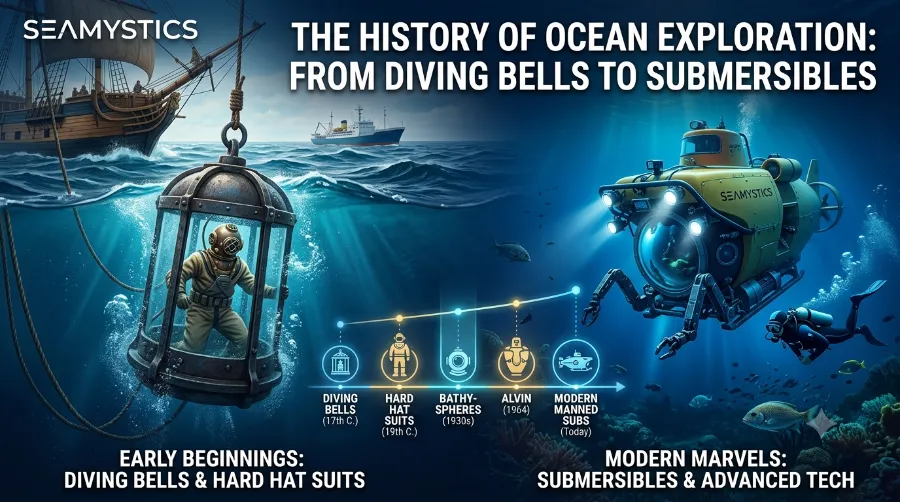
The history of ocean exploration reflects humanity’s endless desire to discover the unknown. From the earliest diving bells to today’s sophisticated submersibles, each generation has expanded our understanding of the underwater world. Every technological breakthrough has allowed scientists to explore deeper, map more accurately, and reveal extraordinary marine ecosystems.
Even now, much of the ocean remains unexplored. As robotics, artificial intelligence, and advanced research vessels continue to evolve, future expeditions will uncover new species, improve climate science, and strengthen marine conservation. The next great chapter in ocean exploration has only just begun.history-of-ocean-exploration