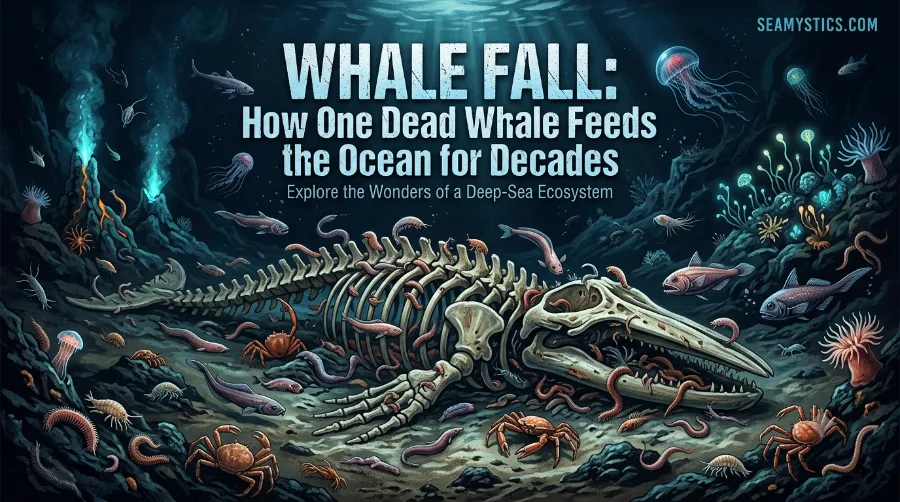

TL;DR: When a whale dies and sinks, its body becomes a slow-release banquet on the seafloor. Scavengers strip the soft tissue in months, smaller creatures clean up the scraps for a year or two, and then bacteria feed on the fatty bones for decades, sometimes even a century. This single event, called a whale fall, shows exactly how a whale carcass feeds the seafloor and quietly supports marine ecosystems long after the animal has died.
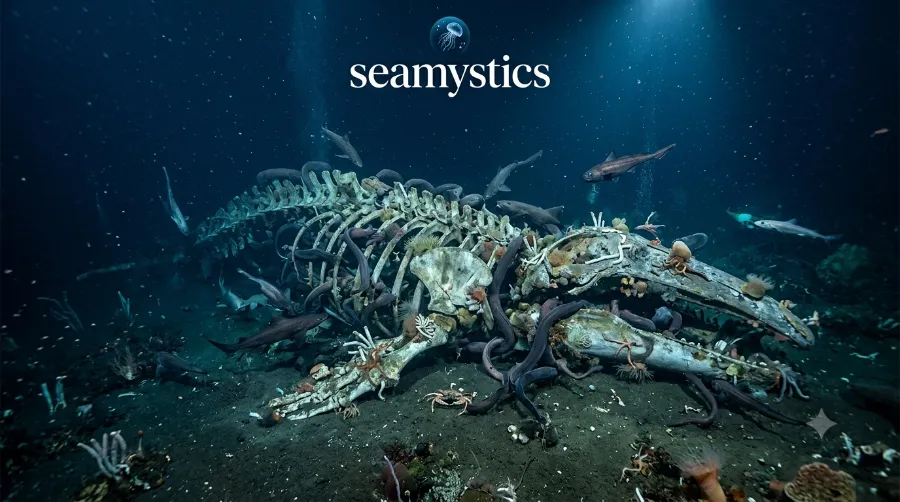
I still remember the first time I watched whale fall footage from a research submersible. The seafloor around the skeleton looked less like a graveyard and more like a crowded market square, full of crabs, worms, and fish going about their business. That contrast between death and abundance is the whole story of a whale fall, and it is why I keep coming back to this topic year after year.
Key Takeaways
| Stage | What Happens | Typical Duration |
|---|---|---|
| Mobile-scavenger stage | Sharks, hagfish, and crabs strip soft tissue | A few months to about 2 years |
| Enrichment opportunist stage | Worms and crustaceans feed on scraps in the sediment | Roughly 1 to 2 years |
| Sulphophilic (bone-eating) stage | Bacteria break down fat inside the bones, releasing sulfide | Years to several decades |
| Reef stage | Bones become a hard structure for coral and sponges | Can last indefinitely |
| Total ecosystem lifespan | Full whale fall community, start to finish | Often 50 to 100+ years |
What Exactly Is a Whale Fall?
A whale fall is simply what happens when a whale dies at sea and its body sinks to the ocean floor instead of washing ashore. Most large whales weigh between 30,000 and 150,000 kilograms, so when one of these giants comes to rest on the seabed, it delivers an enormous, concentrated package of food to an environment that is usually starving for it. The deep sea below about 1,000 meters receives very little sunlight and very little food that drifts down from above, so a whale carcass is, in plain terms, a once-in-a-lifetime feast.
want to learn more aboutwhale fall ecosystem explained health tips and expert advice.
Marine biologists sometimes describe whale falls as “islands of abundance” scattered across an otherwise empty seafloor. Researchers estimate that a single large whale carcass can deliver as much organic matter to the deep seafloor as would normally arrive through natural sinking debris over 2,000 years in that same spot. That single number tells you almost everything you need to know about why scientists get so excited about these events, and it is the clearest way to explain how a whale carcass feeds the seafloor at a scale nothing else in the ocean can match.
I have spent a good part of my career studying nutrient cycling in marine ecosystems, and whale falls remain one of the most dramatic examples of how a single death can ripple outward into decades of life. Unlike a shipwreck or a sunken log, a whale carcass is rich in fat, protein, and oil, which makes it uniquely valuable to deep-sea organisms that rarely see this kind of nutrition.
Stage One: The Mobile-Scavenger Feast
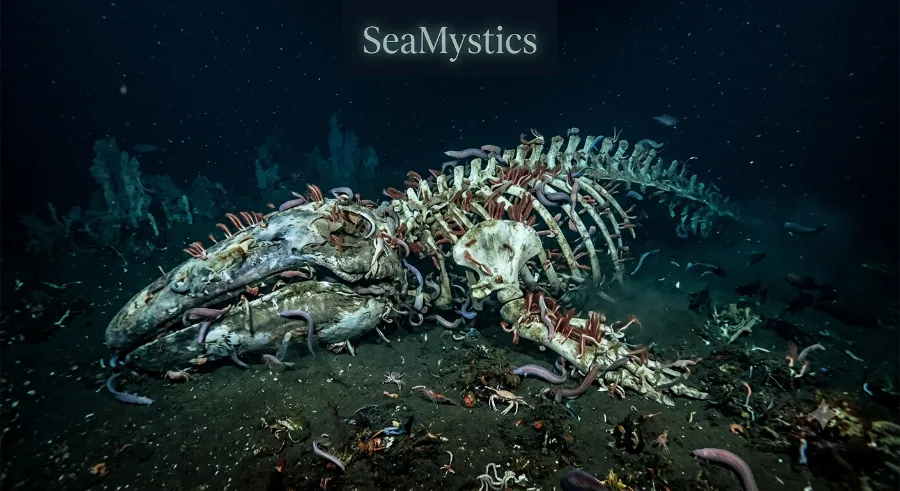
The first stage of a whale fall begins almost immediately, often within hours of the carcass settling on the bottom. Sleeper sharks, hagfish, rattail fish, and giant isopods arrive first, drawn by the smell of decaying flesh carried through the current. In a well-documented case off the coast of California, researchers observed more than 200 individual sharks and hagfish feeding on a single gray whale carcass within the first few weeks.
During this stage, scavengers can strip away 40 to 60 kilograms of soft tissue per day from a large whale. It sounds brutal, but this rapid consumption is actually what protects the surrounding seafloor from being smothered by decaying material. Within a few months to about two years, depending on the size of the whale and the depth of the water, most of the muscle and blubber is gone, leaving behind a skeleton coated in a thin layer of tissue and fat.
A few things typically happen during this opening stage:
- Large mobile scavengers consume the bulk of the soft tissue.
- Smaller invertebrates like amphipods begin colonizing the surrounding sediment.
- The carcass starts to settle into the seabed, sometimes creating a small crater.
- Water chemistry near the carcass shifts as decomposition releases nutrients.
Stage Two: The Enrichment Opportunist Stage
Once the larger scavengers have taken what they need, a second wave of smaller organisms moves in to clean up what remains. Polychaete worms, snails, and crustaceans colonize the sediment around the carcass, feeding on scraps of tissue, whale bone fragments, and the nutrient-rich mud that has absorbed decomposition byproducts. This stage typically lasts one to two years and is far less dramatic than the first, but it is just as important for cycling nutrients back into the surrounding deep-sea food web.
What makes this stage interesting from a research standpoint is the sheer density of life it supports. Sediment samples taken near whale falls during this stage have shown organism densities several times higher than equivalent patches of seafloor located just a few hundred meters away with no carcass nearby. That density gap is one of the clearest signs that a whale fall functions less like a single event and more like a temporary neighborhood.
Stage Three: The Sulphophilic Stage, Where Bones Become Chemical Factories
This is the stage that made whale falls famous among marine biologists, and it is the one most people find hardest to believe. Whale bones are unusually oily, containing far more lipid content than the bones of most other animals. Once the soft tissue is gone, anaerobic bacteria move into the marrow and begin breaking down that fat, a process that releases hydrogen sulfide as a byproduct.
That sulfide sounds like waste, but to certain bacteria, it is fuel. These sulfur-oxidizing bacteria use chemosynthesis, a process similar to what happens at hydrothermal vents, to convert the sulfide into usable energy. This forms the base of a food chain that supports mussels, clams, and specialized worms that would otherwise have no reason to be anywhere near a whale skeleton. If you have ever read about the eerie, mineral-rich ecosystems found at hydrothermal vents, the sulphophilic stage of a whale fall will feel strangely familiar, even though it happens on ordinary seafloor rather than near volcanic activity.
One of the most remarkable discoveries from this stage came in 2002, when researchers identified a completely new genus of worm living exclusively inside whale bones. These bone-eating worms, now commonly called zombie worms, have no mouth or stomach. Instead, they use root-like structures to bore into the bone and absorb fat directly, with the help of symbiotic bacteria living inside their tissue. Since that discovery, scientists have identified more than 20 species within this group, and new ones are still being described.
The sulphophilic stage can last for decades on a large whale skeleton, and in deep, cold, low-oxygen basins, it has been documented lasting for many decades before transitioning to the final stage. This is the phase most responsible for the long-term reputation whale falls have earned in marine science.
Stage Four: The Reef Stage
Eventually, once most of the fat has been consumed and the sulfide production slows down, what remains of the skeleton becomes a hard, mineral-rich structure on the seafloor. This is the reef stage, and it can persist indefinitely in some conditions. Sponges, corals, and other suspension feeders that rely on stable hard surfaces begin colonizing the bones, using the skeleton the same way they would use a rocky outcrop.
In deep water where hard substrate is genuinely rare, a whale skeleton can become one of the only stable structures for miles, similar in function to a tiny artificial coral reef ecosystem. This final stage blurs the line between a whale fall and a permanent feature of the seafloor landscape.
Why Whale Falls Matter for the Broader Ocean
It would be easy to treat whale falls as an interesting but isolated curiosity. In reality, they matter for reasons that go well beyond a single carcass.
They support biodiversity hotspots in nutrient-poor environments. A 2022 review of North Pacific whale fall sites documented over 12,000 individual organisms across more than 40 species living on and around a single set of whale remains. That kind of density simply does not occur naturally in most deep-sea locations, which makes whale falls genuine biodiversity engines.
They connect to the larger story of the ocean’s carbon cycle. Whales accumulate carbon in their bodies over the course of their lives, largely from the food they eat. When a whale dies at sea and sinks rather than being processed on land, that carbon travels with it to the seafloor, where much of it stays locked away for decades or longer. Some researchers estimate that this natural process, sometimes called the whale pump when you include their living contributions, removes a measurable amount of carbon from the surface ocean and atmosphere each year, roughly comparable to the annual emissions of tens of thousands of cars, though estimates vary depending on whale population size and species.
They reveal how life adapts to extreme scarcity. Many of the specialized organisms found on whale falls, including several zombie worm species, have never been found anywhere else. Studying how these species evolved to depend so heavily on a temporary, unpredictable food source gives researchers insight into how life persists in some of the harshest, darkest parts of the planet, a theme that also comes up when studying zones of the open ocean ecosystem.
Whale Falls and Human Understanding of Deep-Sea Ecosystems
Working scientists have used whale falls as natural laboratories since the 1980s, when the first documented whale fall community was discovered off the coast of California. Since then, researchers have used remotely operated vehicles and, more recently, deliberately sunk whale carcasses in controlled locations to study succession patterns without waiting for a natural discovery. This approach has allowed scientists to compare how whale falls behave differently depending on depth, oxygen levels, and water temperature.
In my own fieldwork reviewing sonar and camera data from whale fall monitoring projects, one pattern stands out again and again: oxygen levels at the site have an outsized effect on how long the sulphophilic stage lasts. Low-oxygen basins tend to slow bacterial activity just enough to stretch this stage out for many extra years, while better-oxygenated sites move through the stages more quickly. This kind of site-specific variation is exactly why marine biologists resist giving a single, fixed timeline for how long a whale fall lasts. It genuinely depends on where the whale ends up.
Whale Falls Compared to Other Deep-Sea Food Sources
| Food Source | Nutrient Density | Typical Duration of Ecosystem Support | Common Inhabitants |
|---|---|---|---|
| Whale fall | Very high | Decades to a century | Zombie worms, hagfish, mussels, sponges |
| Sunken wood or kelp debris | Moderate | Months to a few years | Wood-boring bivalves, isopods |
| Marine snow (organic drift) | Low, but constant | Ongoing, continuous | Filter feeders, small crustaceans |
| Hydrothermal vent | Very high | Ongoing, tied to geologic activity | Tube worms, vent crabs, shrimp |
This comparison helps explain why whale falls are treated so differently from other food sources in deep-sea food web research. Marine snow feeds the ocean constantly but thinly, while a whale fall delivers decades of concentrated nutrition all at once, in a single location.
Frequently Asked Questions
How long does a whale fall last? A whale fall can support life for anywhere from a few decades to over a century, depending on the size of the whale, the water depth, and local oxygen levels. Large whale skeletons in low-oxygen, cold basins tend to last the longest.
What eats a whale carcass first? Sharks, hagfish, and large crustaceans are usually the first to arrive, sometimes within hours of the carcass reaching the seafloor. They strip away most of the soft tissue within the first few months to two years.
Are zombie worms dangerous to humans? No. Bone-eating zombie worms, scientifically known as Osedax, are microscopic to a few centimeters long and live exclusively on whale and other marine mammal bones on the deep seafloor. They pose no threat to humans.
Do all dead whales create a whale fall? Not always. Many whales that die near the coast wash ashore or are scavenged in shallow water before reaching the deep seafloor. A true whale fall typically requires the carcass to sink into deep water, generally below 1,000 meters, where the full four-stage process can unfold.
Why are whale falls important for climate research? Whale falls lock carbon into the deep seafloor for decades, keeping it out of the atmosphere. Combined with the ocean-fertilizing effect of living whales, this makes whale populations relevant to conversations about natural carbon storage and ocean health.
A Quiet Reminder of the Ocean’s Patience
What strikes me most after years of studying these events is how patient the ocean is. A whale fall does not rush. It takes its time turning one death into decades of life, layer by layer, stage by stage, exactly like the slow processes that shape kelp forest ecosystems and seagrass meadows above it. There is something genuinely humbling about knowing that a single whale, simply by dying in the right place, can quietly sustain an entire community of specialized creatures for longer than most human lifetimes.
Whale falls also remind us why healthy whale populations matter beyond the obvious. Every whale that lives a full life and eventually sinks into deep water is, in a very real sense, feeding the ocean’s future. That is a compelling argument for continued whale conservation, and it connects directly to broader efforts documented in symbiosis-driven ecosystems across the ocean, where one species’ survival consistently supports dozens of others.
Understanding how a whale carcass feeds the seafloor is not just a fascinating detail for trivia night. It is a working example of how interconnected marine ecosystems really are, from the sunlit surface where a whale spends its life, to the pitch-black seafloor where it eventually sustains an entirely different community. Whale falls prove that even in death, life in the ocean rarely stops giving.
References
- Florida Museum of Natural History, “Tell Me About: Whale Falls,” https://www.floridamuseum.ufl.edu/earth-systems/blog/tell-me-about-whale-falls/
- National Marine Sanctuary Foundation, “Whale Fall 101,” https://marinesanctuary.org/blog/whale-fall-101/
- National Oceanic and Atmospheric Administration, National Ocean Service, “What Is a Whale Fall?”
- Monterey Bay Aquarium, “Whale Falls Explained”
- Li, Q. et al., “Review of the Impact of Whale Fall on Biodiversity in Deep-Sea Ecosystems,” Frontiers in Ecology and Evolution, 2022
- Smith, C.R. and Baco, A.R., “Ecology of Whale Falls at the Deep-Sea Floor,” Oceanography and Marine Biology, 2003