
The ocean continues to surprise scientists with remarkable discoveries. In 2026, two unusual creatures captured worldwide attention: the Elven abyss tunicate and Iskra’s glitter worm. These species look as if they came from a fantasy novel rather than Earth’s deep oceans.
Scientists recently placed both animals among the most remarkable marine species described from recent research. Their discovery highlights how much of the deep sea remains unexplored and why marine biodiversity deserves greater protection. According to researchers, more than 2,500 marine species were identified during 2025 alone, showing that the ocean still holds countless secrets.
Why Scientists Are Talking About These New Species
Every year, researchers discover thousands of organisms. However, only a small number receive widespread attention.
The Elven abyss tunicate and glitter worm stand out because they combine unusual appearances with fascinating survival strategies. Furthermore, both species help scientists better understand life in extreme environments.
Key reasons these discoveries matter:
- They expand our understanding of deep-sea biodiversity.
- They reveal new evolutionary adaptations.
- They demonstrate how little we know about ocean ecosystems.
- They support conservation efforts for fragile marine habitats.
What Is the Elven Abyss Tunicate?
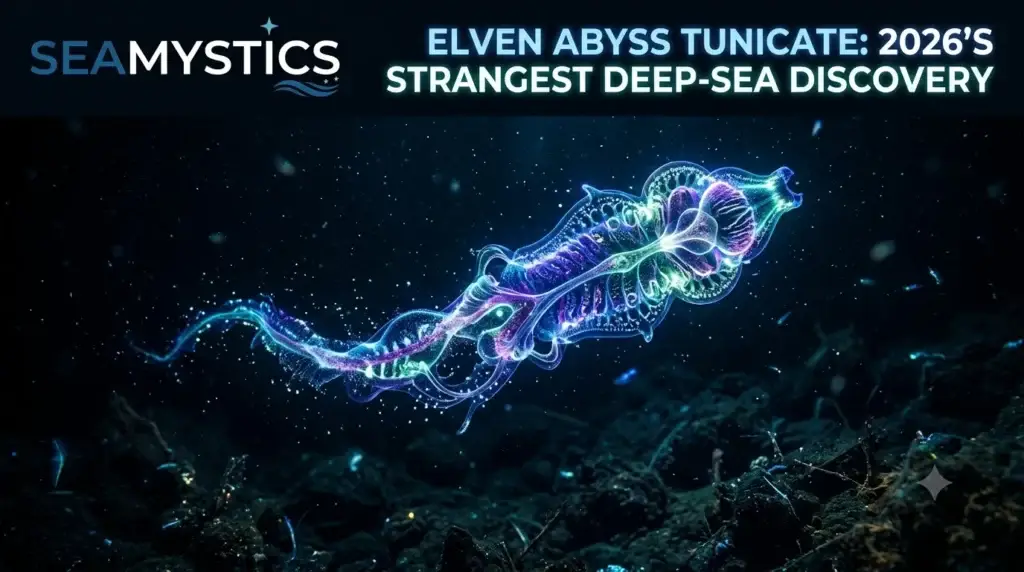
The Elven abyss tunicate, scientifically known as Kaikoja undume, is a deep-sea sea squirt discovered off Western Australia. Researchers collected specimens from depths between 2,000 and 4,000 meters below the ocean surface.
Unlike most tunicates, which filter tiny particles from seawater, this species has evolved into a predator.
Unique Features of the Elven Abyss Tunicate
| Feature | Description |
|---|---|
| Scientific Name | Kaikoja undume |
| Habitat | Deep ocean floor |
| Depth Range | 2,000–4,000 meters |
| Feeding Style | Predatory |
| Discovery Publication | 2025 |
| Region Found | Western Australia |
The creature’s feeding structure resembles a Venus flytrap. Instead of filtering plankton, it traps small animals drifting through the dark ocean depths. Scientists named it after an Elvish word created by J.R.R. Tolkien because of its mysterious appearance and deep-sea habitat.
How the Tunicate Hunts
Most sea squirts are passive feeders. However, this species follows a different strategy.
Its hunting process works like this:
- The large siphon remains open.
- Small prey approaches.
- The structure quickly closes.
- The prey becomes trapped.
- Digestion begins.
As a result, the tunicate survives in an environment where food remains scarce.
Meet Iskra’s Glitter Worm
Iskra’s glitter worm, officially named Photinopolynoe iskrae, is another extraordinary deep-sea discovery. Scientists described this shimmering worm during research on unusual Pacific Ocean ecosystems.
The worm gained attention because of its sparkling scales and ability to thrive in multiple extreme environments.
Quick Facts About Iskra’s Glitter Worm
| Characteristic | Details |
| Scientific Name | Photinopolynoe iskrae |
| Discovery Year | 2025 |
| Habitat Type | Deep-sea ecosystems |
| Appearance | Iridescent scales |
| Feeding Environment | Chemosynthetic habitats |
| Ocean Region | Pacific Ocean |
Why Is It Called a Glitter Worm?
The worm possesses reflective scales that create a glittering appearance under scientific imaging equipment.
These scales produce colorful reflections that make the species visually stunning. Consequently, researchers quickly recognized it as one of the most beautiful deep-sea organisms described in recent years.
Where Scientists Found the Glitter Worm
One reason researchers find this species so important involves its habitat flexibility.
Scientists observed the worm in:
- Whale falls
- Wood falls
- Methane seeps
Most related species occupy only one specialized habitat. In contrast, Iskra’s glitter worm successfully survives across several different ecosystems. Therefore, researchers believe it may offer insights into adaptation and evolution.
Comparison Between the Two Species
Discovery Comparison Table
| Trait | Elven Abyss Tunicate | Iskra’s Glitter Worm |
| Animal Type | Tunicate | Scale Worm |
| Habitat | Deep Ocean Floor | Deep-Sea Ecosystems |
| Feeding Method | Predatory | Scavenging/Chemosynthetic |
| Discovery Area | Australia | Pacific Ocean |
| Appearance | Translucent Body | Glittering Scales |
| Scientific Interest | Evolutionary Adaptation | Habitat Flexibility |
The Growing Wave of New Marine Discoveries
These species are only part of a much larger story.
Ocean Census initiatives reported more than 1,100 potentially new marine species during recent expeditions. Meanwhile, researchers continue discovering strange organisms across the world’s deepest waters.
Recent Discovery Statistics
| Metric | Figure |
| New Marine Species Found by Ocean Census | 1,121 |
| Estimated Ocean Species | 1–2 Million |
| Formally Identified Marine Species | About 240,000 |
| New Marine Species Identified in 2025 | Over 2,500 |
Sources: Ocean Census, WoRMS, Scripps Institution of Oceanography.
Chart: Marine Species Discovery Progress
Known Marine Species          ████████████ 240,000
Estimated Total Species       ██████████████████████████████████████ 1–2 Million
New Species Found (2025)      █ 2,500+
Ocean Census Discoveries      █ 1,121
The chart demonstrates that scientists have documented only a fraction of ocean life.
Why Deep-Sea Research Matters
The deep ocean covers most of Earth’s surface. Yet researchers have explored only a small percentage of it.
Deep-sea studies help us:
- Discover new species.
- Understand evolution.
- Identify potential medical compounds.
- Protect fragile ecosystems.
- Track environmental change.
Moreover, many species could disappear before scientists formally describe them. This possibility makes exploration increasingly urgent.
Real-World Example: Technology Driving Discovery
In 2020, researchers used remotely operated vehicles (ROVs) to collect specimens that later became the Elven abyss tunicate. Without advanced robotics, scientists would never have reached those extreme depths.
Similarly, high-resolution imaging and DNA sequencing now allow researchers to identify organisms far more quickly than in previous decades.
What These Discoveries Mean for Conservation
New species discoveries often influence conservation priorities.
When scientists identify unique organisms, governments and environmental organizations gain stronger evidence for protecting habitats.
For example:
- Deep-sea mining proposals require biodiversity assessments.
- Protected marine areas depend on species data.
- Conservation funding often follows significant discoveries.
As more species emerge from unexplored regions, the argument for ocean protection becomes even stronger.
Frequently Asked Questions
What is the Elven abyss tunicate?
It is a newly described deep-sea tunicate species named Kaikoja undume. Researchers discovered it in waters near Western Australia.
Why is the glitter worm special?
Its shimmering scales and ability to survive in multiple extreme habitats make it unusual among related species.
How deep do these animals live?
The Elven abyss tunicate lives between 2,000 and 4,000 meters below sea level. The glitter worm inhabits several deep-sea ecosystems in the Pacific Ocean.
Are scientists still discovering new marine species?
Yes. Researchers continue identifying thousands of new marine species every year. Recent projects documented more than 1,100 potential new species in a single year.
Why should people care about these discoveries?
New species improve scientific knowledge, support conservation efforts, and help researchers understand how life adapts to extreme environments.
Conclusion
The Elven abyss tunicate and Iskra’s glitter worm prove that the deep ocean remains one of Earth’s greatest frontiers. Their unusual adaptations, striking appearances, and scientific importance demonstrate how much remains undiscovered beneath the waves. As exploration technology improves, researchers will likely uncover even stranger species in the years ahead, providing valuable insights into biodiversity, evolution, and conservation.