

A single blue whale can swallow up to four tonnes of krill in one day. Yet each of those tiny shrimp lived on microscopic algae that you cannot see without a lens. That simple link sits at the heart of the ocean food chain, so it shows how the biggest animal on Earth depends on the smallest.
I have spent two decades studying how life in the sea connects. During that time, I learned that most people picture a neat line from a small fish to a big fish. However, the real story is wider, messier, and far more fragile. Here, I will walk you through it in plain words, from plankton to apex predators. Finally, we will look at a threat many readers have never heard of: ghost nets.
TL;DR: The ocean food chain starts with plankton, which turn sunlight into food. Next, small animals eat plankton, bigger animals eat them, and apex predators sit at the top. Because energy drops at every step, losing even one group, through overfishing or lost fishing gear, can shake the whole system.
Key Takeaways at a Glance
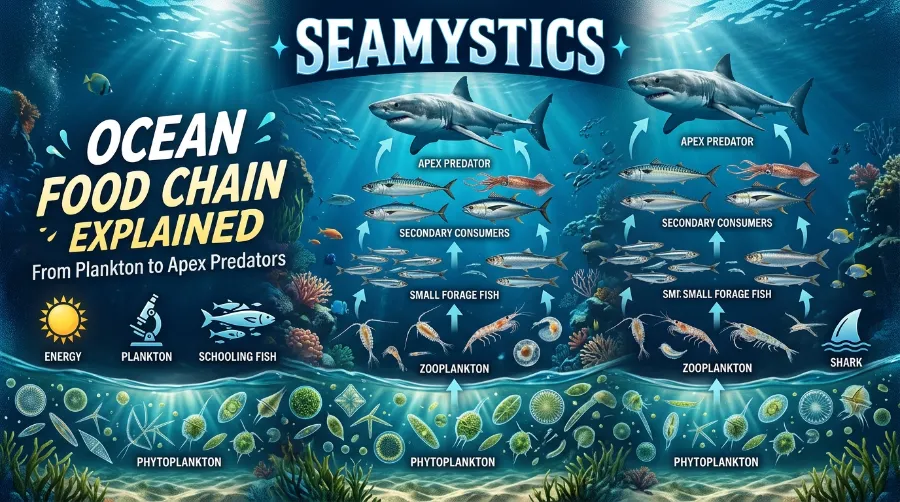
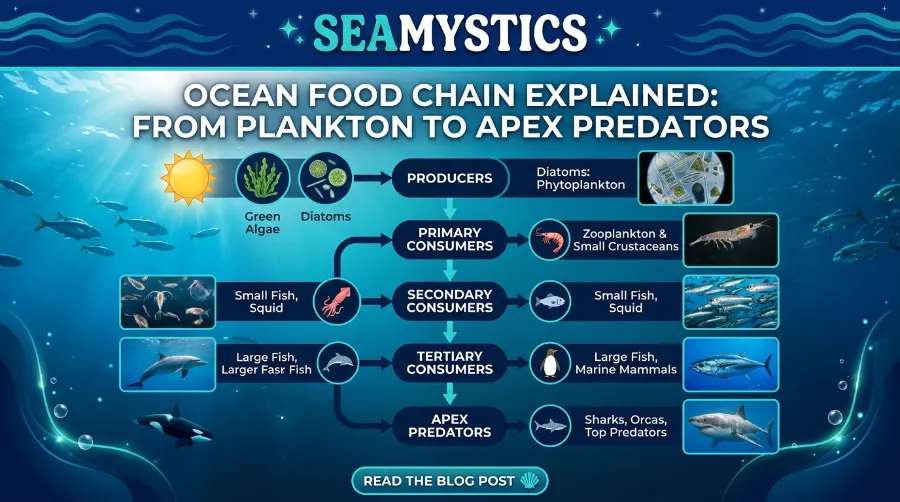
| Level | Who lives here | Example | Main job |
|---|---|---|---|
| Producers | Phytoplankton, algae, seagrass | Diatoms | Make food from sunlight |
| Primary consumers | Zooplankton, small grazers | Krill, copepods | Eat producers |
| Secondary consumers | Small fish, squid | Sardines, anchovies | Eat grazers |
| Tertiary consumers | Larger fish, seabirds | Tuna, penguins | Eat small fish |
| Apex predators | Top hunters | Orcas, great white sharks | Keep numbers balanced |
| Decomposers | Bacteria, sea cucumbers | Deep-sea microbes | Recycle nutrients |
What Is the Ocean Food Chain?
Put simply, the ocean food chain is the path that energy takes when one living thing eats another. It begins with sunlight and ends with the top hunters. Scientists call every step along the way a trophic level.
You will also hear the terms marine food chain and ocean food web. A chain shows one simple path, but a web shows all the paths together. Because most animals eat more than one thing, a web is the more honest picture. For example, a tuna may eat squid on Monday and sardines on Tuesday.
If you want a friendly overview first, Blue Planet Aquarium explains the ocean food chain with clear examples. Meanwhile, younger readers can enjoy the short Time for Kids ocean food chain page.
The Plankton Food Chain: Where Everything Begins
Almost all life in the sea rests on the plankton food chain. The word plankton comes from a Greek term meaning “wanderer,” because these living things drift with the current. Overall, they fall into two main groups.
Phytoplankton: The Ocean’s Grass
Phytoplankton are tiny plant-like cells. Just like land plants, they use sunlight, carbon dioxide, and water to make sugar. As a result, NASA and NOAA scientists estimate that they produce roughly half of the oxygen we breathe.
Diatoms are a common type, and they wear glass-like shells. Dinoflagellates are another type, so you may have seen them glow blue in the water at night. When spring arrives, these cells can bloom so fast that satellites see green swirls from space.
Zooplankton: The First Grazers
Zooplankton are tiny animals that graze on phytoplankton. Among them, copepods are the most common, and many scientists call them the most abundant animals on the planet. Krill, baby fish, and young jellyfish also count as zooplankton.
On research cruises, I often pull a fine net through the water at dusk. Almost every time, it comes back full of wriggling life. In fact, one small bucket of seawater can hold thousands of copepods, so it tells me more about a region’s health than a dozen fish counts.
Why Plankton Matter to You
Plankton do more than feed fish. When they die and sink, they also carry carbon to the deep sea, which helps slow climate change. Therefore, a drop in plankton numbers affects people far from the coast.
How the Marine Food Pyramid Works
The marine food pyramid shows how much energy each level can use. It is wide at the bottom and narrow at the top. The reason is simple: energy is lost at every step.
The 10 Percent Rule
Animals burn most of their food to move, grow, and stay warm. Because of this, only about 10 percent of the energy passes to the next level. Still, this is a rule of thumb, since real numbers range from about 5 to 20 percent.
The table below shows how fast the energy shrinks.
| Trophic level | Example | Energy available (approx.) |
|---|---|---|
| Phytoplankton | Diatoms | 10,000 units |
| Zooplankton | Copepods | 1,000 units |
| Small fish | Sardines | 100 units |
| Larger fish | Tuna | 10 units |
| Apex predator | Orca | 1 unit |
This pattern explains why there are far fewer sharks than sardines. After all, the top of the pyramid has very little room.
What This Means for Fishing
The same rule shows why fishing top predators is risky. For instance, one tuna needs many sardines, and each sardine needs thousands of copepods. If people remove big fish faster than they can recover, the pyramid loses its top and the balance shifts.
According to the Food and Agriculture Organization of the United Nations, about 37.7 percent of assessed fish stocks were overfished in 2021. You can read the full data in The State of World Fisheries and Aquaculture. Sadly, that share has grown steadily over the past fifty years.
Climbing the Ocean Food Web: Level by Level
To see how this works, let us follow one path through the Southern Ocean near Antarctica.
Step 1: Sunlight Feeds Phytoplankton
During the southern summer, long days trigger huge blooms. Meanwhile, iron from melting ice and nearby land helps the cells grow.
Step 2: Krill Graze on the Bloom
Next, Antarctic krill feast on these cells. Scientists estimate their total weight at several hundred million tonnes. Consequently, krill rank among the most abundant wild animals on Earth by weight.
Step 3: Fish, Penguins, and Seals Eat Krill
Adelie penguins, crabeater seals, and many fish depend on krill. In one season, a single penguin colony can eat tonnes of them.
Step 4: Leopard Seals and Orcas Hunt the Hunters
Leopard seals prey on penguins and young seals. Above them, orcas act as the true apex predators, since they hunt seals and even large whales.
Step 5: Decomposers Close the Loop
When an animal dies, bacteria and scavengers break its body down. A whale fall, which happens when a dead whale sinks to the sea floor, can feed deep-sea life for decades. In the end, this recycling returns nutrients to the surface, where new phytoplankton use them.
Apex Predators: The Keepers of Balance
Adult apex predators have no natural enemies. Great white sharks, orcas, polar bears, and large tuna all belong to this group. However, they are more than hunters, because they shape how the whole system behaves.
The Sea Otter Story
A famous case comes from the North Pacific. Sea otters eat sea urchins, so when fur traders nearly wiped out the otters, urchin numbers exploded. Soon after, the urchins grazed kelp forests down to bare rock.
Researchers such as James Estes documented this in the Aleutian Islands from the 1970s onward. Later, when otters returned to an area, the kelp grew back. Scientists call this chain reaction a trophic cascade, because it starts at the top and flows down.
The Cod Collapse
Newfoundland offers a harder lesson. In 1992, Canada closed its northern cod fishery after stocks fell to a tiny fraction of earlier levels. As a result, tens of thousands of people lost their jobs. Even three decades later, parts of the stock are still rebuilding.
I often tell students that this case is not only about fish. Instead, it shows how fast a food web can change when the top disappears. It also shows how slowly the web heals.
An Opinion From the Field
Many people think saving a big predator is a luxury. My view is the opposite. In my experience, predators are cheap monitors, because thin or scarce sharks and seabirds often signal trouble lower down. Usually, this warning appears years before a fish count shows it.
Real Examples of a Shaken Food Web
Food webs react to heat, pollution, and fishing in surprising ways. Here are three recent cases.
- The Blob, 2014 to 2016: A huge marine heatwave warmed the northeast Pacific. Because plankton shifted to less nutritious species, Pacific cod in the Gulf of Alaska dropped sharply. Meanwhile, large numbers of seabirds, especially common murres, starved.
- Coral reef bleaching: Since 2016, rising heat has caused repeated mass bleaching on the Great Barrier Reef. As a result, reef fish lose both food and shelter.
- Krill under pressure: Warming in parts of the Southwest Atlantic has pushed krill south. At the same time, fishing has grown in that area, so penguins and whales feel the squeeze.
For plain-language updates on these changes, visit the NOAA Ocean Service. Teachers may also enjoy the NOAA Teacher at Sea blog, where field notes show what it feels like to sample plankton on a real research ship.
Ghost Nets: The Silent Killers Drifting Through the Deep Ocean
Now we reach the part of the story that worries me most. Ghost nets are fishing nets, lines, and traps that people lose or throw away at sea. Sadly, they keep catching animals long after anyone stops caring about them.
How Big Is the Problem?
Researchers estimate that hundreds of thousands of tonnes of fishing gear enter the ocean each year, and a widely cited figure is near 640,000 tonnes. In addition, a 2018 study of the Great Pacific Garbage Patch found that nets made up at least 46 percent of the large plastic by weight. Because makers design nets to be strong, they can drift or rest on the sea floor for decades.
How Ghost Nets Break the Food Chain
A ghost net does not pick its catch. Instead, it traps fish, turtles, seals, sharks, and even whales. Then something worse happens: scavengers such as crabs and seabirds arrive to eat the trapped animals, and they get caught too. In effect, the net baits itself.
I call this loop the “ghost feeding cycle.” First, the net kills. Next, the dead attract more animals. Finally, those animals die as well, so every level of the food chain suffers at once.
A Case From the Field
On a reef survey in the Indian Ocean, our team found a tangled net draped over a coral head. Inside, we counted two dead reef sharks, a green turtle, and dozens of small fish. Two days of careful cutting by hand were needed to free it. Even then, the coral underneath was already dead.
That single net had removed predators, grazers, and reef builders from one spot. Unfortunately, no fishing quota covers this kind of loss, because nobody counts it.
What Is Being Done?
Fortunately, there is good news. Groups such as Ocean Conservancy and the Global Ghost Gear Initiative train divers, map lost gear, and work with fishers to report it. Likewise, the NOAA Marine Debris Program funds removal projects across the United States. In Europe, the Single-Use Plastics Directive now makes fishing gear producers share part of the cleanup cost.
To learn more about plastic in the deep sea, see our guide to marine debris and the deep sea here at Sea Mystics.
Simple Ways You Can Help
- Choose seafood from fisheries certified by groups such as the Marine Stewardship Council.
- Join local beach and harbor cleanups when you can.
- Report any ghost net you spot to your coast guard or marine agency.
- Buy gear from brands that take back old nets.
- Finally, share what you learn with friends and family.
How Humans Fit Into the Ocean Food Chain
People are part of the ocean food chain too. We eat fish at many levels, and we also change the water they live in. Three habits matter most.
- Fishing down the food web: As big fish become rare, fleets turn to smaller fish and invertebrates. Over time, catches therefore shift to lower levels.
- Nutrient runoff: Fertilizer from farms feeds algae blooms. When those blooms die, they use up oxygen and create dead zones. For example, the Gulf of Mexico dead zone has covered thousands of square miles in recent summers.
- Plastics and microplastics: Zooplankton eat tiny plastic pieces, so the particles move up the chain. In fact, studies have found microplastics in fish, seabirds, and even whale tissue.
To see how deep-sea life copes with these changes, read our guide on deep-sea species. Likewise, our piece on plankton and carbon explains why tiny cells matter for the climate.
How to Spot Trustworthy Ocean Food Web Information
Readers often ask me where to find reliable facts on this topic. First, look for pages that name their authors and show their dates. Second, check whether the page links to original studies and explains how it got its numbers. Be careful with round figures that have no source. If you are unsure, compare the number with a government or university site.
Frequently Asked Questions
What is the ocean food chain in simple words?
It is the path of energy in the sea. Plankton make food from sunlight, small animals eat plankton, and bigger animals eat them in turn.
What is the difference between a marine food chain and an ocean food web?
A chain shows one straight path. In contrast, a web joins many paths together, which is closer to real life.
Who is at the top of the ocean food chain?
Apex predators such as orcas, great white sharks, and large tuna sit at the top. However, humans also eat at many levels.
Why is plankton so important?
Plankton feed almost every sea animal and make about half of Earth’s oxygen. Besides that, they help store carbon in the deep ocean.
What is a marine food pyramid?
It is a diagram that shows how energy drops as it moves up. Each step holds about 10 percent of the energy from the level below.
Do ghost nets really harm the food chain?
Yes, because they catch animals at every level. Moreover, the dead animals attract scavengers that also get trapped.
Conclusion
The ocean food chain is a story of connection. Tiny plankton feed krill, krill feed fish and whales, and apex predators keep the whole system in balance. When one link breaks, the effects spread in ways we are still learning to measure.
Ghost nets, overfishing, and warming seas are today’s biggest pressures. Still, we can solve all three. Every choice you make about seafood, plastic, and ocean science helps keep the web strong. So the next time you see a fish on your plate, remember the long chain of life that put it there.
Quick Quiz: Test What You Learned
1. What forms the base of the ocean food chain?
A) Sharks
B) Phytoplankton
C) Whales
2. About how much energy passes to the next trophic level?
A) 1 percent
B) 10 percent
C) 50 percent
3. Which animal is an apex predator?
A) Copepod
B) Sardine
C) Orca
4. What did sea otters help protect in the North Pacific?
A) Coral reefs
B) Kelp forests
C) Mangroves
5. Why are ghost nets so harmful?
A) They keep catching animals after being lost
B) They make the water warmer
C) They only affect surface fish
Answers: 1) B, 2) B, 3) C, 4) B, 5) A
References
- Food and Agriculture Organization of the United Nations, The State of World Fisheries and Aquaculture 2024
- NOAA Ocean Service, educational resources on food chains and marine ecosystems
- NOAA Marine Debris Program, ghost gear and removal projects
- Lebreton, L. et al., 2018, Evidence that the Great Pacific Garbage Patch is rapidly accumulating plastic, Scientific Reports
- Estes, J. A. and Palmisano, J. F., 1974, Sea otters: their role in structuring nearshore communities, Science
- Global Ghost Gear Initiative, estimates of annual lost fishing gear