
Stand on any beach with your eyes closed and you already know where you are. That salty, slightly sulfurous, oddly comforting scent is one of the most recognizable smells on Earth, yet most people have never asked what it’s actually made of. Ocean smell science turns out to be less about “salt water” and much more about biology: tiny algae, dying seaweed, and bacteria working together to build a very specific chemical signature. Once you understand what makes ocean smell the way it does, you’ll never smell a beach the same way again.
Key Takeaways
| Question | Short Answer |
|---|---|
| What causes ocean smell? | Mostly a gas called dimethyl sulfide (DMS), released by marine algae and phytoplankton |
| Does salt water itself smell? | No, pure salt water is odorless; the smell comes from biology, not salt |
| Why do some beaches smell stronger? | Warmer water, algae blooms, low tide, and decaying seaweed all intensify it |
| Is the smell harmful? | Usually not, though large algal blooms can release compounds that irritate airways |
| Can the smell change with seasons? | Yes, it peaks in warmer months when plankton activity is highest |
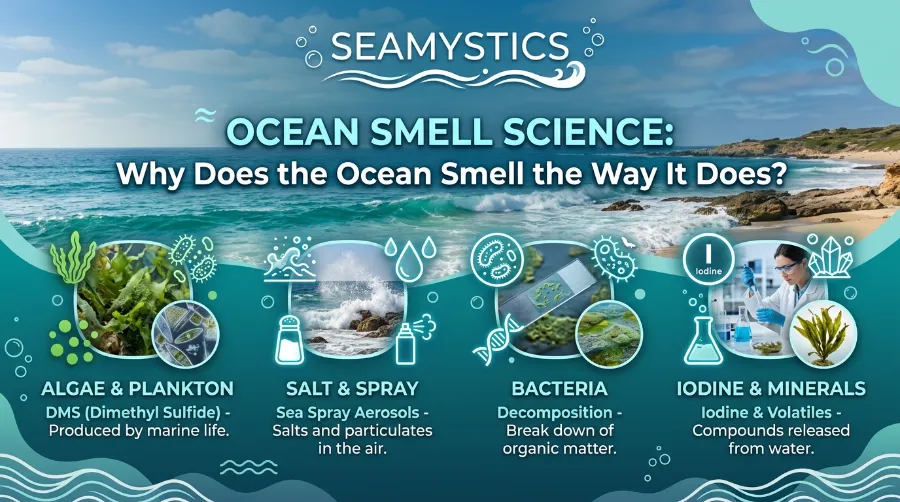
TL;DR: Ocean smell science comes down to one main culprit, dimethyl sulfide, a gas released when marine algae and phytoplankton break down. Add in decaying seaweed, bacteria, and trapped organic matter at low tide, and you get the familiar “sea smell.” The stronger or weirder the smell, the more biological activity is happening just offshore.
What Makes Ocean Smell? The Basic Chemistry
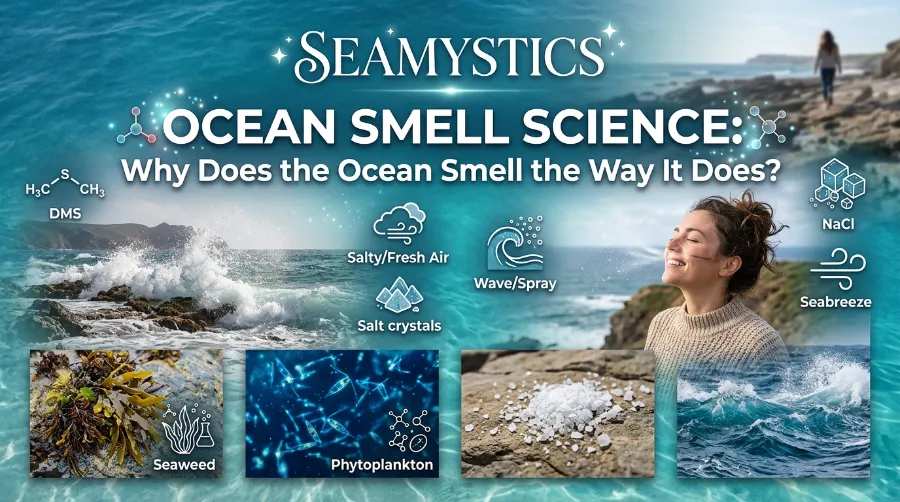
Here’s the part that surprises most people: seawater on its own doesn’t smell like much at all. Pure H2O with dissolved salt is essentially odorless, so the scent we call “ocean smell” is actually a byproduct of life in the water, not the water itself.
The main compound responsible is dimethyl sulfide (DMS), a gas produced when marine phytoplankton and algae break down, either naturally or when eaten by zooplankton. British scientist James Lovelock first identified DMS as a major sulfur emission from the oceans back in 1972, and later research (Charlson et al., 1987) linked it to cloud formation, since DMS oxidizes in the atmosphere and helps seed marine clouds. That’s a genuinely wild fact: the smell of the beach is chemically connected to the weather above it.
For a deeper look at how these trace compounds shift ocean conditions more broadly, our guide on ocean salinity trends covers how chemistry and climate interact below the surface.
Sea Smell Chemistry: The Molecules Behind the Scent
Beyond DMS, a handful of other compounds contribute to what we casually call “sea smell chemistry”:
- Bromophenols – produced by marine algae and worms, giving a slightly medicinal, iodine-like note
- Hydrogen sulfide – the “rotten egg” smell, released when organic matter decays in low-oxygen mud or sand
- Geosmin – the same earthy compound responsible for the smell of rain, also produced by certain marine bacteria
- Trimethylamine – linked to decaying fish and seaweed, giving that “fishy” edge at low tide
Each beach has its own blend depending on which organisms dominate the local ecosystem. A kelp-heavy Pacific coastline will smell noticeably different from a coral-adjacent stretch of the Caribbean, because the source organisms are different even though the underlying chemistry (sulfur compounds) is similar.
Beach Smell Science: Why Some Coasts Smell Stronger Than Others
If you’ve ever wondered why one beach smells mild and another practically knocks you over, beach smell science has a fairly simple answer: biological density and exposure time.
- Low tide exposure – when seaweed and organic debris sit exposed to air and sun, bacteria break it down faster, releasing more sulfur compounds
- Water temperature – warmer water accelerates algae growth and microbial activity, intensifying the smell
- Algal blooms – a bloom of phytoplankton or red tide can spike DMS and other compound levels dramatically within days
- Wind direction – onshore wind pushes volatile compounds toward the coast, while offshore wind can carry the smell away entirely
The Gulf Coast of Florida, for example, has experienced notably strong odor events during red tide blooms caused by Karenia brevis, with reports of noticeable smell and respiratory irritation extending along dozens of miles of coastline during peak bloom years. If you’re curious how temperature swings affect marine life more broadly, our piece on deep ocean temperature breaks down how heat moves through different ocean layers.
Ocean Smell Explained: Algae, Seasons, and Storms
Seasonal shifts matter more than most people realize. Ocean smell explained through a yearly lens looks roughly like this:
- Spring and summer: phytoplankton blooms peak, DMS production rises, smell intensifies
- After storms: wave action stirs up sediment and decaying matter from the seafloor, temporarily amplifying odor
- Fall and winter: cooler water slows microbial activity, and the smell is generally milder
This is also where “ocean smell” gets confused with pollution. A sudden, sharp chemical or petroleum smell is not natural ocean chemistry, it’s usually a sign of runoff, an algal bloom fueled by fertilizer pollution, or an actual spill, and should be reported rather than dismissed as normal sea smell.
According to marine science outreach from the University of Texas Marine Science Institute, this distinction between biological odor and pollution-driven odor is one of the most common misunderstandings the public has about coastal smells.
What Makes Ocean Smell Change from Beach to Beach
No two coastlines smell identical, and that variation itself is a useful diagnostic tool for marine scientists. Researchers studying declining fish populations sometimes use unusual odor shifts as an early indicator of ecosystem stress, since a drop in the usual “sea smell” can signal reduced algae or plankton activity. That connection between smell and ecosystem health ties directly into concerns we’ve covered around ocean fish depletion, where changes in the food web ripple outward in ways you can sometimes literally smell before you can measure them.
A few real-world factors that shift the “smell fingerprint” of a coastline:
- Kelp forests produce a stronger, more herbaceous sea smell due to high organic turnover
- Coral reef areas tend to smell milder, with more of that bromophenol, iodine-like note
- Estuaries and river mouths often smell muddier due to mixing freshwater sediment with marine bacteria
- Polar coastlines smell noticeably fainter, since colder water suppresses microbial breakdown
For context on how varied coastal ecosystems really are, our explainer on ocean and land biodiversity is a useful companion read.
Does the Ocean’s Smell Affect Human Health?
For most people, ocean smell is harmless and even linked to relaxation, some researchers have pointed to negative air ions near breaking waves as a contributor to that “clears my head” feeling many people report at the coast. But during large harmful algal blooms, compounds like brevetoxin (from red tide) can become airborne and cause coughing, throat irritation, or eye discomfort, particularly for people with asthma. If a beach smells unusually sharp or chemical rather than earthy and briny, that’s a reasonable cue to check local water quality advisories before swimming.
For a broader look at how surfers and ocean scientists describe this experience firsthand, Science of Surfing’s breakdown of ocean smell and Olorama’s piece on the smell of the sea both offer good sensory-level detail that complements the chemistry here.
Some of this also connects to broader ocean myths worth clearing up, which we cover in more depth in our ocean myths debunked guide.
FAQ: Ocean Smell Science
Q: Why does the ocean smell like rotten eggs sometimes?
That’s hydrogen sulfide, produced when organic matter decomposes in low-oxygen conditions, often in mudflats or stagnant tide pools.
Q: Is the ocean smell the same everywhere in the world?
No. Local algae species, water temperature, and organic matter all shape a slightly different chemical mix at each coastline.
Q: Does climate change affect how the ocean smells?
Indirectly, yes. Warmer waters tend to increase algae growth and microbial activity, which can intensify DMS and related compounds in many regions.
Q: Can you get sick from ocean smell?
Normal sea smell isn’t harmful, but sharp, chemical, or unusually strong odors during algal blooms can cause respiratory irritation for sensitive individuals.
Q: Why does the ocean smell stronger at low tide?
Exposed seaweed and organic debris break down faster in open air and sunlight, releasing more volatile sulfur compounds.
Quick Quiz: Test Your Ocean Smell Knowledge
- What is the main gas responsible for typical ocean smell?
a) Carbon dioxide b) Dimethyl sulfide c) Nitrogen d) Methane - Who first identified DMS as a major ocean-atmosphere gas?
a) Charles Darwin b) James Lovelock c) Jacques Cousteau d) Sylvia Earle - What causes the “rotten egg” smell sometimes found near tide pools?
a) Hydrogen sulfide b) Salt crystallization c) Chlorine d) Ozone - True or False: Pure salt water has a strong natural smell.
- Which condition tends to intensify ocean smell the most?
a) Cold, calm winter water b) Warm water with an algal bloom c) Deep polar water d) Distilled seawater
Answers: 1-b, 2-b, 3-a, 4-False, 5-b
Conclusion
The next time a beach smell hits you, whether it’s a gentle briny note or an overpowering low-tide funk, you’re really smelling a living, working ecosystem, not the water itself. Dimethyl sulfide, hydrogen sulfide, bromophenols, and a rotating cast of algae and bacteria are behind nearly every version of “ocean smell” you’ve ever encountered, and the intensity of that smell can genuinely tell you something about what’s happening just below the surface. Understanding ocean smell science doesn’t just satisfy curiosity, it gives you a small, practical way to read the health of a coastline with nothing more than your nose.
References
- Lovelock, J.E. et al. (1972). “Atmospheric dimethyl sulphide and the natural sulphur cycle.” Nature.
- Charlson, R.J. et al. (1987). “Oceanic phytoplankton, atmospheric sulphur, cloud albedo and climate.” Nature.
- University of Texas Marine Science Institute, “Smelly Seas” radio program.
- Science of Surfing, “The Smell of the Ocean.”
- Olorama, “The Smell of the Sea.”