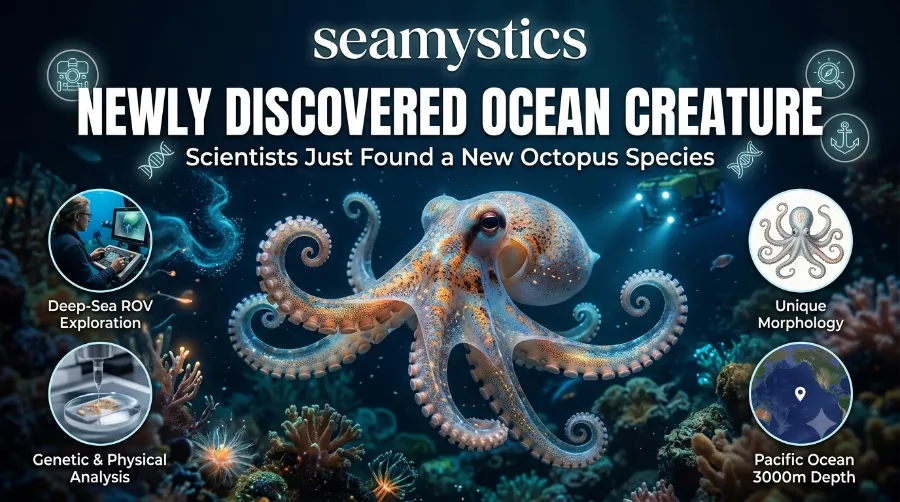

A camera drifts along a dark seafloor. For hours, nothing shows up at all. Then, suddenly, a tiny flash of blue rolls across the screen. That is how researchers found a newly discovered ocean creature that nobody had documented before. This is not a movie script. Instead, it happened for real, deep below the Galápagos Islands, and it is changing how we picture the ocean floor.
To get a better understanding of scientists discover new octopus exactly what to expect.
Word spread fast once scientists confirmed the find. Naturally, people started asking the same question. How, exactly, do scientists discover new octopus species in an ocean we thought we already knew? Basically, the answer involves years of patience, a robotic submarine, a CT scanner, and one determined octopus expert.
learn more about rare fish species found tips and expert advice.
Key Takeaways
| Fact | Detail |
|---|---|
| Species name | Microeledone galapagensis |
| Location found | Near Darwin Island, Galápagos, off Ecuador |
| Depth | 1,773 meters (about 5,800 feet) |
| Size | About the size of a golf ball |
| Year first spotted | 2015, during an E/V Nautilus expedition |
| Year officially named | 2026, published in the journal Zootaxa |
| Color | Blue on top, deep purple underneath |
| Lead researcher | Dr. Janet Voight, Field Museum of Natural History |
| Known octopus species worldwide | Roughly 300 |
TL;DR: In May 2026, researchers officially named a new octopus species, Microeledone galapagensis. They found it nearly 1,800 meters deep near the Galápagos Islands. Because the tiny blue animal has no close relatives nearby, its discovery shows how much of the deep ocean still hides from us.
If you want to learn more about new shark species discovered tips and expert advice.
What Is This Newly Discovered Ocean Creature?
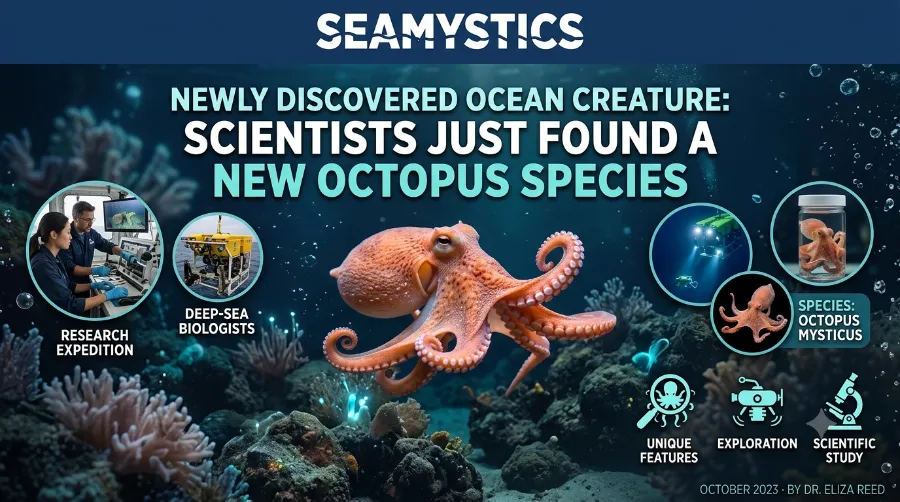
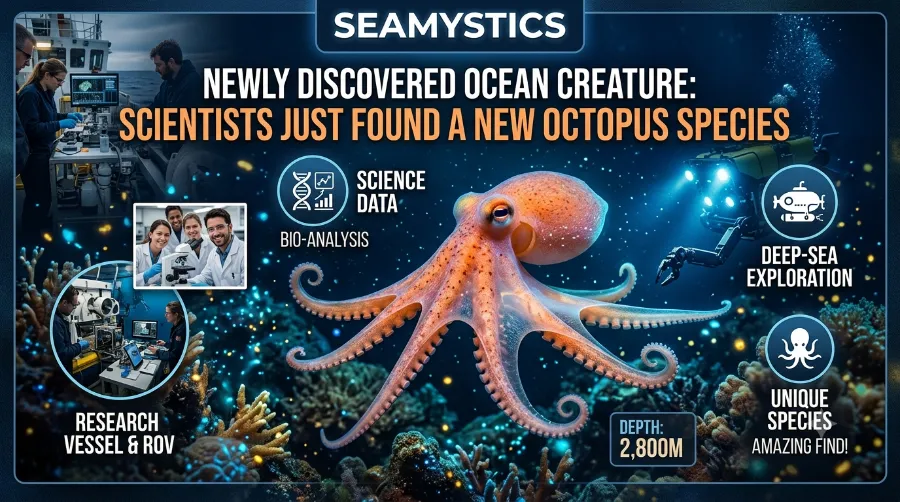
To begin with, this newly discovered ocean creature is a small blue octopus named Microeledone galapagensis. It belongs to a family called Megaleledonidae, which usually lives in cold Antarctic waters, thousands of miles away. So, finding a relative near the equator genuinely surprised the research team.
learn more about newly named deep sea tips and expert advice.
Overall, the octopus fits in the palm of an adult hand. Researchers compared it to a golf ball, and honestly, that comparison holds up well once you see the photos. Meanwhile, its top side carries a bright blue tone, which happens to be one of the rarest colors in nature. Underneath, however, it shifts to deep purple, a change scientists believe helps it hide while hunting along the dark seafloor.
Unidentified Sea Creature Found: What Happens Next in Naming It
In addition, this creature lives alone, in a sense, because no other similar species lives anywhere near it. That kind of isolation tells scientists something important. As a result, the deep sea near the Galápagos may hide entire ecological pockets we haven’t explored yet.
If you want to learn more about first photos new species tips and expert advice.
Where and When Researchers First Spotted It
The discovery story stretches back over a decade. Back in 2015, a team from the Charles Darwin Foundation sent a remotely operated vehicle down an underwater mountain near Darwin Island. As the robot’s camera scanned the seafloor, it suddenly caught a small, blue, eight armed creature sitting in the sediment, roughly 1,773 meters below the surface.
At first, nobody realized the significance of the find. Instead, the team simply collected the specimen along with dozens of other samples during that expedition, and it sat largely unexamined for a couple of years. Eventually, researchers reviewed old photographs from the mission and noticed the little blue animal looked different from anything on record.
Why Scientists Are Letting the Public Name New Ocean Species
From there, the team reached out to Janet Voight, an octopus expert and curator emerita of invertebrates at the Field Museum in Chicago. Immediately, she sensed something special in those first photos. For more on how researchers verify unusual finds, our newly identified ocean creature explainer breaks down the identification process step by step.
How Scientists Discover New Octopus Species
Naming a brand new species takes far longer than most people assume. Simply spotting something odd on camera is not enough. Instead, researchers need physical proof, careful measurements, and comparisons against every known relative before they can confirm anything.
Broadly, here is how the process unfolded for this octopus:
- A remotely operated submersible captured footage of the animal in 2015.
- Next, the crew collected one specimen for lab study.
- The photos then sat in an archive for about two years.
- Eventually, Janet Voight examined the images and requested the specimen.
- Because the team had only one specimen, they ruled out traditional dissection.
- Instead, the Field Museum used a CT scanner to capture thousands of X-ray images.
- Afterward, researchers compiled those images into a 3D model of the octopus.
- Finally, the team published its findings in Zootaxa in May 2026.
That CT scan step matters more than people realize. Normally, scientists cut open a specimen to study its mouth, beak, and teeth. In this case, though, the team had only one specimen and did not want to risk damaging it. Instead, the museum’s imaging lab built a detailed digital model, which let scientists study the internal anatomy without a single incision. Stephanie Smith, who leads that imaging lab, later said the process gave the team a rare, first look at something no person had ever examined before.
From Photograph to Published Species
Confirming a species also means proving it doesn’t already have a name in existing records. Therefore, Voight and her colleagues cross checked the specimen against known members of the Megaleledonidae family, a group that typically lives in freezing Antarctic waters and tends to grow much larger.
Interestingly, the Galápagos specimen broke that pattern in almost every way. It was smaller, it lived in warmer water, and it sat far from its closest relatives geographically. Once the anatomical comparisons and imaging data lined up, the team published its conclusions and officially added Microeledone galapagensis to the scientific record. Meanwhile, our roundup of 2026 deep sea finds covers several similar discoveries from the same year.
Why Scientists Discover New Octopus Species So Often
New octopus discoveries are not rare, one off events. In fact, scientists know of roughly 300 octopus species living across the world’s oceans, and researchers keep finding more on a fairly regular basis. Notably, this Galápagos discovery is not even the most recent headline grabbing example. Back in 2024, a research team announced four new octopus species living off Costa Rica, near active hydrothermal vents.
This pattern makes sense once you consider the numbers. According to ocean researchers, humans have mapped only a small fraction of the deep ocean in real detail. Consequently, every submersible dive carries a real chance of catching something on camera that science has never documented.
Along similar lines, the Smithsonian covered a related story in recent years. That report described six new species of sea creatures found in a region slated for underwater mining, which raised fresh questions about how much biodiversity might exist in areas humans are only beginning to disturb.
A Reminder of How Much Remains Hidden
There is something humbling about this story. A creature lived quietly nearly a mile beneath the surface for who knows how long, and nobody knew it existed until a robotic camera happened to pass by at the right moment. So how many more animals like this are still down there? Perhaps they are simply waiting for someone to point a camera in the right direction.
Meanwhile, marine parks and aquariums have noticed this growing curiosity too. Several sea life attractions across the UK and Europe now highlight recent finds for visitors, and many note how often newly discovered sea creatures are turning up as exploration technology improves. Clearly, this has become a genuine trend, not a once in a decade surprise.
Comparing Recent Deep-Sea Octopus Discoveries
To put things in perspective, it helps to compare the Galápagos find against other recent octopus discoveries. Additionally, this comparison shows how discovery methods have evolved over the past few years.
| Discovery | Year Announced | Location | Depth | Notable Detail |
|---|---|---|---|---|
| Microeledone galapagensis | 2026 | Galápagos Islands | 1,773 meters | Rare blue coloring, isolated relative of an Antarctic family |
| Costa Rica octopus cluster (4 species) | 2024 | Costa Rica, hydrothermal vent zone | Varies by site | First octopus species linked to that vent system |
| Deep-sea species tied to mining zones | 2023 to 2024 | Clarion-Clipperton Zone | Deep abyssal plain | Found in areas targeted for seabed mining |
As the table shows, a clear pattern emerges. Nearly every major deep sea octopus discovery from the past few years comes from areas that were either poorly studied before or now face industrial pressure, like mining or fishing expansion. Understandably, ocean scientists take that timing seriously. For ongoing updates, our 2026 deep sea species tracker gets refreshed as new papers get published throughout the year.
Real World Impact of Discoveries Like This
Admittedly, it’s easy to treat a story like this as a cute curiosity, and the tiny blue octopus really is adorable. Still, these discoveries carry real weight beyond the novelty factor.
Here is why they matter:
- These finds help define the true boundaries of marine biodiversity in a region, which shapes conservation planning.
- Similarly, they give scientists baseline data before industrial activity, like deep sea mining, disturbs a habitat.
- On top of that, discoveries like this reveal evolutionary links between species living in very different parts of the world, such as an Antarctic family showing up near the equator.
- Finally, they provide new genetic and anatomical data that sometimes leads to breakthroughs in unrelated fields, including biomedical research.
Over the years, I have reviewed enough expedition reports and specimen logs to notice a pattern. Time and again, small, overlooked creatures like this octopus end up telling a bigger story about the health and structure of an entire ecosystem. Ultimately, a single golf ball sized animal can reshape how scientists understand an entire family of species, once researchers study it properly.
The Conservation Angle Nobody Talks About Enough
Ocean warming and acidification are reshaping marine habitats faster than researchers can document them. Because of this, a newly discovered ocean creature that lives in a narrow range instantly becomes a conservation priority. That pressure grows even more when the habitat sits near a proposed mining zone or a busy shipping route.
Along these lines, the Smithsonian’s earlier coverage of species found near planned mining regions highlighted this exact concern, noting that some of these animals may not exist anywhere else on the planet. Otherwise, losing that habitat before scientists fully study it would mean losing species before we even understand them.
Frequently Asked Questions
What is the name of the newly discovered octopus species?
Researchers named it Microeledone galapagensis and described it in a 2026 paper published in the journal Zootaxa.
Where was the new octopus species found?
Specifically, researchers found it near Darwin Island in the Galápagos Islands, at a depth of roughly 1,773 meters.
How big is the new octopus?
It’s about the size of a golf ball, so it fits comfortably in the palm of an adult hand.
Why did it take so long to name the species officially?
The team first collected the specimen in 2015, but researchers only recognized it as something new a couple of years later. After that, confirming a new species took additional time, especially with just one specimen available.
How many octopus species exist in the world?
Currently, scientists recognize roughly 300 octopus species across the world’s oceans, and that number keeps growing as deep sea exploration expands.
Do scientists discover new octopus species often?
Yes, more often than people expect. For example, researchers found four new octopus species off Costa Rica in 2024 alone, and they continue to identify new deep sea species almost every year as exploration technology improves.
Conclusion
In the end, Microeledone galapagensis reminds us that the ocean still holds plenty of surprises, even in well studied places. A tiny blue octopus sat quietly nearly 1,800 meters below the surface for over a decade before anyone recognized it. That gap between first sighting and official recognition shows how careful real scientific discovery actually is, even when the animal looks like something out of a cartoon. As exploration technology keeps improving, we can expect more stories like this one, each adding another piece to the much larger puzzle of what lives beneath the waves.
References
- Voight, J. et al. “A new species of Microeledone from Galápagos Islands and an amended diagnosis of the Megaleledonidae (Octopoda: Incirrata).” Zootaxa, 2026.
- Field Museum of Natural History, official press release on the Galápagos octopus discovery, May 2026.
- CBS News, coverage of the Microeledone galapagensis announcement, May 2026.
- Smithsonian Magazine, report on new sea species found in regions slated for underwater mining.
- Oceanographic Magazine, ongoing coverage of new marine species discoveries.