
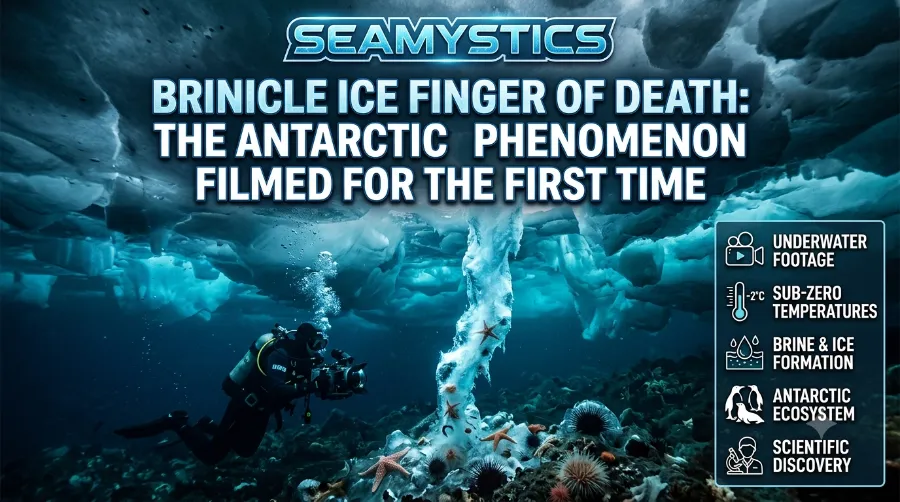

Picture a tendril of ice creeping down through pitch black seawater. It freezes every starfish and urchin it touches along the way. That is not a scene from a horror film. It is a real, documented event called a brinicle, nicknamed the brinicle ice finger of death. It happens right now under the sea ice of Antarctica. In 2011, a BBC film crew captured this process on camera for the first time. The footage still shocks people more than a decade later.
The Sargasso Sea Mystery: Why Ships Report Strange Silence There
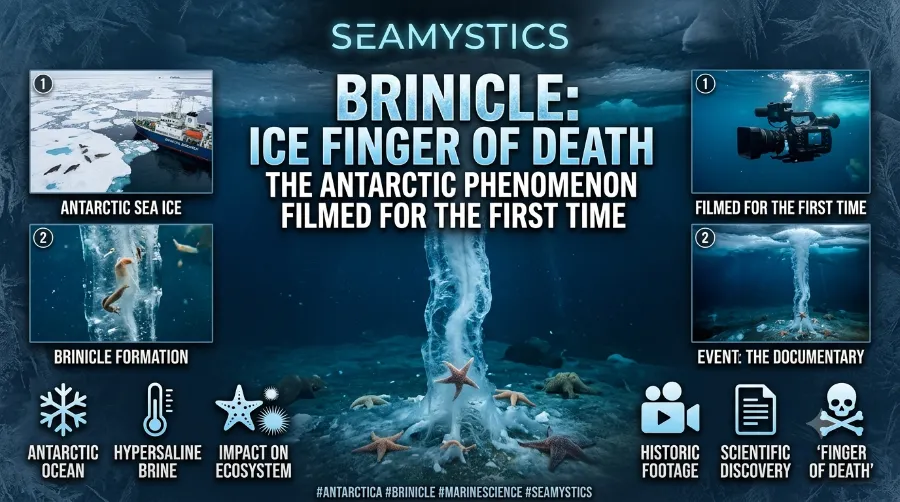
TL;DR: A brinicle forms when super cold, super salty brine sinks out of newly formed sea ice. It freezes a hollow ice tube around itself as it drops toward the seafloor. Where it touches the bottom, it can freeze slow moving creatures like sea urchins and starfish on contact. The process was first filmed in 2011 near McMurdo Sound, Antarctica. Lab studies published as recently as 2024 have measured exactly how fast these ice fingers grow.
The Bermuda Triangle What Ocean Science Actually Says
Cold Seeps The Deep Sea Ecosystems That Run on Gas Not Sunlight
| Key Takeaway | What It Means |
|---|---|
| What it is | A downward growing ice tube formed around sinking brine |
| Where it happens | Antarctic and Arctic sea ice, most famously McMurdo Sound |
| First filmed | 2011, BBC Frozen Planet, Little Razorback Island |
| Formation time | As fast as 5 to 6 hours for a single brinicle |
| Danger level | Freezes slow marine animals on contact at the seafloor |
| Scientific interest | May mirror conditions linked to the origin of life |
What Exactly Is a Brinicle
A brinicle forms because sea ice and freshwater ice are not built the same way. Freshwater freezes into one solid, even block. Sea ice behaves very differently. It traps pockets of leftover salt inside a sponge-like structure as it hardens.
That trapped salt does not just sit still. Sea ice cracks and leaks out the saline water to the open ocean as it forms. The released brine acts like a heavy liquid dropped into a lighter one. Brine is heavier than the surrounding water, so it sinks toward the ocean floor while freezing the relatively fresh water it touches. That freezing forms a hollow tube around the descending brine stream. Earthly MissionEarthly Mission
The result looks like an icicle growing downward instead of upward. That is exactly why the nickname stuck. Brinicles belong to a wider family of strange, hard to explain ocean phenomena, alongside cases covered in our guide to unidentified submerged objects. Scientists have known about brinicles since the 1970s, through field observations near Antarctica recorded by researchers like Paige, and later Dayton and Martin. It just took decades before anyone managed to film one actually forming.
The Temperature Gap That Drives It All
The physics behind a brinicle comes down to a striking temperature gap. In winter, air temperature above the sea ice can drop below negative 20 degrees Celsius, while the seawater underneath sits at only about negative 1.9 degrees Celsius. That gap forces heat to move upward, from the relatively warmer sea toward the freezing air. New ice keeps forming from the bottom of the ice sheet as a result. Meteo Giornale
As new ice forms, salt gets pushed into narrow channels rather than freezing along with the water. That salty brine becomes colder and denser than the water around it. It becomes denser than the water beneath, and the result is a descending plume of brine sinking downward. Smithsonian Magazine
Here is a simple breakdown of the temperature conditions researchers have recorded:
| Layer | Approximate Temperature |
|---|---|
| Air above the ice | Below -20°C |
| Surrounding seawater | About -1.9°C |
| Sinking brine plume | Colder and saltier than surrounding seawater |
| Seafloor “brine pool” zone | Can remain liquid but lethally cold |
The 2011 Filming That Made Brinicles Famous
Brinicles were known for decades. Almost nobody had actually seen one forming in real time. That changed in 2011, when a BBC Frozen Planet crew set out to film one near Little Razorback Island, close to Antarctica’s Ross Archipelago.
Cameraman Hugh Miller led the filming rig. He later explained the pressure of the shoot. Miller and his team noticed an area where three or four brinicles had formed previously, with one actively forming as they explored. Nobody knew the exact formation speed at the time. The crew had to move fast once they spotted the right conditions. Meteo Giornale
That gamble paid off. Miller reported that a brinicle spotted a week earlier kept growing visibly, with the entire formation only taking around five to six hours from start to finish. The final footage became one of the most talked about ocean science clips of the decade. It is still widely referenced in Antarctic brinicle video searches today. Meteo Giornale
Polar oceanographer Dr. Mark Brandon of the Open University later helped explain the science to a wider audience. He walked through why sea ice freezes so differently from the ice in a home freezer.
Why the “Ice Finger of Death” Name Fits
Once a brinicle reaches the seafloor, it does not just stop. Where the brinicle met the seabed, a web of ice spread outward and froze everything it touched, including sea urchins and starfish. Slow moving invertebrates have almost no way to escape once the ice sheath reaches them. Smithsonian Magazine
Marine ecologist Dr. Andrew Thurber of Oregon State University has observed brinicle growth firsthand. He described the structures in vivid terms. According to Thurber, they resemble upside down cacti blown from glass, delicate enough to break at the slightest touch.
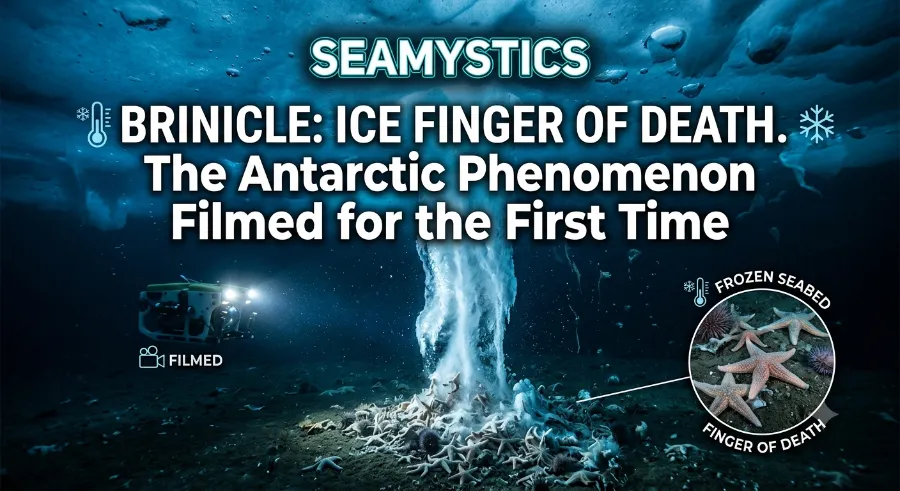
Thurber has also documented what happens after a brinicle forms. He notes that areas near active brinicles can develop small, clear pools of extremely cold brine nicknamed black pools of death, littered with the skeletons of animals that wandered in. At Little Razorback Island, brinicles have been observed at roughly 3 meters depth. Thousands of amphipods live alongside these ice formations in that same area, in a food web that has some parallels to the chemical-driven communities found in our piece on cold seep ecosystems. Kidscoop
Brinicle Formation Science: What Changed in Recent Research
For decades, most brinicle knowledge came from scattered field sightings. There was also a single 1974 lab study by researcher Martin. He found that brinicle radius increases over time and that internal brine flow controls tip size. Newer research has gone much further.
From Field Sightings to Lab Data
A pivotal shift came in 2013. A team led by Julian Cartwright at the University of Granada proposed that brinicles behave less like icicles and more like inverse chemical gardens. These structures have more in common with mud volcanoes and hydrothermal vents than with cave stalactites. That reframing mattered, since hydrothermal vents are widely considered by scientists to be a strong candidate for where life on Earth may have first taken hold. IFLScience
Cartwright’s team went further. They argued brinicles create some of the same conditions once thought necessary for life to emerge. The study points to chemical gradients, electric potentials, and membrane-like structures that brinicles generate, the same basic conditions found at hydrothermal vents. That idea reframed brinicles from a curiosity into a genuine astrobiology talking point. Similar brine and ice conditions might exist on icy moons like Europa. IFLScience
The 2024 Lab Experiments
The most direct follow up arrived in 2024. Researchers Testón-Martínez, Barge, Eichler, Sainz-Díaz, and Cartwright published lab results in the journal The Cryosphere. Their team built controlled brine plume experiments to measure brinicle growth directly, rather than relying only on field footage. Wider gaps between brine flow walls produced the classic hollow tubular shape. Narrower gaps tended to clog and form solid ice instead.
Here is a quick timeline of how the research has developed:
- 1970s — Early field observations recorded by Paige, and later Dayton and Martin, document brinicles in Antarctic waters.
- 1974 — Martin publishes the first lab based model of brinicle growth and tip stability.
- 2011 — BBC Frozen Planet crew films a brinicle forming in real time for the first time.
- 2013 — Cartwright’s team proposes the inverse chemical garden model and links brinicles to the origin of life question.
- 2019 to 2020 — The MOSAiC Arctic expedition uses remotely operated vehicles to observe brine drainage under drifting pack ice.
- 2023 to 2024 — New mathematical models and lab experiments quantify brinicle descent rates and tube expansion with far more precision.
That progression matters for anyone searching brinicle formation science. It shows the topic moved from anecdote to measurable, testable data over roughly five decades.
Underwater Ice Tube Structure: What a Brinicle Actually Looks Like
The underwater ice tube shape of a brinicle is not solid all the way through. It is a thin ice sheath wrapped around a still moving core of liquid brine. That structure is part of why divers describe brinicles as fragile. It is also the kind of slow, hidden flow pattern that shows up elsewhere in our coverage of the underwater river mystery, where dense water moves through the ocean in ways that look almost impossible from the surface.
A Real Diver Encounter in McMurdo Sound
Diver Rory Welsh was photographed swimming past one such formation in McMurdo Sound. He encountered a brinicle roughly 2 meters long during expedition work documented by Thurber’s research team. That length gives a real sense of scale. A formation that size can reach well past the immediate seafloor and affect a meaningful patch of benthic habitat.
A few practical facts about the physical structure, based on field and lab reporting:
- The outer wall is thin, brittle ice. It can shatter if disturbed by a diver, seal, or strong current.
- The interior brine core stays liquid. Its high salt content lowers its freezing point well below normal seawater.
- Growth happens from the top down, following the same downward direction as the sinking brine plume.
- Multiple brinicles can form in the same area within one season, sometimes several at a single site.
Ice Finger Death Risk: How Real Is the Danger to Marine Life
The nickname ice finger of death is not just dramatic marketing. It reflects a genuine ecological event on the Antarctic seafloor every winter freezing season.
Slow moving bottom dwellers like sea stars and urchins bear the brunt of it. Once the ice sheath reaches the seabed and spreads, animals in its path can be frozen in place within a short window. The resulting brine pools stay hostile to marine life long after the visible ice fingers dissolve.
Why the Danger Stays Localized
The danger is highly localized. A single brinicle event affects a defined patch of seafloor, not a wide stretch of ocean. Researchers studying sites like McMurdo Sound have observed the same general areas recovering between freezing seasons. Anyone drawn in by the horror movie framing of an Antarctic brinicle video should know the science underneath it is just as compelling as the spectacle.
Frequently Asked Questions
What is a brinicle in simple terms?
A brinicle is a tube of ice that forms underwater in polar seas. It happens when extremely cold, salty brine sinks out of sea ice and freezes the surrounding seawater into a hollow tube around it.
Why is a brinicle called the ice finger of death?
Because when it reaches the seafloor, the ice can spread and freeze slow moving animals like starfish and sea urchins that cannot escape in time.
How long does it take a brinicle to form?
Field observations from the 2011 BBC filming near Little Razorback Island recorded a formation time of roughly five to six hours for one complete brinicle.
Where do brinicles form?
They form under sea ice in polar regions, most famously documented in McMurdo Sound and the Ross Archipelago near Antarctica. Related brine drainage processes have also been observed in Arctic pack ice.
Are brinicles dangerous to humans?
Not directly. Divers can observe and even accidentally disturb them. The real danger applies mainly to small, slow moving seafloor creatures rather than to people.
Conclusion
The brinicle ice finger of death sits in a rare category. It is both scientifically important and genuinely eerie to watch. Scattered field notes from the 1970s eventually led to one of the most striking pieces of ocean footage ever filmed, captured in 2011. Since then, it has grown into a serious research thread connecting sea ice chemistry to questions about how life itself may have first formed. Brinicles prove that some of the most alien looking events on the planet happen in our own oceans, not on some distant world. If deep sea mysteries like this one interest you, our full archive of ocean anomalies at Sea Mystics covers plenty more, including strange formations documented in the Sargasso Sea mystery.
References
- Discover Wildlife, “Brinicle” — https://www.discoverwildlife.com/environment/brinicle
- Scientific American, “How Eerie Sea-Ice Brinicles Form” — https://www.scientificamerican.com/article/how-sea-ice-brinicles-form/
- Smithsonian Magazine, “All the Conditions Required for Life to Appear Are Here, in Antarctica’s Amazing Ice Stalactites” — https://www.smithsonianmag.com/smart-news/all-the-conditions-required-for-life-to-appear-are-here-in-antarcticas-amazing-ice-stalactites-18088357/
- Testón-Martínez, S., Barge, L. M., Eichler, J., Sainz-Díaz, C. I., and Cartwright, J. H. E., “Experimental modelling of the growth of tubular ice brinicles from brine flows under sea ice,” The Cryosphere, 18, 2195 to 2205, 2024.
- BBC Frozen Planet, filmed by Hugh Miller and Doug Anderson, Little Razorback Island, Ross Archipelago, Antarctica, 2011.